If you are researching VR training examples, you are probably past the stage of asking whether virtual reality is “interesting.” The better question is whether it can improve real business outcomes like safety, retention, confidence, speed to competency, and training consistency.
The answer is yes, especially when the training topic benefits from repetition, realism, and controlled practice. IGIVU positions VR training around realistic simulations, risk-free practice, and customized programs for business use. Public case studies from companies like Walmart and UPS, along with PwC’s widely cited research on immersive learning, show why the category keeps growing: better engagement, stronger recall, and training that can be repeated without exposing people, equipment, or customers to real-world risk.
PwC found that learners in VR completed training four times faster than classroom learners, felt more emotionally connected to the material, and reached cost parity with classroom learning at scale. Walmart said VR training improved confidence and retention while raising test scores by 10 to 15 percent, and UPS described VR as a way to let drivers practice realistic hazards before operating an actual vehicle.
That does not mean every learning program should move into a headset. But it does mean there are specific business cases where VR training for business is a strong fit. Below are 10 practical examples.
1. Safety onboarding for new employees
One of the best vr training examples is safety onboarding. New hires often need to learn site rules, hazard awareness, emergency procedures, and correct behavior before stepping into real environments. Traditional onboarding can explain those rules, but VR lets employees rehearse them.
In a virtual environment, new hires can identify hazards, move through a site, respond to an incident, and learn correct procedures before they ever enter a warehouse, factory floor, job site, or hospital unit.
Why this works:
- mistakes are safe
- scenarios are repeatable
- every learner gets the same baseline experience
- trainers can assess comprehension before live work begins
This is especially useful when training must be standardized across locations.
2. Lockout/tagout and hazardous equipment procedures
IGIVU’s training examples page specifically highlights lockout/tagout simulation as a manufacturing use case, and that is a strong one. High-risk equipment procedures are difficult to teach through slides alone because the learner needs to understand sequence, context, and consequence.
With VR, employees can practice:
- shutting down equipment
- isolating energy sources
- following the exact order of steps
- identifying what happens when a step is missed
This type of corporate vr training reduces the pressure of “first time on real equipment” and gives supervisors a better way to verify readiness.
3. Forklift, driver, and vehicle safety training
Vehicle operation is another strong fit for immersion. UPS publicly says it uses VR to help train drivers by simulating realistic road hazards before they get behind the wheel, including pedestrians, parked cars, and oncoming traffic.
The same logic applies to forklift operators, delivery drivers, mobile equipment operators, and other roles where awareness and reaction time matter. VR gives learners controlled exposure to scenarios that are dangerous, expensive, or impractical to recreate repeatedly in real life.
Business value comes from:
- safer practice
- lower training risk
- repeatable scenario testing
- more confidence before live operation
4. Manufacturing process training
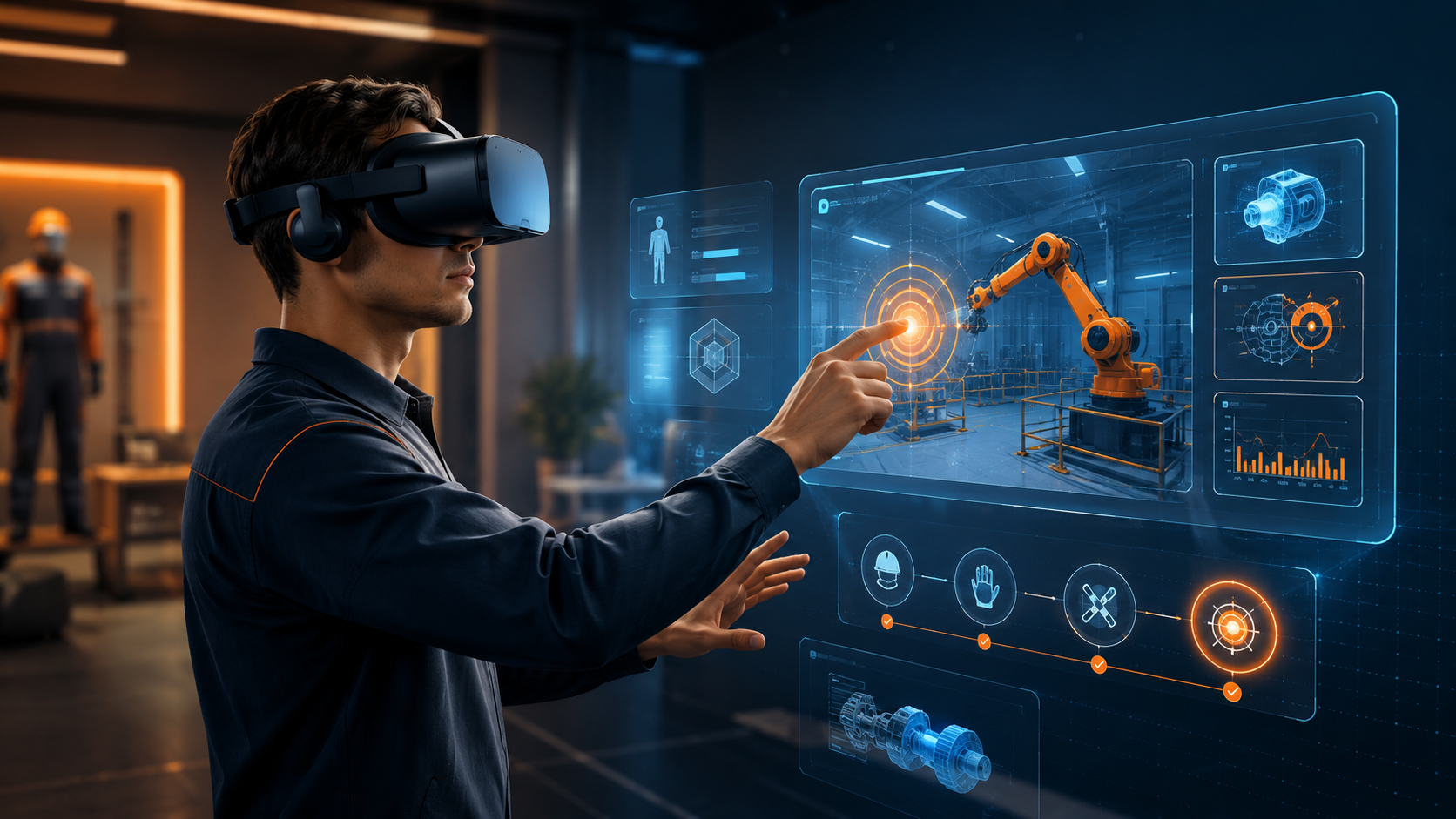
Manufacturing is full of procedures that are easy to describe and hard to master. Employees need to understand machine interfaces, process flows, inspection steps, and shutdown procedures. IGIVU’s examples include CNC machine training, assembly line training, and injection molding maintenance, all of which show how well VR fits step-based industrial learning.
Instead of halting production for demonstrations or tying up expert operators, teams can train in a virtual version of the workflow. That can help with:
- standard operating procedures
- maintenance walkthroughs
- repetitive assembly tasks
- line-changeover training
- troubleshooting sequences
This is one of the clearest workforce training use cases because the return is not just knowledge transfer. It is reduced downtime and fewer costly practice errors.
5. Retail customer service and peak-event preparation
Walmart is one of the most cited enterprise examples in VR training. The company said it scaled VR training to stores across the U.S. and used the technology to improve confidence, retention, and test performance.
Retail is a great use case because associates need to practice situations that are emotional, high-volume, or unpredictable, such as:
- holiday rush periods
- difficult customer interactions
- service recovery
- empathy-based scenarios
- new process rollouts
The advantage is not just realism. It is consistency. Every employee can practice the same standard of response, which is hard to achieve when training depends entirely on local coaching quality.
6. Leadership, communication, and soft-skills development
Many people still assume VR training is only for technical skills. PwC’s research is important because it showed meaningful results for soft-skills training as well, including faster completion and stronger emotional connection to the content.
This opens up use cases like:
- difficult conversations
- inclusive leadership
- manager coaching
- customer empathy
- conflict resolution
- presentation confidence
Soft-skills learning is often difficult because learners do not just need information. They need perspective, emotional context, and the chance to practice without high real-world stakes. VR helps because it places the learner inside a scenario rather than outside it.
7. Maintenance and field service training
Field teams are often expected to service equipment in environments where downtime is expensive and expert supervision is limited. VR can shorten the path from theory to hands-on readiness by helping technicians learn:
- equipment layouts
- inspection sequences
- service procedures
- troubleshooting logic
- part replacement steps
This is useful in manufacturing, utilities, telecom, medical devices, and enterprise hardware support. The more expensive the equipment and the more important the first-time fix, the stronger the business case tends to be.
8. Healthcare and emergency response simulation
Healthcare and emergency-response training has long been a natural fit for immersive simulation. Teams need to build muscle memory, situational awareness, and decision confidence under pressure. VR allows that practice without putting a patient, patient family, or live environment at risk.
Typical applications include:
- triage
- trauma response
- patient communication
- infection-control procedures
- surgical preparation
- code-response drills
Even when VR is not the only method used, it can play a high-value role inside a blended program by helping staff rehearse before live simulation or supervised clinical exposure.
9. Aviation and complex technical procedures
Aviation has used simulation for decades, but newer immersive tools continue to expand access and flexibility. Boeing’s Virtual Airplane platform is positioned as a way for pilots and flight training teams to practice procedures using immersive, customizable tools with real data and 3D cockpit simulation.
That same principle applies well outside aviation. Any industry with complex procedures, expensive assets, and low tolerance for error can benefit from immersive rehearsal, including:
- energy
- defense
- rail
- marine
- advanced manufacturing
- robotics
The more complex the system, the more valuable visual, spatial, and procedural training becomes.
10. Sales, product knowledge, and customer-facing training
Not all VR training for business is operational. Sales and customer-facing teams can use VR to understand products, environments, and customer scenarios more deeply.
Examples include:
- learning product features in a simulated environment
- rehearsing product demos
- practicing objection handling
- understanding customer workflows
- training franchise or partner networks consistently
This works especially well when the product is experiential, physical, or difficult to explain through decks and PDFs. A virtual scenario can help representatives understand not just what the product does, but how it is used and why it matters.
What all strong VR training examples have in common
The best programs usually share a few traits.
First, the training topic benefits from “learning by doing.” If the learner needs spatial awareness, procedural memory, or scenario-based judgment, VR is a better fit.
Second, there is a clear cost to mistakes. The higher the safety risk, equipment value, compliance burden, or operational consequence, the more useful a safe simulation becomes.
Third, the organization needs consistency at scale. PwC’s findings suggest that VR becomes especially compelling when organizations need to train many people on similar topics across locations.
Fourth, the scenario is difficult to recreate live. You cannot easily stage every emergency, customer conflict, machine fault, or hazardous condition on demand. VR lets you do that repeatedly.
When VR training may not be the best fit
Virtual reality is powerful, but it is not the answer to everything.
It may be the wrong choice when:
- the content is mostly passive knowledge transfer
- the skill has little benefit from simulation
- the organization has no plan for rollout, support, or device management
- the learning objective could be solved faster with simpler tools
In many cases, the best answer is blended learning: some combination of classroom instruction, e-learning, coaching, and immersive practice. PwC explicitly notes that VR does not replace every other format, but works well as part of a broader learning strategy.
Final thoughts
The most useful vr training examples are not flashy tech demos. They are business applications where realism, repetition, and safe practice create measurable value.
For some companies, that means onboarding workers before they enter risky environments. For others, it means helping managers practice leadership conversations, helping technicians learn procedures without taking equipment offline, or helping drivers experience hazards before they hit the road.
The opportunity is not limited to one sector. Retail, logistics, manufacturing, healthcare, aviation, customer service, and enterprise training all have strong use cases already in market.
If your organization is exploring the next step, the smartest move is to start with a focused pilot tied to one learning problem that matters. Then you can measure engagement, completion speed, confidence, and readiness before scaling further.
To turn one of these ideas into a live pilot, explore our VR training solutions and map the right use case for your team.