VR rental costs typically range from $75-300 per headset per day for basic packages to $2,000-10,000+ for full event activations with multiple stations, setup support, and custom content. Your actual cost depends on equipment tier, rental duration, number of units, delivery distance, and whether you need on-site support.
VR Rental Cost Quick Reference: Daily, Weekly & Event Rates
Understanding baseline VR rental pricing helps you establish a realistic budget before diving into specific event requirements. The rental market has matured significantly, with standardized pricing tiers emerging across major providers.
Standard VR Headset Rental Rates by Model
Entry-level headsets (Quest 2): $75-125/day per unit
The Meta Quest 2 remains the most popular rental option, offering wireless freedom and a vast content library. Most providers charge $75-100 for single-day rentals, with rates dropping to $85/day for 3-day events. These units handle 90% of event use cases effectively.
Premium headsets (Quest 3, PICO 4): $125-200/day per unit
Newer models command premium rates due to enhanced resolution, processing power, and mixed reality capabilities. Quest 3 rentals average $150/day, while PICO 4 units range from $125-175/day depending on market availability.
Enterprise models (HTC Vive Pro, Varjo Aero): $200-300/day per unit
Professional-grade headsets with superior tracking and visual fidelity cost $200-300/day. These units excel for architectural visualization, medical training, and high-stakes demonstrations where image quality directly impacts outcomes.
Volume discounts typically start at 5+ units, reducing per-unit costs by 10-15%. Renting 10 Quest 2 headsets often brings the daily rate down to $65-70 per unit. Weekly rates usually offer 20-30% savings versus daily pricing, making 5-day rentals cost-effective at roughly 3.5 times the daily rate.
Complete Package Pricing vs Equipment-Only Rentals
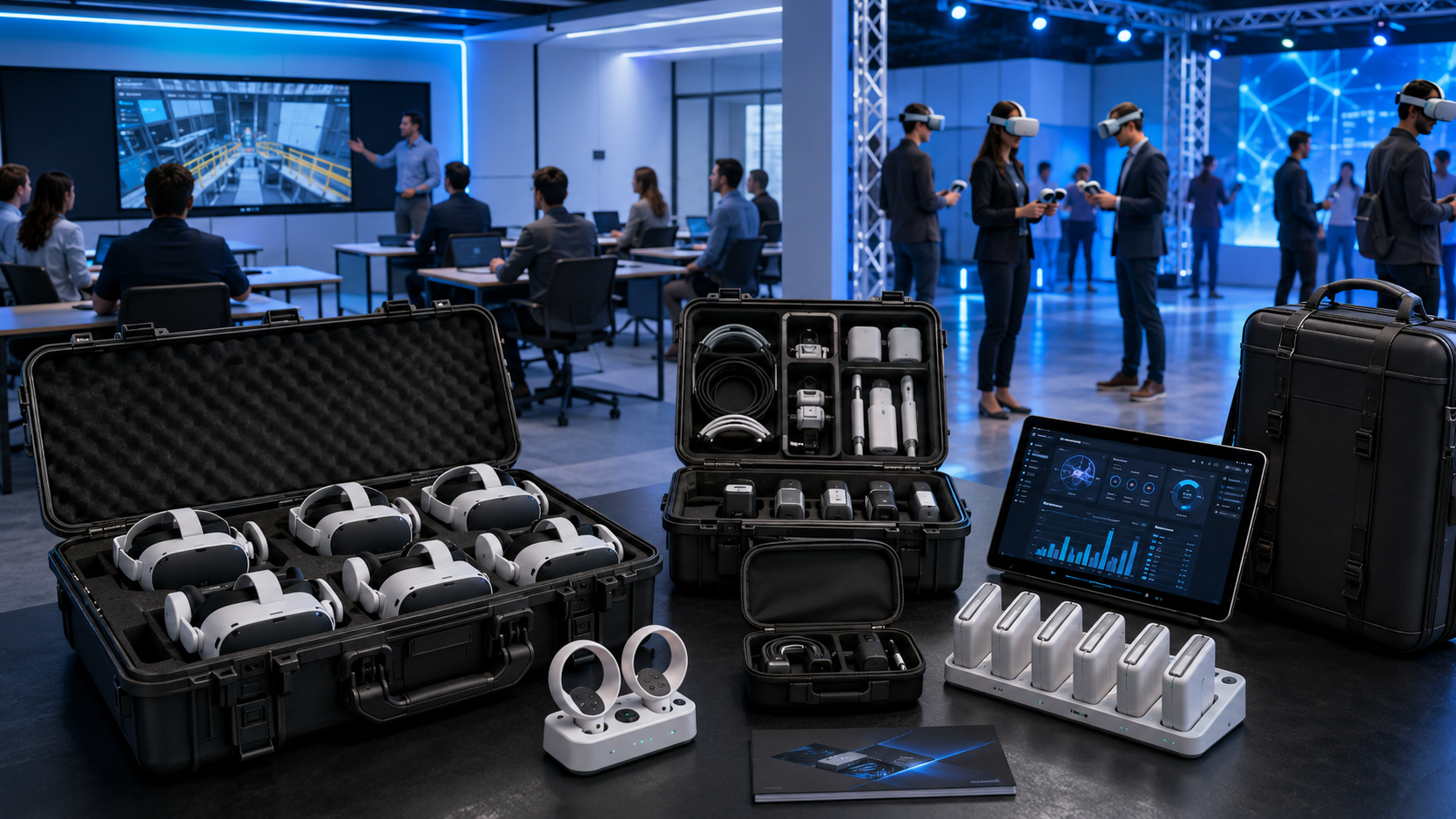
Equipment-only rentals provide just the hardware and essential accessories, typically including headsets, controllers, and charging cables. These bare-bones options suit tech-savvy teams with VR experience and existing content libraries.
Managed packages include comprehensive support services that justify their 40-60% premium over equipment-only rates. A typical managed package for 5 Quest 2 headsets runs $600-750/day versus $375-500 for equipment-only. The added value includes:
- Pre-loaded content library with 20-50 experiences
- Professional setup and configuration (saves 2-4 hours)
- On-call technical support during your event
- Hygiene supplies and cleaning protocols
- Backup equipment (typically 1 spare per 5 units)
- Post-event data analytics and engagement reports
Packages make financial sense when your team lacks VR expertise, you’re running a high-stakes event, or when setup time costs exceed the package premium. For a corporate team billing $150/hour internally, the 3-hour setup time saved already justifies most package upgrades.
VR Rental Pricing by Event Type and Scale
Different event formats require different VR configurations, affecting both equipment needs and total cost. A trade show booth activation has different pricing dynamics than a corporate training session or birthday party.
Trade Show & Exhibition VR Rental Costs
Typical 3-day trade show setup: $3,000-8,000
Standard trade show packages include 4-6 headsets configured for quick-rotation demos (3-5 minutes per user). Base pricing covers equipment, standard content, and basic booth integration. The wide price range reflects variables like:
- Headset tier (Quest 2 vs Quest 3 configurations)
- Custom demo development ($2,000-10,000 additional)
- Lead capture integration ($500-1,500)
- Branded headset skins and booth graphics ($300-800)
- Dedicated booth technician ($1,500-2,500 for 3 days)
Multi-city tour pricing offers economies of scale, with providers typically reducing per-show costs by 15-20% for 5+ consecutive events. Shipping between venues adds $200-500 per move, while equipment storage between shows costs $100-300/month.
ROI metrics favor VR over traditional displays when measuring engagement quality. While a standard booth display might generate 500 badge scans at $6 per lead, a VR station typically produces 150-200 deeply engaged prospects at $20-40 per meaningful interaction—often with 3x higher conversion rates.
Corporate Event & Training VR Pricing
Half-day training session (10-20 participants): $2,000-4,000
Corporate training rentals prioritize simultaneous usage over total headset count. A 20-person training requiring all participants in VR simultaneously costs more than rotating 20 people through 5 headsets over several hours.
Team building events (20-50 people): $3,000-7,000
Large team events often use a station approach, rotating groups through different VR experiences. A typical 50-person event might deploy 10-15 headsets across 3-4 activity stations, with pricing including facilitation support and multiplayer software licenses.
Conference breakout sessions: $1,500-3,000 per session
Conference organizers typically rent 8-12 headsets for 90-minute breakout sessions. Premium conferences might run 4-6 concurrent VR sessions, qualifying for volume discounts bringing per-session costs down 20-25%.
Multi-day corporate retreats: $5,000-15,000
Extended corporate events benefit from weekly rates and package deals. A 3-day executive retreat with 10 headsets, custom content, and full support typically runs $8,000-12,000, including all logistics and facilitation.
Bulk training program discounts reward recurring rentals, with quarterly contracts often reducing costs by 25-35% versus one-off bookings. Companies running monthly training sessions should expect to pay $1,500-2,000 per session on annual contracts.
Private Party & Consumer Event Rates
Birthday party package (2-4 hours, 4-8 headsets): $800-1,500
Consumer events command different pricing than corporate rentals, with providers offering simplified packages including age-appropriate content, safety briefings, and party-friendly support. Premium packages include printed certificates, winner prizes, and themed decorations.
Wedding entertainment station: $1,000-2,500
Wedding VR stations typically run 4-6 hours with 2-4 headsets, including elegant display stands and formal event staffing. Premium packages feature custom experiences like virtual venue tours or honeymoon destination previews.
School or library events: $500-1,200
Educational institutions receive preferential pricing, with many providers offering 30-40% educational discounts. A typical school assembly setup with 6 headsets and educational content costs $600-800 for a half-day program.
Fundraiser or charity event special pricing
Nonprofits often access donated or heavily discounted rentals. Providers typically offer 40-50% discounts for registered charities, with some providing free equipment for high-profile fundraising events in exchange for recognition.
Holiday party add-on stations: $400-800 per station
Seasonal events often incorporate VR as one of multiple entertainment options. Single-station rentals with 2-3 headsets and party-friendly content run $400-800 for 4-hour events, with multi-station discounts available.
Hidden Costs and Budget Considerations
The advertised rental rate is rarely the final cost. Understanding additional fees and optional services helps you budget accurately and avoid surprises.
Delivery, Setup & Logistics Fees
Local delivery typically $100-300 within 50 miles
Most providers charge flat-rate local delivery based on distance zones. Downtown deliveries might incur additional fees for parking, elevator certificates, or union labor requirements ($200-500 extra in major cities).
Shipping costs for self-setup: $50-150 each way per unit
Self-setup saves money but adds shipping complexity. Each headset kit ships in a 15-20 pound package costing $50-75 via ground shipping, or $100-150 for overnight delivery. Return shipping doubles these costs unless negotiated upfront.
Professional setup service: $500-1,500 depending on complexity
Basic setup for 5-10 headsets takes 2-3 hours and costs $500-750. Complex installations with custom play areas, overhead cable management, or multi-room configurations run $1,000-1,500. Setup fees often waive with premium packages.
Overnight shipping for last-minute needs: 2-3x standard shipping
Rush orders within 48 hours trigger expedited shipping at premium rates. A 5-headset order normally shipping for $250 might cost $600-750 for next-day delivery, plus 15-25% rush processing fees.
International shipping and customs considerations
Cross-border rentals add complexity and cost. Canadian events from US providers typically add $500-1,000 in shipping, customs brokerage, and duties. European rentals might make more sense sourcing locally despite higher base rates.
Content, Customization & Support Costs
Standard content library usually included in packages
Most rental packages include 20-50 pre-loaded experiences covering gaming, education, meditation, and professional applications. Premium content like Beat Saber or specialized training modules might incur additional licensing.
Custom branded experiences: $5,000-50,000 development
Simple logo integration and color customization starts at $5,000. Full custom experiences range from $15,000 for basic interactions to $50,000+ for photorealistic product demonstrations. Development typically requires 4-8 weeks lead time.
Content licensing for specific titles: $50-500 per title
Commercial event licenses for popular games cost $50-200 per title per event. Specialized software like medical simulations or enterprise training platforms might require $300-500 per license per device.
On-site technician support: $75-150/hour or $500-1,000/day
Technical support rates vary by market and expertise level. Major cities command $100-150/hour for experienced VR technicians. Full-day support typically offers better value at $500-750 for 8 hours versus hourly billing.
Remote support typically included, premium support upgrades available
Basic packages include business-hours remote support via phone or chat. Premium support with guaranteed 15-minute response times and dedicated technicians adds $200-500 per event day.
Insurance, Damage Waivers & Deposits
Security deposits: typically 50-100% of rental value
Providers hold security deposits ranging from $500-5,000 depending on equipment value and rental history. First-time renters face higher deposits, while established clients might qualify for deposit waivers.
Damage waiver fees: 10-15% of rental cost
Optional damage waivers limit liability for accidental damage. A $300 waiver on a $2,000 rental caps your damage liability at $500 versus full replacement cost. Most events find waivers worthwhile for peace of mind.
Event insurance requirements and coverage options
Many venues require $1-2 million general liability coverage naming them as additional insured. Event insurance policies cost $200-500 and might already cover rental equipment. Verify coverage limits and deductibles before purchasing redundant protection.
Replacement costs for lost or damaged equipment
Full replacement costs range from $500 for Quest 2 headsets to $2,000+ for professional models. Controllers cost $75-150 each, while accessories like face cushions or head straps run $20-50. Minor damage like scratched lenses might incur $100-200 repair fees.
Credit card holds and payment terms
Expect credit card holds of $2,000-10,000 depending on rental value. Corporate accounts might access NET 30 terms after establishing payment history. Some providers offer financing for rentals exceeding $10,000.
Cost Comparison: VR Rental vs Purchase for Events
For businesses running multiple events per year, the rent-versus-buy calculation becomes important. Here’s how to determine your break-even point and make the right financial decision.
Break-Even Analysis for Event Professionals
Typical break-even: 8-12 rental days per year per headset
A Quest 3 costing $650 to purchase breaks even after 8-10 rental days at $75/day. However, this simple calculation ignores several ownership costs:
- Protective cases and charging stations: $200-300 per headset
- Annual software licenses: $100-300 per device
- Replacement parts and repairs: $100-200 annually
- Storage and inventory management: $50-100/month
- Staff time for updates and maintenance: 2-4 hours monthly
Technology refresh cycles complicate the analysis further. VR hardware advances rapidly, with major upgrades every 2-3 years. A purchased Quest 2 from 2021 now seems dated compared to Quest 3 rentals, potentially impacting event impressions.
The true break-even point for most organizations lands around 15-20 event days annually when factoring total ownership costs. Companies running monthly events clearly benefit from purchasing, while quarterly users should continue renting.
When Renting Makes More Financial Sense
Irregular event schedule (less than monthly)
Organizations running fewer than 10 events annually almost always save money renting. The flexibility to scale headset count per event and access the latest technology outweighs ownership benefits.
Need for latest technology without upgrade costs
Renting provides automatic access to newest models as providers refresh inventory. This matters most for customer-facing events where cutting-edge technology impacts brand perception.
Multi-location events with shipping logistics
Shipping owned equipment between cities adds cost and complexity. Local rentals at each venue eliminate shipping risks, customs delays, and equipment damage during transport. A 5-city roadshow might save $2,000-3,000 in logistics through local rentals.
Testing VR before committing to purchase
Many organizations rent different models across several events before purchasing. This real-world testing reveals which features matter most for your specific use cases, preventing costly procurement mistakes.
Seasonal or campaign-specific activations
Marketing campaigns running 3-6 months benefit from rental flexibility. Purchasing equipment for limited-duration campaigns rarely makes financial sense, especially when campaign success remains uncertain.
How to Optimize Your VR Rental Budget
Smart planning and strategic choices can reduce your VR rental costs by 20-40% without compromising the experience quality.
Booking Strategies to Reduce Costs
Book 30+ days in advance for 10-15% early bird discounts
Advanced bookings help providers optimize inventory and logistics, savings they pass to customers. Booking 60+ days out might unlock additional 5% discounts during slow seasons.
Bundle multiple events for volume pricing
Committing to multiple events upfront typically reduces per-event costs by 15-25%. A 5-event series booked together might cost $12,000 versus $15,000 booked individually.
Choose off-peak rental periods (avoid conference season)
Spring (March-May) and fall (September-November) represent peak conference seasons with premium pricing. Summer and winter events often access 15-20% discounts due to lower demand.
Negotiate multi-day rates even for single-day events
If your one-day event falls midweek, ask about 3-day rates. Providers sometimes offer weekly rates for 5-day blocks, effectively giving you free backup days for weather contingencies or setup flexibility.
Ask about last-minute availability discounts
Providers occasionally offer 20-30% discounts on idle inventory within 72 hours of events. Building relationships with multiple providers lets you capitalize on these opportunities for flexible events.
Package Selection and Equipment Optimization
Match headset tier to actual experience requirements
Many events don’t require premium headsets. If you’re running simple 360° videos or basic interactions, Quest 2 units deliver excellent value. Save Quest 3 rentals for experiences leveraging mixed reality or demanding graphics.
Share headsets across sessions to reduce unit count
Structure your event to rotate participants through VR stations rather than providing simultaneous access. A 100-person event might need only 10-15 headsets with proper scheduling versus 25-30 for concurrent usage.
Use mixed fleet (premium for demos, basic for volume)
Deploy premium headsets for VIP demonstrations while using entry-level units for general attendees. This hybrid approach can reduce costs by 25-30% while maintaining quality where it matters most.
Leverage included content before commissioning custom
Explore providers’ existing content libraries thoroughly. Many included experiences can be lightly customized with logos or messaging for minimal cost, avoiding expensive custom development.
Self-setup options for tech-savvy teams
If your team includes IT-comfortable members, self-setup saves $500-1,500 per event. Providers typically offer video tutorials and remote support to guide DIY setup, which takes 2-3 hours for 10 headsets.
Alternative Pricing Models and Creative Solutions
Revenue share models for ticketed events
Some providers offer equipment at reduced rates or free in exchange for 20-30% of ticket revenue. This model works well for uncertain attendance projections or cash-flow constrained organizers.
Sponsorship opportunities to offset costs
VR experiences create natural sponsorship opportunities. A prominent brand might cover your entire rental cost in exchange for branded experiences and data capture rights. Tech companies particularly value VR event sponsorships.
Partner with VR content creators for co-marketing deals
Content developers sometimes subsidize hardware rentals to showcase their applications. Educational content creators might provide free software licenses worth $1,000-2,000 in exchange for user feedback and testimonials.
Educational and nonprofit discounts
Most providers offer 25-40% discounts for educational institutions and registered nonprofits. Some maintain donation programs providing free rentals for qualifying community events.
Seasonal package deals and promotional periods
Black Friday, New Year, and summer promotional periods often feature 20-30% discounts. Providers clearing previous-generation inventory might offer 40-50% discounts on older but capable models.
Getting Accurate VR Rental Quotes
To get precise pricing for your specific event, you’ll need to provide key details to rental providers. Here’s what information to gather and questions to ask.
Information to Provide for Accurate Quotes
Event date, duration, and location
Specify exact event dates including setup/breakdown days. Include venue address for delivery calculations and note any access restrictions like loading dock hours or freight elevator requirements.
Number of simultaneous users vs total attendees
Clarify whether all attendees need concurrent VR access or if rotation works. A 200-person event might need only 10 headsets with proper scheduling, dramatically impacting costs.
Type of experience needed (gaming, training, branded)
Different content categories require different hardware and licensing. Training simulations might need premium headsets while party games run fine on entry-level equipment.
Setup complexity and venue constraints
Describe your space dimensions, power availability, and any mounting requirements. Venues with limited power might need battery packs, while overhead mounting systems add setup complexity.
Support level required (self-managed vs full-service)
Specify whether you need on-site technicians, remote support only, or complete hands-off management. Each support tier significantly impacts pricing.
Key Questions to Ask Rental Providers
What’s included in the base price vs add-ons?
Request itemized quotes showing base rental, delivery, setup, support, and any additional fees. Understanding the breakdown helps identify negotiation opportunities.
Cancellation and rescheduling policies
Most providers require 14-30 days notice for cancellations. Understand penalties and rescheduling options, particularly important for outdoor or weather-dependent events.
Technical support response times and coverage
Clarify support hours and guaranteed response times. Weekend events might incur premium support charges, while business-hour events typically include standard support.
Equipment backup and contingency plans
Professional providers include 10-20% spare equipment. Verify their contingency plans for equipment failure and whether backup units incur additional charges.
Post-event data and analytics availability
Many systems capture usage analytics valuable for ROI measurement. Confirm what data you’ll receive and whether advanced analytics incur additional fees.
Frequently Asked Questions
What’s the average cost to rent VR equipment for a corporate event?
Corporate events typically cost $2,000-5,000 for a half-day session with 10-20 participants, including equipment, setup, and basic support. Premium experiences with custom content can reach $7,000-10,000.
Do VR rental prices include delivery and setup?
Basic quotes rarely include delivery or setup. Expect to add $100-300 for local delivery and $500-1,500 for professional setup, though premium packages often bundle these services.
How much does it cost to rent 10 VR headsets for a week?
Ten Quest 2 headsets for one week typically cost $3,500-5,000 including basic support and content. Quest 3 configurations run $5,000-7,000, while professional setups with full support reach $7,000-10,000.
Are there minimum rental periods for VR equipment?
Most providers enforce 1-day minimums for local rentals and 3-day minimums for shipped equipment. Some offer half-day rates for small local events, typically priced at 75% of full-day rates.
What’s the price difference between Quest 2 and Quest 3 rentals?
Quest 3 rentals cost 50-75% more than Quest 2, with Quest 2 at $75-100/day and Quest 3 at $125-175/day. The premium reflects superior performance, mixed reality capabilities, and limited availability.
Do VR rental companies offer insurance or damage protection?
Most providers offer damage waivers for 10-15% of rental cost, limiting liability for accidental damage. These waivers typically exclude theft, negligence, or intentional damage.
Can I get a discount for renting VR equipment for multiple events?
Multi-event commitments typically yield 15-25% discounts. Booking 5+ events annually might qualify for corporate account pricing with additional 10-15% savings.
What’s typically included in a VR rental package vs equipment-only?
Packages include headsets, controllers, hygiene supplies, content library, basic setup support, and remote technical assistance. Equipment-only rentals provide just hardware with minimal support.
How far in advance should I book to get the best VR rental rates?
Book 30-60 days ahead for optimal pricing and equipment availability. Last-minute bookings within 7 days often incur 15-25% rush charges and limited equipment selection.
Are there hidden fees I should watch for in VR rental quotes?
Watch for delivery fees, setup charges, damage waivers, technical support costs, content licensing, and credit card processing fees. Request fully itemized quotes to avoid surprises.
Conclusion
VR rental pricing varies significantly based on your specific event requirements, but understanding the cost structure empowers better budget decisions. Whether you’re planning a corporate training session, trade show activation, or private celebration, focus on total value rather than base rental rates.
The key to optimizing VR rental costs lies in matching equipment to your actual needs, booking strategically, and leveraging package deals where they make sense. Remember that the cheapest option rarely delivers the best event outcome, factor in support quality, equipment reliability, and content relevance when evaluating quotes.
As VR technology continues advancing and rental markets mature, prices are stabilizing while service quality improves. Today’s VR rental market offers options for every budget level, from DIY equipment-only rentals under $500 to full-service enterprise deployments exceeding $10,000.
Ready to bring VR to your next event? Start by defining your core requirements: audience size, experience goals, and support needs. Then request quotes from multiple providers at least 30 days before your event. Compare not just prices but included services, support quality, and equipment specifications. With proper planning and smart vendor selection, you can deliver an unforgettable VR experience while staying within budget.