

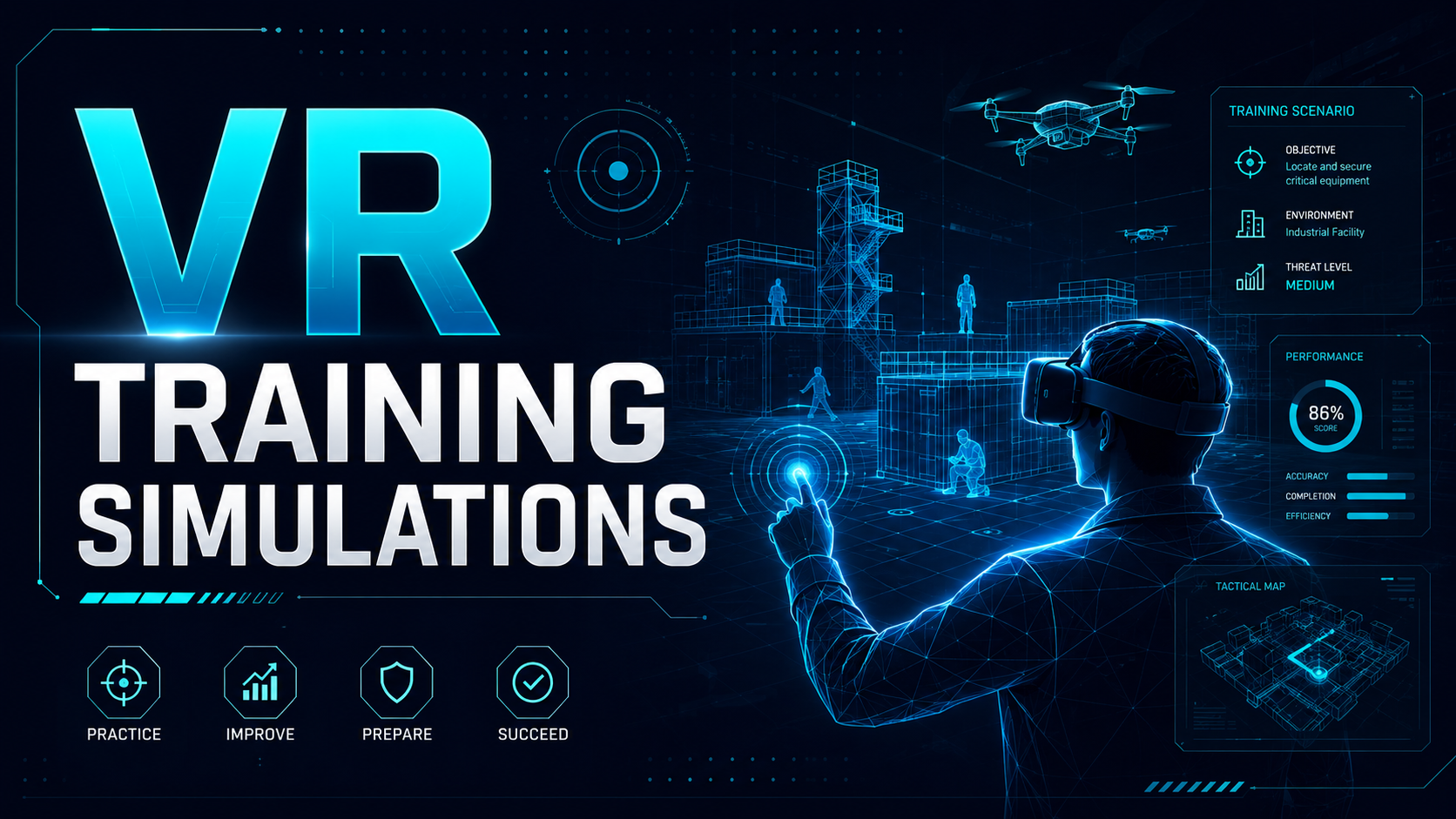
Virtual reality training simulations are transforming how enterprises develop workforce capabilities. This comprehensive guide examines the technical requirements, implementation strategies, and ROI metrics that learning teams need to deploy successful VR training programs at scale.
What Makes VR Training Simulations Different from Traditional E-Learning
VR training simulations create controlled, repeatable environments where employees practice high-stakes scenarios without real-world consequences. Unlike video-based training or classroom instruction, VR places learners directly into situations—from emergency response to customer interactions—generating muscle memory and emotional engagement that transfers to actual performance.
The fundamental difference lies in experiential learning. While traditional e-learning presents information for cognitive processing, VR training simulations engage multiple sensory channels simultaneously. Learners don’t watch someone perform a task; they perform it themselves in a three-dimensional space that responds to their actions in real-time.
Presence and Embodiment in Virtual Environments
Spatial presence in VR triggers genuine physiological responses that mirror real-world reactions. When employees practice emergency evacuations in virtual reality training programs, their heart rates elevate, stress hormones release, and decision-making processes activate identically to actual emergency situations. This biological authenticity creates learning experiences that traditional training cannot replicate.
Hand tracking technology enables natural interaction with virtual objects, building procedural memory through repeated practice. Manufacturing workers learning equipment maintenance develop muscle memory for tool manipulation, valve rotation sequences, and safety procedures. The brain encodes these movements as if performed on actual machinery, creating neural pathways that activate during real-world tasks.
Haptic feedback systems add tactile dimensions to virtual interactions. Surgeons practicing procedures feel resistance when cutting virtual tissue. Mechanics sense vibrations indicating equipment problems. These sensory inputs strengthen skill transfer by engaging the somatosensory cortex during learning, creating more robust memory formation than visual observation alone.
Cognitive load distribution differs fundamentally between VR and screen-based training. Traditional e-learning requires learners to mentally translate 2D representations into 3D understanding. VR eliminates this translation layer, freeing cognitive resources for skill acquisition and decision-making practice.
Data Capture Unique to VR Training
Eye tracking within VR headsets reveals where learners focus attention during critical moments. Training managers identify whether employees check safety indicators before operating equipment, scan environments for hazards, or maintain situational awareness during emergency procedures. This granular attention data enables targeted coaching impossible with traditional observation methods.
Decision tree analytics track every choice point within scenarios. VR simulation training software records not just final outcomes but the complete decision pathway—which options learners considered, how long they deliberated, and what environmental factors influenced their choices. This creates comprehensive behavioral maps showing how employees navigate complex situations.
Response timing metrics measure reaction speeds under various stress conditions. The system tracks how quickly workers identify equipment malfunctions, how stress affects decision quality, and whether repeated practice improves performance under pressure. These temporal patterns reveal skill development trajectories and identify employees who may need additional support.
Biometric integration captures stress indicators during high-pressure scenarios. Heart rate variability, galvanic skin response, and pupil dilation data show how learners manage stress during critical procedures. Organizations use these insights to design stress inoculation training that builds resilience before employees face actual high-stakes situations.
Movement efficiency analysis tracks body mechanics and ergonomics during physical tasks. The system identifies unsafe lifting techniques, inefficient movement patterns, and fatigue indicators that increase injury risk. This preventive approach to safety training reduces workplace injuries by correcting problematic behaviors before they become habits.
High-Impact Use Cases for VR Training Simulations
VR training delivers maximum ROI in scenarios where real-world practice is dangerous, expensive, or logistically complex. Manufacturing, healthcare, and retail have pioneered adoption, but emerging applications span every industry where human judgment and motor skills intersect.
Safety and Emergency Response Training
Fire evacuation scenarios place employees in smoke-filled environments where visibility decreases progressively. Learners practice locating exits, assisting colleagues, and making decisions about evacuation routes while experiencing realistic visual and audio conditions. Organizations report 73% better emergency response performance after VR evacuation training compared to traditional drills.
Active threat training creates high-stress scenarios without traumatizing participants. Employees practice lockdown procedures, communication protocols, and evacuation decisions in various facility layouts. The controlled environment allows repeated practice of life-saving procedures that would be impossible to rehearse realistically through conventional methods.
Hazardous material handling simulations expose workers to virtual chemical spills, gas leaks, and contamination scenarios. Learners practice proper PPE selection, containment procedures, and decontamination protocols without actual exposure risks. Mistakes in VR become learning opportunities rather than environmental disasters or injury incidents.
Equipment failure scenarios simulate catastrophic breakdowns, pressure vessel ruptures, and electrical faults. Maintenance teams practice emergency shutdown procedures, isolation protocols, and repair sequences under time pressure. The ability to experience rare but critical failures prepares workers for situations they might encounter once in a career.
Technical Skills and Equipment Operation
Complex machinery operation training eliminates production downtime during learning. New operators practice on virtual production lines identical to actual equipment, making mistakes without material waste or quality impacts. Automotive manufacturers report 50% reduction in training time when combining VR simulation with hands-on practice.
Surgical procedure rehearsal with haptic feedback allows repeated practice of delicate operations. Residents perform virtual surgeries with realistic tissue resistance, bleeding simulation, and anatomical variation. Studies show VR-trained surgeons make 40% fewer errors during their first live procedures compared to traditionally trained peers.
Assembly line training begins before facilities exist. Companies launching new products train workers on virtual production lines while physical lines are under construction. This parallel approach accelerates production ramp-up by ensuring trained workforces are ready when equipment becomes operational.
Maintenance procedure standardization ensures consistent service quality across global operations. Technicians practice diagnostic sequences, component replacement, and calibration procedures on virtual equipment matching their assigned machinery. This standardization reduces warranty claims and improves first-time fix rates.
Soft Skills and Customer Interaction
De-escalation training with AI-driven avatars prepares employees for difficult customer interactions. Retail workers practice calming angry customers, healthcare staff manage aggressive patients, and law enforcement officers rehearse tension reduction techniques. The AI adapts responses based on learner actions, creating dynamic scenarios that evolve naturally.
Sales conversation practice with branching dialogues develops consultative selling skills. Representatives navigate complex product discussions, handle objections, and identify customer needs through realistic conversations. The system tracks conversation patterns, identifying successful techniques and areas needing improvement.
Leadership scenarios simulate team dynamics during organizational changes. Managers practice delivering difficult messages, facilitating team discussions, and managing resistance to change. Virtual team members exhibit diverse personality types and reactions, preparing leaders for the full spectrum of human responses.
Cultural sensitivity training immerses employees in diverse cultural contexts. Learners navigate business interactions across cultural boundaries, practicing appropriate greetings, negotiation styles, and communication patterns. This experiential approach builds cultural intelligence more effectively than classroom diversity training.
Building Your VR Training Program: Technical Architecture
Successful VR training deployment requires careful orchestration of hardware, software, content, and learning management systems. Organizations must balance immersion quality against scalability, choosing between tethered high-end systems and standalone headsets based on training objectives.
Hardware Selection and Fleet Management
Standalone headsets like Meta Quest 3 and Pico 4 Enterprise offer deployment flexibility for distributed workforces. These devices operate without external computers, simplifying setup and reducing IT support requirements. Quest 3’s mixed reality capabilities enable training that blends virtual elements with physical environments, useful for equipment familiarization in actual workspaces.
Pico 4 Enterprise provides robust device management tools designed for corporate deployment. Centralized control over app installation, usage monitoring, and remote troubleshooting reduces IT overhead. The platform’s kiosk mode locks devices to specific training applications, preventing unauthorized use while maintaining security compliance.
High-fidelity training scenarios requiring precise hand tracking or photorealistic graphics may justify tethered systems. Varjo Aero’s human-eye resolution enables reading actual instrument panels and technical documentation within VR. HTC Vive Pro 2 with lighthouse tracking provides sub-millimeter precision for surgical training or precision assembly tasks.
Mobile device management platforms streamline headset fleet administration. ArborXR and ManageXR enable remote deployment of training content, usage analytics, and device health monitoring. These platforms support mixed fleets, allowing organizations to deploy different headset models for various training needs while maintaining centralized control.
Hygiene protocols require careful planning for shared equipment. UV-C sanitization cabinets kill pathogens between uses without degrading materials. Replaceable facial interfaces allow quick swapping between users while maintaining comfort. Some organizations issue personal facial interfaces to frequent users, similar to safety equipment policies.
Content Development vs Licensing
Off-the-shelf training libraries provide immediate deployment for common scenarios. Platforms like Immerse and STRIVR offer pre-built modules for safety training, customer service, and leadership development. These solutions work well for standardized training needs but may not address organization-specific procedures or equipment.
Custom scenario development ensures perfect alignment with actual workflows and equipment. Development costs range from $50,000 for simple scenarios to $500,000 for complex simulations with multiple branching paths. Timeline typically spans 3-6 months from concept to deployment, depending on complexity and iteration requirements.
Hybrid approaches using authoring platforms balance customization with development speed. Tools like CenarioVR and Uptale enable subject matter experts to create scenarios without programming knowledge. Organizations build libraries of reusable assets and templates, reducing costs for subsequent training modules.
Procedural generation techniques create variety within training scenarios without manual content creation. Algorithms generate different customer personalities, equipment configurations, or emergency scenarios, ensuring learners face novel situations rather than memorizing specific sequences. This approach maintains engagement across repeated training sessions.
Digital twin integration connects training simulations to actual equipment data. Maintenance training scenarios reflect real-time equipment status, allowing practice on current fault conditions. This connection ensures training remains relevant as equipment configurations change over time.
Integration with Learning Management Systems
SCORM compliance enables VR modules to communicate with existing learning management systems. Training completion, assessment scores, and time spent transfer automatically to LMS gradebooks. This integration maintains unified training records across VR and traditional content delivery methods.
xAPI provides richer data capture than traditional SCORM. Every action within VR scenarios generates data statements—where learners looked, what they touched, how they moved through space. Learning analytics platforms aggregate this data to identify patterns and optimize training design.
Competency mapping links VR training performance to specific skill requirements. The system tracks which competencies each scenario addresses and measures proficiency development over time. This granular tracking supports certification programs and regulatory compliance documentation.
Blended learning pathways combine VR simulations with traditional instruction methods. Learners complete theoretical modules online, practice skills in VR, then demonstrate competency in real-world assessments. This progression ensures knowledge foundation before expensive VR sessions while maintaining practical skill focus.
Implementation Roadmap: From Pilot to Scale
Most successful VR training programs start with focused pilots that prove ROI before expanding. This phased approach minimizes risk while building internal champions and refining deployment processes.
Phase 1: Pilot Program Design (Weeks 1-8)
High-impact use case selection focuses on scenarios with measurable performance gaps. Organizations identify training challenges where current methods fall short—high error rates, long time-to-competency, or safety incidents. The pilot addresses a specific, bounded problem rather than attempting comprehensive transformation.
Success metrics definition establishes clear evaluation criteria before deployment. Quantitative measures might include error reduction percentages, time-to-competency improvements, or safety incident decreases. Qualitative metrics capture learner confidence, engagement levels, and knowledge retention rates.
Baseline measurements document current performance levels for comparison. Organizations conduct pre-assessments, observe current training sessions, and analyze historical performance data. This baseline enables accurate ROI calculation and identifies specific improvement opportunities.
Pilot participant recruitment balances representation with manageability. Groups of 20-30 learners provide statistical significance while remaining logistically feasible. Selection includes various experience levels, ages, and technology comfort to understand adoption challenges across demographics.
Control group establishment enables rigorous comparison between VR and traditional training. Matched groups complete identical learning objectives through different delivery methods. This parallel structure isolates VR’s impact from other variables like instructor quality or content updates.
Phase 2: Content Development and Testing (Weeks 9-16)
Scenario design workshops bring together subject matter experts, instructional designers, and VR developers. Teams map critical decision points, identify common errors, and define performance standards. These collaborative sessions ensure technical accuracy while maintaining engaging narrative structures.
Iterative testing with target learners identifies usability issues early. Small groups complete prototype scenarios while developers observe and gather feedback. Common adjustments include movement speed calibration, instruction clarity improvements, and comfort optimizations for extended use.
Accessibility accommodations ensure inclusive training experiences. Subtitle options support hearing-impaired learners. Seated play modes accommodate mobility limitations. Color-blind friendly interfaces ensure critical information remains distinguishable. These modifications often improve usability for all learners, not just those with specific needs.
Instructor training prepares facilitators for VR session management. Trainers learn headset operation, troubleshooting common issues, and coaching techniques specific to VR environments. They practice guiding learners through initial experiences, managing motion sensitivity, and interpreting VR performance data.
Documentation development creates sustainable support systems. User guides explain headset operation and navigation controls. Facilitation guides outline session structure and debrief techniques. Technical documentation ensures IT staff can maintain and troubleshoot equipment independently.
Phase 3: Pilot Execution and Measurement (Weeks 17-24)
Deployment logistics require careful scheduling to maximize equipment utilization. Sessions run in 30-45 minute blocks with 15-minute buffers for sanitization and setup. Organizations often establish dedicated VR training rooms with appropriate space, lighting, and network connectivity.
Real-time support during initial sessions builds learner confidence. Technical staff remain on-site to address equipment issues, comfort adjustments, and navigation challenges. This high-touch approach during early adoption phases reduces frustration and abandonment rates.
Performance tracking captures both VR metrics and real-world application. The system records scenario completion rates, error patterns, and decision timing within VR. Supervisors evaluate on-the-job performance improvements using standardized observation tools. This dual measurement approach validates training transfer.
Learner feedback collection through surveys and focus groups identifies improvement opportunities. Questions explore comfort levels, perceived value, and suggested enhancements. This qualitative data complements performance metrics, revealing adoption barriers that quantitative measures might miss.
Iteration cycles refine content and delivery based on pilot findings. Common adjustments include scenario difficulty progression, additional practice opportunities for challenging skills, and improved onboarding sequences. These refinements prepare the program for broader deployment.
Phase 4: Scaling Strategy (Months 7-12)
ROI analysis compiles pilot results into compelling business cases. Calculations include training time reduction, performance improvements, and cost savings from reduced errors or accidents. Organizations typically see break-even within 12-18 months when deploying VR training at scale.
Infrastructure requirements for enterprise deployment expand beyond pilot configurations. Network capacity must support multiple simultaneous VR sessions. Storage systems accommodate large 3D asset libraries. Help desk procedures incorporate VR-specific support protocols.
Change management strategies address organizational resistance to new training methods. Communication campaigns highlight pilot successes and peer testimonials. Champions from pilot programs become advocates within their departments. Gradual rollout allows cultural adaptation rather than forcing sudden transitions.
Vendor partnership decisions balance internal capability development with external expertise. Some organizations build internal VR development teams for ongoing content creation. Others maintain vendor relationships for specialized content while developing basic authoring capabilities internally.
Governance structures establish oversight for expanded programs. Steering committees include representatives from learning and development, IT, operations, and finance. These groups prioritize content development, allocate resources, and ensure alignment with business objectives.
Measuring ROI and Training Effectiveness
VR training justifies its higher upfront costs through dramatic improvements in retention, performance, and training time reduction. Organizations tracking the right metrics consistently report 40-70% improvements over traditional methods.
Quantitative Performance Metrics
Time-to-competency measurements show VR-trained employees reaching proficiency 40-60% faster than traditionally trained peers. Manufacturing workers master assembly procedures in days rather than weeks. Customer service representatives handle complex scenarios confidently after fewer practice sessions.
Error rate analysis reveals 32-45% fewer mistakes during real-world task execution. Surgical residents make fewer procedural errors. Maintenance technicians correctly diagnose problems more frequently. These improvements directly impact quality metrics and customer satisfaction scores.
Knowledge retention testing at 30, 60, and 90-day intervals demonstrates VR’s superiority for long-term learning. Employees retain 75-80% of VR-trained skills after three months compared to 20-30% retention from traditional training. This durability reduces refresher training requirements and maintains workforce readiness.
Training throughput increases as VR eliminates scheduling constraints. Multiple employees train simultaneously without instructor bottlenecks. Self-paced progression allows fast learners to advance quickly while others receive additional practice. Organizations report 3x training capacity increases without additional instructor hiring.
Qualitative Impact Assessment
Learner confidence scores increase significantly after VR training experiences. Employees report feeling better prepared for challenging situations. This confidence translates to improved job performance and willingness to handle complex tasks independently.
Instructor feedback highlights improved preparation levels among VR-trained employees. Trainers spend less time on remedial instruction and more time on advanced skills development. The consistency of VR training ensures all learners receive identical foundational experiences.
Safety incident correlation analysis shows 43% reduction in workplace accidents following VR safety training implementation. Near-miss reporting increases as employees better recognize hazardous conditions. This proactive safety culture reduces injury costs and insurance premiums.
Employee satisfaction surveys reveal training quality as a retention factor. Workers value employers who invest in advanced training technologies. VR training programs become recruitment advantages, particularly for younger workers expecting modern learning approaches.
Total Cost of Ownership Calculation
Hardware refresh cycles typically span 3-4 years for enterprise VR equipment. Annual costs average $500-800 per headset including replacement parts, accessories, and warranty coverage. Organizations planning 4-year depreciation schedules budget accordingly for technology updates.
Content update frequency varies by industry and regulatory requirements. Healthcare simulations require annual updates for procedure changes. Manufacturing training updates with new equipment deployments. Budget 15-20% of initial development costs annually for content maintenance.
Travel expense reduction often covers entire VR program costs. Eliminating trainer travel to remote facilities saves hundreds of thousands annually. Centralizing specialized training through VR removes lodging and transportation costs for employees. These savings compound as programs scale globally.
Opportunity cost calculations reveal hidden VR training benefits. Production lines maintain output during training periods. Experienced workers avoid mentoring disruptions. Equipment remains operational rather than being allocated for training. These productivity gains significantly impact overall ROI calculations.
Common Pitfalls and How to Avoid Them
Organizations rushing into VR training often stumble on predictable challenges. Understanding these patterns helps design programs that deliver sustained value rather than becoming expensive experiments.
Technical Barriers to Adoption
Motion sickness affects 15-20% of VR users initially but decreases with proper design and acclimatization. Smooth locomotion systems, comfort settings customization, and gradual exposure protocols reduce symptoms. Starting with stationary experiences before introducing movement helps sensitive users adapt.
Network infrastructure inadequacies cause streaming failures and poor experiences. VR training requires consistent 50+ Mbps connections for cloud-based content. Local network assessment before deployment identifies necessary upgrades. Edge computing solutions reduce bandwidth requirements for facilities with limited connectivity.
Cross-platform compatibility issues arise when organizations use mixed hardware fleets. Content developed for one platform may not function properly on others. Selecting development tools supporting multiple platforms ensures flexibility. Testing across all target devices before deployment prevents compatibility surprises.
Update management becomes complex with large headset fleets. Staggered update schedules prevent system-wide disruptions. Automated deployment tools push updates during off-hours. Version control systems track content iterations and enable rollbacks if issues arise.
Organizational Resistance Points
Instructor role evolution concerns trainers who fear technology replacement. Successful programs position instructors as VR facilitators and coaches rather than information deliverers. Their expertise shifts toward personalized guidance and real-world application support. This evolution often increases job satisfaction by eliminating repetitive content delivery.
Generational technology gaps create adoption disparities. Younger employees embrace VR quickly while senior workers may struggle initially. Peer mentoring programs pair technology-comfortable employees with those needing support. Extended onboarding periods for VR-hesitant learners ensure nobody falls behind.
Union negotiations around training credits require early engagement. VR training may not fit traditional hour-based certification structures. Collaborative development of competency-based assessments satisfies regulatory requirements while leveraging VR’s capabilities. Unions often support VR training once safety benefits become apparent.
Executive skepticism about gaming technology requires careful positioning. Focus discussions on business outcomes rather than technology features. Demonstrate serious applications through pilot results. Arrange executive VR experiences showcasing professional training rather than entertainment content.
Content Quality and Relevance
Generic scenarios that ignore organizational specifics fail to engage learners. Employees quickly identify unrealistic situations or incorrect procedures. Customization investment ensures training reflects actual workflows, equipment models, and company policies. This authenticity drives adoption and transfer to real-world performance.
Outdated procedures in rapidly changing environments undermine training credibility. Establish content review cycles aligned with operational changes. Create modular content architectures enabling partial updates without complete rebuilds. Maintain version tracking to ensure all learners receive current information.
Over-gamification distracts from learning objectives when points and badges overshadow skill development. Balance engagement mechanics with professional training goals. Focus rewards on performance improvement rather than completion speed. Ensure game elements reinforce rather than replace learning outcomes.
Insufficient practice variety leads to memorization rather than skill mastery. Procedural generation creates scenario variations maintaining challenge across repeated sessions. Random element introduction forces adaptive thinking. This variety ensures employees develop judgment rather than simply following scripts.
Frequently Asked Questions
How much does a VR training program typically cost to implement?
Initial implementation costs range from $50,000 to $500,000 depending on scale and customization needs. A 50-person pilot program with off-the-shelf content and Quest 3 headsets costs approximately $75,000-100,000. Custom content development adds $50,000-200,000 per training module. Enterprise deployments for 500+ employees typically require $300,000-500,000 initial investment, with annual operating costs of 20-30% of initial investment.
What’s the minimum number of employees needed to justify VR training investment?
Organizations with 25-50 employees requiring specialized training can justify VR investment when traditional training costs exceed $2,000 per person annually. High-risk industries see positive ROI with smaller groups due to accident prevention value. Companies with distributed workforces benefit regardless of size by eliminating travel costs. The key factor is training complexity and frequency rather than absolute employee numbers.
Can VR training simulations work for remote employees?
Standalone headsets enable complete remote deployment of VR training programs. Organizations ship headsets directly to employee homes with pre-installed content. Cloud-based platforms enable real-time updates and progress tracking. Virtual collaboration features allow instructor-led sessions with geographically distributed participants. IT support uses remote desktop tools for troubleshooting. This approach proved especially valuable during pandemic-driven remote work transitions.
How do you handle employees who experience motion sickness in VR?
Start with stationary experiences allowing acclimatization before introducing movement. Implement comfort settings including peripheral vision reduction, snap turning, and teleportation locomotion. Schedule shorter initial sessions (15-20 minutes) gradually extending duration. Provide anti-nausea aids like ginger supplements or acupressure bands. Maintain alternative training paths for the 2-3% of employees who cannot adapt to VR. Most users overcome initial discomfort within 3-4 sessions.
What’s the typical development timeline for custom VR training content?
Simple scenarios with linear narratives require 8-12 weeks from concept to deployment. Complex branching simulations with multiple outcomes need 16-24 weeks. Initial requirements gathering and design takes 2-4 weeks. Asset creation and programming spans 6-12 weeks. Testing and iteration adds 4-6 weeks. Post-launch updates and optimizations continue for 2-3 months. Parallel development of multiple modules improves efficiency through asset reuse.
How do VR training certifications transfer across regulatory bodies?
VR training certifications gain acceptance through documented equivalency studies comparing outcomes to traditional training. Aviation authorities approved VR flight training after extensive validation studies. Medical boards accept VR simulation hours toward residency requirements. OSHA recognizes VR safety training meeting specific performance criteria. Organizations should engage regulatory bodies early, providing performance data and assessment protocols demonstrating VR training effectiveness.
Should we build VR training capabilities in-house or partner with vendors?
Hybrid approaches typically provide optimal results. Partner with specialized vendors for initial platform development and complex simulations. Build internal capabilities for content updates and basic scenario creation. This structure balances expertise access with long-term sustainability. Organizations producing 5+ training modules annually benefit from internal development teams. Smaller programs maximize value through vendor partnerships supplemented by authoring tools for minor customizations.
Conclusion
VR training simulations represent a fundamental shift in enterprise learning, moving from information transfer to experiential skill development. Organizations implementing these immersive training simulations report dramatic improvements in performance, safety, and employee engagement while reducing overall training costs.
Success requires thoughtful planning across technology selection, content development, and organizational change management. The phased approach outlined in this guide—from focused pilots to scaled deployment—minimizes risk while building momentum for transformation.
The data is clear: enterprise
deliver measurable ROI through reduced training time, improved retention, and fewer workplace incidents. As hardware costs decrease and content libraries expand, VR training transitions from competitive advantage to operational necessity.
Ready to transform your organization’s training outcomes? Start by identifying one high-impact use case where current training falls short. Assemble a cross-functional team including learning professionals, IT staff, and operational leaders. Launch a pilot program following this guide’s framework, measuring results against clear success criteria.
The future of enterprise training is experiential, data-driven, and immersive. Organizations acting now position themselves to attract top talent, reduce operational risks, and build workforces prepared for tomorrow’s challenges. The question isn’t whether to adopt VR training, but how quickly you can begin capturing its benefits.

