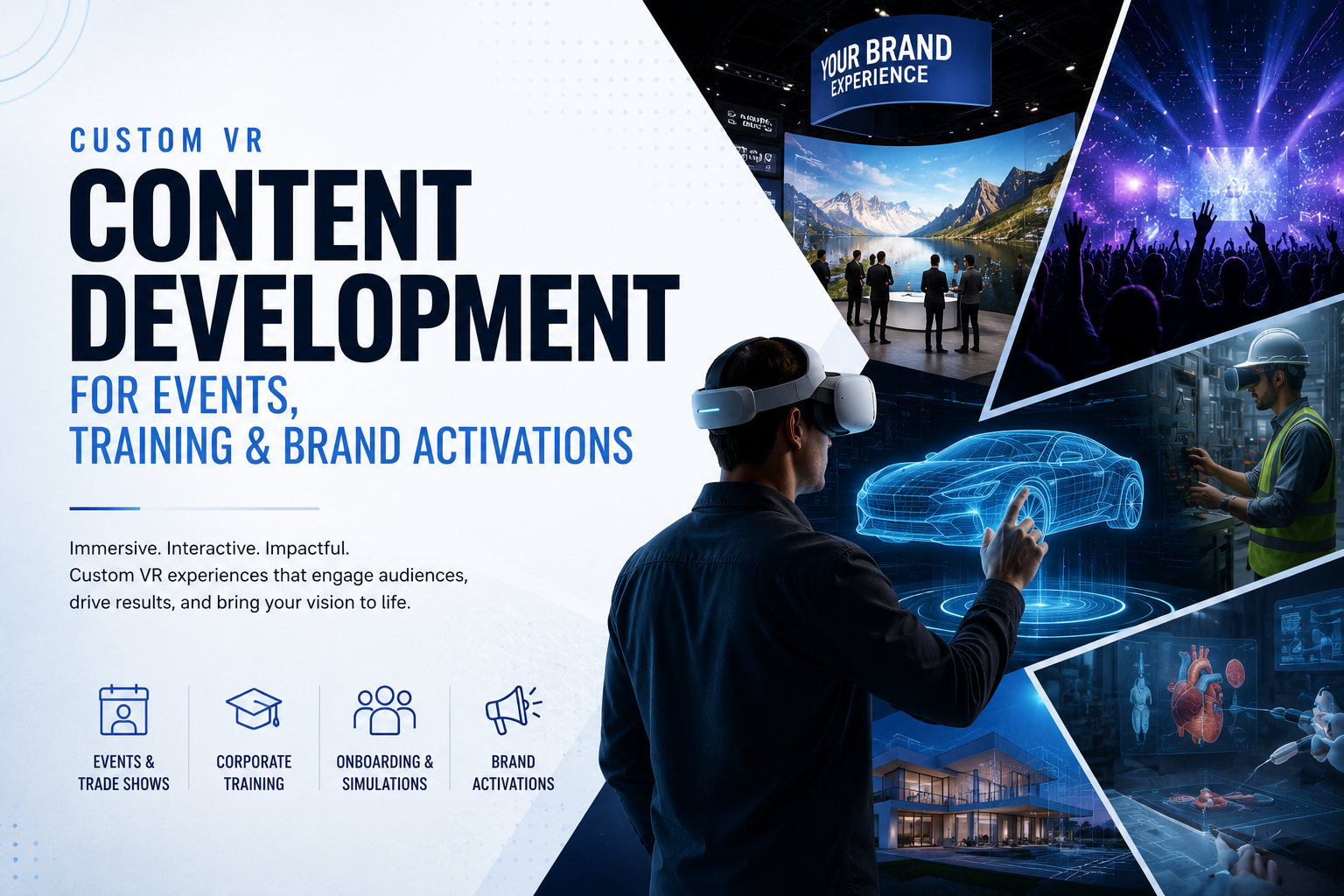
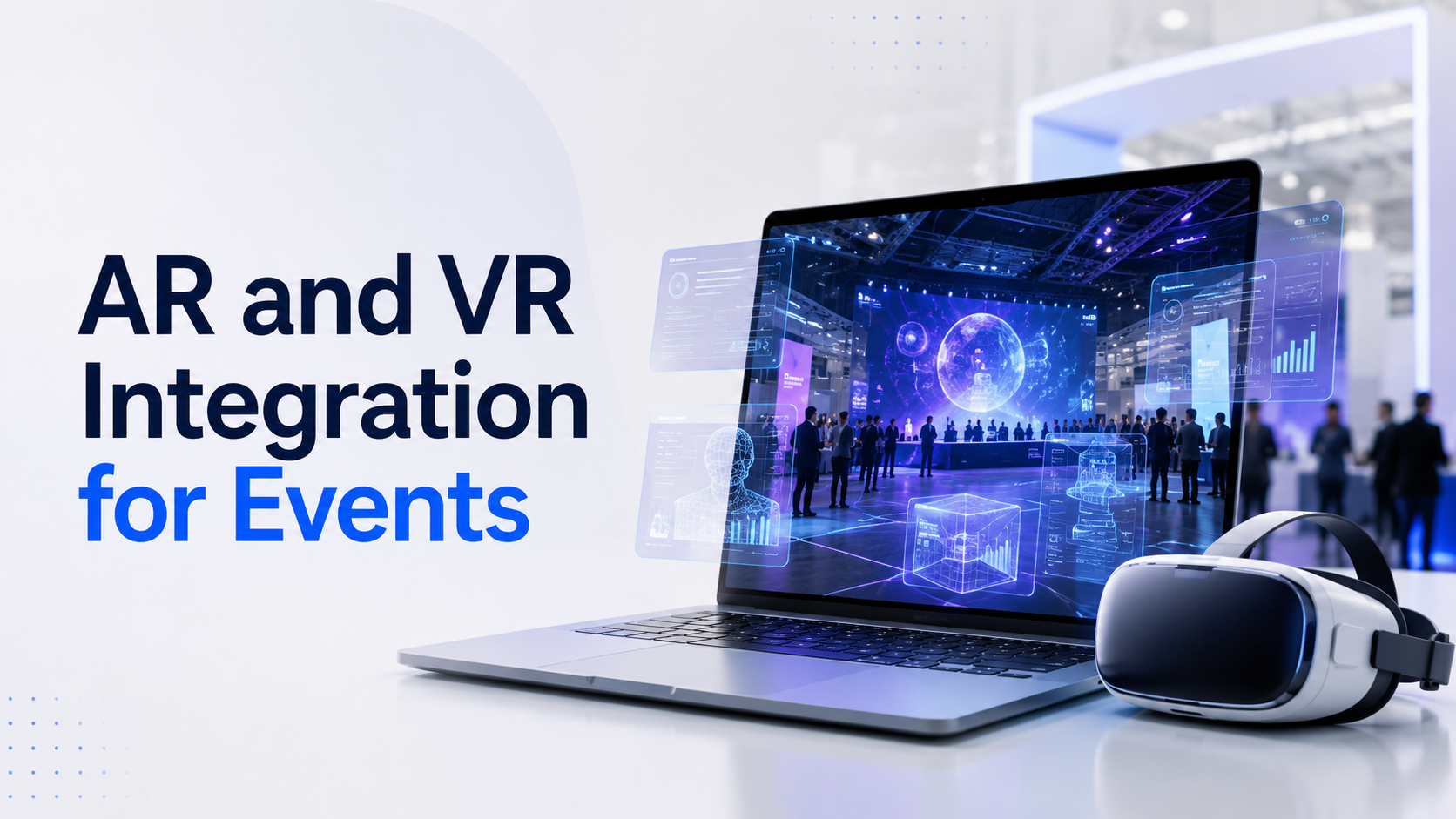
The convergence of augmented reality (AR) and virtual reality (VR) technologies creates powerful opportunities for events, training programs, and brand activations. While each technology offers distinct advantages, their strategic combination can deliver experiences that neither could achieve alone. This comprehensive guide explores practical implementation strategies, equipment requirements, and rental considerations for organizations planning mixed reality deployments.
Understanding AR and VR Integration: When to Use Each Technology
AR and VR serve different purposes in immersive experiences – AR overlays digital elements onto the real world while VR creates fully immersive environments. Understanding when to deploy each technology, or combine them in a single activation, determines the success of your event or training program.
AR vs VR: Core Technology Differences for Event Planners
The fundamental distinction between AR and VR shapes every aspect of event planning, from space requirements to audience capacity.
Hardware requirements vary significantly between technologies. AR experiences typically run on smartphones, tablets, or specialized AR glasses like the HoloLens 2 or Magic Leap 2. These devices allow users to maintain awareness of their surroundings while viewing digital overlays. VR requires dedicated headsets such as the Meta Quest 3 or Pico 4, which completely replace the user’s visual field with virtual environments.
User mobility and space needs present contrasting challenges. AR users can move freely through physical spaces, making it ideal for trade show floors where visitors navigate between booths. A 10×10 foot booth can accommodate multiple AR users simultaneously. VR experiences require dedicated safety zones – typically 6×6 feet minimum per user – with physical boundaries to prevent collisions.
Content creation complexity impacts both timeline and budget. AR content often involves 3D models optimized for real-time rendering on mobile devices, with development costs ranging from $5,000-$50,000 depending on complexity. VR experiences demand higher-fidelity assets and more sophisticated interaction design, with costs typically starting at $15,000 for basic experiences and exceeding $100,000 for custom enterprise solutions.
Audience capacity and throughput rates differ dramatically. AR experiences on tablets can serve 20-30 users per hour per device, with multiple devices operating simultaneously. VR stations typically handle 6-10 users per hour due to headset adjustment, onboarding, and sanitization requirements between sessions.
Mixed Reality Spectrum: Choosing Your Integration Approach
Organizations can combine AR and VR through several strategic approaches, each offering unique benefits for specific use cases.
Sequential experiences guide users through AR attraction followed by VR immersion. A automotive manufacturer might use tablet AR to showcase vehicle features on the show floor, then direct interested prospects to VR stations for virtual test drives. This approach maximizes reach through accessible AR while providing depth through selective VR engagement.
Parallel stations deploy different technologies for distinct audience segments simultaneously. Technical buyers might engage with AR product configurators while decision-makers experience VR facility tours. This strategy requires careful space planning but enables personalized experiences based on visitor profiles.
Hybrid applications leverage passthrough capabilities in modern VR headsets like the Quest 3 or Pico 4 Enterprise. These devices can switch between full VR immersion and AR-like mixed reality modes, eliminating the need for separate hardware. Passthrough quality continues improving, with the Quest 3 offering color passthrough at 4K resolution.
Cost-benefit analysis reveals that dual technology deployments typically increase hardware costs by 60-80% compared to single technology approaches. However, engagement metrics often show 2-3x improvement in qualified lead generation and 40% higher satisfaction scores, justifying the additional investment for high-value activations.
AR and VR Integration Use Cases by Industry
Different industries leverage AR/VR combinations in unique ways. Trade show exhibitors might use AR for product visualization and VR for immersive demos, while training programs combine AR job aids with VR simulations.
Trade Shows and Brand Activations
Trade show environments demand scalable solutions that balance engagement depth with visitor throughput.
AR product catalogs and configurators on tablets enable sales representatives to showcase entire product lines without physical samples. Visitors can visualize industrial equipment in actual size, explore internal components, and customize configurations. Implementation requires 2-3 iPad Pros per booth staff member, with rental costs averaging $150-200 per device per day.
VR experience zones create memorable brand interactions that generate social sharing and extended dwell time. A 20×20 booth can accommodate 2-3 VR stations with proper spacing, processing 50-75 visitors daily. Successful implementations include virtual factory tours, product demonstrations in context, and gamified brand experiences.
Lead capture workflows must seamlessly integrate across both technologies. QR codes displayed in AR experiences can trigger lead forms, while VR experiences can capture interaction data and heat maps showing areas of highest interest. Marketing automation platforms like HubSpot and Salesforce offer APIs for real-time lead synchronization.
Booth layout optimization for dual technology requires strategic traffic flow planning. Position AR stations at booth peripheries to attract passersby, with VR experiences deeper within the space for qualified prospects. Include charging stations for every 3-4 devices and dedicated storage for equipment during breaks.
Corporate Training and Onboarding
Mixed reality training programs combine the accessibility of AR with the immersion of VR to accelerate skill development and improve retention.
AR for on-the-job performance support delivers contextual guidance through smartphones or AR glasses. Maintenance technicians access step-by-step repair instructions overlaid on actual equipment, reducing error rates by up to 35% according to industry studies. Microsoft Dynamics 365 Guides provides enterprise-ready AR instruction authoring and deployment.
VR for safe environment skill practice enables employees to rehearse dangerous or expensive procedures without risk. Chemical plant operators practice emergency response procedures, while medical staff rehearse rare surgical techniques. VR training sessions typically last 15-20 minutes, with retention rates exceeding 75% compared to 20% for traditional training methods.
Integration with existing LMS platforms ensures training continuity. SCORM-compliant VR modules upload directly to systems like Cornerstone or Moodle, while AR performance data feeds back into employee development dashboards. API integration typically requires 40-60 hours of development time.
Measuring effectiveness across mixed reality training requires unified analytics. Track completion rates, assessment scores, and time-to-competency across both AR and VR modules. Organizations report 40% reduction in training time and 25% improvement in first-time quality metrics after implementing mixed reality programs.
Retail and Real Estate Applications
Retail and real estate sectors leverage AR/VR integration to bridge online and offline customer experiences.
AR for in-store product visualization allows customers to see furniture in their homes or preview clothing fits without trying items on. IKEA Place and similar apps demonstrate mature AR retail applications, with development costs ranging from $30,000-$100,000 for custom solutions.
VR for virtual showrooms extends reach beyond physical locations. Luxury automotive brands offer VR configurators where customers explore vehicle options in photorealistic detail. Real estate firms provide virtual property tours, reducing unnecessary site visits by 40% while maintaining conversion rates.
Customer journey mapping across technologies reveals optimal touchpoints for each platform. AR typically excels during research and consideration phases, while VR drives emotional connection and purchase decisions. Retailers report 30% higher average order values when customers engage with both AR and VR experiences.
ROI metrics for mixed reality retail show compelling returns. Conversion rates increase 94% for customers who interact with AR, while VR experiences generate 27% higher brand recall. Combined deployments achieve 2.7x return on investment within 12 months for implementations exceeding $50,000.
Equipment Requirements for AR/VR Integration
Successful AR/VR integration requires careful equipment selection and compatibility planning. Rental packages can provide the flexibility to test different configurations without major capital investment.
AR Hardware Options and Rental Considerations
Selecting appropriate AR hardware depends on use case requirements, audience demographics, and deployment environment.
Tablet-based AR offers the most accessible entry point. iPad Pro models with LiDAR sensors provide superior tracking and occlusion handling, essential for realistic object placement. The 12.9-inch iPad Pro rents for $75-100 per day, while Android alternatives like the Samsung Galaxy Tab S9 Ultra cost $60-80 daily. Purchase prices range from $800-$1,500 per device.
AR glasses deliver hands-free experiences ideal for training and field service applications. The HoloLens 2 offers 52-degree field of view with hand tracking and voice commands, renting for $500-700 per day or $3,500 monthly. Magic Leap 2 provides superior comfort for extended wear at similar rental rates. Purchase costs exceed $3,500 per unit.
Smartphone AR leverages existing devices through BYOD (Bring Your Own Device) strategies or provided hardware. ARCore (Android) and ARKit (iOS) enable sophisticated experiences on modern phones. Providing devices ensures consistency but adds $40-60 per phone per day in rental costs. Consider audience demographics – 85% of trade show attendees carry AR-capable smartphones.
Network and bandwidth requirements scale with simultaneous users. AR applications consume 5-10 Mbps per device for cloud-based content delivery. Events require dedicated WiFi access points supporting 50-75 devices per AP, with rental costs of $200-300 per AP per day. 5G connectivity offers an alternative for locations with coverage.
VR Headset Selection for Mixed Reality Events
VR hardware choices impact experience quality, operational complexity, and total deployment costs.
Standalone headsets simplify deployment by eliminating external computers. The Meta Quest 3 offers 4K+ resolution, pancake lenses for improved clarity, and color passthrough for mixed reality applications. Daily rental rates average $75-100, with purchase prices around $500-650. The Pico 4 Enterprise provides similar capabilities with enhanced device management features at comparable costs.
PC-tethered options deliver maximum visual fidelity for demanding applications. The HTC Vive Pro 2 offers 5K resolution but requires gaming PCs costing $2,000-$3,000 each. Tethered setups rent for $200-300 daily including PC hardware. Consider these for permanent installations or high-value demonstrations where quality justifies complexity.
Passthrough AR features in modern VR headsets enable mixed reality without separate AR hardware. The Quest 3’s color passthrough supports room-scale AR at 18 pixels per degree, approaching dedicated AR device quality. The Pico 4 Enterprise offers similar capabilities with added enterprise management features. Passthrough modes consume 20-30% more battery than full VR.
Hygiene and comfort accessories ensure safe public deployment. Silicone face covers ($10-15 each) enable easy sanitization between users. Disposable hygiene masks ($0.50 each) provide additional protection. Elite straps or comfort modifications ($50-100 per headset) reduce fatigue during extended sessions. Budget $30-50 per headset for consumable hygiene supplies during multi-day events.
Supporting Infrastructure and Setup Requirements
Infrastructure planning prevents day-of technical issues that can derail mixed reality activations.
Power and charging station planning requires calculating total device consumption. Each VR headset needs 18W for operation plus charging, while tablets require 20-30W. Plan for 150% of peak power requirements. Charging stations with 10 ports cost $200-300 to rent daily. Position charging areas away from user experiences to maintain immersion.
Network configuration for multiple devices demands enterprise-grade connectivity. Configure separate VLANs for AR/VR devices to prevent bandwidth competition. Implement Quality of Service (QoS) rules prioritizing real-time content delivery. Most venues charge $500-1,500 for dedicated internet drops with guaranteed bandwidth.
Physical space design must accommodate both technologies safely. VR areas require minimum 6×6 feet per station with physical barriers or guardian systems. AR zones need clear sightlines and adequate lighting for computer vision tracking. Mark boundaries with floor tape and provide 3-foot buffer zones between technology areas.
Staff training needs vary by technology complexity. AR tablet experiences require 2-4 hours of training for brand ambassadors. VR station attendants need 4-6 hours including troubleshooting procedures. Allocate additional time for rehearsals with actual hardware. Consider hiring specialized VR/AR staff at $35-50 per hour for complex deployments.
Content Strategy for Combined AR/VR Experiences
Creating cohesive experiences across AR and VR requires strategic content planning. The narrative and interaction design must flow naturally between technologies while leveraging each platform’s strengths.
Content Development Approaches
Successful mixed reality experiences maintain narrative continuity while optimizing for each platform’s capabilities.
Unified storytelling across AR and VR touchpoints creates memorable brand experiences. Develop a core narrative that adapts to each technology’s strengths – AR for contextual information and VR for emotional engagement. A museum might use AR to reveal artifact histories while VR transports visitors to historical periods.
Asset reuse and optimization strategies reduce development costs by 30-40%. Create modular 3D assets that scale across platforms – high-poly models for VR with automated decimation for AR deployment. Texture atlasing and LOD (Level of Detail) systems ensure smooth performance across device capabilities.
User journey mapping for technology transitions prevents jarring experience breaks. Design natural handoff points where users complete AR objectives before entering VR. Include visual and audio cues that maintain thematic consistency. User testing reveals that 15-second transition buffers between technologies improve satisfaction scores by 25%.
Testing and iteration processes for mixed reality require structured protocols. Conduct separate platform testing before integration testing. Allocate 20% of development timeline for optimization based on user feedback. A/B testing different transition methods and content sequences identifies optimal configurations.
Existing Content Libraries and Customization
Leveraging pre-built content accelerates deployment while reducing costs.
Pre-built AR/VR experience catalogs offer tested solutions for common use cases. Platforms like Sketchfab and Unity Asset Store provide thousands of 3D models and complete experiences. Medical training libraries from companies like Osso VR or FundamentalVR cost $10,000-$50,000 annually but include dozens of procedures.
Customization levels range from simple branding to complete redesigns. Level 1 customization (logos and colors) costs $2,000-$5,000. Level 2 (modified interactions and content) runs $10,000-$25,000. Level 3 (fully custom experiences) starts at $40,000. Each level adds 2-4 weeks to deployment timelines.
Brand integration and white-labeling options enable seamless experience ownership. Replace default branding elements, customize user interfaces, and modify color schemes to match brand guidelines. White-label solutions typically add 15-20% to base licensing costs but provide complete brand control.
Content management systems for mixed reality centralize experience deployment and updates. Platforms like ArborXR or ManageXR enable remote content pushing, usage analytics, and device management. Monthly costs range from $10-30 per device depending on feature requirements.
Implementation Timeline and Project Planning
Deploying integrated AR/VR experiences requires coordinated planning across technology selection, content preparation, and on-site logistics. A phased approach reduces risk and allows for optimization.
Pre-Event Planning Phase
Strategic planning 3-4 months before events ensures smooth execution and maximizes impact.
8-12 week timeline for custom content development accommodates design, development, and testing phases. Weeks 1-2: concept development and storyboarding. Weeks 3-6: asset creation and initial development. Weeks 7-9: integration and testing. Weeks 10-12: optimization and final deployment preparation. Compress timelines by 30% using existing assets or templates.
4-6 week lead time for equipment rental and testing prevents availability issues. Reserve hardware 6 weeks in advance for major trade shows or peak seasons. Schedule equipment delivery 3-5 days before events for testing. Negotiate 10-15% discounts for early bookings or multi-event contracts.
Staff training and rehearsal scheduling ensures confident day-of execution. Conduct initial training 2 weeks before events using rental equipment. Schedule dress rehearsals 2-3 days prior at venue or similar space. Document common issues and solutions in quick reference guides. Assign primary and backup operators for each station.
Contingency planning for technical issues minimizes disruption impact. Maintain 20% spare equipment for immediate replacement. Prepare offline modes for network-dependent experiences. Create simplified backup experiences that run on reduced hardware. Document escalation procedures with vendor support contacts.
Day-of Execution and Support
Successful event execution requires systematic setup procedures and responsive support protocols.
Setup sequence and timing requirements vary by deployment scale. Allow 2 hours for basic 2-3 device setups, 4-6 hours for complex 10+ device installations. Start with network configuration, then power infrastructure, followed by device setup and content loading. Complete testing 1 hour before doors open.
On-site technical support staffing levels depend on experience complexity and audience size. Maintain 1 technical staff per 3-4 AR stations or 2 VR stations. Add floating troubleshooter for deployments exceeding 6 stations. Technical staff costs average $50-75 per hour with 4-hour minimums.
User onboarding and queue management maintains steady throughput. Design 30-second AR onboarding sequences and 90-second VR orientations. Implement virtual queuing systems for experiences exceeding 5-minute durations. Display estimated wait times and provide AR teaser experiences for queued visitors.
Real-time troubleshooting protocols minimize downtime impact. Establish diagnostic checkpoints: power, network connectivity, tracking functionality, content loading. Maintain hot-swappable backup devices with pre-loaded content. Document issues for post-event analysis and future prevention.
Budget Planning: Rental vs Purchase for AR/VR Integration
The decision to rent or buy AR/VR equipment depends on usage frequency, technical expertise, and budget constraints. Rental packages offer flexibility for testing integration strategies before committing to purchases.
Cost Comparison Framework
Understanding total cost of ownership versus rental expenses informs optimal procurement strategies.
Hardware rental rates vary by equipment type and rental duration. Daily rates: tablets $75-100, VR headsets $75-150, AR glasses $500-700. Weekly rates typically offer 30% savings (5-day weeks charged as 3.5 days). Monthly rates provide 50-60% discounts versus daily rates. Annual contracts reduce costs by 70-80%.
Purchase costs include initial investment plus ongoing expenses. VR headsets: $500-1,500 plus $100-200 annual maintenance. Tablets: $800-1,500 plus protective cases and MDM software. AR glasses: $3,500-5,000 plus enterprise support agreements. Calculate 15-20% annual budget for replacements and upgrades.
Hidden costs impact total ownership calculations. Storage requires climate-controlled space at $50-100 per month for 10-device deployments. Software updates demand 2-4 hours monthly IT time. Hardware obsolescence occurs every 18-24 months for VR, 24-36 months for tablets. Insurance adds 2-3% of hardware value annually.
Break-even analysis reveals optimal procurement strategies. Organizations using equipment more than 15 days annually should consider purchasing tablets. VR headsets justify purchase at 20+ days annual usage. AR glasses rarely justify purchase below 40 days annual usage. Mixed deployments benefit from hybrid rental-purchase strategies.
Rental Package Options for Mixed Reality
Rental providers offer increasingly sophisticated packages tailored to mixed reality deployments.
Bundled AR/VR rental configurations simplify procurement and reduce costs. Standard packages include 5 tablets + 2 VR headsets for $800-1,000 daily. Premium packages add AR glasses and high-end VR for $2,000-3,000 daily. Custom configurations accommodate specific requirements with 10-15% package discounts.
Scalability for different audience sizes requires flexible rental agreements. Start with base packages and add devices as needed. Most providers offer same-day equipment additions for 20% premiums. Scale down mid-rental for 50% daily rate credits. Maintain 20% buffer capacity for unexpected attendance.
Technical support inclusion varies significantly between providers. Basic packages include remote phone support during business hours. Premium packages add dedicated on-site technicians and 24/7 support. Support additions cost $500-1,500 daily but prevent costly downtime. Negotiate support inclusion for rentals exceeding $5,000.
Insurance and damage protection considerations protect against unexpected costs. Standard damage waivers cost 10-15% of rental value and cover accidental damage. Comprehensive coverage including theft adds 15-20%. Self-insurance makes sense for experienced operators with strong handling procedures. Photograph all equipment during receipt and return.
Measuring Success: KPIs for AR/VR Integration
Tracking performance across both AR and VR components requires unified metrics that capture engagement, business impact, and operational efficiency.
Engagement and Experience Metrics
Quantifying user engagement across mixed reality experiences reveals optimization opportunities.
Session duration and completion rates indicate experience effectiveness. AR sessions average 2-3 minutes with 70% completion rates for well-designed experiences. VR sessions run 5-7 minutes with 85% completion rates due to higher commitment requirements. Track drop-off points to identify friction areas.
User satisfaction scores through post-experience surveys provide qualitative insights. Implement 3-question surveys: overall satisfaction (1-5 scale), likelihood to recommend (NPS), and most valuable feature. AR typically scores 4.2/5 while VR achieves 4.5/5. Combined experiences average 4.6/5 due to variety.
Social sharing and word-of-mouth indicators measure viral potential. AR experiences generate 3x more social shares due to easy photo capture. VR creates stronger word-of-mouth with 40% of users actively recommending to others. Provide branded sharing stations to amplify reach.
Repeat usage and referral patterns demonstrate lasting impact. Track return visitors across multiple days for trade shows. Monitor referral sources through unique QR codes or referral links. Successful activations achieve 20-30% repeat usage and 15-20% referral rates.
Business Impact Measurements
Connecting mixed reality experiences to business outcomes justifies investment and guides optimization.
Lead generation and qualification rates directly impact ROI. AR experiences capture 40-60 leads per day per device with 30% qualification rates. VR generates 20-30 leads with 50% qualification rates due to higher engagement thresholds. Combined approaches achieve 65% overall qualification rates.
Sales conversion attribution requires integrated tracking systems. Implement unique identifiers linking experience interactions to CRM records. Track progression through sales funnel with 30-90 day attribution windows. Mixed reality leads convert at 2.3x traditional trade show lead rates.
Training effectiveness and knowledge retention metrics validate learning applications. Pre/post assessments show 40% knowledge improvement for AR training, 60% for VR, and 75% for combined approaches. Long-term retention testing at 30 and 90 days maintains 70% of initial gains versus 20% for traditional training.
Cost per engagement calculations enable comparison with traditional methods. AR achieves $8-12 cost per meaningful engagement, VR runs $15-25, while combined experiences average $18-30. Traditional booth interactions cost $50-100 per qualified conversation. Factor in higher conversion rates for complete ROI analysis.
Frequently Asked Questions
What’s the minimum budget for an AR/VR integrated event activation?
Basic integrated activations start at $5,000-$7,000 for 3-day events. This includes rental of 3-4 tablets ($1,200), 2 VR headsets ($600), basic content licensing ($1,500), and technical support ($2,000). Custom content development adds $15,000-$50,000 depending on complexity.
Can AR and VR share the same content assets?
Yes, with proper planning. 3D models can be optimized for both platforms using LOD systems and texture compression. Shared assets reduce development costs by 30-40%. However, interaction designs and user interfaces require platform-specific optimization.
How many staff members are needed to run combined AR/VR experiences?
Minimum staffing includes 1 technical operator per 3-4 AR devices or 2 VR stations, plus 1 brand ambassador for audience engagement. A typical 5-device mixed reality activation requires 2-3 dedicated staff members throughout operating hours.
Which industries see the best ROI from AR/VR integration?
Manufacturing, healthcare, and real estate report highest returns. Manufacturing achieves 3.2x ROI through reduced training time and improved safety. Healthcare sees 2.8x ROI via better surgical outcomes and reduced errors. Real estate generates 2.5x ROI through increased conversion rates and reduced site visits.
Should we start with AR or VR if testing mixed reality?
Start with AR for broader reach and easier deployment. Tablet-based AR requires minimal infrastructure and serves more users per hour. Add VR after validating audience interest and refining operational procedures. This phased approach reduces risk while building organizational expertise.
How do passthrough VR headsets compare to dedicated AR devices?
Passthrough VR headsets like Quest 3 offer 80% of dedicated AR device functionality at 20% of the cost. Color passthrough enables room-scale AR experiences suitable for most marketing and training applications. Dedicated AR glasses remain superior for precision work requiring persistent overlays and all-day wear comfort.
The integration of AR and VR technologies creates transformative opportunities for events, training, and customer engagement. Success requires careful planning across technology selection, content strategy, and operational execution. Whether deploying tablet-based AR for broad reach or immersive VR for deep engagement, the combination of both technologies consistently delivers superior results compared to single-platform approaches.
Organizations new to mixed reality should begin with rental packages to test different configurations and validate use cases before committing to purchases. Focus initial deployments on high-value scenarios where the unique capabilities of combined AR/VR justify additional complexity and cost. Measure success through unified metrics that capture both immediate engagement and long-term business impact.
As AR and VR technologies continue converging through improved passthrough capabilities and cloud computing, the distinction between platforms will blur. Forward-thinking organizations that gain experience with integrated deployments today will be best positioned to leverage tomorrow’s unified mixed reality platforms.
Ready to explore AR and VR integration for your next event or training program? Start by defining clear objectives, selecting appropriate use cases, and partnering with experienced providers who can guide technology selection and content development. The future of immersive experiences lies not in choosing between AR or VR, but in strategically combining both to create unforgettable mixed reality experiences.