Why VR Rentals Transform Corporate Events Beyond Traditional AV Equipment
Corporate event rentals have evolved from projectors and sound systems to immersive technologies that turn attendees into active participants. Virtual reality rentals deliver 3-5x higher engagement rates than photo booths or gaming stations, with 87% of event planners reporting increased booth traffic at trade shows when VR experiences are deployed.
The shift toward experiential marketing has fundamentally changed how companies approach event technology. While traditional AV equipment facilitates passive consumption, VR transforms attendees into protagonists of branded narratives. This psychological shift from observer to participant creates memorable touchpoints that resonate long after events conclude.
Engagement Metrics: VR vs Traditional Event Rentals
The data speaks volumes about VR’s superiority in capturing and maintaining attention at corporate events. Average dwell time with VR experiences ranges from 8-12 minutes, compared to just 90 seconds at traditional photo booths. This extended engagement translates directly into deeper brand connections and message retention.
Social sharing rates for VR experiences exceed traditional activations by 340%. Attendees share VR content at rates of 73% compared to 21% for standard photo booth experiences. This organic amplification extends event reach beyond physical attendees, creating digital impressions that multiply marketing investment returns.
Brand recall studies demonstrate VR’s lasting impact. Participants remember 90% of VR experience details after one week, compared to 20% retention for traditional booth interactions. This cognitive persistence stems from VR’s multi-sensory engagement, which creates stronger neural pathways than passive observation.
Queue formation serves as a visible engagement indicator that attracts additional participants. VR stations consistently generate lines of 10-15 people during peak event hours, creating social proof that draws curious attendees. This viral effect transforms single VR stations into event focal points that drive overall attendance patterns.
Corporate Use Cases That Justify VR Investment
Product Demonstrations and Virtual Showrooms
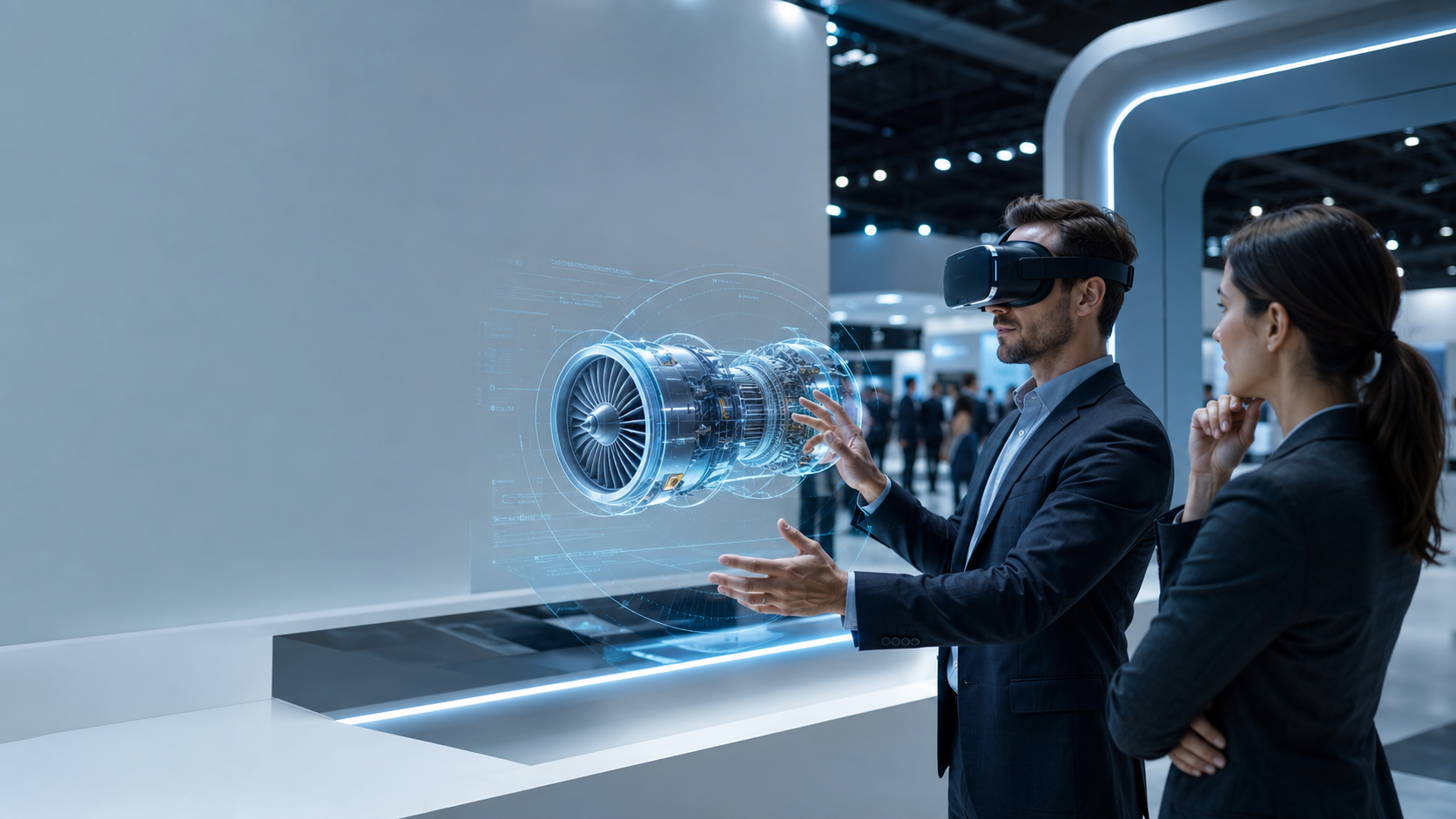
Manufacturing and technology companies leverage VR to showcase products impossible to transport to events. Boeing uses VR rentals at trade shows to give attendees virtual tours of aircraft assembly lines. Automotive manufacturers deploy VR experiences that let potential buyers explore vehicle interiors and customization options without physical inventory.
Virtual showrooms eliminate logistics constraints while providing richer product interactions. Furniture retailers create room-scale experiences where clients arrange virtual products in photorealistic spaces. Real estate developers offer property walkthroughs before construction completion, accelerating pre-sales cycles.
Team Building and Collaborative Experiences
VR team building activities generate 45% higher participation rates than traditional exercises. Multiplayer VR experiences like virtual escape rooms or collaborative puzzle-solving create shared challenges that strengthen team bonds. Remote teams particularly benefit from VR’s ability to create presence despite physical separation.
Companies report improved cross-departmental collaboration after VR team building events. The novel environment removes hierarchical barriers, encouraging interaction between employees who rarely engage during normal operations. This democratization effect persists post-event, with 62% of participants reporting increased colleague interactions.
Training Simulations and Skills Assessment
VR training at corporate events combines education with engagement. Medical device companies use VR to train surgeons on new equipment during conferences. Safety training simulations let industrial workers practice hazardous procedures without risk. Soft skills training through VR role-playing improves customer service and sales performance.
Assessment capabilities distinguish VR from traditional training methods. Performance metrics captured during VR experiences provide objective skill evaluations. Heat maps show where users focus attention, revealing comprehension gaps that inform follow-up training.
Trade Show Booth Differentiation
VR rentals transform standard 10×10 booths into destination experiences that compete with larger exhibitors. The vertical nature of VR experiences maximizes limited floor space while creating memorable brand interactions. Smaller companies level playing fields by offering experiences that overshadow static displays from established competitors.
VR Rental Pricing Models and Budget Planning for Corporate Events
VR rental pricing varies from $500-5000 per event based on headset quantity, experience complexity, and support level. Understanding pricing structures helps event planners allocate budget effectively while avoiding hidden costs that derail event ROI.
Pricing transparency remains challenging in the VR rental market, with vendors often requiring consultations before providing quotes. This opacity stems from legitimate variables affecting cost, but savvy planners can navigate pricing discussions armed with industry benchmarks and clear requirements.
Cost Breakdown by Event Type and Scale
Small Team Events (5-10 headsets): $500-1500
Internal team building events and training sessions represent the entry point for corporate VR rentals. Basic packages include consumer-grade headsets pre-loaded with standard experiences. Self-setup options reduce costs but require technically confident staff. Most vendors offer half-day minimums at this tier.
Trade Show Booths (2-4 stations): $1500-3000
Exhibition deployments command premium pricing due to logistics complexity and reliability requirements. Costs include commercial-grade equipment, branded experiences, and on-site technical support. Multi-day shows benefit from daily rate reductions, typically 20-30% for events exceeding three days.
Large Conferences (10+ units): $3000-5000+
Enterprise deployments scale pricing based on concurrent users rather than total attendees. Synchronized experiences for 20+ participants require specialized software and network infrastructure. Custom content development adds $5000-15000 depending on complexity and exclusivity requirements.
Multi-day Rental Discounts and Volume Pricing
Extended rentals unlock significant savings through tiered pricing structures. Week-long rentals typically cost 3-4x daily rates rather than 7x. Annual contracts for frequent users reduce per-event costs by 40-50% while guaranteeing equipment availability during peak seasons.
Volume discounts apply within single events and across multiple engagements. Orders exceeding 20 headsets trigger 15-25% discounts. Multi-city roadshow deployments benefit from consolidated logistics that reduce per-location costs by 30%.
What’s Included vs Additional Services
Base Rental Components
Standard VR rental packages include headsets, controllers, and basic content libraries containing 10-15 experiences. Most vendors provide carrying cases, charging cables, and basic setup instructions. Hygiene supplies like disposable face masks and lens wipes typically accompany rentals.
Content libraries focus on broadly applicable experiences: virtual tours, simple games, and meditation apps. Business-focused content like presentation viewers and collaboration tools appears in enterprise packages. Licensing restrictions may limit simultaneous users for premium content.
Setup Support and On-site Technician Costs
Professional setup services add $500-1500 per event but eliminate technical risks. Technicians handle equipment configuration, space optimization, and network connectivity. On-site support throughout events costs $75-150 per hour, with 4-hour minimums common.
Dedicated VR attendants improve user experience while protecting equipment. Attendant services run $35-50 per hour per station. Experienced attendants manage 2-3 stations simultaneously during lower-traffic periods, reducing staffing costs.
Custom Content Development Pricing
Branded VR experiences differentiate corporate events but require significant investment. Simple customizations like logo placement and color schemes cost $1000-2500. Interactive product demonstrations range from $10000-25000 depending on complexity and platform requirements.
Development timelines affect pricing and feasibility. Rush orders commanding 50-100% premiums for delivery under 30 days. Reusable content for multiple events amortizes development costs across deployments.
Insurance and Damage Waiver Options
Equipment protection plans cost 10-15% of rental fees but provide crucial financial protection. Standard waivers cover accidental damage but exclude theft or negligence. Comprehensive coverage including theft adds 5-8% to total costs.
Self-insurance through corporate policies may provide adequate coverage, but vendors often require proof of coverage naming them as additional insured. Deductibles for damaged equipment range from $500-1500 per headset without protection plans.
Selecting VR Equipment and Experiences for Your Corporate Audience
Choosing appropriate VR hardware and content determines event success. Enterprise audiences require different considerations than consumer events, prioritizing ease of use, hygiene protocols, and professional content over gaming experiences.
The enterprise VR landscape differs markedly from consumer markets. While gaming drives consumer adoption, corporate deployments emphasize reliability, manageability, and professional presentation. Understanding these distinctions guides equipment selection that aligns with business objectives.
Hardware Selection for Corporate Settings
Standalone vs PC-tethered Headsets for Event Logistics
Standalone headsets like Meta Quest 3 and Pico 4 Enterprise dominate corporate rentals due to setup simplicity. Elimination of gaming PCs and cable management reduces setup time by 75% while minimizing trip hazards in crowded venues. Battery life of 2-3 hours suffices for most corporate interactions with hot-swapping for continuous operation.
PC-tethered systems justify complexity for specific use cases requiring maximum graphical fidelity. Architectural visualizations and engineering simulations benefit from workstation-class graphics cards. However, tethered systems limit user movement and increase failure points through cable wear and connection issues.
Meta Quest 3 vs Pico 4 Enterprise for Business Use
Meta Quest 3 offers superior content ecosystem with 500+ business applications available. Hand tracking capabilities eliminate controller learning curves for first-time users. Passthrough features enable mixed reality experiences that blend virtual content with physical spaces.
Pico 4 Enterprise provides enterprise-specific features including centralized device management and kiosk modes. Enhanced privacy controls address corporate data security concerns. Regional availability varies, with Pico dominating Asian markets while Meta maintains North American leadership.
Hygiene Solutions and Multi-user Considerations
Hygiene protocols became mandatory post-2020, fundamentally changing VR rental operations. Silicone face guards create barriers between users and foam interfaces. UV-C sanitization stations provide 99.9% pathogen elimination between users. Disposable hygiene covers cost $0.50-1.00 per user but ensure comfort and safety.
Multi-user optimization requires careful attention to interpupillary distance (IPD) adjustment mechanisms. Quick-adjust systems reduce changeover time between users with different facial structures. Prescription lens adapters accommodate glasses-wearing attendees who represent 64% of corporate audiences.
Space Requirements and Safety Zones
Minimum play areas of 6×6 feet per station prevent collisions and equipment damage. Optimal configurations provide 10×10 feet, enabling room-scale experiences that showcase VR’s full potential. Boundary marking with physical barriers or floor tape creates clear safety zones.
Ceiling height considerations often overlooked during planning prove critical for standing experiences. Minimum 8-foot clearances prevent controller strikes during overhead reaching motions. Venues with lower ceilings require seated experiences or careful content curation to avoid accidents.
Content Curation for Professional Audiences
Industry-specific Simulations and Training Modules
Healthcare organizations deploy surgical simulations that provide risk-free practice environments. Manufacturing companies use assembly training modules that reduce onboarding time by 40%. Financial services firms leverage data visualization tools that transform spreadsheets into immersive 3D landscapes.
Content relevance directly correlates with engagement metrics. Generic experiences see 30-40% participation rates while industry-specific content achieves 70-80% uptake. Pre-event audience surveys identify optimal content mix balancing education with entertainment.
Team Building Experiences That Scale to 20+ Participants
Multiplayer VR experiences create shared narratives that strengthen team cohesion. Virtual escape rooms accommodate 4-6 players simultaneously with multiple rooms running parallel sessions. Competitive experiences like virtual archery or racing create friendly competition that energizes corporate gatherings.
Scalability challenges emerge beyond 20 concurrent users due to network limitations and physical space constraints. Rotation systems alternating between VR participants and spectator roles maximize involvement while managing logistics. Leaderboards and tournament structures maintain engagement for non-active participants.
Brand Activation Content and Custom Development Timelines
Branded VR experiences require 6-12 week development cycles for meaningful customization. Simple branding overlays take 2-3 weeks but provide limited differentiation. Interactive product showcases need 8-10 weeks including stakeholder reviews and revisions.
Content reusability justifies development investment for companies with multiple events annually. Modular experiences allowing easy updates extend content lifespan. Cloud-based deployment enables instant updates across distributed events without physical media management.
Avoiding Motion Sickness in First-time Users
Motion sickness affects 25-40% of first-time VR users, potentially creating negative brand associations. Teleportation-based movement reduces nausea compared to smooth locomotion. Stationary experiences eliminate motion sickness entirely while maintaining engagement through interactive elements.
Progressive difficulty curves ease users into VR gradually. Initial experiences should last 3-5 minutes before extending to longer sessions. Comfort ratings help attendants guide users toward appropriate content based on VR experience levels.
Setup Logistics and Technical Requirements for Corporate VR Rentals
VR deployment at corporate venues requires advance planning for power, network, space, and staffing. Understanding technical requirements prevents day-of failures that damage event reputation and attendee experience.
Successful VR deployments begin months before events with comprehensive site surveys and technical assessments. Early planning identifies potential obstacles while allowing time for solutions. Last-minute additions rarely succeed due to venue limitations and equipment availability constraints.
Venue Assessment and Pre-Event Planning
Power Requirements: 2-3 Outlets Per VR Station
Each VR station requires dedicated 15-amp circuits to prevent overloading. Standalone headsets need single outlets for charging stations while PC-based systems demand 3-4 outlets per setup. Power distribution units (PDUs) consolidate connections but require careful load balancing.
Venue power audits reveal capacity limitations that affect deployment scale. Older facilities may lack sufficient circuits for large VR installations. Portable generators provide supplementary power but add complexity and cost. Battery backup systems ensure uninterrupted experiences during power fluctuations.
Internet Needs for Cloud-based Experiences
Cloud-dependent VR content requires minimum 25 Mbps per headset for smooth operation. Multiplayer experiences demand 50 Mbps per concurrent user plus overhead for backend services. Dedicated networks isolate VR traffic from general conference WiFi, preventing bandwidth competition.
Redundant internet connections mitigate single points of failure. Cellular hotspots provide backup connectivity for critical demonstrations. Local content caching reduces bandwidth requirements but limits experience selection flexibility.
Minimum 6×6 ft Play Areas with Safety Boundaries
Physical space allocation determines maximum concurrent users and experience types. Guardian boundaries in VR software prevent users from leaving safe zones. Physical barriers provide additional protection for high-traffic areas.
Adjacent station spacing prevents arm-swing collisions between users. 3-foot buffers between play areas accommodate enthusiastic gestures. Spectator areas require additional space, typically doubling total footprint requirements.
Load-in Timing and Setup Duration (2-4 Hours Typical)
Professional VR deployments require significant setup time often underestimated by planners. Equipment unpacking and inspection takes 30-45 minutes. Software configuration and content loading adds another hour. Play area setup and safety checks consume additional time.
Venue access scheduling must accommodate setup requirements. Union venues may restrict setup windows or require specific labor. Early morning setups minimize disruption but increase labor costs. Build-in buffer time for troubleshooting inevitable technical issues.
Staffing Models: Self-Service vs Managed Experiences
VR Attendant Ratios (1:4 for Smooth Operation)
Optimal staffing ratios balance cost with user experience quality. Single attendants managing 4 stations can provide basic support during steady traffic. Peak periods require 1:2 ratios for seamless experiences. Premium events benefit from 1:1 dedicated support.
Attendant responsibilities extend beyond technical support to include crowd management and hygiene protocols. Experienced attendants recognize motion sickness symptoms and intervene before incidents. Enthusiasm and presentation skills prove equally important as technical knowledge.
Training Requirements for Internal Staff
Internal staff operation reduces costs but requires comprehensive training. Basic operation training takes 2-3 hours covering equipment handling and troubleshooting. Content curation training adds another hour for selecting appropriate experiences.
Training materials should include quick reference guides and video tutorials for day-of refreshers. Vendor support hotlines provide backup for complex issues. Practice sessions before events identify knowledge gaps requiring additional training.
Full-service Vendor Management Benefits
Turnkey solutions eliminate technical burdens from event planners. Vendor-provided staff bring experience from hundreds of deployments. Professional presentation and branded attire enhance event perception. Insurance and liability transfer to vendors reduces organizational risk.
Full-service premiums of 40-60% over self-operated rentals prove worthwhile for high-stakes events. Vendor relationships with equipment manufacturers expedite replacement for failures. Dedicated project managers coordinate logistics and serve as single points of contact.
Troubleshooting Protocols and Backup Equipment
Common issues include tracking problems, controller pairing failures, and software crashes. Troubleshooting guides should address 90% of typical problems. Escalation procedures define when to contact vendor support versus attempting fixes.
Backup equipment requirements depend on event criticality and attendee expectations. Minimum 20% spare inventory covers typical failure rates. Mission-critical demonstrations warrant 50% redundancy. Hot-swappable configurations minimize downtime during equipment switches.
Measuring ROI and Success Metrics for Corporate VR Rentals
Justifying VR rental investment requires tracking specific metrics that demonstrate value beyond traditional event KPIs. Smart event planners establish measurement frameworks before deployment to prove impact to stakeholders.
ROI measurement for VR rentals extends beyond simple cost-per-lead calculations. Experiential marketing creates brand affinity and employee engagement that manifest in long-term value. Comprehensive measurement frameworks capture both immediate and lasting impacts.
Quantifiable Metrics That Matter
Participation Rates and Queue Management Data
VR participation rates average 65-75% of event attendees compared to 20-30% for traditional activations. Queue management systems track wait times and abandonment rates. Optimal wait times of 5-10 minutes balance throughput with crowd generation.
Time-of-day analysis reveals peak engagement periods for staff optimization. Morning sessions see 40% lower participation than afternoon peaks. Final hour surges as attendees complete must-do activities before departure.
Lead Capture Through VR Experience Registration
Registration requirements for VR access generate qualified leads with 85% accuracy rates. Progressive data capture during multi-stage experiences increases form completion. Gamification elements incentivize providing additional contact information.
Lead quality from VR experiences exceeds traditional methods with 3x higher conversion rates. Extended engagement time enables deeper qualification conversations. Post-experience follow-up sees 60% higher response rates due to memorable interactions.
Post-event Survey Scores and NPS Improvement
VR experiences drive 15-20 point increases in event Net Promoter Scores. Attendee satisfaction ratings improve 25% when VR activations are included. Specific VR experience ratings consistently exceed 4.5/5 stars.
Qualitative feedback reveals VR experiences dominate event highlights in open-ended responses. Social proof from satisfied participants drives word-of-mouth promotion for future events. Negative feedback typically focuses on wait times rather than experience quality.
Social Media Mentions and Earned Media Value
VR activations generate 5x more social media content than traditional event elements. User-generated content from VR experiences sees 300% higher engagement rates. Branded hashtags associated with VR experiences trend 45% more frequently.
Earned media value calculations show VR investments returning 4-7x in publicity value. Press coverage gravitates toward innovative VR deployments over standard event activities. Influencer participation amplifies reach beyond traditional attendee networks.
Building the Business Case for Future Events
Cost Per Engaged Attendee Calculations
Traditional booth staffing costs $50-75 per meaningful interaction. VR experiences achieve $15-25 per engaged attendee including all rental and support costs. Higher dwell times with VR create deeper engagement despite lower total throughput.
Multi-touch attribution models credit VR experiences with 30-40% of eventual conversions. Customer lifetime value from VR-engaged leads exceeds traditional leads by 25%. Retention rates for VR-acquired customers show 15% improvement over baseline.
Comparison to Traditional Activation Costs
Celebrity appearances cost $25,000-100,000 for limited engagement windows. VR rentals provide consistent experiences throughout entire events for fraction of celebrity fees. Traditional game rentals achieve similar participation at 50% higher cost per user.
Shipping and drayage for physical displays often exceeds VR rental costs for comparable impact. VR eliminates property storage and maintenance between events. Digital experiences enable instant updates without physical reproduction costs.
Long-term Rental Agreements and Volume Discounts
Annual contracts reduce per-event costs by 35-45% compared to ad-hoc rentals. Guaranteed minimums secure preferential pricing and equipment availability. Flexible contracts allow experience swapping to maintain freshness across multiple events.
Portfolio approaches bundling VR with other event technologies unlock additional savings. Integrated vendor relationships simplify logistics and accountability. Master service agreements streamline procurement for rapid deployment.
Integration with Broader Event Technology Stack
VR data integration with CRM systems enables sophisticated lead nurturing. Badge scanning integration eliminates manual data entry while maintaining experience flow. Marketing automation triggers personalized follow-up based on VR experience choices.
Analytics platforms aggregate VR metrics with overall event performance for holistic ROI assessment. Real-time dashboards enable dynamic staff allocation based on demand patterns. Historical data improves future event planning and content selection.
Vendor Evaluation Criteria for Corporate VR Rental Partners
Selecting a VR rental vendor requires evaluating beyond equipment quality to assess support capabilities, insurance coverage, and enterprise readiness. The right partner reduces event risk while maximizing experience impact.
Vendor selection significantly influences event success beyond equipment specifications. Professional vendors bring expertise that transforms good events into exceptional experiences. Due diligence during selection prevents day-of disasters that damage brand reputation.
Critical Vendor Capabilities
Equipment Inventory Depth and Backup Units
Leading vendors maintain 20-30% excess inventory for emergency replacements. Equipment age should average less than 18 months for optimal performance. Refresh cycles ensuring latest hardware availability demonstrate vendor investment.
Inventory management systems tracking equipment location and status indicate operational maturity. Redundant equipment stationed regionally reduces replacement time for failures. Vendor partnerships with manufacturers expedite warranty replacements.
Geographic Coverage and Shipping Logistics
National vendors with regional warehouses minimize shipping costs and transit damage. Local presence enables rapid response for last-minute needs or equipment failures. International capabilities matter for global event programs.
White-glove shipping services ensure equipment arrives in optimal condition. Climate-controlled transport prevents temperature damage to sensitive electronics. Chain-of-custody documentation provides accountability throughout logistics.
Technical Support Response Times and SLAs
Enterprise vendors guarantee 15-minute response times during event hours. 24/7 support availability accommodates international events and time zones. Dedicated account managers provide consistent points of contact.
Service level agreements should specify replacement timeframes for equipment failures. Financial penalties for SLA breaches demonstrate vendor confidence. Escalation procedures ensure rapid resolution for critical issues.
Experience Portfolio Matching Your Industry
Vendors specializing in corporate events understand professional audience expectations. Industry-specific content libraries accelerate deployment without custom development. Case studies from similar companies provide confidence in execution capability.
Reference architectures for common use cases reduce planning complexity. Proven playbooks for trade shows, training, and team building ensure success. Vendor networks with complementary service providers simplify comprehensive solutions.
Red Flags and Risk Mitigation
Insurance Requirements and Liability Coverage
Vendors should carry minimum $2 million general liability insurance. Additional insured status for clients transfers risk from event organizers. Equipment coverage should include replacement value, not depreciated amounts.
Certificates of insurance must list specific coverage types and amounts. Waiver of subrogation prevents vendors from pursuing clients for claims. Professional liability coverage protects against errors and omissions.
Cancellation Policies and Force Majeure Terms
Flexible cancellation terms accommodate uncertain event planning environments. Graduated penalties based on notice period balance vendor and client interests. Force majeure clauses should specifically address pandemic-related cancellations.
Deposit structures should align with industry standards of 25-50%. Refund timelines must accommodate corporate payment cycles. Rescheduling options provide alternatives to complete cancellation.
Equipment Age and Maintenance Standards
Vendors should document equipment purchase dates and usage hours. Maintenance logs demonstrating regular cleaning and testing indicate professionalism. Firmware update policies ensuring latest software versions reduce compatibility issues.
Hygiene protocols gained importance post-pandemic, requiring documented procedures. UV-C sanitization or equivalent methods between users are now mandatory. Replacement schedules for worn components like head straps and face cushions ensure comfort.
References from Similar Corporate Clients
Three references from comparable events within past 12 months validate current capabilities. References should include event planners, not just procurement contacts. Specific metrics from reference events provide performance benchmarks.
Site visits to vendor facilities reveal operational capabilities beyond marketing claims. Equipment demonstrations before commitment ensure expectation alignment. Vendor participation in industry associations indicates professional commitment.
Frequently Asked Questions
How far in advance should I book VR rentals for a corporate event?
Book VR rentals 6-8 weeks before your event for optimal equipment selection and pricing. Peak seasons (September-November, March-May) require 10-12 week advance booking. Custom content development needs 12-16 week lead times. Last-minute rentals within 2 weeks incur 25-50% rush charges and limit equipment options.
What happens if VR equipment fails during our event?
Professional vendors include backup equipment and on-site technicians for rapid replacement. Hot-swappable configurations minimize downtime to under 5 minutes. Remote diagnostic capabilities resolve 70% of issues without physical intervention. Service level agreements specify maximum resolution times and financial remedies for extended outages.
Can VR rentals integrate with our event registration system?
Modern VR rental platforms integrate with major registration systems including Cvent, EventBrite, and custom databases. API connections enable real-time attendee verification and experience assignment. Data synchronization captures participation metrics directly into CRM systems. GDPR-compliant data handling ensures regulatory compliance for international events.
Do we need special insurance for VR rentals at corporate events?
Most corporate general liability policies cover VR rentals, but verification is essential. Vendors typically require certificates of insurance naming them as additional insured. Specialized event insurance costs $500-1500 for additional protection. Damage waivers from vendors (10-15% of rental cost) provide alternative risk transfer.
How many VR headsets do I need for a 200-person corporate event?
For 200-person events, 6-8 VR headsets achieve 60-70% participation over 4 hours. Trade show formats benefit from 4-6 units creating consistent traffic. Team building events require 10-12 headsets for concurrent group activities. Calculate based on 8-minute average experience time plus 2-minute transitions.
What’s the typical setup and breakdown time for VR rentals?
Professional setup takes 2-4 hours depending on scale and complexity. Basic 4-headset deployments require 2 hours including testing. Large installations with 20+ units need 4-6 hours for proper configuration. Breakdown takes 50% of setup time. Union venues may extend timelines due to labor requirements.
Can VR experiences be branded with our company logo and colors?
Basic branding (logos, color schemes) takes 1-2 weeks and costs $1000-2500. Deep customization including branded environments requires 6-8 weeks and $10,000-25,000 investment. Modular branding systems allow rapid customization for multi-client vendors. Rights management determines content reusability across events.
Conclusion
VR rentals represent the evolution of corporate event technology from passive display to active engagement. The data overwhelmingly supports VR’s superiority in generating meaningful attendee interactions, with engagement rates 3-5x higher than traditional activations and dwell times extending from seconds to minutes.
Success with corporate VR rentals requires careful attention to audience needs, technical requirements, and vendor capabilities. Event planners who invest time in proper planning, vendor selection, and success measurement consistently achieve exceptional ROI that justifies premium pricing over traditional event rentals.
The corporate events industry has reached an inflection point where VR transitions from novel attraction to expected amenity. Organizations that embrace VR now establish competitive advantages in talent recruitment, customer engagement, and brand differentiation that compound over time.
Ready to transform your next corporate event with VR? Start by defining clear objectives and success metrics. Request proposals from 3-4 qualified vendors at least 8 weeks before your event. Focus on total value delivered rather than lowest price, as professional support and quality equipment determine experience success. The future of corporate events is immersive – position your organization at the forefront of this transformation.