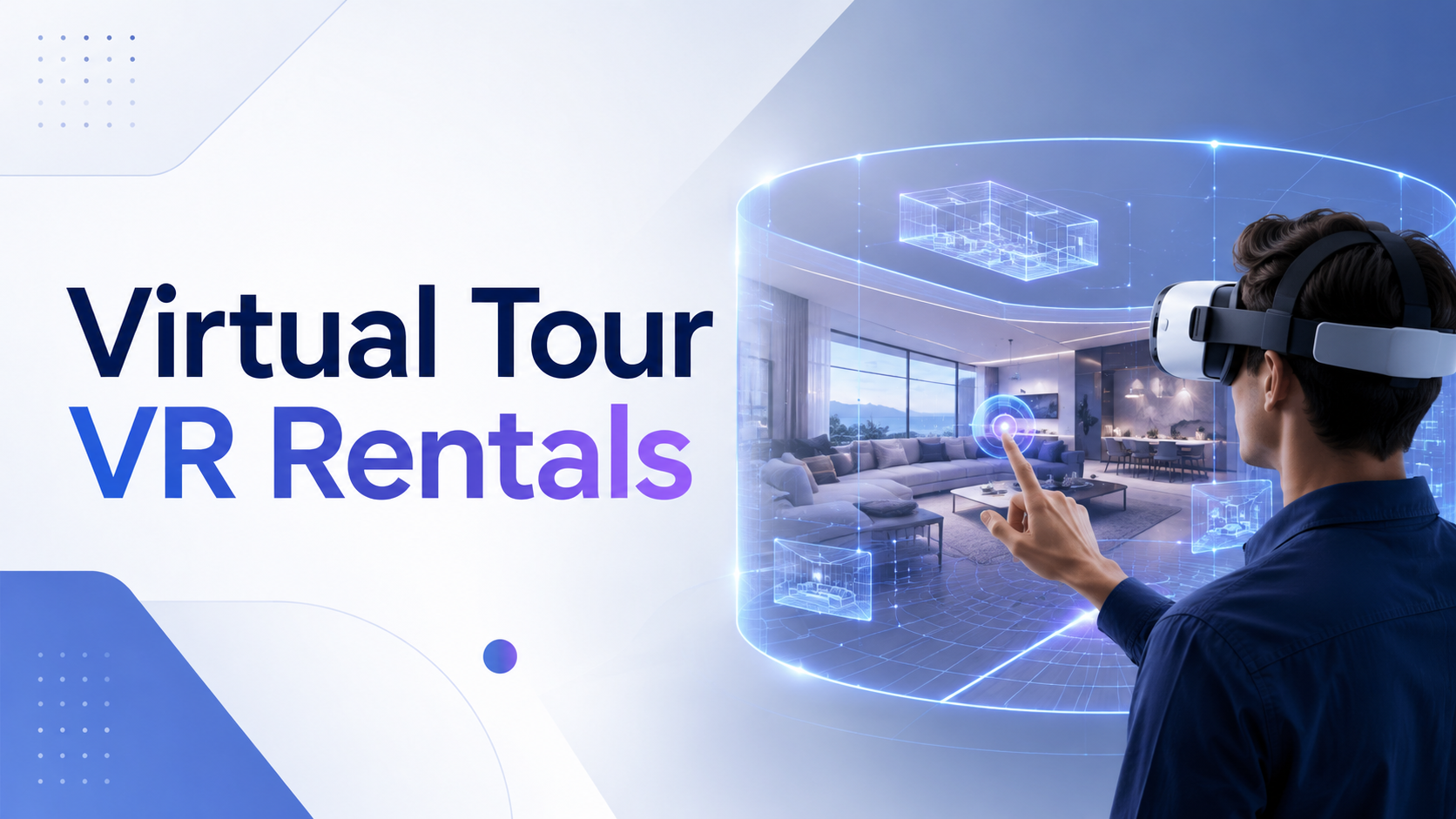
Virtual tours transform static presentations into immersive walkthroughs where viewers control their exploration of spaces, products, or experiences. Unlike 360-degree videos or photo tours viewed on screens, VR-based virtual tours place users inside the environment, creating presence and engagement that drives decisions – whether touring a property, exploring a venue, or experiencing a product line.
What Are Virtual Tours and Why Rent VR Equipment for Them
The shift from traditional property showings to immersive virtual experiences represents more than technological advancement – it fundamentally changes how businesses connect with prospects. When potential buyers slip on a VR headset, they step inside your property, venue, or facility from anywhere in the world. This presence creates emotional connections that flat screens cannot replicate.
Virtual Tours vs Traditional Walkthroughs
Traditional in-person tours require physical presence, limiting reach to local prospects and consuming significant time for both parties. Video tours expand reach but offer passive, linear experiences where viewers follow predetermined paths. Interactive 360-degree photo tours viewed on computers provide user control but lack immersion – viewers remain aware they’re looking at a screen.
VR virtual tours deliver fundamentally different experiences. Users stand inside spaces, look around naturally, and move through environments at their own pace. This autonomy increases engagement time by 300% compared to video tours. Real estate firms using VR tours report 40% higher conversion rates than traditional photo galleries, with qualified leads spending an average of 5-7 minutes in virtual properties versus 30 seconds on standard listings.
The ROI becomes most apparent for high-value properties, international buyers, and time-sensitive decisions. A luxury real estate developer in Miami reported closing three pre-construction penthouses to overseas buyers who never visited the site – the VR tours provided sufficient confidence for multi-million dollar purchases.
Why Businesses Choose VR Rental Over Purchase for Tours
The mathematics of VR equipment ownership rarely favor purchase for virtual tour deployments. A professional VR setup suitable for public events costs $15,000-$25,000 including multiple headsets, tracking systems, and powerful computers. This investment becomes obsolete within 18-24 months as manufacturers release improved models with higher resolution and better comfort.
VR rentals for virtual tours typically cost $500-$2,000 per event, including 4-8 headsets, all accessories, and technical support. This pricing structure allows businesses to deploy virtual tours exactly when needed – during open houses, at trade shows, or for special client presentations – without carrying equipment costs between activations.
Rental providers maintain diverse headset inventories, enabling businesses to select appropriate models for each use case. A property developer might choose high-resolution Varjo Aero headsets for luxury penthouse tours while selecting more durable Quest 3 units for high-volume open house events. This flexibility extends to quantity – rent 20 headsets for a major trade show, then scale down to 4 units for intimate client meetings.
Professional rental services include content loading, configuration, and on-site support. Technical staff handle software installation, ensure tours run smoothly across all devices, and troubleshoot issues during events. This support proves invaluable for businesses without dedicated VR expertise.
Industries Using VR Rentals for Virtual Tours
From real estate showcases to university campus tours, businesses across sectors use rented VR equipment to deliver virtual tours at key moments – open houses, trade shows, recruitment events, and sales meetings. Each industry applies virtual tours differently based on their audience needs and activation contexts.
Real Estate and Property Development
Pre-construction property sales present unique challenges – selling homes that exist only as architectural plans and renderings. VR tours solve this visualization gap by placing buyers inside photorealistic representations of future homes. Developers rent VR stations for sales centers, allowing multiple prospects to simultaneously explore different unit types and customization options.
At traditional open houses, VR expands showing capabilities exponentially. Instead of touring one property, agents showcase entire portfolios. A single Sunday afternoon open house becomes an opportunity to walk prospects through dozen properties across the city or showcase international investment opportunities. Agents report that VR tours filter serious buyers – those willing to wear headsets demonstrate genuine interest.
International property marketing particularly benefits from VR tours. Luxury real estate firms rent VR equipment for overseas property exhibitions, bringing Manhattan penthouses to Hong Kong hotel ballrooms or London townhouses to Dubai investment summits. These virtual showings eliminate preliminary site visits, accelerating purchase decisions for time-sensitive opportunities.
Customization walkthroughs elevate the luxury property experience. High-end buyers explore various finish options, furniture arrangements, and architectural modifications in real-time. This interactive customization, delivered through rented VR equipment at design centers, increases average transaction values by 15-20% as buyers visualize and select premium upgrades.
Hospitality and Event Venues
Wedding venues face seasonal challenges – couples planning summer weddings tour venues during winter months when gardens lack bloom and natural light differs dramatically. VR tours capture venues at peak beauty, allowing year-round showcase of optimal conditions. Venue operators rent VR equipment for bridal shows, where engaged couples explore multiple properties without leaving the convention center.
Conference centers and hotels leverage VR tours at industry trade shows to demonstrate their facilities to event planners. Rather than relying on brochures and floor plans, planners walk through ballrooms, inspect breakout rooms, and evaluate logistics virtually. This immersive evaluation accelerates booking decisions and reduces site visit requests by 60%.
Restaurants and bars seeking private event bookings create VR tours highlighting different configuration options. Event coordinators experience the space set for weddings, corporate dinners, and cocktail receptions, understanding how their specific event would look and flow. This visualization capability, deployed through rented VR headsets at food and beverage trade shows, generates qualified leads that convert at twice the rate of traditional marketing.
Hotel chains use VR tours for group sales presentations, bringing their global portfolio to corporate travel managers’ offices. A single VR rental deployment can showcase properties across continents, helping planners select venues for international conferences or incentive trips without extensive travel.
Education and Corporate Facilities
Universities face intense competition for top students who cannot visit every campus of interest. VR campus tours, deployed through rented equipment at college fairs and recruitment events, transport prospective students into dormitories, lecture halls, laboratories, and student centers. Parents particularly appreciate virtual tours, gaining confidence about campus safety and facilities without travel expenses.
Corporate training programs utilize VR facility tours for safety orientation and compliance education. New employees explore manufacturing plants, warehouses, or laboratory environments before entering potentially hazardous areas. This virtual familiarization reduces on-site training time by 40% while improving safety compliance scores.
Manufacturing companies rent VR equipment to provide facility tours for clients who cannot visit due to security restrictions, clean room requirements, or geographical distance. Automotive suppliers showcase production lines to overseas customers, pharmaceutical companies demonstrate quality control processes to regulators, and technology manufacturers reveal fabrication capabilities to potential partners – all through immersive virtual tours.
Remote and hybrid workforces benefit from office space tours that help distant employees understand headquarters layouts, locate resources, and feel connected to physical workspaces they rarely visit. Companies rent VR equipment for onboarding sessions where new remote hires virtually explore offices, meet colleagues’ avatars in actual workspace settings, and understand company culture through environmental immersion.
VR Equipment Selection for Virtual Tours
Choosing the right VR headsets and supporting equipment for virtual tours depends on your tour content, audience size, and deployment environment. Standalone headsets offer portability for property showings, while PC-connected systems deliver ultra-high resolution for architectural details.
Standalone VR Headsets for Mobile Tours
The Meta Quest 3 revolutionized mobile VR tours with its 4K+ resolution per eye, eliminating the screen door effect that plagued earlier headsets. Its inside-out tracking requires no external sensors, enabling setup in any location within minutes. The 2-3 hour battery life supports continuous use during typical open house events, while hot-swappable battery packs extend operations for all-day trade shows.
Quest Pro adds eye tracking and face tracking capabilities valuable for understanding user attention during tours. Heat maps generated from eye tracking data reveal which property features capture interest, informing marketing strategies and pricing decisions. The Pro’s balanced design and adjustable IPD accommodate diverse users comfortably during extended viewing sessions.
Pico 4 Enterprise addresses corporate security concerns with enhanced device management and content protection. Financial institutions and government contractors choose Pico for facility tours because of its enterprise-grade security features and ability to operate completely offline. The headset’s 105-degree field of view matches human peripheral vision, creating natural immersion without the tunnel vision of narrower displays.
Content deployment on standalone headsets requires strategic planning. Pre-loading tours directly onto devices ensures smooth playback without internet dependency, crucial for venues with poor connectivity. However, streaming architectures enable real-time updates and personalized experiences, valuable for customization demonstrations. Most rental providers offer both options, configuring headsets based on specific event requirements.
High-End Systems for Detailed Visualizations
Architectural visualization demands exceptional visual fidelity to convey material textures, lighting nuances, and spatial relationships accurately. The HTC Vive Pro 2 delivers 5K resolution (2448×2448 per eye) with 120Hz refresh rates, presenting architectural details with clarity that rivals physical presence. This precision proves essential for luxury real estate where buyers scrutinize marble veining, wood grain patterns, and fabric textures.
Varjo Aero pushes visual boundaries further with its 35 pixels per degree resolution – approaching human eye clarity. This unprecedented sharpness allows users to read actual text on virtual documents, examine fine architectural drawings, and appreciate artwork displayed in virtual properties. The headset’s automatic IPD adjustment ensures optimal clarity for every user without manual configuration.
These high-end systems require powerful computers – typically RTX 3080 or better graphics cards with 32GB RAM minimum. Rental packages include pre-configured workstations optimized for specific tour content, eliminating technical guesswork. Setup involves positioning base stations for room-scale tracking, calibrating play areas, and ensuring adequate ventilation for computing equipment.
The choice between standalone and PC-tethered systems often depends on deployment context rather than content quality. Trade show booths with limited space favor standalone headsets despite slightly lower resolution. Dedicated showrooms where visual quality paramount justify the complexity of high-end systems. Many businesses rent both types, using Quest 3 units for mobile presentations and Varjo Aero for flagship showroom experiences.
Supporting Equipment and Accessories
Hygiene management becomes critical when multiple users share headsets throughout an event. Disposable face covers cost $0.50-1.00 each but prevent makeup transfer and maintain sanitation between users. Antibacterial wipes specifically designed for VR lenses clean without damaging anti-reflective coatings. UV sanitization stations, increasingly included in rental packages, disinfect headsets between sessions without chemical residues.
Power management infrastructure ensures uninterrupted tours during lengthy events. Charging stations simultaneously power 8-10 headsets while keeping them organized and accessible. For standalone headsets, external battery packs rated at 10,000mAh extend usage time to 6-8 hours. Some rental providers include pre-charged battery sets that swap instantly, eliminating downtime.
Spectator displays transform individual VR experiences into social events. 65-inch monitors mirror the VR user’s view, allowing observers to follow along and generating interest from passersby. This shared viewing proves particularly valuable at trade shows where crowd dynamics drive booth traffic. Split-screen displays showing multiple simultaneous tours create energy and demonstrate scale capabilities.
Professional transport cases protect equipment during shipping and provide organized storage during events. Pelican cases with custom foam inserts secure headsets, prevent cable tangling, and include compartments for accessories. These cases often feature wheels and telescoping handles for easy transport between venue locations. Rental companies typically handle shipping logistics, but understanding packaging helps plan on-site storage and setup areas.
Creating Virtual Tour Content for VR Headsets
Virtual tour content ranges from 360-degree captures of existing spaces to fully rendered 3D environments. The creation method impacts both production costs and the rental equipment needed for playback.
360-Degree Photography and Video Tours
Matterport’s 3D capture technology dominates real estate virtual tour creation, processing physical spaces into navigable 3D models within hours. The platform’s VR output mode generates files optimized for Quest and Vive headsets, maintaining visual quality while ensuring smooth performance. A typical 3,000 square foot property requires 60-90 minutes to scan and produces VR-ready tours within 24 hours.
Resolution considerations become critical when converting 360-degree content for VR viewing. Standard 4K 360 photos appear pixelated in VR headsets due to the limited pixel density spread across the entire sphere. Professional VR tours require minimum 8K source resolution, with 12K-16K delivering optimal clarity for detailed architectural spaces. This resolution requirement influences both capture equipment selection and file size management.
Interactive hotspots transform passive viewing into engaging exploration. Users trigger information panels about specific features, view alternate furniture arrangements, or access detailed specifications. These interactive elements require careful placement to avoid overwhelming the experience while providing valuable information. Professional tour creators balance information density with visual clarity, ensuring hotspots enhance rather than distract from spatial exploration.
Navigation design significantly impacts user comfort and engagement. Teleportation between viewpoints prevents motion sickness while maintaining spatial orientation. Continuous movement options appeal to experienced VR users but require careful speed calibration. Most professional tours offer both navigation modes, allowing users to select their preference. Rental providers can pre-configure navigation settings based on audience demographics and experience levels.
3D Rendered and CGI Tours
Unreal Engine 5’s Nanite virtualized geometry and Lumen global illumination system produce photorealistic architectural visualizations indistinguishable from photography. This technology enables pre-construction property tours that accurately represent how spaces will look and feel upon completion. Real estate developers invest $10,000-50,000 in high-end CGI tours, knowing that VR presentation through rented equipment will accelerate pre-sales.
CAD to VR workflows streamline content creation for architectural firms already using Building Information Modeling (BIM). Autodesk Revit models import directly into VR-ready formats through plugins like Enscape or Twinmotion. This direct pipeline preserves architectural accuracy while adding realistic materials, lighting, and landscaping. The resulting tours maintain dimensional precision crucial for commercial projects where specifications drive decisions.
Customization capabilities distinguish CGI tours from photographic captures. Users modify finishes, furniture, and fixtures in real-time, experiencing personalized versions of spaces. A kitchen might transform from contemporary to traditional style instantly, or office layouts reconfigure to demonstrate flexibility. This interactivity, particularly powerful when delivered through rented VR equipment at design centers, increases customer satisfaction and average transaction values.
Performance optimization ensures smooth playback across various VR headsets. Level-of-detail (LOD) systems reduce geometric complexity for distant objects while maintaining full detail for nearby elements. Occlusion culling prevents rendering of hidden objects, improving frame rates. These optimizations allow complex architectural tours to run smoothly on standalone headsets like Quest 3, expanding deployment options beyond high-end PC-based systems.
Hybrid Approaches and Enhancement Options
Combining photographic captures with CGI elements creates cost-effective tours that balance realism with flexibility. Existing properties photographed in 360 degrees receive CGI furniture, allowing vacant spaces to appear furnished. This hybrid approach costs 70% less than full CGI while delivering comparable visual impact. Real estate agents particularly value this technique for staging vacant properties virtually.
Interactive product placements within tours create revenue opportunities beyond property sales. Furniture manufacturers pay for placement within virtual home tours, allowing users to click items for specifications and purchasing options. Hotels showcase sponsored amenities, conference centers highlight preferred catering partners, and universities feature bookstore merchandise. These monetization strategies help offset tour creation and VR rental costs.
Voiceover narration guides users through complex spaces while maintaining interactivity. Professional narrators highlight key features, provide historical context, or explain technical specifications. Multi-language support expands tour accessibility for international audiences. Spatial audio enhances immersion – narration appears to emanate from specific locations, footsteps echo appropriately in different spaces, and ambient sounds create atmosphere.
Analytics integration tracks user behavior within tours, generating valuable insights about preferences and interests. Heat maps reveal which rooms users explore longest, gaze tracking identifies specific features that capture attention, and navigation patterns indicate optimal tour flows. This data, collected through rented VR equipment at events, informs marketing strategies and property development decisions.
Planning Your Virtual Tour VR Rental
Successful virtual tour deployments require coordination between content preparation, equipment setup, and audience management. Whether running tours at a trade show booth or hosting an open house event, advance planning ensures smooth operations.
Rental Package Components and Pricing
Daily VR rental rates for virtual tour packages range from $150-400 per headset, with volume discounts reducing per-unit costs for larger deployments. A typical 4-headset package for a weekend open house costs $1,200-1,600, including all accessories and basic support. Week-long trade show rentals average $2,500-4,000 for 6-8 headsets with comprehensive support services.
Standard packages include VR headsets, hygiene supplies, charging equipment, and basic setup instructions. Enhanced packages add on-site technicians, content loading services, and backup equipment. Premium packages provide turnkey solutions with full event management, custom booth integration, and real-time analytics reporting. Understanding package tiers helps businesses select appropriate service levels for their specific needs.
Volume discounts apply for multiple events or extended rental periods. Booking quarterly open houses together reduces per-event costs by 20-30%. Annual contracts for businesses running regular VR tours can cut costs by 40-50% compared to individual rentals. Some providers offer rent-to-own programs where rental fees apply toward eventual purchase for businesses discovering ongoing VR needs.
Insurance and damage protection options typically add 10-15% to rental costs but provide crucial coverage for expensive equipment. Standard protection covers accidental damage but excludes theft or negligence. Comprehensive coverage includes theft protection and reduces damage deductibles to $100-250 per headset. For high-traffic public events, comprehensive coverage proves worthwhile despite additional costs.
Content Loading and Configuration
Pre-loading services save significant setup time and prevent technical issues during events. Rental providers load tour content onto all headsets before shipping, test functionality, and configure settings according to specifications. This service typically costs $25-50 per headset but eliminates 30-60 minutes of on-site preparation per device.
Self-installation remains viable for technically proficient teams with straightforward content. Providers supply detailed instructions and remote support for content loading. Quest headsets support simple drag-and-drop file transfers, while enterprise platforms like Pico require specific deployment tools. Understanding your team’s technical capabilities helps determine whether pre-loading services justify their cost.
Enterprise deployment platforms enable centralized content management across multiple headsets. ArborXR and similar mobile device management (MDM) solutions push content updates, lock devices into kiosk mode, and prevent unauthorized access. These platforms prove essential for corporate deployments where security and consistency matter. Rental providers often include enterprise platform access for business customers.
Testing procedures before events prevent embarrassing failures during crucial presentations. Verify all headsets display content correctly, navigation functions properly, and audio plays at appropriate levels. Test under event conditions – bright convention center lighting might wash out displays, requiring brightness adjustments. Schedule testing sessions 24 hours before events, allowing time to address any issues with rental provider support.
Event Day Operations
Staff training transforms VR tours from technical demonstrations into engaging sales experiences. Effective facilitators help users don headsets comfortably, explain controls simply, and guide exploration without overwhelming. A 30-minute training session before events covers equipment basics, troubleshooting common issues, and best practices for user engagement. Many rental providers offer virtual training sessions or video tutorials for remote preparation.
Queue management becomes critical during high-traffic periods. Digital sign-up systems allow prospects to reserve time slots while exploring other booth areas. SMS notifications alert users when their turn approaches, preventing crowding and abandoned appointments. For open houses, 10-15 minute time slots accommodate thorough tours while maintaining flow. Trade shows might use 5-7 minute abbreviated tours to maximize reach.
Hygiene protocols protect users and demonstrate professionalism. Visible cleaning between users reassures hesitant participants. Use lens wipes before each session, replace face covers between users, and sanitize head straps hourly. Display cleaning supplies prominently – the visible commitment to hygiene encourages participation from health-conscious prospects. Some businesses assign dedicated staff to hygiene management during busy events.
Common troubleshooting issues include tracking losses, software crashes, and battery depletion. Tracking losses often result from reflective surfaces or bright lights interfering with sensors – repositioning users or adjusting lighting usually resolves problems. Software crashes require quick headset restarts, taking 60-90 seconds. Dead batteries swap quickly if replacement packs are prepared. Maintaining calm confidence during technical issues preserves professional appearance and user trust.
Measuring Virtual Tour Success and ROI
Virtual tours delivered through rented VR equipment generate measurable outcomes – from qualified leads at trade shows to accelerated purchase decisions in real estate. Tracking both engagement metrics and business results justifies the rental investment.
Engagement and Experience Metrics
Tour completion rates indicate content quality and user interest levels. Professional VR tours achieve 85-90% completion rates compared to 30-40% for traditional video content. High abandonment rates suggest issues with comfort, content quality, or tour length. Analyzing drop-off points identifies problematic areas requiring refinement.
Average viewing duration provides insights into engagement depth. Residential property tours average 5-7 minutes in VR versus 30-60 seconds for online photo galleries. Commercial facility tours run longer – 10-15 minutes for manufacturing plants or university campuses. Extended viewing correlates with purchase intent, as seriously interested prospects invest time exploring details.
Heat mapping reveals areas of highest interest within tours. Kitchen and master bedroom areas receive 40% more attention in residential tours. Conference centers see concentrated attention on ballroom spaces and catering facilities. This intelligence informs marketing emphasis and pricing strategies. Advanced analytics from eye-tracking capable headsets provide even granular insights about specific features capturing attention.
User feedback scores, collected immediately after VR experiences, average 4.6/5.0 across industries. Common praise includes feeling “transported” to locations and appreciating self-directed exploration. Criticisms typically involve comfort issues or technical glitches rather than content quality. Post-event surveys sent 48 hours later maintain high scores, indicating lasting positive impressions beyond initial novelty.
Business Impact and Conversion Tracking
Lead quality from VR tour participants exceeds traditional marketing channels significantly. Real estate agents report that prospects who complete VR tours convert at 32% compared to 11% for standard website inquiries. The immersive experience pre-qualifies serious buyers, reducing time spent on uncommitted prospects.
Sales cycle acceleration represents VR tours’ most dramatic impact. Commercial real estate transactions involving VR tours close 28% faster than traditional processes. International property sales see even greater acceleration – 45% faster closings when buyers tour virtually before committing to site visits. This speed advantage proves crucial in competitive markets where delays lose opportunities.
Cost per qualified lead calculations demonstrate VR rental ROI clearly. A weekend open house generating 40 VR tours at $1,500 rental cost equals $37.50 per experience. With 32% conversion to qualified leads, cost per lead reaches $117. Traditional open houses averaging $250 per qualified lead make VR tours highly cost-effective despite equipment rental expenses.
Return visitor and referral rates indicate experience quality and memorability. Properties showcased through VR tours generate 3x more referrals than traditional showings. Trade show booth visitors experiencing VR tours share experiences on social media at 5x rates compared to standard booth interactions. This viral amplification extends marketing reach beyond direct participants, multiplying rental investment value.
Frequently Asked Questions
How much does it cost to rent VR equipment for virtual tours?
VR rental costs for virtual tours typically range from $150-400 per headset per day, with packages of 4-6 headsets for weekend events costing $1,200-2,000. Week-long trade show rentals average $2,500-4,000 for 6-8 headsets including support services. Volume discounts and extended rental periods can reduce per-event costs by 20-40%.
Can I use my existing 360 tour content with rented VR headsets?
Most 360-degree tour content works with rented VR headsets after format conversion. Matterport, Kuula, and similar platforms export VR-compatible files. However, content optimized for web viewing may require resolution enhancement for VR clarity. Rental providers often include content conversion services or guidance for preparing existing tours.
How many people can experience virtual tours simultaneously?
The number of simultaneous users depends on available headsets and physical space. Most rental packages include 4-8 headsets supporting concurrent tours. Large events might deploy 20-30 headsets across multiple stations. Each VR station requires approximately 6×6 feet of clear space for safe movement during room-scale experiences.
What’s the difference between VR tours and 360 video tours?
VR tours place users inside environments with natural head movement and spatial presence, creating immersion that drives emotional connection. 360 video tours viewed on screens maintain user awareness of their actual surroundings, reducing engagement. VR tours achieve 3x longer viewing times and 40% higher conversion rates compared to screen-based 360 tours.
Do I need technical staff to run VR tours at my event?
Basic VR tour deployments require minimal technical expertise – rental providers supply setup instructions and remote support. However, dedicated facilitators improve user experience significantly. Many rental companies offer on-site technician services for $500-1,000 per day, handling setup, troubleshooting, and user assistance.
How far in advance should I book VR rentals for virtual tours?
Book VR rentals 3-4 weeks before events to ensure equipment availability and allow content preparation time. Major trade shows or peak real estate seasons may require 6-8 week advance booking. Last-minute rentals remain possible but limit equipment options and increase costs by 25-40%.
Can virtual tours be customized for different audiences?
Virtual tours support extensive customization through content variations, language options, and interactive features. Real estate tours might emphasize different features for families versus investors. Rental providers can load multiple tour versions onto headsets, allowing quick switches between audience segments during events.
What happens if VR equipment is damaged during my rental?
Standard rental agreements include basic damage protection with deductibles of $500-1,000 per headset for accidental damage. Comprehensive insurance options reduce deductibles to $100-250 and cover theft. Document equipment condition upon receipt and return, photographing any existing wear to avoid disputes.
Conclusion
Virtual tour VR rentals represent a strategic approach to leveraging immersive technology without the burden of equipment ownership. As VR hardware continues advancing rapidly, renting ensures access to latest capabilities while avoiding obsolescence risks. The combination of improving visual quality, decreasing rental costs, and proven ROI metrics makes VR tours increasingly essential for competitive businesses.
Success with virtual tour VR rentals depends on matching equipment to content requirements, preparing thoroughly for deployments, and measuring results systematically. Whether showcasing luxury properties to international buyers, demonstrating manufacturing capabilities to remote clients, or recruiting students to university programs, VR tours deliver engagement and conversion rates that justify rental investments.
The virtual tour landscape will continue evolving as headsets become lighter, resolutions increase, and content creation tools simplify. Businesses that establish VR tour capabilities now, even through rentals, position themselves ahead of competitors still relying on traditional marketing methods.
Ready to transform your property showings, venue tours, or facility demonstrations with immersive VR experiences? Contact professional VR rental providers to discuss your virtual tour requirements and discover how rented equipment can deliver immediate impact without long-term commitment. Your audience awaits transportation into the remarkable spaces you’re ready to share.