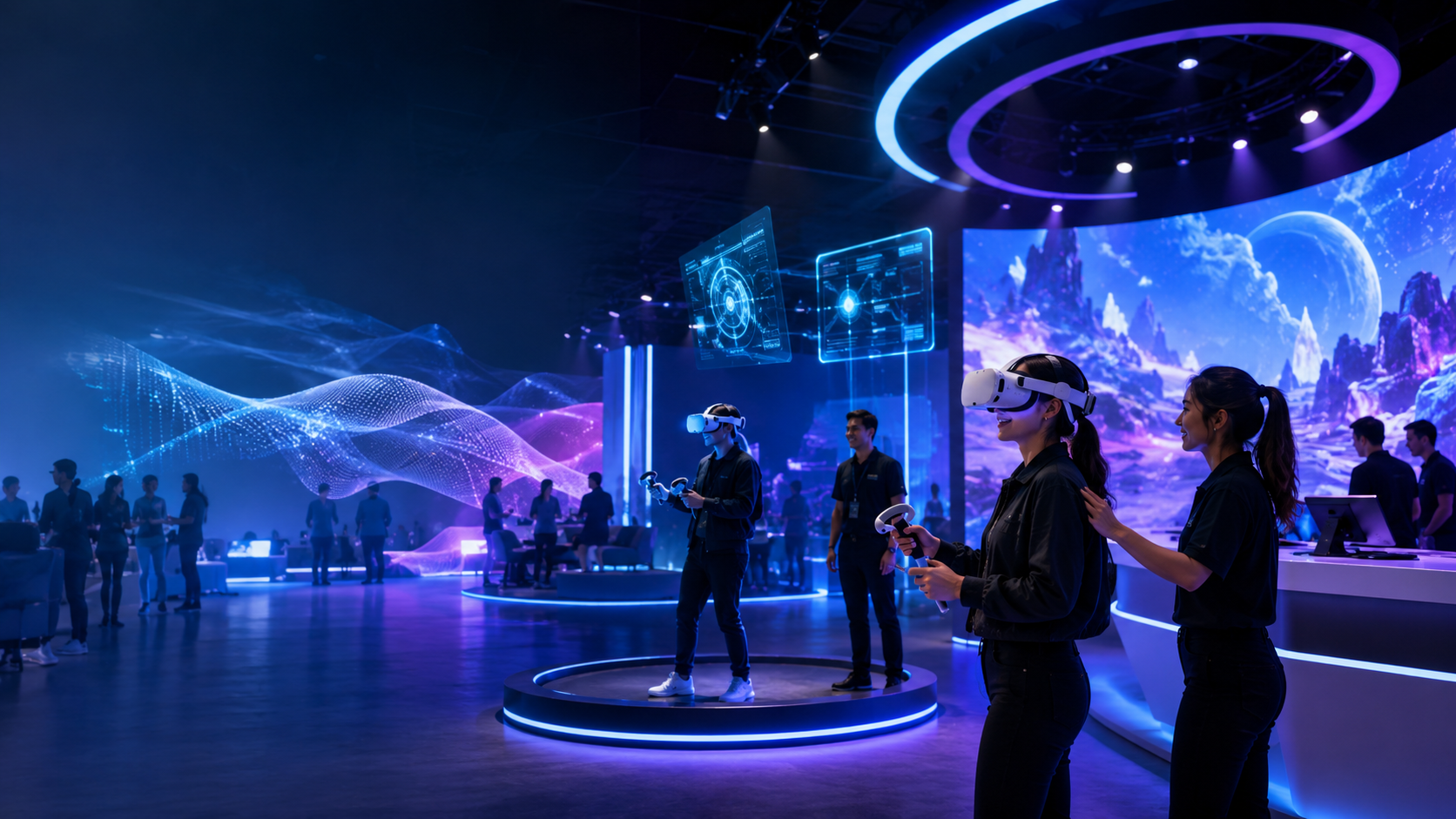
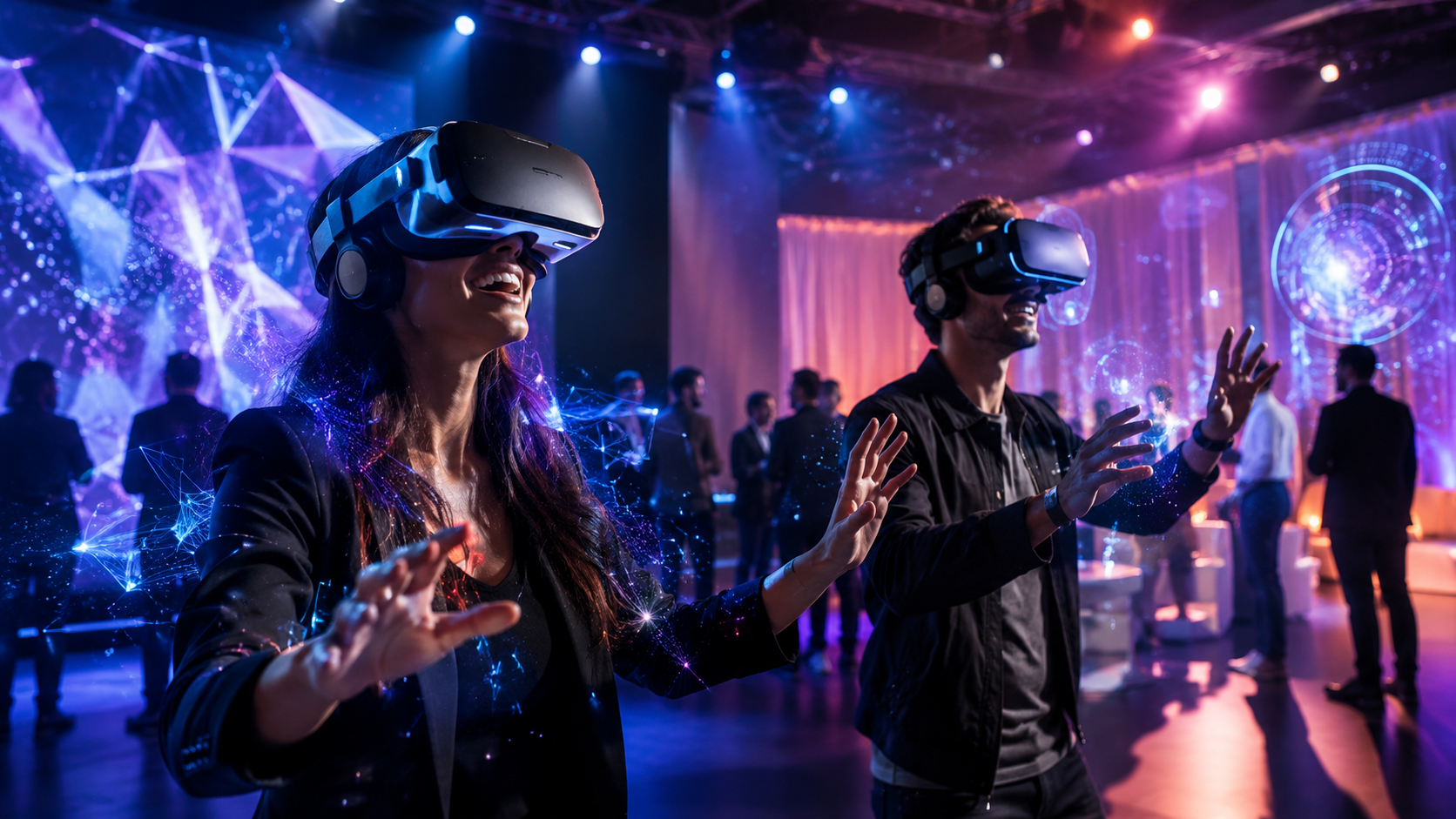
Virtual reality has evolved from gaming novelty to essential event technology. Today’s event VR entertainment delivers measurable engagement, creates shareable moments, and transforms passive attendees into active participants. This guide equips event professionals with the strategies, logistics, and metrics needed to implement successful VR experiences at corporate events, trade shows, and brand activations.
What Makes VR Entertainment Different for Events
Unlike traditional entertainment that positions attendees as viewers, VR transforms them into active participants. This shift from passive to immersive creates memorable moments that drive engagement metrics event marketers actually care about – dwell time, social sharing, and post-event recall.
Active Participation vs Passive Viewing
VR fundamentally changes attendee behavior patterns at events. Instead of watching a stage performance or walking past a display, participants physically move, reach, and interact within virtual environments. This active engagement triggers different neurological responses than passive observation.
Research from event technology firms shows VR stations maintain average dwell times of 8-12 minutes, compared to 30-90 seconds for traditional booth displays. Participants waiting in queue often spend an additional 5-10 minutes watching others play, creating natural gathering points that facilitate networking.
The physical nature of VR interaction enhances memory formation through embodied cognition. When attendees physically duck, reach, or move to complete VR challenges, their brains encode these experiences more deeply than visual-only memories. Post-event surveys consistently show 85% recall rates for VR experiences after 30 days, compared to 20-30% for traditional entertainment formats.
Engagement metrics tell a compelling story:
- Participation rates: 70-80% of attendees will try VR when offered
- Social sharing: 3x more likely to post about VR experiences
- Conversation starter: 92% discuss their VR experience with others
- Return visits: 40% of participants return for additional sessions
Multi-User Experiences and Social VR
Modern VR entertainment for corporate events extends beyond individual headset experiences. Multi-user systems enable 2-8 participants to share virtual spaces simultaneously, seeing and interacting with each other as avatars. This social dimension transforms VR from isolated experience to group activity.
Spectator modes amplify engagement beyond active participants. Large screens mirror the VR user’s perspective, allowing crowds to watch, cheer, and provide commentary. This creates stadium-like atmospheres around VR stations, particularly effective for competitive experiences or skill challenges.
Team-based VR formats excel at corporate events where collaboration matters. Virtual escape rooms require groups to communicate and problem-solve together. Competitive tournaments pit departments against each other in friendly rivalry. Collaborative building challenges demonstrate teamwork principles through shared virtual construction projects.
Mixed reality solutions blend physical and virtual elements, allowing VR participants to interact with non-VR attendees. One person wearing a headset might defuse a virtual bomb while teammates provide verbal instructions from printed manuals. These hybrid experiences maximize participation without requiring headsets for everyone.
VR Entertainment Formats by Event Type
Each event format demands different VR entertainment approaches. Trade shows need quick, high-throughput experiences. Corporate gatherings benefit from team challenges. Brand activations require customizable, on-brand content.
Trade Show Booth Experiences
Trade show VR must balance immersion with efficiency. Typical trade show VR experiences run 2-3 minutes, allowing 20-30 participants per hour per station. Short durations maintain queue flow while delivering memorable brand interactions.
Product visualization transforms complex offerings into tangible experiences. B2B software companies use VR to demonstrate enterprise platforms through interactive 3D dashboards. Manufacturing firms showcase factory processes through virtual facility tours. Medical device companies enable surgeons to practice procedures with virtual instruments.
Virtual showrooms overcome physical booth limitations. Automotive brands display entire vehicle lineups in 10×10 spaces. Furniture manufacturers present complete catalogs without shipping costs. Architecture firms walk clients through unbuilt projects at full scale.
Lead capture integrates seamlessly with VR stations. Participants register before putting on headsets, automatically entering CRM systems. Experience data – time spent, interactions completed, products explored – enriches lead profiles. Post-experience surveys capture purchase intent while impressions remain fresh.
Queue management strategies prevent congestion:
- Digital sign-ups via event apps
- Timed session scheduling
- Overflow activities for waiting attendees
- Multiple stations for parallel experiences
Corporate Event Entertainment
Corporate gatherings leverage VR for team building, networking, and celebration. Longer format events allow extended experiences that wouldn’t work in trade show environments.
Virtual reality event ideas for team building focus on collaboration over competition. Virtual escape rooms require groups to solve puzzles cooperatively, with each participant seeing different clues. Construction challenges task teams with building virtual structures together. Trust exercises translate to VR through scenarios requiring verbal guidance between players.
VR lounges create unique networking environments. Instead of background music, networking receptions feature VR stations where attendees bond over shared experiences. Short, social experiences like virtual mini-golf or painting applications provide conversation starters without dominating the event.
Awards ceremonies incorporate VR for dramatic reveals. Winners experience virtual congratulations from remote executives. Achievement visualizations transform abstract metrics into immersive data stories. Virtual red carpets let all attendees experience winner perspectives.
Gala entertainment options include:
- Virtual reality art creation stations
- Time travel experiences to company history moments
- Future vision presentations of company goals
- Celebrity meet-and-greets via volumetric capture
Brand Activation Experiences
Brand activations demand custom VR brand activation ideas that embody company values and product benefits. Generic experiences fail to create lasting brand associations.
Product launch simulations let consumers experience benefits before availability. Cosmetics brands offer virtual makeovers with unreleased products. Automotive companies provide test drives of concept vehicles. Food brands create virtual cooking experiences with new ingredients.
Virtual store tours bridge online and retail experiences. Customers explore virtual flagships, discovering products through gamified interactions. Exclusive virtual showrooms reward loyalty program members. Pop-up activations preview upcoming retail locations.
Try-before-you-buy experiences reduce purchase hesitation. Furniture retailers enable virtual room decoration. Fashion brands offer virtual fitting rooms. Travel companies provide destination previews through 360-degree experiences.
Social media integration amplifies reach:
- Automatic video capture of VR highlights
- Branded frames and filters for sharing
- Leaderboards driving competitive posting
- Hashtag challenges tied to VR achievements
Planning Your VR Entertainment Setup
Successful VR entertainment requires more than just headsets. Space requirements, power access, staffing, and content selection all impact the attendee experience and your event’s success metrics.
Space and Infrastructure Requirements
Each VR station requires minimum 6×6 feet of clear floor space, though 8×8 feet provides better safety margins. This accounts for arm movements, stepping motions, and safety buffers. Room-scale experiences need 10×10 feet or larger, depending on content requirements.
Power infrastructure often determines station placement. Each VR setup requires:
- 2-3 standard outlets per station
- 500-1000 watts total power draw
- Dedicated circuits for multiple stations
- UPS backup for critical components
Cable management prevents tripping hazards. Overhead cable suspension systems work best, routing cables above head height. Floor cable covers provide secondary option but impact accessibility. Wireless adapters eliminate some cables but add complexity and potential interference issues.
Safety zones require physical barriers. Retractable belt barriers define play areas. Foam mats indicate boundaries through texture changes. LED floor strips provide visual warnings. Padded poles protect players from collisions.
Lighting affects tracking accuracy. Bright spotlights can interfere with infrared sensors. Reflective surfaces create tracking dead zones. Optimal lighting maintains even, diffused illumination without harsh shadows or glare. Window coverings may be necessary for daytime events.
Staffing and Support Needs
VR attendants serve multiple critical roles beyond technical support. Primary responsibilities include:
Safety supervision: Monitoring players for balance issues, preventing collisions, stopping experiences if needed
Experience facilitation: Helping users put on headsets, adjusting straps, selecting appropriate content, explaining controls
Hygiene management: Cleaning headsets between users, replacing face cushions, managing sanitation supplies
Queue coordination: Managing sign-ups, explaining wait times, entertaining waiting guests, maintaining fair rotation
Training requirements vary by experience complexity. Basic operation takes 1-2 hours to learn. Troubleshooting skills require additional technical training. Customer service excellence matters more than technical expertise for most attendant roles.
Hygiene protocols have become paramount. Between users:
- Antibacterial wipes for hard surfaces
- UV-C sanitization for thorough cleaning
- Disposable face masks or cushion covers
- Hand sanitizer stations at entry/exit
- Scheduled deep cleaning breaks
Common technical issues and solutions:
- Tracking loss: Check for reflective surfaces, adjust lighting
- Display problems: Verify cable connections, restart systems
- Controller issues: Replace batteries, re-pair devices
- Software crashes: Maintain backup systems, quick restart procedures
Content Library Selection
Content selection determines experience success. Consider audience demographics, event goals, and logistical constraints when choosing VR experiences.
Demographic matching ensures relevance:
- Executives prefer strategy and puzzle games
- Sales teams enjoy competitive experiences
- Technical audiences appreciate detailed simulations
- Mixed groups need broadly appealing content
Duration optimization balances immersion with throughput:
- Trade shows: 2-3 minute experiences
- Corporate events: 5-10 minute sessions
- Team building: 15-30 minute challenges
- Training simulations: 30-60 minute modules
Difficulty levels accommodate varying comfort:
- First-time users need simple interactions
- Seated experiences reduce motion sickness risk
- Comfort modes limit intense movements
- Skip options for challenging sections
Accessibility options expand participation:
- Subtitle support for hearing impaired
- Color-blind modes for visual differences
- One-handed control schemes
- Height adjustment for wheelchair users
Implementation Timeline and Logistics
VR entertainment typically requires 4-6 weeks lead time for corporate events, with setup taking 2-4 hours depending on scale. Understanding the timeline helps event planners integrate VR seamlessly into their production schedule.
Pre-Event Planning Phase
6 weeks out: Initial consultation and experience selection
Begin with stakeholder meetings to define objectives. Determine whether goals prioritize entertainment, education, lead generation, or team building. Review available experiences matching these objectives. Consider custom content development timelines if needed.
Budget parameters guide equipment selection. Establish headset quantity based on expected attendance and desired wait times. Calculate staffing needs for planned operating hours. Include contingency for equipment failure or higher-than-expected demand.
4 weeks out: Space planning and technical requirements
Conduct site visits to evaluate venues. Measure available floor space and ceiling heights. Identify power outlet locations and circuit capacity. Test internet connectivity for cloud-based content or multiplayer experiences. Note potential obstacles like pillars, mirrors, or windows.
Create detailed floor plans showing VR station placement. Account for queue areas and spectator viewing zones. Plan traffic flow to prevent congestion. Coordinate with other vendors to avoid conflicts.
2 weeks out: Content customization and branding
Finalize any custom branding elements. Submit logos, color schemes, and brand guidelines. Review and approve virtual environment modifications. Test custom content for bugs or performance issues.
Develop supporting materials including instruction cards, waiver forms, and promotional signage. Create digital assets for pre-event marketing. Prepare social media templates for attendee sharing.
1 week out: Final headcount and equipment confirmation
Confirm expected attendance numbers. Adjust equipment quantities if needed. Verify delivery schedules and contact information. Review contingency plans for common issues.
Conduct final staff briefing. Distribute run-of-show documents. Confirm staff arrival times and responsibilities. Review emergency procedures and escalation protocols.
Day-of Setup and Testing
Load-in timing depends on event scale. Single station setups require 30-45 minutes. Multi-station installations need 2-4 hours. Complex custom builds may take 6-8 hours.
Equipment staging sequence:
- Unload and inventory all equipment
- Position VR stations according to floor plan
- Run power and network cables
- Mount sensors and tracking equipment
- Connect and configure headsets
- Install content and updates
- Calibrate play areas
- Test all systems thoroughly
Network setup for multiplayer experiences requires dedicated attention. Configure routers for local network isolation. Test bandwidth under full load. Establish backup connectivity options. Verify firewall exceptions for required ports.
Staff briefing covers operational procedures. Review experience rotation schedules. Practice headset adjustment and cleaning protocols. Demonstrate troubleshooting procedures. Assign specific stations and responsibilities.
Guest flow planning prevents bottlenecks:
- Mark queue lines with stanchions
- Position check-in tablets or clipboards
- Create waiting areas with entertainment
- Display estimated wait times
- Establish overflow procedures
Measuring VR Entertainment ROI
VR entertainment delivers measurable results beyond attendee satisfaction. From booth traffic increases to social media amplification, the data supports continued investment in immersive experiences.
Engagement Metrics
Dwell time provides primary engagement indicator. VR entertainment rental for events typically generates:
- Average session length: 8-12 minutes
- Queue observation time: 5-10 minutes additional
- Total engagement: 15-20 minutes per participant
- Traditional activation comparison: 10-20x longer engagement
Participation rates demonstrate broad appeal:
- 70-80% of attendees try VR when available
- 40% return for multiple sessions
- 60% bring colleagues to watch
- 90% complete full experience once started
Demographic breakdowns reveal audience insights:
- Age distribution of participants
- Department or company representation
- Geographic origins for trade shows
- Title/seniority level engagement
Queue formation creates valuable social proof. Visible lines attract curious attendees. Spectator crowds generate excitement. Social dynamics encourage participation from hesitant individuals.
Business Impact Measurements
Lead quality improves through VR engagement. Participants spending 10+ minutes with brand experiences show higher purchase intent. Contact information provided willingly reduces fake data. Behavioral data enriches lead scoring models.
Post-event surveys reveal lasting impact:
- 85% recall VR experience after 30 days
- 73% associate experience with brand positively
- 67% share experience with colleagues
- 45% seek additional information about products
Social media amplification extends event reach:
- 3x more posts about VR vs other activities
- 5x higher engagement on VR-related content
- User-generated content provides authentic testimonials
- Hashtag campaigns gain organic momentum
Sales pipeline attribution for B2B events:
- Track leads from VR station registration
- Monitor progression through sales stages
- Calculate close rates vs. other lead sources
- Measure deal velocity and average values
Budget Considerations and Package Options
VR entertainment costs vary based on equipment quantity, experience complexity, and support level. Understanding package structures helps align investment with event objectives.
Rental Package Structures
Per-headset pricing models:
- Daily rates: $500-1,500 per headset
- Weekly rates: $2,000-5,000 per headset
- Monthly rates: $5,000-12,000 per headset
- Volume discounts: 10-30% for 5+ units
Event packages bundle equipment and services:
- Basic: Headsets, standard content, setup/breakdown
- Professional: Add dedicated staff, custom branding
- Premium: Include custom content, full production
Staffing costs vary by expertise level:
- VR attendant: $30-50 per hour
- Technical specialist: $75-125 per hour
- Experience designer: $150-250 per hour
- Project management: 10-20% of total budget
Insurance and damage considerations:
- Damage waivers: 10-15% of rental cost
- Full replacement coverage: 20-25% of rental cost
- Liability insurance requirements
- Security deposit options
Cost Comparison to Traditional Entertainment
VR delivers superior cost-per-engagement metrics:
Photo booth comparison:
- Photo booth: $1,000-2,000 per event
- Average use: 2-3 minutes per person
- Typical throughput: 100-150 people
- Cost per engagement: $10-20
VR station comparison:
- VR station: $1,500-2,500 per event
- Average use: 10-15 minutes per person
- Typical throughput: 60-80 people
- Cost per engagement: $20-40
- Value: 5x longer engagement for 2x cost
Multi-day events improve VR economics:
- Setup/breakdown amortized over multiple days
- Reduced per-day equipment rates
- Staff efficiency through experience
- Content variety maintains interest
Hidden costs to budget:
- Power distribution and cable management
- Internet connectivity upgrades
- Additional space rental
- Shipping for remote locations
- Overtime for extended hours
- Content licensing for premium experiences
Frequently Asked Questions
How many VR stations do I need for my event size?
Calculate based on expected participation rate and desired wait times. For 500 attendees with 70% participation rate, you need 350 experiences. With 5-minute experiences over 4 hours, each station handles 48 people. You need 8 stations to maintain reasonable queues.
What happens if someone gets motion sick?
Motion sickness affects 5-10% of users. Prevention includes: selecting comfortable experiences, limiting session duration, providing ginger candies, maintaining proper ventilation. Have seating areas nearby and staff trained to recognize symptoms early.
Can we customize VR content with our branding?
Yes, customization ranges from simple logo placement to fully branded environments. Basic branding takes 1-2 weeks. Custom environments require 4-8 weeks. Costs range from $2,000 for simple modifications to $50,000+ for custom experiences.
Do attendees need prior VR experience?
No, modern VR interfaces are intuitive. Staff provide quick tutorials. Choose experiences with simple controls for first-time users. 95% of newcomers successfully complete experiences with minimal instruction.
How do we handle hygiene between users?
Implement strict cleaning protocols: antibacterial wipes between every user, UV-C sanitization during breaks, disposable face covers available, hand sanitizer stations, and scheduled deep cleaning. Budget 2-3 minutes between users for proper sanitization.
What’s the typical setup and breakdown time?
Single station: 30-45 minutes setup, 20-30 minutes breakdown. Four-station activation: 2-3 hours setup, 1 hour breakdown. Complex installations: 4-6 hours setup, 2-3 hours breakdown. Include buffer time for testing and troubleshooting.
Can VR entertainment work outdoors?
Yes, with proper planning. Requirements include: tent coverage for sun protection, weighted bases for wind stability, generator power for remote locations, anti-glare screens for spectator viewing. Avoid direct sunlight which interferes with tracking.
How do we integrate VR with our event app or registration system?
Modern VR platforms offer API integration. Connect registration systems for automated check-in. Push notifications for available time slots. Export participation data to CRM systems. Display leaderboards in event apps. Integration typically requires 2-3 weeks development time.
Conclusion
VR entertainment has evolved from novelty to necessity for forward-thinking event professionals. The technology delivers measurable engagement, creates lasting memories, and provides rich data for ROI analysis. Success requires careful planning, appropriate content selection, and professional execution.
The investment in VR entertainment pays dividends through increased dwell time, enhanced lead quality, and amplified social reach. As hardware costs decrease and content libraries expand, VR becomes accessible for events of all sizes and budgets.
Start planning your VR activation 6-8 weeks before your event. Partner with experienced providers who understand both technology and event logistics. Focus on experiences that align with your audience and objectives rather than chasing the latest technology trends.
Ready to transform your next event with immersive VR entertainment? Contact professional VR rental companies for consultations, request case studies from similar events, and consider starting with smaller activations to build internal confidence. The future of event engagement is virtual—and it’s available today.