Event marketing faces a crisis of attention. Your carefully designed booth competes with smartphones, endless vendor options, and shrinking attention spans. While traditional displays and giveaways generate foot traffic, they rarely create the memorable interactions that drive pipeline growth. Virtual reality rental programs offer a practical solution—transforming passive booth visits into active brand experiences that generate measurable engagement data without the complexity of hardware ownership.
Why Traditional Brand Engagement Falls Short at Modern Events
Event marketers invest millions in trade shows and activations, yet struggle to capture meaningful attention. The modern attendee moves through events like a speed dater—quick introductions, surface-level conversations, and forgotten interactions. This engagement crisis demands new approaches that break through the noise and create lasting brand connections.
The Attention Economy Challenge for Brand Activations
The numbers paint a sobering picture of event engagement reality. Trade show attendees visit an average of 26 exhibitors during 8.5 hours on the floor—roughly 20 minutes per booth including travel time. Without interactive elements, booth dwell time averages just 3.4 minutes. During those precious minutes, mobile devices steal focus, reducing engagement quality by 40% as attendees check messages, take photos, or browse social media.
Your booth competes not just with neighboring exhibitors, but with the entire digital ecosystem in every attendee’s pocket. Static displays and product demonstrations blend into background noise. Even interactive touchscreens fail to command full attention as visitors simultaneously scan the floor for their next destination.
The traditional playbook—branded giveaways, prize wheels, and presentation theaters—generates traffic but not transformation. Attendees collect swag bags full of items they’ll discard within weeks. They sit through presentations while mentally planning their next meeting. These surface-level touchpoints create activity metrics but not actual engagement.
Measuring Real Engagement vs Vanity Metrics
Badge scans tell a deceptive story. That stack of 500 leads from your last event looks impressive in the post-show report, but how many represented genuine interest versus polite participation? The brutal truth: most “leads” were simply attendees willing to trade contact information for a t-shirt or entry into an iPad drawing.
Real engagement requires active participation that forms memories. Neuroscience research shows that memory formation strengthens when multiple senses engage simultaneously and when individuals make choices that affect outcomes. Passive observation—watching a demo, viewing a display, listening to a pitch—activates limited neural pathways compared to hands-on interaction.
Quality of interaction directly correlates with downstream metrics that matter. Engaged leads show 3x higher email open rates, 2.5x better meeting acceptance rates, and 4x stronger conversion to opportunity. Yet most event programs optimize for quantity over quality, celebrating badge scan counts while pipeline contribution stagnates.
How VR Transforms Brand Engagement Through Active Participation
Virtual reality creates what traditional activations cannot: moments of complete immersion where your brand story becomes the only reality. When attendees put on a VR headset, their phone disappears, the convention floor vanishes, and your experience commands their complete attention. This isn’t just another screen—it’s a portal into your brand universe.
The Neuroscience of VR Brand Experiences
VR triggers spatial presence—the brain’s acceptance of virtual environments as real spaces. This psychological phenomenon creates memory formation patterns similar to actual experiences rather than viewed content. When attendees navigate your virtual product demonstration or explore your virtual facility, their hippocampus encodes these moments as places they’ve been, not videos they’ve watched.
Hand tracking and physical movement amplify retention through embodied cognition. When users reach out to interact with virtual objects, rotate products to examine details, or physically walk through virtual spaces, motor memory reinforces cognitive processing. These multi-sensory experiences create neural pathways 5x stronger than passive viewing.
Emotional response amplification sets VR apart from traditional media. The amygdala processes VR experiences with heightened intensity because immersion removes the psychological distance of screens. Fear, excitement, curiosity, and satisfaction register more powerfully, creating emotional bookmarks that make experiences memorable and shareable.
Stanford University’s Virtual Human Interaction Lab found that VR experiences generate empathy and behavior change at rates 3x higher than traditional video content. When applied to brand engagement, this emotional amplification transforms product features into felt benefits and company values into lived experiences.
VR Engagement Metrics That Matter
VR generates granular engagement data impossible to capture through traditional activations. Heat mapping reveals exactly where users focus attention within virtual environments—which product features draw investigation, which messages get noticed, which pathways users choose. This attention data informs both immediate experience optimization and broader marketing strategy.
Interaction timestamps provide engagement depth metrics beyond simple duration. You see not just how long someone stayed, but what they did each second—when they leaned in for closer examination, how quickly they grasped controls, where they spent extra time exploring. These behavioral patterns reveal genuine interest versus polite participation.
Completion rates indicate content effectiveness with precision. Unlike video views that might play in the background, VR completion requires active participation. A 75% completion rate on an 8-minute VR experience represents 6 minutes of undivided attention—impossible to achieve with traditional booth presentations.
Social amplification metrics show VR’s viral potential. Attendees share VR experiences on social media 3x more frequently than standard booth visits. User-generated content from VR activations generates 5x more engagement than brand-posted content. The novelty and visual interest of VR naturally encourages organic sharing that extends reach beyond event walls.
Building Your VR Brand Engagement Strategy Without Buying Hardware
Rental programs eliminate the barriers that keep organizations from leveraging VR for brand engagement. No capital expenditure requests, no IT infrastructure requirements, no obsolescence risk. You get enterprise-grade VR experiences with professional support while maintaining flexibility to evolve your approach based on results and feedback.
Matching VR Experiences to Brand Objectives
Product demonstrations in VR solve the logistics challenge of bringing large, complex, or numerous products to events. Industrial equipment manufacturers use VR to showcase factory-scale machinery in 10×10 booths. Automotive brands let attendees test-drive vehicles without leaving the convention center. Real estate developers offer property tours across entire portfolios.
Virtual facility tours create transparency and trust for B2B engagement. Prospects explore manufacturing facilities, data centers, or headquarters without travel costs or scheduling complexity. These behind-the-scenes experiences build confidence in capabilities while demonstrating innovation and openness.
Gamified brand stories transform company narratives into interactive adventures. Consumer brands create virtual worlds where users complete challenges that reinforce brand values. B2B companies develop puzzle-solving experiences that demonstrate product benefits through hands-on problem resolution.
Training simulations serve partner education and customer onboarding needs. Channel partners practice product installation in risk-free virtual environments. Customers learn complex software workflows through guided VR tutorials. These educational experiences position your brand as a committed partner in customer success.
Rental Package Selection for Different Event Types
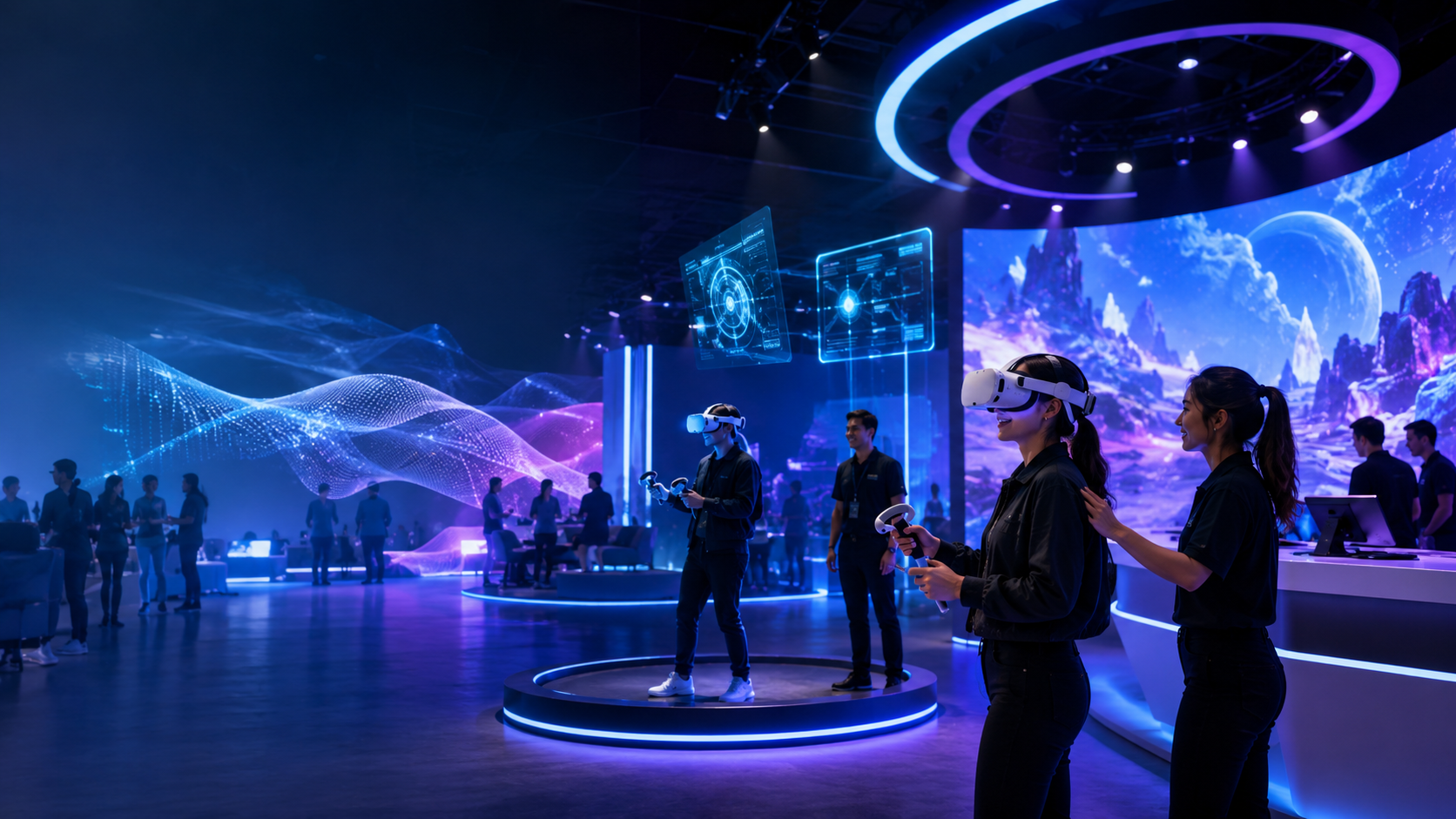
Trade shows require 4-6 headset stations to maintain flow while avoiding excessive queues. Each station needs 8×8 feet of space for safe movement, plus queue management areas. Include spectator displays so waiting attendees can preview the experience. Premium rental packages include on-site technical support to maximize uptime.
Corporate events benefit from 10-20 headsets enabling simultaneous experiences for larger groups. All-hands meetings, sales kickoffs, and customer conferences use synchronized VR sessions for shared experiences. Rental providers offer session management software that launches content simultaneously across all headsets.
Retail activations typically need 2-3 headsets with brand ambassadors facilitating experiences. Pop-up stores, mall activations, and product launches use VR to extend physical space limitations. Portable setups with quick-deploy configurations support multi-location campaigns.
Roadshows demand redundancy and portability. Include backup equipment in rental packages to ensure continuity across multiple stops. Flight cases, pre-configured networking equipment, and rapid setup procedures minimize venue requirements. Some rental providers offer tour management with equipment logistics and on-site support at each location.
Content Development vs Licensed Experiences
Custom branded experiences require 8-12 weeks of development but deliver complete brand alignment. Work with VR production studios to create bespoke experiences featuring your products, facilities, and brand story. Development costs range from $25,000 to $150,000 depending on complexity and interactivity.
Modified templates reduce timeline to 2-4 weeks while maintaining brand consistency. Start with proven experience frameworks—product configurators, virtual showrooms, training modules—then customize with your branding, products, and messaging. Template modification costs typically run $5,000 to $25,000.
Licensed content libraries offer immediate deployment for testing VR engagement concepts. Access pre-built experiences for common use cases—virtual tours, product demos, team building exercises. Monthly licensing fees range from $500 to $2,500 depending on content variety and usage rights.
Cost-benefit analysis should consider event frequency, audience expectations, and competitive differentiation. High-frequency exhibitors justify custom content investment through per-event cost amortization. Occasional activations might start with licensed content before investing in custom development.
Implementation Playbook: From Setup to Success Metrics
Successful VR brand engagement extends beyond having cutting-edge technology. Operational excellence—from spatial planning to staff preparedness to data integration—determines whether your VR investment generates meaningful returns or becomes an expensive distraction.
Physical Space and Setup Requirements
Each VR station requires minimum 8×8 feet of clear space for safe user movement. Mark boundaries with floor decals or stanchions to prevent collisions with booth structures or other attendees. Position stations away from high-traffic pathways to avoid disruption from passing crowds.
Power infrastructure needs 2 standard outlets per headset station—one for the headset processing unit, one for the tracking system. Avoid daisy-chaining power strips which can cause performance issues. Confirm venue power capacity during booth planning to prevent circuit overloads.
WiFi bandwidth requirements vary by content delivery method. Cloud-based experiences need stable 25 Mbps per headset for smooth streaming. Local content runs independently but may need connectivity for data synchronization. Consider dedicated MiFi devices as backup for venues with unreliable WiFi.
Queue management and spectator viewing enhance the overall experience. Install external displays showing the user’s perspective to entertain waiting attendees and generate curiosity from passersby. Design queue paths that showcase brand messaging while managing flow. Digital queue management systems can text attendees when their turn approaches, freeing them to explore while waiting.
Staff Training and Experience Management
Schedule 30-minute staff orientations before events open. Cover headset adjustment, controller basics, common troubleshooting, and hygiene protocols. Practice the attendee journey from introduction through experience completion. Ensure every team member can confidently guide users through the VR experience.
Hygiene protocols protect users and equipment. Provide disposable face masks or hygiene barriers for headsets. Stock antibacterial wipes for controller cleaning between users. Schedule deep cleaning breaks every 2 hours for thorough equipment sanitization. Display cleaning procedures prominently to build attendee confidence.
Troubleshooting preparation prevents minor issues from disrupting engagement. Train staff to recognize and resolve common problems—tracking loss, controller pairing, software freezes. Document escalation procedures for technical issues requiring vendor support. Maintain backup equipment to swap out problematic devices without stopping experiences.
Lead capture happens naturally during VR experiences. While attendees register, staff can qualify interest and gather context. During experience setup, natural conversation reveals pain points and priorities. Post-experience debriefs capture immediate reactions and next step commitments while enthusiasm peaks.
Data Capture and CRM Integration
Pre-experience registration workflows streamline data collection. Use tablets or kiosks for quick registration that captures essential contact information and qualifying questions. QR code scanning can pre-populate forms for badged attendees. Progressive profiling gathers additional details without creating friction.
In-VR data collection opportunities exist throughout experiences. Embed survey questions at natural pause points. Track product feature interactions to gauge interest. Capture preference data through choose-your-own-adventure branching. Export interaction logs for behavioral analysis.
Post-experience surveys should deploy immediately while memories remain fresh. Send automated emails within 2 hours containing experience highlights and feedback requests. Include social sharing buttons to amplify reach. Offer exclusive content or follow-up experiences to maintain engagement momentum.
Marketing automation platform integration ensures VR engagement data flows into nurture campaigns. Map VR interactions to lead scoring models—completion equals high intent, specific feature exploration indicates product fit. Trigger targeted follow-up sequences based on experience behavior. Sync engagement metrics to CRM records for sales visibility.
ROI Calculation: Rental Programs vs Traditional Engagement Tactics
VR rental programs deliver measurable returns through enhanced engagement quality, not just quantity. The business case becomes clear when comparing actual costs and outcomes against traditional event tactics that generate activity without impact.
Cost Comparison Framework
VR rental packages for typical trade show deployments cost $3,000-8,000 per event, including equipment, setup support, and basic content licensing. Compare this to purchasing enterprise VR systems at $50,000+ plus ongoing maintenance, storage, and upgrade costs. Rental eliminates capital expenditure while providing access to latest hardware.
Cost per engaged lead calculations favor VR despite higher upfront investment. VR generates average cost per engaged lead of $45—calculated from rental costs divided by attendees completing experiences. Traditional giveaway programs average $120 per engaged lead when accounting for premium items needed to attract quality prospects plus the low engagement rate of swag recipients.
Setup labor comes included with professional rental packages. Vendors handle equipment configuration, testing, and troubleshooting. Internal IT resources remain focused on core responsibilities rather than learning VR systems. Traditional displays require internal labor for assembly, configuration, and operation.
Content flexibility advantages become apparent across multiple events. Rental programs allow different experiences for different audiences without additional hardware investment. Test emerging content formats without long-term commitment. Traditional displays lock you into specific configurations requiring replacement for messaging updates.
Engagement Quality Metrics
Average interaction time tells the engagement depth story. VR experiences average 8 minutes of undivided attention—impossible to achieve with traditional booth presentations competing against floor noise and distractions. Static displays generate 45-second average interactions, mostly passive viewing while walking past.
Lead scoring improvements reflect engagement quality differences. VR participants score 2.3x higher on intent indicators than badge scan leads. They demonstrate product knowledge, express specific interest areas, and provide behavioral data indicating readiness to buy. Traditional leads require extensive nurturing to reach similar qualification levels.
Follow-up response rates validate the memorability of VR experiences. Email opens reach 67% for VR participants versus 23% for traditional booth visitors. Meeting acceptance rates hit 45% for VR-engaged leads compared to 15% standard. This responsiveness accelerates pipeline development and reduces sales cycle length.
Sales cycle acceleration of 18% for VR-engaged leads drives revenue impact. These prospects enter sales conversations with deeper product understanding and stronger emotional connection to solutions. They require fewer touches to reach decision points and show higher close rates. Traditional leads need extensive education before reaching similar readiness.
Scaling Your VR Brand Engagement Program
Success with initial VR implementations creates momentum for expanded deployment. Organizations evolve from testing VR as an event tactic to integrating immersive experiences throughout their engagement strategy. This progression requires systematic planning but delivers compounding returns as VR becomes a brand differentiator.
Phase 1: Pilot Program Design
Select a high-visibility event where VR impact will be noticed and measured. Industry conferences with senior decision-maker attendance provide ideal proving grounds. Alternatively, choose customer events where experience quality directly influences satisfaction scores.
Document baseline metrics before introducing VR to establish clear comparison points. Track current booth dwell times, lead quality scores, follow-up response rates, and pipeline contribution. Survey event teams about pain points with current engagement tactics. These baselines become your success benchmarks.
Stakeholder feedback collection should be systematic and comprehensive. Interview booth staff about operational experiences. Survey attendees about experience quality and brand perception impact. Gather sales team input on lead quality and follow-up conversations. Document executive reactions to engagement metrics and ROI calculations.
ROI calculation compares actual results against both projections and traditional tactics. Include all costs—rental, content, staff time—in your analysis. Measure both hard metrics (leads, pipeline) and soft benefits (brand perception, team morale). Build the business case for expanded investment with concrete evidence.
Phase 2: Multi-Event Deployment
Standardized procedures ensure consistent quality across distributed events. Create playbooks covering setup specifications, staff training requirements, and troubleshooting protocols. Document lessons learned from pilot programs to prevent repeated mistakes. Establish quality checkpoints for pre-event preparation.
Content libraries serve different audience segments without redundant development costs. Build modular experiences that can be customized for vertical markets or buyer personas. Develop shortened versions for high-traffic events and extended versions for executive briefings. Create seasonal updates to maintain freshness for returning attendees.
Distributed team training enables regional events without central team travel. Develop video training modules covering VR operation and lead capture procedures. Establish certification requirements for staff managing VR experiences. Create support channels for real-time assistance during events.
Preferred vendor relationships reduce costs and complexity as volume increases. Negotiate volume discounts for multiple event packages. Establish dedicated support contacts who understand your requirements. Lock in equipment availability for key events through annual agreements.
Phase 3: Integrated Engagement Strategy
Digital campaign connections extend VR experiences beyond physical events. Create web-based VR previews that generate event registration. Offer virtual experience continuations that require lead capture. Develop AR companions that reinforce VR memories after events.
Pre-event touchpoints build anticipation and drive booth traffic. Send “save the date” communications highlighting VR experiences. Offer VIP time slot reservations for priority prospects. Create social media teasers showing experience previews.
Sales enablement integration brings VR benefits to field teams. Develop portable VR kits for customer site visits. Create VR leave-behinds that prospects can experience independently. Build VR demonstrations into standard sales presentations.
Proprietary content assets become competitive differentiators. Invest in signature experiences that competitors cannot replicate. Develop ongoing content series that encourage repeat engagement. Create VR experiences that become anticipated highlights of industry events.
Frequently Asked Questions
How many VR headsets do I need for a trade show booth?
Plan for 4-6 headsets for standard 20×20 to 30×30 trade show booths. This configuration serves 30-40 attendees per hour while maintaining reasonable wait times. Larger island exhibits can accommodate 8-10 stations. Consider your booth traffic patterns and experience duration when determining optimal quantity.
What’s the typical rental cost for VR equipment at events?
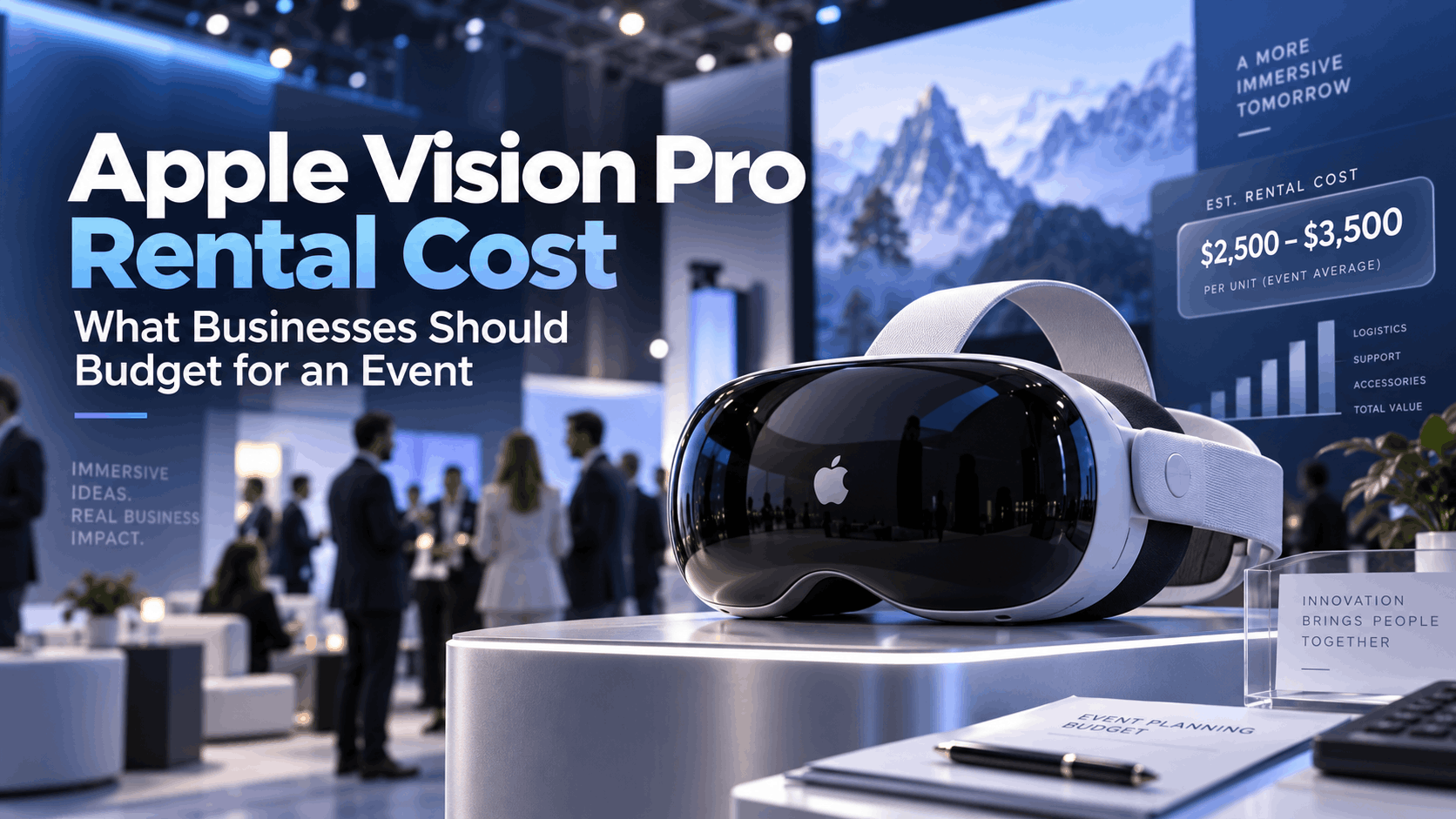
Professional VR rental packages range from $800-1,500 per headset for 3-day events, including setup support and basic troubleshooting. Premium packages with dedicated technical staff, custom content, and analytics platforms run $2,000-3,000 per headset. Volume discounts apply for multiple events or larger deployments.
How long does it take attendees to complete a VR brand experience?
Optimal VR brand experiences run 5-8 minutes, balancing engagement depth with throughput requirements. Shorter 3-minute experiences work for high-traffic consumer activations. Executive briefing centers can support 15-20 minute detailed demonstrations. Design modular content allowing natural exit points for time-constrained attendees.
Can VR experiences integrate with our CRM system?
Modern VR platforms support API integration with major CRM and marketing automation systems. Registration data, interaction metrics, and survey responses can flow automatically into lead records. Work with rental providers who offer integration support or provide data exports in CRM-compatible formats.
What happens if VR equipment fails during an event?
Professional rental packages include backup equipment and support protocols for equipment issues. On-site technical support can resolve most problems within minutes. Hot-swappable backup headsets minimize downtime. Choose providers offering guaranteed response times and replacement equipment for critical events.
How do we measure ROI from VR brand engagement?
Track both quantitative and qualitative metrics. Quantitative: cost per engaged lead, follow-up response rates, pipeline contribution, sales cycle acceleration. Qualitative: brand perception surveys, social media amplification, team feedback, competitive differentiation. Compare these metrics against traditional tactics and baseline performance.
Should we create custom VR content or use existing experiences?
Start with modified templates or licensed content to prove the VR engagement concept with minimal investment. After validating ROI and understanding audience preferences, invest in custom content for differentiation. Consider hybrid approaches—custom hero experiences supplemented by licensed supporting content.
Conclusion: Your Path to Immersive Brand Engagement
VR rental programs eliminate the barriers between your brand and truly memorable event experiences. While competitors distribute forgotten giveaways and deliver ignored presentations, your VR activation creates moments of genuine connection that attendees remember, share, and act upon.
The data speaks clearly: VR-engaged leads show 2.3x higher intent scores, respond to follow-up at 3x the rate of traditional leads, and accelerate through sales cycles 18% faster. These aren’t incremental improvements—they’re transformation metrics that justify investment and drive competitive advantage.
Start with a pilot program at your next major event. Choose a rental partner who provides not just equipment but success enablement—setup support, staff training, and performance analytics. Document your baseline metrics, deliver amazing experiences, and measure the difference. The results will build the business case for expanded deployment.
Ready to transform your event engagement strategy? Contact our VR rental specialists for a consultation on designing your pilot program. We’ll assess your event calendar, recommend optimal configurations, and connect you with proven content options that align with your brand objectives. Stop competing for attention and start commanding it with VR experiences that turn booth visitors into brand advocates.