
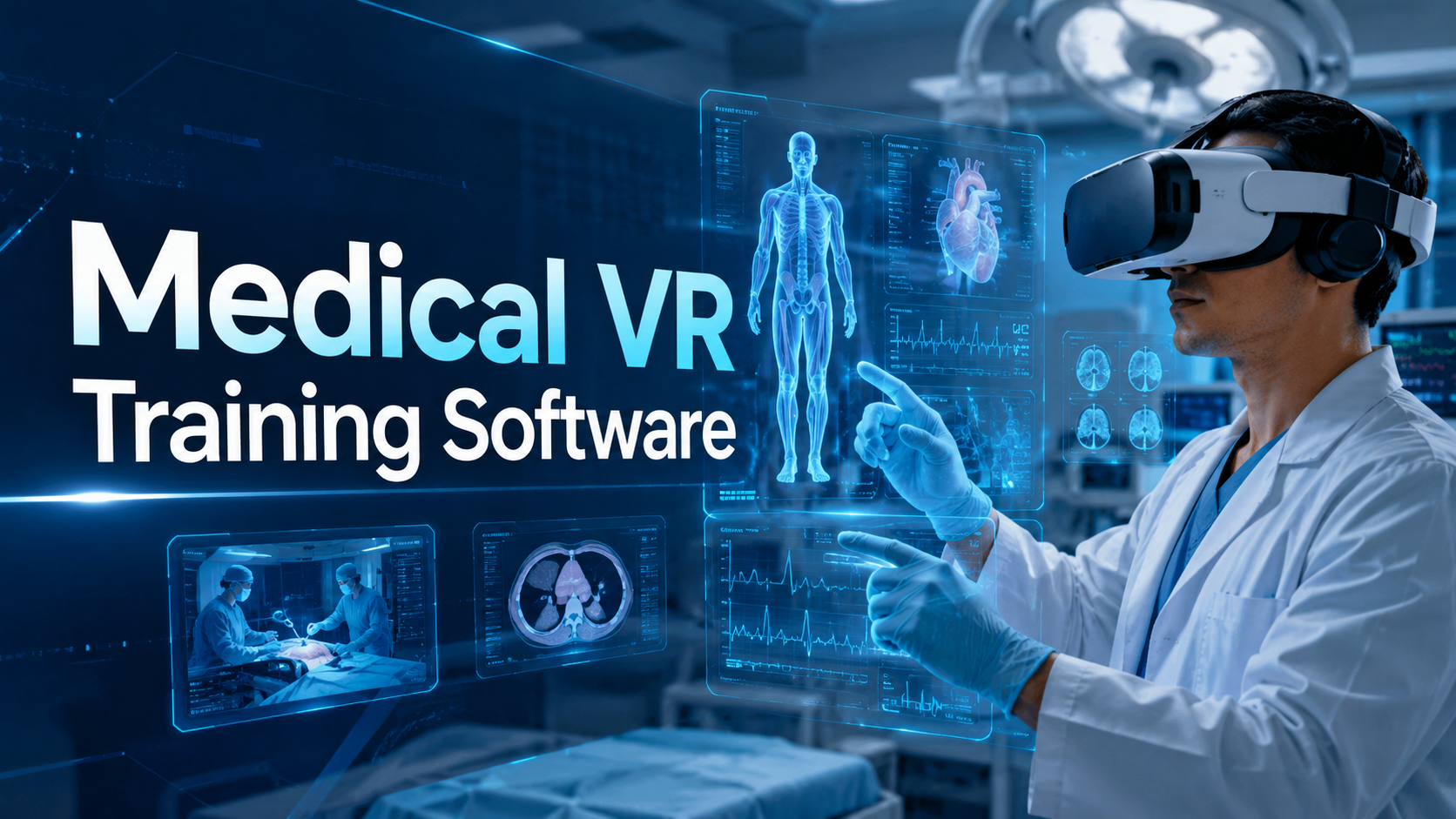
Healthcare organizations face an unprecedented training crisis. Clinical placement spots are shrinking while student enrollment grows. Patient safety concerns limit hands-on practice opportunities. Geographic barriers prevent standardized training across distributed campuses. Medical VR training software offers a proven solution—delivering repeatable, risk-free clinical scenarios that scale instantly without requiring patient involvement or physical simulation labs.
Why Healthcare Organizations Are Adopting VR Medical Training Software
Medical training faces mounting pressure: limited clinical placement spots, patient safety concerns during training, and the need for standardized assessment across distributed learners. VR medical training software addresses these challenges by providing repeatable, risk-free clinical scenarios that scale across locations without requiring patient involvement.
The $1.2 Million Problem with Traditional Medical Training
Traditional medical simulation centers require significant capital investment and ongoing operational costs that strain healthcare budgets. A typical simulation lab costs $500,000 to $2 million to build, with annual operating expenses reaching $300,000 for staffing, maintenance, and consumable supplies.
Physical mannequins for advanced procedures cost $30,000 to $250,000 each and require replacement parts costing thousands annually. Each training session consumes disposable supplies—IV catheters, surgical drapes, medications—adding $50 to $500 per procedure practiced. Faculty time for in-person supervision averages $150 per hour, with most procedures requiring 2-3 instructors present.
Clinical placement shortages compound these costs. The Association of American Medical Colleges reports a 15% shortage in clinical rotation spots, forcing institutions to pay $500 to $1,500 per week for external placements. Rural programs spend an additional $1,200 per student on travel and accommodation for centralized training.
Malpractice insurance premiums increase 5-8% when students perform procedures on actual patients during training. Risk management departments calculate each adverse event during training costs hospitals $75,000 to $400,000 in legal fees, settlements, and reputation damage.
VR medical simulation software eliminates these expenses through one-time content licensing and minimal hardware requirements. A complete VR training station costs $3,000 to $5,000, supporting unlimited procedure repetitions without consumables or dedicated faculty supervision.
How VR Training Transforms Medical Education Outcomes
Johns Hopkins neurosurgeons using VR training demonstrated 230% improvement in surgical precision and 45% faster procedure completion compared to traditional training methods. The VR-trained group made 6 times fewer errors during their first live surgeries.
Stanford Medical School’s VR anatomy program increased student test scores by 23% while reducing study time by 30%. Students retained complex spatial relationships 40% better after VR sessions compared to textbook study.
Standardization across campuses becomes automatic with VR platforms. The University of California system deployed identical VR scenarios across five medical schools, ensuring every student experiences the same high-stakes situations regardless of location. Assessment scoring remains consistent since the software tracks objective performance metrics rather than subjective instructor evaluation.
Rare procedure training no longer depends on case availability. Pediatric residents at Children’s Hospital Los Angeles performed 50 virtual congenital heart surgeries before encountering their first actual case. Traditional training might provide 2-3 observation opportunities during an entire residency.
Emotional intelligence development accelerates through patient interaction scenarios. Embodied Labs’ dementia simulations helped nursing students at UCLA increase empathy scores by 34% and improve patient communication ratings by 28%.
Leading Medical VR Training Software Platforms Compared
The medical VR training market includes specialized clinical platforms, anatomy visualization tools, and surgical simulators. Each platform serves different training needs, from nursing education to surgical residency programs. Here’s how the major platforms compare for healthcare organizations considering pilots.
Clinical Skills Training Platforms
Oxford Medical Simulation delivers comprehensive nursing education through 100+ clinical scenarios covering medical-surgical, pediatric, mental health, and critical care specialties. The platform tracks vital signs in real-time, allowing learners to observe deterioration and intervene appropriately. OSCE preparation modules align with nursing board requirements across 15 countries. Rental pricing starts at $2,500 per month for 10 concurrent users, while annual licenses cost $15,000 to $30,000 depending on student volume.
Health Scholars focuses on emergency medicine and acute care scenarios. Their ACLS and BLS certification programs meet American Heart Association standards, eliminating the need for separate certification courses. Team-based scenarios support up to 4 simultaneous users responding to cardiac arrests, strokes, and trauma cases. The platform includes 50+ scenarios with branching decision trees based on clinical guidelines. Monthly rentals cost $3,000 for unlimited users within a single facility, with enterprise pricing at $75,000 annually.
Embodied Labs specializes in aging simulation and caregiver training. Their library includes first-person experiences of macular degeneration, hearing loss, Alzheimer’s disease, and end-of-life conversations. Healthcare workers completing Embodied Labs training show 42% improvement in person-centered care metrics. The platform rents for $1,500 monthly for up to 20 users or $12,000 annually for unlimited institutional access.
SimX provides multiplayer medical simulations for team training. Up to 10 participants join the same virtual emergency department or battlefield scenario, practicing communication and coordination. The platform includes 60+ cases spanning emergency medicine, tactical combat casualty care, and disaster response. Rental packages start at $4,000 monthly with dedicated support and custom scenario development available.
Surgical and Procedural Training Systems
Osso VR leads orthopedic surgical training with hand-tracking technology that eliminates controllers. Surgeons practice knee replacements, spine fusions, and fracture repairs with haptic feedback through compatible gloves. The platform provides objective assessment metrics including accuracy, efficiency, and technique scores aligned with residency milestones. Academic institutions rent Osso VR for $5,000 monthly per specialty module, with annual licenses at $40,000 including unlimited procedures and users.
FundamentalVR combines visual and haptic feedback through their HapticVR system. Surgeons feel tissue resistance, bone density, and instrument vibration during procedures. Multi-user operating room scenarios allow attending surgeons to guide residents through complex cases remotely. The platform covers general surgery, orthopedics, and ophthalmology with 20+ procedures. Hardware and software rental packages cost $8,000 monthly, requiring specialized haptic devices that ship pre-configured.
PrecisionOS focuses exclusively on spine surgery with 50+ procedure modules. The platform includes fluoroscopy simulation, allowing surgeons to practice minimizing radiation exposure. Curriculum alignment tools map training to ACGME milestones and track resident progress automatically. Monthly rentals start at $3,500 for individual licenses or $15,000 for institutional access including instructor tools and analytics dashboards.
Anatomy and Physiology Visualization Tools
3D Organon offers complete body system visualization with 15,000 anatomical structures. Pathology libraries show disease progression through 500+ conditions. Built-in quiz modes test structure identification and spatial relationships. Cross-platform compatibility allows synchronized viewing between VR headsets and tablets for instructor-led sessions. Educational licenses rent for $800 monthly for 30 users or $5,000 annually for unlimited campus access.
VIVED Anatomy simulates cadaver dissection without formaldehyde exposure or specimen limitations. Students perform virtual dissections layer by layer, with unlimited ability to reset and repeat. The platform correlates 3D models with actual MRI and CT scan data, bridging anatomy study with radiology interpretation. Rental pricing starts at $1,200 monthly for 20 concurrent users, with volume discounts for larger deployments.
Complete Anatomy integrates with existing medical curricula through pre-built course templates. Instructors create custom lessons combining 3D models, animations, and quizzes. Student progress tracking shows time spent, structures viewed, and assessment scores. The platform rents for $600 monthly for 50 users or $4,000 annually with LMS integration and priority support.
Healthcare-Specific Requirements for VR Training Implementation
Medical VR training deployments face unique regulatory, technical, and operational requirements that don’t apply to corporate training. Understanding these requirements before selecting a platform prevents costly compliance issues and ensures successful adoption across clinical and academic settings.
HIPAA Compliance and Data Security
VR training platforms handling any patient information must maintain HIPAA compliance through technical safeguards, administrative procedures, and physical security measures. Even simulated patient scenarios using realistic demographics require protection if they could identify actual individuals.
Cloud-based platforms must sign Business Associate Agreements (BAAs) and demonstrate SOC 2 Type II certification. Data encryption must meet AES-256 standards for storage and TLS 1.3 for transmission. Audit logs must track user access, content viewing, and assessment results for minimum 6-year retention periods.
On-premise deployment eliminates cloud security concerns but requires internal IT resources for server maintenance, updates, and backups. Network segmentation isolates VR training systems from clinical networks containing actual patient data. Air-gapped installations provide maximum security for high-risk environments but prevent automatic content updates and multi-site collaboration.
User authentication integrates with existing Active Directory or SAML providers, enforcing password policies and multi-factor authentication. Role-based access control restricts administrative functions, content creation, and performance data viewing based on user credentials.
Medical Device Regulations and Validation
FDA classification determines regulatory requirements for VR medical training systems. Class II medical device software requires 510(k) premarket notification if the platform claims to improve clinical competence or patient outcomes. Pure educational tools without performance claims typically avoid medical device classification.
European deployment requires CE marking under Medical Device Regulation (MDR) 2017/745 for any software influencing clinical decision-making. Manufacturers must maintain technical documentation, conduct clinical evaluations, and implement post-market surveillance systems.
Clinical validation studies demonstrate training effectiveness through randomized controlled trials comparing VR-trained cohorts with traditional methods. Primary endpoints include skill assessment scores, time to competency, error rates, and knowledge retention. Secondary endpoints measure user satisfaction, cognitive load, and motion sickness incidence.
Quality management systems following ISO 13485 standards ensure consistent platform performance and content accuracy. Change control procedures validate software updates before release. Risk management processes identify and mitigate potential training inadequacies that could impact patient care.
Integration with Medical Education Systems
Learning Management System (LMS) compatibility enables seamless grade recording and progress tracking. SCORM 2004 compliance allows VR modules to report completion status, time spent, and assessment scores to Canvas, Blackboard, or Moodle. xAPI support provides detailed learning analytics including gaze tracking, hand movements, and decision timing.
Curriculum mapping aligns VR content with accreditation standards. LCME Element 6.3 requires self-directed learning opportunities that VR platforms fulfill through on-demand access. ACGME Milestone Project competencies map to specific VR scenarios demonstrating progressive skill development.
Single Sign-On (SSO) integration eliminates separate login credentials, improving adoption and security. SAML 2.0 or OAuth 2.0 protocols connect with institutional identity providers. Session management prevents unauthorized access to VR content after timeout periods.
Assessment data exports support accreditation reporting through CSV, PDF, or API connections. Competency dashboards aggregate individual and cohort performance across multiple scenarios. Automated reporting reduces administrative burden for program directors and education coordinators.
Implementing Medical VR Training Through Rental Pilots
Starting with a rental pilot eliminates capital budget requirements and allows healthcare organizations to test multiple platforms before committing to purchases. This approach reduces risk while building internal champions and gathering usage data to support larger deployments.
Structuring Your 90-Day Pilot Program
Success metrics must align with institutional priorities and accreditation requirements. Skills assessment scores should improve 20-30% between pre and post-VR training. Usage rates target 80% of assigned learners completing all required modules. Learner satisfaction scores should exceed 4.2 on 5-point scales.
Pilot cohort selection balances early adopters with skeptics to gather representative feedback. Residents benefit most from procedural training platforms, while nursing students excel with clinical decision-making scenarios. Medical students prefer anatomy visualization tools for exam preparation. Include 15-20 participants per cohort to achieve statistical significance in outcome measurements.
Content curation focuses pilot evaluation on highest-impact training needs. Emergency procedures with time-critical decisions show immediate VR training benefits. High-risk, low-frequency events like malignant hyperthermia provide practice opportunities impossible with traditional methods. Communication scenarios address soft skills gaps identified in performance reviews.
Implementation timeline allocates sufficient preparation and evaluation periods:
- Week 1-2: Platform setup, IT configuration, facilitator training
- Week 3-4: Learner orientation, baseline assessments, initial sessions
- Week 5-10: Core training period with weekly sessions
- Week 11-12: Final assessments, feedback collection, data analysis
- Week 13: Stakeholder presentation and expansion planning
VR Hardware Selection for Medical Training
Meta Quest 3 offers optimal price-performance for medical training at $649 per headset. The 4K+ resolution displays fine anatomical detail while 120Hz refresh rate minimizes motion sickness. Hand tracking eliminates controller hygiene concerns. 512GB storage accommodates extensive content libraries for offline use. Passthrough mode allows interaction with physical mannequins or instruments during hybrid training.
PICO 4 Enterprise provides centralized management tools essential for healthcare IT departments. Remote deployment pushes content and updates without handling individual headsets. Kiosk mode prevents users from accessing non-training applications. The $899 price includes enterprise support and extended warranties. Eye tracking enables foveated rendering and gaze-based analytics.
Hygiene protocols require medical-grade materials and cleaning procedures. Silicone facial interfaces withstand repeated disinfection with 70% isopropyl alcohol or quaternary ammonium wipes. Disposable face covers cost $0.50 each for single-use protection. UV-C sanitization cabinets disinfect headsets in 3 minutes between users without chemical residue.
Prescription lens adapters accommodate users with vision correction needs. Magnetic inserts cost $80-120 per headset and prevent glasses from scratching displays. Adjustable IPD (interpupillary distance) ranges from 58-72mm cover 95% of adult populations. Blue light filtering reduces eye strain during extended sessions.
Backup equipment maintains training continuity during failures or maintenance. Plan 20% spare inventory—2 backup headsets per 10 primary units. Hot-swappable batteries extend usage beyond 2-hour built-in capacity. Charging stations accommodate 10 headsets simultaneously while maintaining organization.
Setup Requirements for Clinical Environments
Space allocation requires minimum 6×6 feet per VR station with 8-foot ceiling clearance. Guardian boundaries prevent users from contacting walls or furniture during room-scale experiences. Padded floor mats mark safe movement areas and reduce fatigue during standing sessions. Acoustic panels minimize noise interference between adjacent stations.
Network infrastructure must support 50 Mbps per headset for streaming content or cloud rendering. 5GHz WiFi 6 access points handle 30 concurrent connections without latency issues. Dedicated VLANs isolate VR traffic from clinical systems. Local caching servers reduce bandwidth requirements for frequently accessed content.
Infection control protocols align with hospital standards for shared equipment. Cleaning logs track sanitization between users with timestamp verification. Contact time requirements vary by disinfectant—30 seconds for alcohol, 1 minute for quaternary ammonium compounds. Monthly deep cleaning includes strap adjustment mechanisms and speaker grilles.
Storage infrastructure protects equipment while maintaining charging readiness. Locking cabinets prevent theft while allowing ventilation during charging. Cable management systems prevent tangling and tripping hazards. Environmental monitoring ensures temperature stays between 60-80°F and humidity below 70% to prevent condensation.
Measuring ROI of Medical VR Training Programs
Healthcare CFOs require clear financial justification for training technology investments. VR training delivers measurable returns through reduced training time, improved patient outcomes, decreased medical errors, and eliminated travel costs for distributed learners.
Direct Cost Savings Calculation
Physical simulation lab reduction generates immediate savings of $500,000 to $2 million in construction costs. Operating expense reductions reach $300,000 annually through decreased staffing, maintenance, and utility costs. A 10-station VR lab costs $35,000 to establish versus $1.2 million for equivalent physical simulation capacity.
Travel elimination saves $1,200 per learner for centralized training programs. Rural residency programs report $150,000 annual savings by conducting VR training locally instead of sending residents to urban simulation centers. International medical graduates save $5,000-10,000 in visa, travel, and accommodation costs for skills assessment preparation.
Consumable supplies savings accumulate rapidly with high-volume procedures. Central line insertion training consumes $75 in supplies per attempt with physical mannequins. VR training allows unlimited practice without material costs. A 50-resident program practicing 20 attempts each saves $75,000 annually on this single procedure.
Faculty time reduction through automated scenarios saves $150 per hour of instruction. Self-directed VR training requires 75% less supervision than traditional simulation. A program with 1,000 training hours annually saves $112,500 in instructor costs while maintaining educational quality.
Clinical Outcome Improvements
Medication error rates decrease 40% following VR-based prescription verification training. Each prevented error avoids $4,685 in additional treatment costs and potential litigation. A 500-bed hospital preventing 50 errors annually saves $234,250 while improving patient safety metrics.
Time to competency accelerates by 50% with VR training supplementation. Residents achieve procedural independence 6 months earlier, generating additional revenue through increased procedure volume. Each resident performing 10 additional procedures monthly at $500 average reimbursement generates $30,000 over 6 months.
Patient satisfaction scores improve 8-12% when staff complete empathy and communication VR training. Higher HCAHPS scores increase Medicare reimbursements through value-based purchasing programs. A 1% improvement in patient experience scores yields $300,000 additional annual revenue for average hospitals.
Supervision requirement reductions allow attending physicians to manage more residents simultaneously. VR-trained residents require 30% less direct oversight during procedures. An attending physician gains 10 hours weekly for clinical care, generating $2,000 in additional revenue at $200 hourly billing rates.
Building Your Business Case
Pilot data collection must demonstrate measurable improvements to secure expansion funding. Track pre and post-training assessment scores, procedure completion times, and error rates. Document time savings for both learners and instructors. Survey participants on confidence levels and training satisfaction.
Stakeholder alignment requires tailored messaging for each audience. Medical education leaders focus on accreditation compliance and standardized curricula. IT departments need security assurances and integration specifications. Finance requires detailed ROI calculations with conservative assumptions. Clinical leadership wants evidence of improved patient outcomes and reduced liability.
Phased rollout planning manages risk while building success. Start with single department pilots before expanding hospital-wide. Begin with elective training before mandating participation. Implement basic scenarios before advanced multi-user simulations. Scale hardware purchases based on actual usage rather than projections.
Funding sources extend beyond traditional training budgets. Simulation center allocations often include equipment refresh cycles perfect for VR adoption. Healthcare innovation grants from CMS, HRSA, and private foundations support technology pilots. Medical device manufacturers sponsor VR training for their products. Alumni donations target cutting-edge educational technology.
Getting Started with Medical VR Training Rentals
Launching a medical VR training pilot doesn’t require months of procurement or IT integration. With the right rental partner, healthcare organizations can have learners in VR within two weeks, gathering the evidence needed to scale successful programs.
Your Medical VR Pilot Checklist
Define 3-5 specific training objectives that address measurable skill gaps or compliance requirements. Examples include reducing catheter insertion attempts by 30%, improving code blue response time by 2 minutes, or achieving 95% pass rates on OSCE examinations. Avoid broad goals like “improve clinical skills” that lack quantifiable outcomes.
Identify 10-20 pilot participants representing your target learner population. Include mix of experience levels to test content difficulty appropriateness. Select motivated early adopters as champions but include skeptics to address adoption barriers. Ensure demographic diversity for inclusive design feedback.
Allocate dedicated training space with lockable storage, adequate ventilation, and proximity to learner areas. Minimum 200 square feet accommodates 4 VR stations with safety clearance. Provide seating for orientation and debriefing discussions. Install whiteboards for collaborative review of VR experiences.
Schedule facilitator training 1 week before learner sessions begin. Allocate 4 hours for technical setup, troubleshooting, and content familiarization. Train 2-3 facilitators to ensure coverage during illness or vacation. Create quick reference guides for common issues and session workflows.
Plan assessment methodology including pre-training baseline, formative progress checks, and summative final evaluations. Use validated instruments like the System Usability Scale for technology acceptance. Track objective performance metrics from VR platform analytics. Schedule focus groups for qualitative feedback on learning experience.
Common Implementation Mistakes to Avoid
Starting with overly broad objectives dilutes pilot impact and complicates success measurement. “Transform medical education” fails as pilot goal. “Reduce IV insertion failure rate from 35% to 15%” provides clear target with measurable outcome. Focus initial deployment on 1-2 high-impact use cases before expanding scope.
Skipping facilitator preparation leads to poor learner experiences and technology abandonment. Facilitators need technical troubleshooting skills, content expertise, and debriefing capabilities. Assuming clinical expertise translates to VR instruction effectiveness overlooks unique pedagogical requirements of immersive learning.
Underestimating hygiene requirements creates infection control violations and user reluctance. Each headset needs 5 minutes between users for proper sanitization and drying. Schedule 15-minute buffers between sessions for cleaning, charging, and reset. Budget for disposable face covers and cleaning supplies from day one.
Excluding IT departments until implementation causes security vulnerabilities and network conflicts. IT needs 2-3 weeks to configure firewalls, provision WiFi capacity, and establish update procedures. Early engagement prevents last-minute delays and ensures compliance with institutional policies.
Neglecting change management principles results in resistance from traditional educators. Address concerns about technology replacing instructors by positioning VR as enhancement rather than replacement. Provide evidence of improved outcomes from peer institutions. Celebrate early adopter successes publicly to build momentum.
Frequently Asked Questions
How much does medical VR training software cost to rent vs buy?
Monthly rentals range from $1,500 to $8,000 depending on platform complexity and user volume. Annual purchases cost $12,000 to $75,000 with perpetual licenses reaching $150,000 for enterprise deployments. Rentals include support and updates while purchases may require separate maintenance contracts at 20% annual cost.
Which VR headsets work best for medical training applications?
Meta Quest 3 provides best overall value at $649 with high resolution, hand tracking, and extensive content compatibility. PICO 4 Enterprise offers superior device management for large deployments at $899. HTC Vive Focus 3 delivers premium build quality for $1,300 but has limited medical content availability.
Can VR medical training software integrate with our existing LMS?
Most medical VR platforms support SCORM 2004 or xAPI standards for LMS integration. Native integrations exist for Canvas, Blackboard, and Moodle. API access enables custom connections with proprietary systems. Verify specific integration capabilities during platform evaluation as implementation complexity varies significantly.
How do you maintain hygiene standards with shared VR equipment?
Use medical-grade silicone facial interfaces that withstand hospital-approved disinfectants. Apply 70% isopropyl alcohol or quaternary ammonium wipes with 30-60 second contact time. Provide disposable face covers for single-use protection. Implement UV-C sanitization for rapid turnover. Document cleaning between each user per infection control policies.
What’s the minimum space needed for a VR medical training lab?
Individual stations require 6×6 feet of clear floor space with 8-foot ceiling height. A 4-station lab needs minimum 200 square feet including circulation space. Add 50 square feet for equipment storage and charging stations. Provide additional space for orientation and debriefing areas outside VR zones.
Do medical VR training platforms require internet connectivity?
Initial content download and user authentication typically require internet access. Many platforms offer offline modes for actual training sessions. Cloud-based platforms need persistent 50 Mbps connections per headset. On-premise deployments operate without internet but sacrifice automatic updates and multi-site collaboration features.
How long does it take to see ROI from medical VR training?
Direct cost savings appear immediately through eliminated travel and consumables. Skill improvement metrics emerge within 30-60 days of regular use. Clinical outcome improvements manifest after 3-6 months as trained cohorts enter practice. Full ROI realization including efficiency gains and error reduction occurs within 12-18 months.
Can VR training count toward continuing medical education credits?
Many VR platforms provide CME, CNE, or CE credits through partnerships with accredited providers. Credit eligibility depends on content type, completion requirements, and assessment components. Verify specific accreditation status with platform vendors and your credentialing bodies before promoting credit availability.
Conclusion
Medical VR training software transforms healthcare education from resource-constrained, location-dependent, high-risk practice into scalable, standardized, safe learning experiences. The technology has matured beyond experimental pilots to deliver measurable improvements in clinical competence, patient safety, and educational efficiency.
Healthcare organizations no longer face the binary choice between million-dollar simulation centers and inadequate training resources. VR platforms provide sophisticated clinical scenarios, surgical simulations, and anatomy visualization at fraction of traditional costs. Rental options eliminate capital budget barriers while allowing thorough evaluation before purchase commitments.
Success requires more than technology deployment. Organizations must address healthcare-specific requirements including HIPAA compliance, infection control protocols, and curriculum integration. Structured pilot programs with clear objectives, appropriate cohort selection, and robust assessment methodology generate evidence for expansion.
The financial case for medical VR training strengthens daily. Direct savings from reduced travel, eliminated consumables, and decreased faculty time provide immediate returns. Clinical improvements including faster skill acquisition, fewer medical errors, and enhanced patient satisfaction deliver long-term value exceeding initial investments.
Ready to transform your medical training with VR? Start with a focused 90-day rental pilot targeting your highest-impact training challenge. Select a platform aligned with your specific needs—clinical decision-making, surgical procedures, or anatomy education. Gather objective performance data proving VR’s effectiveness for your learners. Then scale successful programs across departments and campuses with confidence backed by evidence.
Contact medical VR training platform providers today to schedule demonstrations and discuss rental options tailored to your organization’s requirements. The future of medical education is immersive, accessible, and available now through flexible rental programs that reduce risk while accelerating innovation.