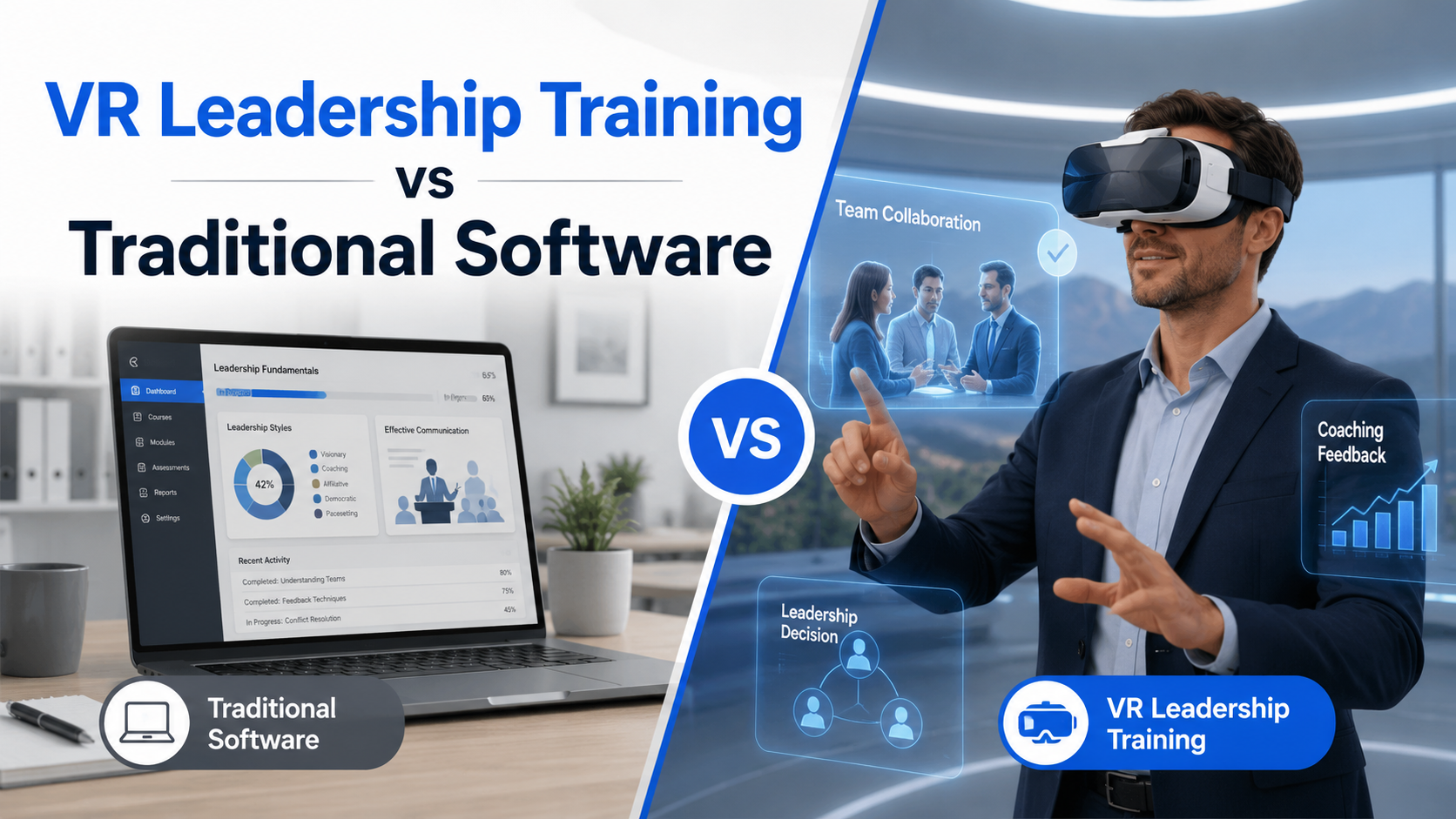
Why Traditional Leadership Training Software Falls Short
Most leadership training platforms deliver the same passive experience: video modules, quizzes, and discussion boards that leaders complete between meetings. The result? 87% completion rates but minimal behavior change. Here’s what’s broken with the current software-first approach to leadership development.
The disconnect between completion and competency reveals a fundamental flaw in how organizations approach leadership development. While digital platforms excel at content delivery and tracking, they fail to create the visceral, memorable experiences that drive lasting behavioral change. Leaders log in, watch videos, pass assessments, and return to their roles unchanged.
The Engagement Problem with Digital Courses
Traditional leadership training software suffers from a critical engagement gap. Research from the Association for Talent Development shows that only 23% of employees apply what they learn from e-learning modules to their actual work. For leadership skills specifically, this transfer rate drops to just 15% when training relies solely on video content and reading materials.
The forgetting curve compounds this problem. Hermann Ebbinghaus’s research, validated repeatedly in corporate training contexts, demonstrates that learners forget 70% of new information within 24 hours of consumption. For traditional e-learning platforms, this means the $366 billion spent annually on corporate training generates minimal lasting impact.
Passive video consumption fails to build the muscle memory essential for leadership skills. Watching a module on conflict resolution differs fundamentally from experiencing the physiological stress of confronting an upset team member. Reading about inclusive leadership practices doesn’t replicate the real-time decision-making required when facilitating diverse team discussions.
Digital courses also struggle with authentic emotional engagement. Leadership often requires managing complex interpersonal dynamics, reading non-verbal cues, and responding to unexpected situations. Traditional software reduces these nuanced interactions to multiple-choice scenarios and branching video paths that feel artificial and predictable.
The asynchronous nature of most leadership training platforms further diminishes their effectiveness. Leaders complete modules in isolation, missing the peer learning and real-time feedback that accelerates skill development. Discussion boards and virtual cohorts attempt to recreate collaborative learning but lack the immediacy and energy of shared experiences.
Hidden Costs of Leadership Training Platforms
The true expense of traditional leadership training software extends far beyond advertised subscription fees. Organizations typically pay $150-500 per user annually for comprehensive platforms, but this represents only the beginning of actual costs.
LMS integration complexity adds substantial IT overhead. The average enterprise spends 3-6 months implementing new learning platforms, requiring dedicated technical resources for API connections, single sign-on configuration, and data migration. Ongoing maintenance consumes 10-15 hours monthly from IT teams, translating to $8,000-12,000 in annual support costs for mid-sized deployments.
Content library limitations force additional investments. While platforms advertise thousands of courses, leadership-specific content often requires premium tier subscriptions or separate licensing agreements. Custom content development, necessary for organization-specific leadership frameworks, costs $25,000-50,000 per hour of finished material.
User management creates ongoing administrative burden. HR teams spend an average of 20 hours monthly managing user accounts, tracking completions, generating reports, and troubleshooting access issues. For a 500-person leadership development program, this administrative overhead equals one full-time equivalent position.
Low utilization rates undermine the per-user pricing model. Despite high completion rates for assigned courses, voluntary platform usage typically hovers around 8-12%. Organizations essentially pay for dormant licenses while struggling to drive consistent engagement beyond mandatory training periods.
The replacement cycle for leadership training platforms averages 3-4 years, requiring repeated implementation costs and change management efforts. Each transition disrupts learning continuity and forces participants to adapt to new interfaces and content structures.
How VR Creates Experiential Leadership Training Without Software Licenses
Instead of watching videos about difficult conversations, leaders practice them in VR. Instead of reading case studies, they navigate crisis scenarios in real-time. VR rental packages deliver immersive leadership experiences without the overhead of traditional training software.
Virtual reality transforms leadership development from passive consumption to active participation. Leaders don’t just learn about emotional intelligence—they practice reading facial expressions and body language of virtual team members responding to their decisions. They don’t memorize feedback frameworks—they deliver performance reviews to avatars programmed with realistic emotional responses.
Scenario-Based Learning Through VR Simulations
VR leadership training leverages presence and embodiment to create memorable learning experiences. When leaders wear a headset, their brain processes virtual interactions as real experiences, triggering the same neurological responses as actual leadership moments.
Conflict resolution scenarios place leaders in heated team discussions where they must de-escalate tensions in real-time. Unlike video-based training, participants can’t pause to consider options—they must respond naturally, building authentic crisis management skills. Virtual team members react dynamically to tone, word choice, and body language, providing immediate feedback on leadership effectiveness.
Public speaking simulations generate genuine performance anxiety by placing leaders before virtual audiences that display realistic behaviors: checking phones, side conversations, skeptical expressions. This physiological stress response, impossible to replicate through traditional e-learning, helps leaders develop authentic presence and confidence.
Team dynamics exercises enable leaders to practice inclusive facilitation with diverse virtual colleagues. Simulations include team members with different communication styles, cultural backgrounds, and engagement levels. Leaders learn to recognize and address subtle exclusion patterns while managing meeting flow and decision-making processes.
Research from PwC’s 2020 study on VR soft skills training demonstrates the impact of this immersive approach. Participants completed training 4x faster than classroom learners and were 275% more confident applying skills post-training. Most significantly, VR learners showed 3.75x greater emotional connection to content compared to e-learning participants.
Stanford University’s Virtual Human Interaction Lab found that VR-based diversity training increased perspective-taking behaviors by 43% compared to traditional video content. These behavioral changes persisted in follow-up assessments eight weeks post-training, suggesting VR creates more durable learning outcomes.
The Rental Model Advantage for Leadership Development
VR equipment rental eliminates the barriers that prevent organizations from adopting immersive training. Instead of purchasing headsets, managing software licenses, and maintaining hardware, companies access complete VR leadership experiences through flexible rental packages.
Cost predictability improves budget planning. A two-day VR leadership workshop for 20 participants typically costs $8,000-12,000 including equipment, content, and technical support. Compare this to annual software subscriptions reaching $75,000-100,000 for the same participant count, plus hidden implementation and support costs.
No IT integration simplifies deployment. VR rental packages arrive pre-configured with leadership training content loaded and tested. Setup requires only power outlets and adequate space—no network configuration, user provisioning, or security reviews. This eliminates the 3-6 month implementation timeline typical of enterprise learning platforms.
Flexibility enables experimentation and iteration. Organizations can test different VR leadership scenarios, adjust program duration, and modify participant groups without long-term commitments. This agility proves especially valuable during pilot phases when determining optimal training design.
The rental model also solves the technology refresh challenge. VR hardware evolves rapidly, with new headsets offering improved resolution, comfort, and tracking capabilities. Rental providers maintain current equipment, ensuring participants always experience optimal technology without capital investment in rapidly depreciating assets.
Concentrated immersive experiences often generate stronger outcomes than distributed digital learning. A quarterly one-day VR workshop creates anticipation, focuses attention, and builds shared experience among leadership cohorts. This event-based approach contrasts with the often-ignored always-available nature of traditional platforms.
VR Leadership Training Implementation Guide
Running VR-based leadership development doesn’t require technical expertise or permanent hardware investments. Here’s exactly how to plan, execute, and measure immersive training events using rental equipment.
Planning Your First VR Leadership Workshop
Optimal group sizes for VR leadership training range from 8-16 participants per session. This allows for meaningful peer interaction while ensuring adequate facilitator attention during immersive exercises. Larger cohorts can rotate through VR stations while others engage in complementary activities like group debriefs or traditional exercises.
Session lengths should account for VR acclimatization and comfort. First-time users need 15-20 minutes for orientation and comfort adjustment. Actual VR experiences work best in 20-30 minute segments, followed by 10-15 minute breaks for discussion and rest. A full-day workshop typically includes 3-4 VR sessions totaling 90-120 minutes of headset time.
Space requirements depend on experience type and equipment configuration. Seated experiences need 6×6 feet per participant, while room-scale simulations require 10×10 feet minimum. Conference rooms, training facilities, or even cleared office spaces work well. Ensure adequate ventilation as VR generates heat and participants may experience mild exertion.
Content selection should align with specific leadership competencies and organizational priorities. Start with universal skills like communication and emotional intelligence before advancing to specialized scenarios. Consider your leadership framework and identify 2-3 key behaviors to target in initial sessions.
Pre-workshop communication reduces anxiety and increases engagement. Share brief VR orientation videos, explain the learning objectives, and address common concerns about motion sickness or technical complexity. Set clear expectations about the experiential nature of training and the value of stepping outside comfort zones.
Equipment and Experience Package Selection
Enterprise VR training typically uses business-focused headsets like Meta Quest 3, Pico 4 Enterprise, or HTC Vive Focus 3. These standalone devices don’t require external computers, simplifying setup and reducing technical complexity. Most rental providers offer pre-configured kits with 8-16 headsets, charging stations, and hygiene supplies.
Multi-user experiences create powerful shared learning moments. Platforms like Immersed and Spatial enable multiple leaders to inhabit the same virtual environment, practicing team dynamics and collaborative decision-making. These experiences require stable WiFi and coordination between headsets but deliver unique training value.
Single-user experiences offer deep, personalized skill development. Applications like Ovation for public speaking or Equal Reality for diversity training provide individual practice with AI-driven feedback. These work well for skills requiring repeated practice and personal reflection.
Support levels vary based on organizational comfort with technology. Basic packages include equipment and remote technical support. Premium options add on-site facilitators who manage technology while trainers focus on learning objectives. First-time implementations benefit from full-service support to ensure smooth execution.
Content libraries from rental providers typically include 20-40 leadership-relevant experiences. Evaluate whether included content addresses your priorities or if custom scenario development is necessary. Some providers offer light customization like adding company logos or modifying scenario parameters.
Measuring Impact and ROI
Pre-assessment strategies establish baseline leadership behaviors before VR intervention. Use 360-degree feedback tools, self-assessments, or behavioral observation scales focusing on targeted competencies. Conduct assessments 1-2 weeks before training to capture authentic baseline data.
Immediate post-training measurement captures confidence and skill acquisition. VR platforms often include built-in analytics tracking decision patterns, response times, and behavioral choices during simulations. Combine this data with participant self-reports and facilitator observations.
Behavioral indicators to track after immersive sessions include meeting effectiveness, conflict resolution frequency, team engagement scores, and peer feedback ratings. Schedule follow-up assessments at 30, 60, and 90 days to measure skill retention and application.
Cost-per-outcome calculations demonstrate VR training value. If a traditional platform costs $100,000 annually and generates 15% behavior change among 200 leaders, the cost per transformed leader equals $3,333. VR workshops costing $40,000 annually that achieve 45% behavior change yield a cost per transformed leader of $444—an 87% improvement in efficiency.
Long-term tracking should connect leadership behavior changes to business outcomes. Monitor team performance metrics, employee retention rates, and engagement scores for VR-trained leaders versus control groups. This data builds the business case for expanded VR implementation.
Real Organizations Using VR for Leadership Development
From Fortune 500 companies to government agencies, organizations are replacing traditional leadership training software with immersive VR experiences. These case studies show the practical results.
Enterprise Case Studies
Walmart deployed VR training across 4,700 stores, training over 1 million associates including 150,000 department managers and team leaders. Their VR leadership modules focus on difficult conversations, compliance scenarios, and emergency response. Post-implementation data showed 70% improvement in employee confidence and 10-15% better retention of training material compared to traditional e-learning.
Bank of America uses VR to prepare relationship managers for emotionally charged client interactions. Their immersive scenarios simulate difficult conversations about fees, account closures, and service complaints. Managers completing VR training demonstrated 23% better empathy scores and resolved customer issues 40% faster than peers trained through traditional role-play.
Verizon implemented VR-based crisis management training for retail store managers, simulating robbery scenarios and active threat situations. Managers practice de-escalation techniques, employee protection protocols, and law enforcement interaction. Post-training assessments showed 97% of participants felt better prepared for emergencies, compared to 47% from video-based training.
MGM Resorts created VR experiences for hospitality leadership development, focusing on inclusive service and cultural sensitivity. Managers navigate scenarios involving guests with disabilities, language barriers, and cultural differences. The program reduced discrimination complaints by 31% and improved guest satisfaction scores by 12% in participating properties.
Fidelity Investments developed VR simulations for customer service leadership, allowing managers to experience challenging client interactions from both employee and customer perspectives. This perspective-taking approach increased manager empathy scores by 38% and reduced team turnover by 20% in the six months following training.
Common Use Cases by Industry
Healthcare organizations use VR for crisis leadership and patient interaction training. Scenarios include managing code blue situations, delivering difficult diagnoses, and leading emergency response teams. Cleveland Clinic reported 40% improvement in crisis response times after VR training implementation. Johns Hopkins reduced medical error rates by 25% in departments where leadership completed immersive crisis simulations.
Retail companies leverage VR for customer service leadership and team management. Simulations cover peak season staffing, theft prevention, and customer de-escalation. Target achieved 33% reduction in customer complaints after store managers completed VR training. Home Depot reported 28% improvement in employee satisfaction scores under VR-trained leaders.
Manufacturing firms apply VR to safety leadership and operational decision-making. Scenarios simulate equipment failures, safety violations, and production line emergencies. Ford documented 70% reduction in safety incidents after supervisors completed VR safety leadership training. Boeing achieved 40% faster problem resolution in teams led by VR-trained managers.
Technology companies use VR for remote team leadership and cross-cultural collaboration. Simulations address timezone coordination, virtual meeting facilitation, and distributed team dynamics. Microsoft reported 45% improvement in remote team engagement scores. Google found VR-trained managers received 35% higher ratings for inclusive leadership behaviors.
Government agencies implement VR for emergency management and public interaction training. Scenarios cover natural disasters, public health crises, and citizen engagement. FEMA reduced emergency response coordination time by 30% after leadership VR training. The State Department improved diplomatic negotiation outcomes by 25% using VR-based scenario training.
VR vs Leadership Training Software: Direct Feature Comparison
How does renting VR equipment for leadership workshops compare to subscribing to traditional training platforms? This breakdown covers costs, logistics, content flexibility, and measurable outcomes.
Total Cost of Ownership Analysis
VR rental pricing for quarterly workshops provides transparent, predictable costs. A typical quarterly program serving 50 leaders across four workshops costs approximately $40,000-50,000 annually. This includes equipment rental, content licensing, shipping, technical support, and facilitator training materials.
Traditional leadership training software for 50 users ranges from $7,500-25,000 in subscription fees, appearing more economical initially. However, total cost of ownership reveals a different picture. Add $15,000-20,000 for implementation, $10,000-12,000 for annual IT support, $8,000-10,000 for content customization, and $5,000-8,000 for administrative overhead. Real annual costs reach $45,500-75,000.
Hidden costs further tip the balance toward VR rental. Traditional platforms require password resets, user training, compliance tracking, and report generation—tasks consuming 15-20 hours monthly from HR staff. VR workshops eliminate this ongoing administrative burden, requiring only event coordination four times annually.
Break-even calculations favor VR at specific participant thresholds. For organizations training fewer than 100 leaders annually, VR rental costs less than comprehensive platform subscriptions. Above 200 participants, traditional platforms may offer better unit economics, though this assumes high utilization rates rarely achieved in practice.
Content refresh costs differ significantly between models. Traditional platforms charge $5,000-15,000 for custom course development. VR rental providers typically include 30-40 leadership scenarios in base packages, with new experiences added regularly at no additional cost.
Implementation Timeline and Complexity
VR workshops launch in days versus weeks for traditional platforms. Once rental agreement is signed, equipment ships within 48-72 hours. Setup requires 2-3 hours for space preparation and equipment testing. First participant experiences begin the same week as decision to proceed.
LMS integration for traditional platforms averages 6-12 weeks. This includes vendor evaluation, security review, contract negotiation, technical integration, user provisioning, and pilot testing. Complex enterprises with strict IT governance may require 4-6 months for full deployment.
Technical requirements favor VR rental simplicity. Traditional platforms need network access, firewall exceptions, browser compatibility, and often dedicated IT support. VR rental equipment operates independently, requiring only power outlets and WiFi for multi-user experiences.
User onboarding effort differs dramatically. Traditional platforms require account creation, password management, navigation training, and ongoing support. Each user needs 30-45 minutes for initial orientation plus continuous assistance. VR workshops include built-in orientation taking 10-15 minutes, with facilitators managing any technical issues.
Change management complexity varies significantly. Traditional platform adoption requires communication campaigns, training materials, manager buy-in, and ongoing reinforcement to drive utilization. VR workshops generate excitement and voluntary participation, with waiting lists common for available sessions.
Getting Started with VR Leadership Training
Ready to move beyond passive video courses? Here’s your step-by-step roadmap for launching immersive leadership development using VR rental packages.
Pilot Program Design
Select your initial participant cohort strategically. Choose 12-16 high-potential leaders or first-time managers who demonstrate openness to innovative approaches. Include diverse perspectives across departments, demographics, and leadership styles. This diversity enriches group discussions and provides varied feedback on experience effectiveness.
Define specific success metrics before launching. Quantitative measures might include 360-feedback score improvements, team engagement increases, or conflict resolution frequency. Qualitative indicators could encompass participant confidence ratings, observed behavior changes, or unsolicited peer feedback. Establish baseline measurements 2-3 weeks before the pilot.
Choose between single-day intensives and multi-session programs based on organizational culture and logistics. Single-day workshops work well for concentrated skill development and team building. Multi-session programs spread across 4-6 weeks allow for practice between sessions and gradual skill building. Consider starting with a one-day pilot to gauge response before committing to extended programs.
Budget allocation should account for complete program costs. Beyond equipment rental, include facilitator time, participant opportunity cost, space rental if needed, and evaluation resources. A comprehensive pilot for 15 participants typically requires $12,000-15,000 total investment, including all direct and indirect costs.
Navigate the approval process by focusing on innovation and competitive advantage. Position VR training as a pilot exploring next-generation leadership development. Emphasize the low-risk rental model versus capital investment. Highlight competitor adoption and industry momentum toward immersive learning. Request pilot funding from innovation budgets if training budgets prove restrictive.
Vendor Selection and Package Configuration
Essential questions for VR rental providers determine partnership fit. Ask about equipment maintenance and hygiene protocols. Understand their technical support model—is it remote, on-site, or hybrid? Clarify content licensing terms and whether experiences can be customized. Investigate their facilitator training resources and implementation support.
Evaluate provider experience with enterprise deployments. Request references from similar organizations and industries. Understand their capacity to scale if pilot succeeds. Assess their content library relevance to your leadership competencies. Verify insurance coverage and equipment replacement guarantees.
Support levels needed for enterprise deployments vary by internal capabilities. Organizations with strong facilitation skills may only need equipment and basic technical support. Those new to immersive learning benefit from full-service packages including on-site technicians and experienced VR facilitators.
Content curation requires matching available experiences to leadership frameworks. Map VR scenarios to specific competencies like emotional intelligence, strategic thinking, or change management. Prioritize experiences addressing current organizational challenges. Balance skill-building scenarios with assessment-focused simulations.
Configure packages to optimize learning outcomes and logistics. Standard configurations include 8-16 headsets, enabling concurrent training while maintaining manageable group sizes. Include backup equipment for technical failures. Ensure adequate hygiene supplies for multi-day events. Request pre-configured content playlists aligned to your agenda.
FAQs
How much does VR leadership training cost compared to traditional software?
VR leadership training through rental packages costs $8,000-12,000 per workshop for 15-20 participants, or approximately $40,000-50,000 annually for quarterly sessions. Traditional leadership training software costs $150-500 per user annually in subscription fees, plus $25,000-50,000 in implementation, support, and customization costs. For organizations training fewer than 100 leaders, VR rental often proves more economical when considering total cost of ownership.
Can VR training integrate with our existing LMS?
VR training can complement existing LMS platforms without requiring technical integration. Most VR experiences generate completion data and performance metrics exportable in standard formats (CSV, PDF) for manual upload to LMS gradebooks. Some enterprise VR platforms offer API connections for automated data transfer, though this typically requires custom development. The rental model intentionally avoids LMS complexity, functioning as standalone workshop events.
What leadership skills work best in VR simulations?
Interpersonal skills requiring emotional intelligence and real-time response excel in VR. Conflict resolution, difficult conversations, public speaking, crisis management, and inclusive leadership translate particularly well to immersive simulations. Skills involving spatial reasoning, such as safety leadership or operational planning, also benefit from 3D visualization. Abstract strategic thinking or financial analysis remain better suited to traditional training methods.
How many people can participate in VR training simultaneously?
Single-facilitator sessions work best with 8-16 concurrent VR participants. Larger groups up to 40 can rotate through VR stations while others engage in complementary activities. Multi-user experiences typically support 4-8 participants in the same virtual environment. Enterprise deployments can run parallel sessions to accommodate hundreds of leaders across multiple days or locations.
Do participants need prior VR experience?
No prior VR experience is necessary. Modern enterprise headsets are designed for first-time users with intuitive controls and comfortable ergonomics. Built-in orientation experiences teach basic navigation in 10-15 minutes. Facilitators guide participants through initial setup and comfort adjustments. Studies show 95% of first-time users successfully complete VR leadership training without technical difficulties.
How do you measure ROI from VR leadership training?
ROI measurement combines quantitative and qualitative metrics. Track behavior change rates through 360-feedback scores, team engagement surveys, and performance reviews. Calculate cost-per-outcome by dividing total program investment by number of leaders demonstrating measurable improvement. Monitor business metrics like employee retention, customer satisfaction, and team productivity under VR-trained leaders. Compare these outcomes to traditional training cohorts for relative ROI assessment.
What happens if VR equipment has technical issues during training?
Professional rental providers include backup equipment and technical support in standard packages. On-site facilitators can typically resolve common issues like connectivity problems or software glitches within minutes. Remote technical support addresses complex problems through screen sharing and diagnostic tools. Equipment failure rates average below 2% with enterprise-grade headsets. Contingency plans should include alternative activities for affected participants while issues are resolved.
Can we customize VR scenarios for our specific leadership framework?
Customization options range from light modifications to full scenario development. Many rental providers offer parameter adjustments within existing scenarios—changing character demographics, modifying difficulty levels, or adding company branding. Deep customization creating entirely new scenarios requires separate development contracts costing $50,000-150,000. Most organizations find sufficient value in configured existing content, reserving custom development for unique or proprietary leadership models.
Conclusion
The evidence is clear: traditional leadership training software fails to deliver the behavior change organizations desperately need. While digital platforms excel at content delivery and compliance tracking, they cannot replicate the visceral, memorable experiences that transform leadership capabilities.
VR rental packages offer a practical, proven alternative that eliminates the complexity and hidden costs of traditional platforms while delivering measurably superior outcomes. By replacing passive video consumption with active scenario navigation, organizations can achieve 3-4x better skill retention and application rates.
The rental model removes every barrier to adoption—no capital investment, no IT integration, no long-term contracts. Organizations can experiment with immersive leadership development through single workshops before committing to broader implementation. This flexibility, combined with demonstrable ROI, makes VR rental the logical next step for leadership development.
Forward-thinking HR and L&D teams are already making this transition, recognizing that leadership development requires more than watching videos and completing quizzes. The question isn’t whether to adopt immersive training, but how quickly you can move beyond outdated software-based approaches.
Ready to transform your leadership development? Start with a pilot VR workshop for your high-potential leaders. Contact VR rental providers for quotes, request references from similar organizations, and design a focused pilot targeting your most critical leadership gaps. Within 30 days, you could be delivering immersive experiences that actually change how your leaders think, feel, and act.
The future of leadership development isn’t in better software—it’s in better experiences. Make the shift from passive learning to active practice. Your leaders, and their teams, will thank you.