

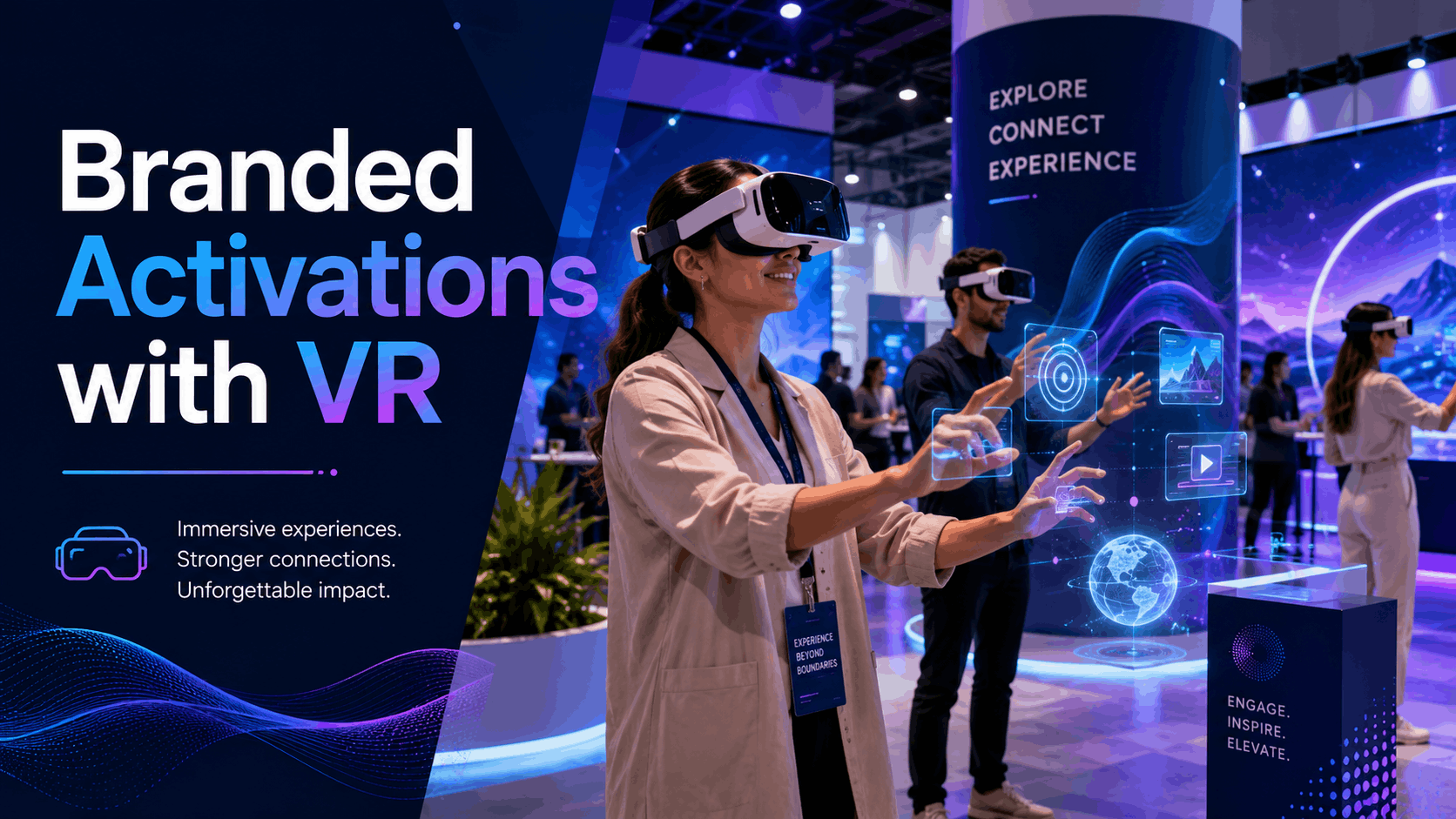
Virtual reality transforms brand activations from crowded-booth competitions into memorable, immersive experiences that attendees actively seek out. This guide provides activation teams with the strategic framework, technical requirements, and measurement strategies needed to execute successful VR brand activations.
Why VR Changes the Brand Activation Game
Traditional brand activations compete for attention in crowded spaces. VR creates contained, immersive environments where your brand controls the entire experience. Here’s what changes when you add VR to your activation toolkit.
From Passive Viewing to Active Participation
VR fundamentally shifts the engagement dynamic at brand activations. Where traditional displays might hold attention for 2-3 minutes, VR experiences consistently achieve 8-12 minute dwell times. This extended engagement happens because participants become active characters in your brand story rather than passive observers.
The neurological impact is measurable. Stanford’s Virtual Human Interaction Lab found that VR experiences generate 27% stronger memory encoding compared to traditional video displays. Participants don’t just remember seeing your brand—they remember being inside it, interacting with it, and experiencing it firsthand.
This participation shift creates emotional investment. When someone virtually test drives a vehicle through mountain roads or explores a destination they’re considering, they form personal connections with the experience. These connections translate to 34% higher brand recall rates two weeks post-event compared to traditional activation methods.
The Social Amplification Effect
VR activations generate approximately 3x more social shares than static displays, driven by the inherent shareability of someone wearing a headset and reacting to virtual stimuli. The spectator value alone creates organic crowd formation—passersby stop to watch participants dodge virtual objects, reach for invisible items, or react with genuine surprise.
This spectator dynamic serves dual purposes. First, it creates natural queue formation as observers become interested participants. Second, it provides content opportunities as friends capture reactions, creating authentic user-generated content that extends your activation’s reach beyond the physical event.
Smart activations leverage this by incorporating mixed reality displays that show what the VR user sees, allowing spectators to follow along. Some brands add commentary or competitive elements, turning individual experiences into group entertainment. The result: one headset can engage 15-20 people simultaneously through direct use and spectator engagement.
VR Activation Formats That Drive Results
Not all VR experiences work for brand activations. These formats consistently deliver engagement and align with activation objectives.
Product Immersion Experiences
Virtual showrooms revolutionize how automotive, real estate, and travel brands showcase offerings at events. Instead of bringing one vehicle or displaying property photos, VR enables complete portfolio exploration. Automotive brands report 67% of VR activation participants schedule test drives, compared to 23% from traditional displays.
For complex B2B products, 360-degree virtual exploration solves the logistics challenge of transporting industrial equipment to trade shows. Manufacturing companies use VR to demonstrate assembly processes, safety features, and customization options. These immersive demonstrations reduce sales cycle length by an average of 18% when used at industry events.
Before/after transformations work exceptionally well for home improvement and beauty brands. Participants can virtually remodel spaces or preview cosmetic procedures, creating emotional investment in potential outcomes. These experiential previews generate 4x more qualified leads than traditional before/after photo displays.
Branded Gaming and Challenges
Competitive VR experiences drive repeat engagement throughout multi-day events. Leaderboard systems encourage participants to return, bringing colleagues or friends to beat their scores. This repeat traffic increases total booth interactions by 45% compared to single-experience activations.
Gaming formats work particularly well for lifestyle and beverage brands targeting younger demographics. A sports drink brand might create a virtual obstacle course, while an outdoor gear company could simulate mountain climbing challenges. These experiences naturally incorporate product placement while maintaining entertainment value.
Prize integration through gameplay provides organic lead capture opportunities. Participants willingly provide contact information to register scores and qualify for prizes. This gamified data collection achieves 78% completion rates compared to 12% for traditional booth survey cards.
Virtual Brand Worlds
Transportation experiences take users to locations impossible to recreate at events. Beverage brands transport participants to origin farms, automotive companies provide factory tours, and travel brands offer destination previews. These narrative journeys create emotional connections to brand heritage and values.
Impossible experiences differentiate activations from competitors. Underwater explorations for marine conservation sponsors, space station visits for technology companies, or historical recreations for heritage brands create talking points that extend beyond the event. Participants share these unique experiences at higher rates, generating 5x more social media mentions than product-focused demos.
Multi-user experiences enable group activations, particularly valuable for B2B events where decision-makers attend together. Synchronized VR experiences for 4-6 participants create shared reference points for post-event discussions, accelerating consensus building in complex sales cycles.
Planning Your VR Brand Activation
Successful VR activations require different planning than traditional booth setups. Here’s your pre-event checklist.
Space and Setup Requirements
Each VR station requires minimum 8×8 feet of clear space for safe movement. This accounts for arm extension and small steps while immersed. Mark boundaries with physical barriers or floor tape to prevent collisions with booth furniture or other attendees.
Power infrastructure needs careful planning. Each VR station typically requires 2-3 dedicated outlets: one for the headset charging/connection, one for the processing unit if PC-powered, and one for display screens. Verify venue power capacity and outlet locations during site visits. Consider battery-powered options for venues with limited electrical access.
Queue management becomes critical for popular activations. Design serpentine queue systems that keep waiting participants engaged with brand messaging or preview screens. Position queues to maximize visibility while preventing congestion in main traffic areas. Include seating for longer waits and clear signage indicating expected wait times.
Spectator viewing areas multiply engagement beyond direct participants. Install large displays showing the VR user’s perspective, creating theater-like experiences for waiting guests. Position these screens at heights visible from distance to attract foot traffic. Add commentary capabilities for brand ambassadors to narrate experiences.
Staffing and Support Needs
Maintain minimum one brand ambassador per two VR stations for optimal participant support. This ratio ensures proper headset fitting, experience guidance, and safety monitoring while maintaining reasonable labor costs. For high-traffic events, consider one-to-one staffing during peak hours.
Technical support requirements vary by system complexity. Standalone headsets like Meta Quest 3 require minimal technical expertise, while PC-powered systems need dedicated IT support. Budget for on-site technical staff or ensure rental partners provide support coverage throughout event hours.
Staff training should cover equipment operation, troubleshooting common issues, hygiene protocols, and experience narration. Conduct training sessions before event day, including hands-on practice with actual equipment. Create quick reference guides for common problems like tracking loss or software crashes.
Hygiene protocols have become paramount post-pandemic. Implement cleaning stations with antibacterial wipes between users. Consider disposable face masks or sanitary barriers. Schedule deep cleaning every 2-3 hours for heavy-use events. Communicate cleaning procedures visibly to build participant confidence.
Content Selection and Customization
Off-the-shelf VR experiences cost $500-5,000 for licensing, providing immediate deployment without development time. These work well for standard activation goals like entertainment or basic product visualization. Popular platforms offer libraries of customizable experiences across industries.
Custom development ranges from $15,000 for simple modifications to $150,000+ for complex, fully branded experiences. Development timelines typically span 8-16 weeks. Custom content provides complete brand control and unique experiences unavailable to competitors.
Branding integration within existing content offers middle-ground solutions. Many experiences allow logo placement, color customization, and audio branding for $2,000-10,000. This approach balances customization with faster deployment and lower costs.
Duration optimization impacts throughput significantly. Three-minute experiences allow 20 participants per hour per station, while eight-minute experiences reduce this to 7-8 participants. Balance engagement depth with event attendance projections. Consider offering both quick teaser and full experiences to accommodate different interest levels.
VR Hardware Selection for Activations
The right headset depends on your activation goals, venue, and audience. Here’s how to match hardware to your needs.
Standalone vs PC-Powered Systems
Meta Quest 3 dominates activation deployments due to portability and ease of setup. At $500-650 per unit, these standalone headsets eliminate cable management and reduce setup time to under 10 minutes per station. Battery life extends 2-3 hours, requiring rotation systems for all-day events.
PC-powered systems like HTC Vive Pro or Varjo Aero deliver superior visual quality crucial for architectural visualization or detailed product demonstrations. These systems cost $1,500-5,000 per complete setup but provide unlimited power and maximum graphical fidelity. Setup complexity increases to 30-45 minutes per station.
Consider hybrid approaches using standalone headsets with optional PC connections. This flexibility allows quality upgrades for specific demonstrations while maintaining portability for standard experiences. Quest 3 supports this configuration, providing versatility for varied activation needs.
Battery management strategies for standalone systems include maintaining 3-4 headsets per active station, rotating units through charging cycles. Portable battery packs extend operation time but add weight. Some teams prefer scheduling 15-minute charging breaks every two hours.
Multi-User Activation Setups
Synchronized experiences across multiple headsets create shared moments that amplify engagement. Systems like SynthesisVR or SpringboardVR enable central control of up to 20 headsets simultaneously, perfect for group competitions or collaborative experiences.
Mixed reality displays showing participant perspectives require additional hardware consideration. Capture cards, green screens, and broadcasting software add $2,000-5,000 per station but dramatically increase spectator engagement. Some headsets include built-in casting capabilities, simplifying setup.
Network infrastructure becomes critical for connected experiences. Dedicated 5GHz WiFi networks prevent interference from attendee devices. For events with unreliable internet, consider local network solutions that don’t require external connectivity. Test bandwidth requirements during setup, accounting for peak usage periods.
Scalability planning should account for success. Design systems that can expand from 2 to 10+ stations without complete reconfiguration. Modular approaches using identical hardware setups simplify troubleshooting and staff training while enabling quick capacity adjustments based on demand.
Measuring VR Activation Success
VR activations generate unique metrics beyond traditional foot traffic. Track these KPIs to prove ROI.
Engagement Metrics
Experience completion rates indicate content effectiveness and participant satisfaction. VR activations typically achieve 85-92% completion rates, significantly higher than video displays at 45-60%. Track dropoff points to identify content improvements for future events.
Dwell time comparisons reveal VR’s engagement advantage. Measure total booth time for VR participants versus non-VR visitors. Leading brands report 4x longer engagement for VR users, translating to deeper brand conversations and higher conversion rates.
Repeat participation signals exceptional engagement. Track returning participants through registration systems or loyalty programs. Successful gaming-style activations see 15-20% repeat participation at multi-day events, creating multiple touchpoints with high-value prospects.
Queue length serves as social proof while indicating capacity needs. Document peak queue times and average wait periods. Visible queues attract additional participants while excessive waits may deter engagement. Target 10-15 minute maximum wait times through capacity planning.
Lead Quality Indicators
Post-experience survey completion rates reach 73% for VR participants versus 19% for traditional activations. The emotional investment from VR experiences creates willingness to provide feedback and contact information. Design brief surveys that capture while enthusiasm remains high.
Contact information capture through VR interfaces achieves higher accuracy than manual entry. Virtual keyboards or voice input within experiences reduce friction while maintaining immersion. Some platforms enable automatic data capture through pre-registration or badge scanning integration.
Sales meeting requests after VR experiences convert at 2.3x the rate of traditional booth interactions. Track meeting scheduling immediately post-experience and follow-up engagement rates. VR participants show higher commitment to sales conversations, shortening overall sales cycles.
Social media metrics specific to VR include hashtag usage, video shares, and user-generated content quality. VR activations generate more video content than photo-based sharing, increasing organic reach through platform algorithms favoring video. Monitor both immediate shares and delayed posts as participants process experiences.
Budget Planning for VR Activations
VR activation costs vary widely based on scale and customization. Here’s how to build your budget.
Rental vs Purchase Economics
Four-day rental packages range $400-800 per headset including basic content and setup support. This pricing makes rental attractive for single events or testing VR activation viability. Extended rentals for touring activations often include volume discounts, reducing per-event costs 20-30%.
Purchase economics favor repeated use. At $500-1,500 per headset, ownership breaks even after 2-3 events. Factor ongoing costs including storage ($50-100/month), maintenance ($200-500/year per unit), and software updates ($100-300/year). Insurance adds 2-3% of equipment value annually.
Rental packages typically include technical support, backup equipment, and content licensing, eliminating hidden costs. Purchases require separate budgets for these elements. Calculate total cost of ownership over expected equipment lifetime (typically 2-3 years for commercial use).
Hybrid approaches optimize budgets by purchasing core equipment while renting supplementary units for large events. This strategy provides consistency while maintaining flexibility for varying activation scales.
Hidden Costs to Account For
Shipping and insurance for VR equipment adds $200-500 per event for standard 4-headset setups. International shipping can triple these costs. Consider regional equipment sourcing or permanent storage near frequent event locations.
Additional staffing specifically for VR management increases labor budgets 30-50% compared to traditional activations. Include training time, setup/breakdown hours, and potential overtime for extended event days. Technical support contractors charge $75-150/hour if not included in rental packages.
Backup equipment should represent 20-25% of active inventory. For 4-station activations, maintain one complete backup station. This redundancy prevents complete failure from technical issues while enabling quick replacements to minimize downtime.
Custom content development often exceeds initial estimates. Budget 20-30% contingency for revisions, platform compatibility updates, and post-launch optimizations. Include ongoing content updates to maintain freshness for touring activations or repeated events.
Common VR Activation Mistakes to Avoid
Learn from others’ experiences. These mistakes can derail an otherwise strong activation.
Technical Failures
WiFi dependency without testing actual event networks causes 35% of VR activation failures. Convention center WiFi often cannot support VR streaming requirements. Test bandwidth, latency, and stability during setup. Prepare offline alternatives or dedicated hotspots as backups.
Battery planning mistakes leave stations inactive during peak traffic. All-day events require 3-4 battery cycles for standalone headsets. Underestimating power needs results in missed engagement opportunities and frustrated attendees. Create charging schedules and maintain spare batteries.
Equipment failure contingencies are often overlooked. Hardware issues affect 1 in 10 headsets during multi-day events. Without backup equipment, single failures can eliminate 25% of capacity. Maintain spare headsets, cables, and accessories to ensure continuous operation.
Content compatibility assumptions create day-of surprises. Not all VR content works across all headsets or operating system versions. Test exact content versions on actual event hardware one week before events. Include time for updates and compatibility fixes in setup schedules.
Experience Design Errors
Excessive experience length reduces total participation by 60-70%. Eight-minute experiences might seem engaging but limit hourly throughput to 7 participants per station. For high-traffic events, design 3-4 minute experiences with optional extended versions for interested participants.
Motion sickness affects 15-20% of VR users with poorly designed content. Rapid movements, acceleration mismatches, and horizon instability trigger discomfort. Select content with comfort ratings and offer stationary alternatives. Train staff to recognize early discomfort signs.
Glasses compatibility overlooked during planning affects 64% of adults requiring vision correction. Many headsets accommodate glasses poorly, creating discomfort or preventing participation. Choose headsets with glasses spacers or provide prescription lens adapters for frequent activations.
Spectator experience represents missed engagement for 40% of VR activations. Single-user experiences without external displays waste crowd attention. Implement mixed reality displays, commentary systems, or competitive elements that engage non-participants. Transform waiting from passive to active through spectator involvement.
Frequently Asked Questions
How many people can experience VR at our activation per hour?
Per-station throughput depends on experience length. Three-minute experiences accommodate 15-20 participants hourly, while eight-minute experiences serve 6-7 participants. Factor 30-60 seconds for headset transitions. Multiple stations multiply capacity linearly.
What’s the typical ROI for VR brand activations?
VR activations generate 3-4x more qualified leads than traditional displays, with conversion rates 2.3x higher. Cost per qualified lead typically decreases 40-50% despite higher initial investment. B2B companies report 18% shorter sales cycles for VR-engaged prospects.
Do we need custom VR content or can we use existing experiences?
Existing experiences work well for 70% of activation goals, particularly for entertainment or general engagement objectives. Custom content becomes valuable for specific product demonstrations, unique brand stories, or competitive differentiation. Start with existing content, then invest in custom development based on proven success.
How do we handle hygiene concerns with shared VR headsets?
Implement visible cleaning protocols between users using antibacterial wipes and sanitizing sprays. Provide disposable face masks or sanitary barriers. Schedule deep cleaning every 2-3 hours. Display cleaning schedules prominently. Consider UV sanitizing stations for high-traffic events.
What’s the minimum booth size needed for a VR activation?
Single-station VR activations require minimum 10×10 feet including safety buffer and queue space. Multi-station setups need 20×20 feet for comfortable operation with spectator areas. Corner booths optimize traffic flow. Island configurations work best for 4+ stations.
Can VR activations work outdoors?
Outdoor VR faces challenges from sunlight interference with tracking systems and screen visibility. Tent coverings or canopies solve lighting issues. Wind affects stability and audio quality. Temperature extremes impact equipment performance and battery life. Indoor venues provide most reliable experiences.
How do we capture leads through VR experiences?
Integrate registration before experience starts through badge scanning or manual entry. Embed data capture within experiences using virtual interfaces. Gamification naturally encourages contact information sharing for leaderboards. Post-experience surveys achieve high completion rates while enthusiasm peaks.
What backup equipment should we have on hand?
Maintain 25% spare capacity for all components: headsets, controllers, cables, and processing units. Include cleaning supplies, batteries, and basic tools. Keep printed troubleshooting guides and contact information for technical support. Test backup equipment during setup to ensure functionality.
Conclusion
VR brand activations transform passive booth visits into memorable experiences that attendees actively seek out and share. Success requires careful planning across space design, equipment selection, content strategy, and measurement frameworks. The investment in VR technology and expertise pays dividends through increased dwell time, higher lead quality, and amplified social reach.
Start with rental equipment and proven content formats to test VR’s impact on your activation goals. Scale gradually based on measured results and audience feedback. Focus on creating experiences that align with brand values while providing genuine value to participants.
Ready to elevate your next brand activation with VR? Begin by defining clear objectives, selecting appropriate hardware and content, and building the operational framework for successful execution. The future of brand activations is immersive, interactive, and impossible to ignore.

