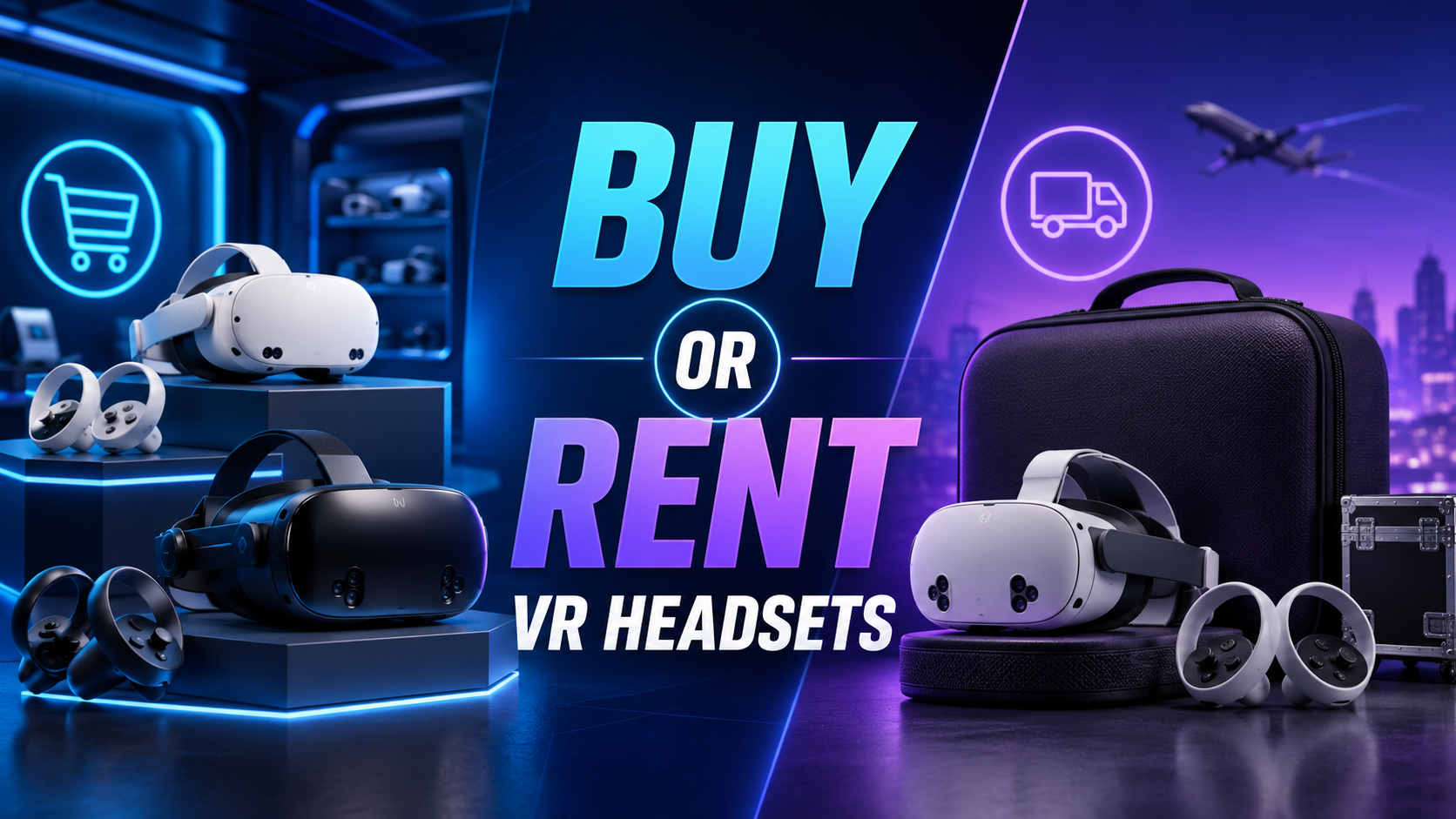
Virtual reality adoption in corporate settings has moved beyond experimentation to strategic implementation. Whether you’re planning immersive training programs, hosting brand activations, or running product demonstrations, the fundamental question remains: should you buy or rent VR equipment for your business needs?
This decision impacts your budget allocation, operational flexibility, and program scalability. The right choice depends on your usage patterns, technical capabilities, and long-term VR strategy. This framework maps specific business scenarios to optimal ownership models, helping you make data-driven decisions about VR infrastructure investments.
When to Rent VR Headsets: Variable-Use Business Scenarios
Rental makes strategic sense when your VR deployment has variable demand, experimental scope, or event-based timing. Here’s how to recognize rental-optimal scenarios and what operational benefits you gain.
Pilot Programs and Proof-of-Concept Testing
VR pilot programs require flexibility that ownership can’t match. When testing training modules with 10-50 employees, renting eliminates the risk of investing in equipment that might not meet your needs after evaluation.
Rental providers offer critical advantages during pilot phases:
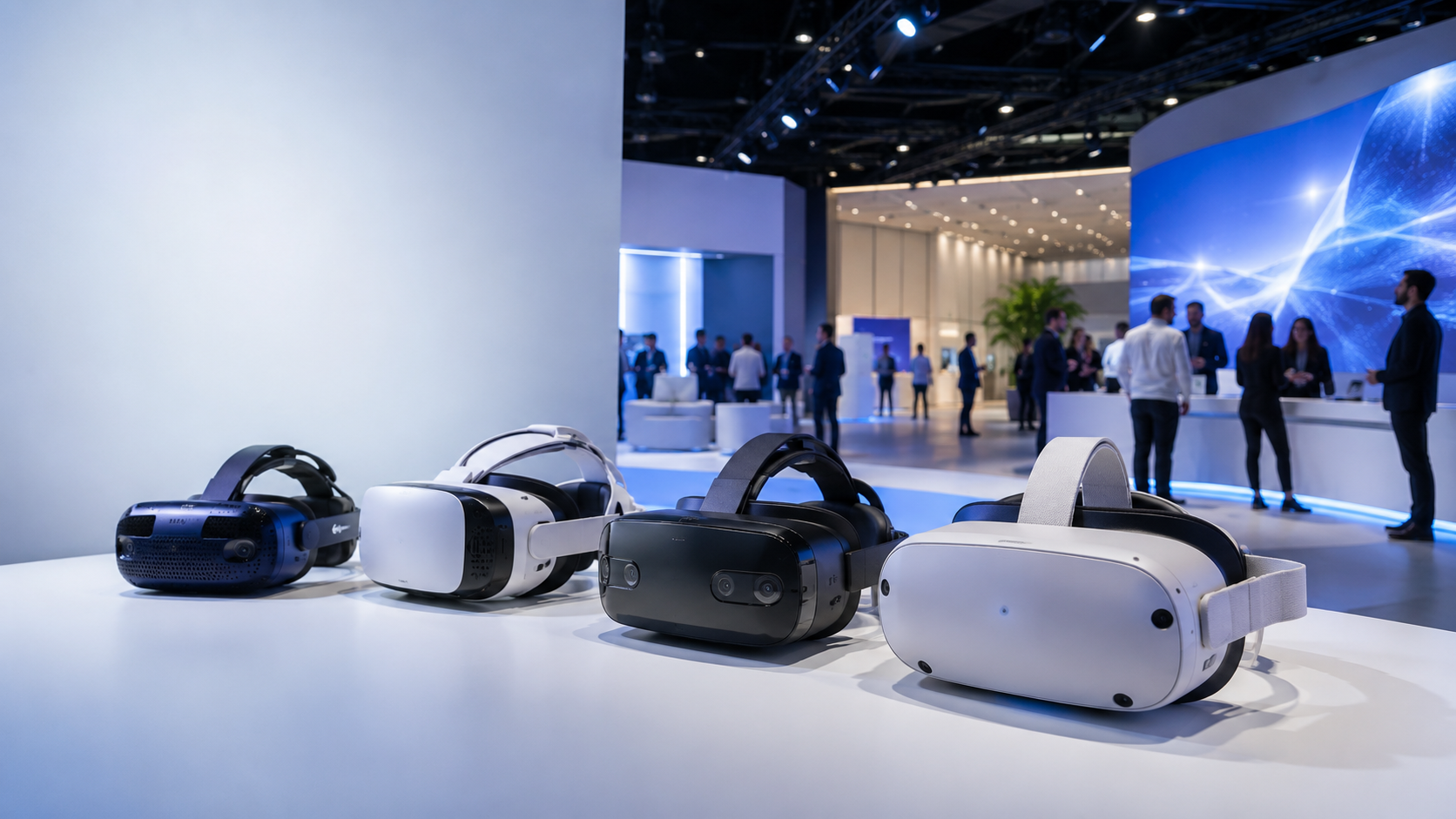
Testing flexibility allows you to switch between Meta Quest 3, PICO 4 Enterprise, and HTC Vive Focus 3 models without purchasing multiple systems. Each headset offers different strengths—Quest 3 for hand tracking, PICO for enterprise management tools, Vive for premium displays—and renting lets you evaluate which aligns with your training objectives.
Preloaded content packages accelerate pilot timelines from weeks to days. Providers like ArborXR and ManageXR include enterprise content libraries spanning safety training, soft skills development, and technical simulations. Your pilot launches immediately without content procurement delays.
Validation metrics emerge before capital commitment. Track engagement rates, completion times, and learning outcomes across different departments. If VR training shows 40% faster skill acquisition but only in technical roles, you’ve learned this without purchasing 50 headsets that sit idle.
Rapid iteration becomes possible when you’re not locked into hardware. Discover that standalone headsets work better than PC-tethered systems? Switch your rental order next month. Find that hand tracking improves engagement over controllers? Upgrade to devices with better sensors without selling existing inventory.
Seasonal Events and Trade Show Circuits
Trade show seasons create predictable but temporary VR demand spikes. Companies exhibiting at CES, NAB, or industry-specific conferences need impressive VR demonstrations for 3-5 events annually, with months of downtime between.
Peak demand economics favor rental when you need 20 headsets for a three-day event but zero headsets for the following quarter. Purchasing those devices means 80% idle time, storage costs, and depreciation without value generation.
Shipping logistics become the rental provider’s responsibility. They ship directly to convention centers, handle customs for international events, and manage return logistics. Your team focuses on booth design and customer engagement rather than tracking 20 headset shipments.
On-site support packages include technicians who handle setup, troubleshooting, and breakdown. When demonstration units fail during peak booth traffic, rental support swaps devices immediately. Owned equipment requires flying your IT staff to events or risking downtime.
Latest model access keeps demonstrations cutting-edge. Rental fleets refresh every 12-18 months, ensuring you showcase products using current-generation hardware. Owned equipment from 2022 looks dated at 2024 events, undermining your innovation messaging.
Multi-Location Activations Without IT Infrastructure
Distributed VR deployments challenge organizations lacking dedicated technical resources at each location. Rental models solve infrastructure gaps through managed services.
Branch office deployments succeed without local VR expertise. A pharmaceutical company training sales representatives across 15 regional offices can rent preconfigured headsets that arrive ready for immediate use. No local IT configuration, no software installation, no network integration required.
Roadshow logistics simplify with rental partnerships. Marketing agencies running 30-city product launch tours rent location-specific quantities—10 headsets for Chicago, 25 for New York, 15 for Los Angeles—without managing interstate equipment transfers.
Device management overhead disappears with rental packages. Providers handle firmware updates, app installations, and security patches remotely. Your branch managers focus on running sessions, not troubleshooting “headset won’t connect” issues.
Turnkey experiences launch immediately upon delivery. Automotive companies demonstrating virtual showrooms receive headsets with experiences preloaded, tested, and optimized. Unbox, power on, and start demonstrations without technical setup.
When to Buy VR Headsets: Sustained-Use Business Cases
Purchasing VR equipment becomes cost-effective when you have consistent usage patterns, dedicated support resources, and long-term training programs. These scenarios justify ownership.
Ongoing Employee Training Programs
Regular VR training sessions transform purchasing from expense to investment. Organizations running weekly orientation programs or monthly skills workshops reach ownership break-even points within 12-15 months.
New hire onboarding programs using VR twice weekly for groups of 8-12 employees generate 100+ sessions annually. At $300-500 per headset rental versus $500-1500 purchase price, ownership pays for itself by month six.
Custom content development requires device control that rental agreements restrict. When building proprietary training modules, you need development devices, testing units, and production headsets under unified management. Rental providers limit software installation and modification rights.
Learning Management System (LMS) integration works better with owned devices. Cornerstone, Workday Learning, and similar platforms require persistent device IDs, custom authentication, and progress tracking that rental rotations complicate.
Break-even analysis typically shows positive ROI at 15-20 rental periods annually. A Quest 3 at $650 purchase price versus $50 daily rental breaks even at 13 days of use. Factor in multi-day discounts, and the threshold rises to approximately 20 rental days before ownership becomes economical.
Permanent Installation Spaces
Dedicated VR environments justify ownership through utilization rates and customization requirements that rental models can’t accommodate.
VR training rooms with fixed play areas, ceiling-mounted cable management, and wall-anchored sensors need consistent hardware. Swapping rental units monthly means recalibrating room-scale boundaries, adjusting safety zones, and updating tracking configurations repeatedly.
Innovation labs showcasing VR capabilities to clients, partners, and employees require immediate availability. Scheduling rental deliveries for unexpected executive visits or spontaneous demonstrations creates friction that owned equipment eliminates.
Customer experience centers operating daily need reliable access. Retail stores offering virtual home design consultations, healthcare facilities providing therapy sessions, and real estate offices showing virtual property tours can’t risk rental availability gaps.
Consistent configurations ensure reliable experiences. Owned devices maintain identical settings, installed applications, and user profiles. Rental rotations introduce variables—different firmware versions, varied app versions, inconsistent settings—that complicate support.
High-Volume Simultaneous Sessions
Large-scale simultaneous VR deployments reach ownership economics through volume discounts and operational efficiencies that rental logistics can’t match.
Training cohorts of 20+ participants require synchronized experiences. Universities running VR chemistry labs for entire classes need identical headsets with matching software versions. Purchasing ensures uniformity; rental risks mixed device generations.
Enterprise deployments exceeding 50 headsets unlock bulk pricing. Meta offers 20-30% discounts on 50+ unit orders. HTC provides enterprise agreements with reduced per-unit costs. These savings don’t apply to rental relationships where providers maintain margins.
Fleet management becomes economical at scale. Investing in ArborXR or similar MDM platforms ($30/device/month) makes sense for 50+ headsets but not for occasional rentals. The management overhead justifies dedicated IT resources.
Simultaneous usage eliminates rental scheduling complexity. Running parallel training sessions across multiple departments requires guaranteed equipment availability that rental providers struggle to ensure during peak seasons.
Total Cost Analysis: Rental vs Purchase Over 12-24 Months
Beyond upfront costs, factor in support, upgrades, content management, and utilization rates. This framework maps true total cost of ownership against rental economics.
Hidden Costs of VR Ownership
Purchasing VR headsets triggers ongoing expenses that initial budgets often overlook. These hidden costs can double the true investment over 24 months.
Device management platforms cost $20-50 per headset monthly for enterprise features. ArborXR, ManageXR, and PICO Business Suite provide essential capabilities—remote app deployment, usage analytics, device lockdown—that internal IT can’t replicate efficiently.
Support overhead consumes 2-4 IT hours weekly per 10 headsets. Troubleshooting tracking issues, updating firmware, replacing foam interfaces, and managing user accounts create ongoing labor costs averaging $200-400 weekly for modest fleets.
Physical infrastructure adds $100-200 per headset. Charging stations ($30-50), carrying cases ($40-80), replacement straps ($25-40), and hygiene covers ($20-30) ensure professional deployment but increase investment 20-30% beyond hardware costs.
Depreciation curves eliminate value within 18-24 months. VR hardware refreshes rapidly—Quest 2 to Quest 3 took 24 months—making two-year-old equipment functionally obsolete for cutting-edge applications. Accounting depreciation at 40% annually reflects market reality.
Insurance and replacements add 5-10% annually. Cracked lenses, dead pixels, and failed straps require immediate replacement to maintain training schedules. Self-insurance through spare units or third-party coverage costs $30-60 per headset yearly.
Rental Package Economics
All-inclusive rental pricing simplifies budgeting while providing operational advantages that ownership can’t match.
Bundled pricing includes shipping, support, and software. Daily rates of $40-75 per headset cover everything except content licensing. No surprise charges for damaged straps or dead batteries.
Setup time savings translate to labor cost reductions. Receiving preconfigured headsets saves 2-3 hours per device in initial setup and 30 minutes per session in preparation. For 20 headsets across 10 events, that’s 100+ hours of staff time saved.
Damage protection eliminates replacement anxiety. Standard rental agreements include accidental damage coverage. Drop a headset during training? Covered. Scratched lens during transport? Included. This protection would cost $50-100 per device annually if purchased separately.
Scaling flexibility matches actual demand. Need 10 headsets in January, 50 in March for a sales meeting, then 15 monthly afterward? Rental accommodates variation without idle inventory or emergency purchases.
Hardware refresh happens automatically. Rental providers upgrade fleets every 12-18 months. Your events always feature current technology without managing trade-ins, resale, or disposal.
Break-Even Calculation Framework
Strategic decision-making requires quantitative analysis beyond simple price comparisons. This framework calculates true break-even points.
Usage frequency thresholds determine ownership viability:
- Under 10 days annually: Always rent
- 10-20 days annually: Evaluate based on other factors
- 20-30 days annually: Lean toward purchasing
- Over 30 days annually: Strong purchase case
Group size impact shifts economics significantly. Training 5 people requires different calculations than training 50:
- Small groups (5-10 headsets): Rental breaks even at 25-30 days
- Medium groups (15-25 headsets): Break-even drops to 20-25 days
- Large groups (30+ headsets): Consider purchasing at 15+ days usage
Geographic distribution affects total cost calculations. Single-location deployments favor ownership through eliminated shipping costs. Multi-city programs benefit from rental providers’ distributed inventory and logistics networks.
Content requirements influence ownership decisions. Generic training content works well with rental packages. Custom applications requiring specific hardware configurations, development testing, or frequent updates justify ownership for control and flexibility.
Hybrid Approach: Core Fleet Plus Surge Rental Capacity
Many businesses find optimal economics in owning a base fleet for regular use while renting additional units for peak demand. This strategy balances cost control with flexibility.
Determining Your Base Fleet Size
Calculating optimal owned inventory requires analyzing usage patterns and accepting some inefficiency for flexibility.
Minimum consistent usage defines your baseline. If you train 10 people weekly, own 12 headsets (20% buffer for maintenance and failures). This core fleet handles 80% of your VR activities cost-effectively.
Standard group sizing influences purchase quantities. Organizations consistently training in cohorts of 15 should own 15-18 headsets rather than constantly renting partial quantities or maintaining excess inventory.
Geographic concentration justifies local ownership. If 70% of VR usage occurs at headquarters, own that capacity there. Rent for occasional branch office deployments rather than shipping owned equipment cross-country.
Budget allocation balances capital and operating expenses. Many organizations prefer predictable opex (rental) over lumpy capex (purchase). Hybrid models allow $50K capex for core fleet with $30K annual opex for surge capacity.
Surge Rental Triggers and Planning
Identifying surge events enables proactive rental planning and budget allocation.
Annual sales kickoffs requiring 100+ headsets for simultaneous training justify rental augmentation. If you own 30 headsets but need 120 for the annual meeting, rent 90 additional units rather than purchasing equipment used once yearly.
Product launch events with uncertain attendance benefit from rental flexibility. Reserve 50 headsets with ability to add 25 more based on registration. This optionality costs marginally more than fixed rental but far less than owning unused capacity.
Pilot program expansion uses rental to validate scaling. Your successful 10-person pilot needs testing with 50 people before company-wide rollout. Rent 40 additional headsets for the expanded pilot, then purchase based on validated requirements.
Technology evaluation leverages rental for comparison. Own Quest 3 headsets but want to evaluate Apple Vision Pro for specific use cases? Rent 5 units for a month rather than making a $17,500 purchase decision blindly.
Implementation Roadmap for Your Chosen Path
Once you’ve decided between renting, buying, or hybrid, execution determines success. These implementation guides ensure smooth deployment regardless of your ownership model.
Rental Implementation Checklist
Successful rental relationships require thorough vendor evaluation and operational planning.
Vendor evaluation criteria:
- Device selection breadth (multiple manufacturers and models)
- Geographic coverage matching your deployment locations
- Support response times (2-hour SLA for events, next-day for training)
- Content library depth and custom content capabilities
- Reference checks from similar-industry clients
Lead time planning prevents availability crises. Large events (50+ headsets) require 3-4 week advance booking. International shipments need 2-3 weeks for customs clearance. Holiday seasons see 50% longer lead times due to demand.
Content specifications ensure smooth deployment:
- File formats and resolution requirements
- Testing protocols for custom applications
- Fallback content if primary experiences fail
- User instruction customization options
- Data collection and analytics requirements
Support negotiations define success criteria:
- On-site technician availability and costs
- Remote support response times
- Replacement unit quantities (typically 10% for critical events)
- Setup and breakdown assistance
- Training for your staff on basic troubleshooting
Return procedures prevent disputes:
- Inspection checklists and damage definitions
- Data wiping confirmation processes
- Shipping label generation and pickup scheduling
- Inventory reconciliation methods
- Billing dispute resolution procedures
Purchase Implementation Checklist
Ownership success requires infrastructure investment beyond hardware acquisition.
Hardware selection matrix:
- Use case requirements (standalone vs. PC-tethered)
- Tracking technology needs (inside-out vs. outside-in)
- Display quality requirements (resolution and field of view)
- Comfort factors for extended use sessions
- Enterprise features (MDM compatibility, bulk configuration)
Management platform deployment:
- MDM solution selection (ArborXR, ManageXR, VMware)
- Network configuration for device communication
- User authentication integration (Active Directory, SSO)
- Application deployment workflows
- Update scheduling and testing procedures
Content systems architecture:
- Licensing models (per-device vs. concurrent user)
- Distribution methods (sideloading vs. cloud deployment)
- Version control for custom applications
- Analytics integration for usage tracking
- Backup and recovery procedures
Staff training curriculum:
- Basic troubleshooting (90% of issues)
- Hardware maintenance and cleaning
- Software deployment and updates
- User support and guidance
- Escalation procedures for complex issues
Lifecycle management planning:
- Refresh cycle timing (18-24 months typically)
- Budget allocation for replacements
- Disposal procedures for old equipment
- Trade-in program evaluation
- Technology roadmap alignment
Vendor Partnership Considerations
Strategic vendor relationships optimize both rental and purchase paths through structured agreements.
Long-term rental agreements unlock volume discounts. Committing to $50K annual rental spending might reduce per-day rates 20-30%. These agreements provide budget predictability while maintaining flexibility.
Rent-to-own programs bridge rental and purchase decisions. Some providers apply 50-70% of rental fees toward purchase price if buying within 6 months. This allows extended evaluation before ownership commitment.
Managed services models combine owned and rented assets under unified support. Providers manage your owned fleet while supplying rental units for surge capacity, creating operational consistency across ownership models.
Content development partnerships leverage vendor expertise. Many rental providers offer custom content creation services, spreading development costs across their client base while ensuring hardware optimization.
Service level agreements define performance expectations:
- Equipment availability guarantees (99% for planned events)
- Support response times (2-hour event support, 24-hour standard)
- Replacement procedures for failed units
- Update coordination for firmware and software
- Data security and privacy compliance
Frequently Asked Questions
What’s the typical break-even point between renting and buying VR headsets?
Most businesses reach break-even at 15-20 rental days per year. A $600 headset renting at $40 daily breaks even at 15 days of use. Factor in hidden ownership costs (management software, support time, accessories), and the break-even point extends to 20-25 days for full cost recovery.
Can I rent VR headsets with my custom training content preloaded?
Yes, most enterprise rental providers preload custom content as part of their service. You’ll need to provide applications 5-7 business days before delivery for testing and deployment. Providers typically charge $5-10 per headset for custom content loading, though this is often waived for larger orders.
How do rental companies handle damaged or lost VR equipment?
Standard rental agreements include accidental damage protection covering normal wear, scratches, and minor breaks. Gross negligence or loss typically incurs replacement costs minus depreciation (usually 50-70% of retail price). Purchase damage waiver insurance for $5-10 per headset per rental period for complete coverage.
What’s the minimum rental period for business VR headsets?
Most providers offer single-day rentals, though pricing favors longer terms. Daily rates might be $50-75, while weekly rates average $200-300 (effectively $28-43 per day). Monthly rentals drop to $500-800 ($17-27 daily), making extended rentals more economical for multi-week projects.
Should startups buy or rent VR equipment for demos?
Startups should generally rent unless conducting daily demonstrations. Limited capital, uncertain product-market fit, and rapid iteration favor rental flexibility. Once achieving consistent demo schedules (3+ weekly), evaluate purchasing 2-3 units while maintaining rental relationships for larger events.
How much IT support is needed for owned vs rented VR headsets?
Owned headsets require approximately 0.5 IT hours weekly per 10 devices for maintenance, updates, and support. Rented headsets need virtually no IT involvement beyond initial training on basic operation. Factor $100-200 weekly in IT labor costs per 10 owned headsets versus zero for rentals.
Can I mix different VR headset models in a rental package?
Yes, most providers offer mixed-model packages. This allows testing different devices (Quest 3 for hand tracking, PICO 4 for enterprise features) or matching headsets to specific use cases. Expect 10-15% price premiums for mixed packages due to increased complexity.
What happens to rented VR headsets between events?
Rental providers sanitize, update, and test returned equipment before redeployment. Professional companies perform factory resets, apply hygiene protocols, update firmware/software, and conduct quality checks. This maintenance cycle typically takes 24-48 hours between rentals.
Do VR rental packages include backup units for large events?
Most providers include 5-10% spare units for orders over 20 headsets. For critical events, negotiate higher backup ratios (15-20%) or on-site technicians with replacement inventory. Backup units typically cost 25-50% of standard rental rates as insurance.
Conclusion
The decision to buy or rent VR headsets isn’t binary, it’s strategic. Your optimal approach depends on usage patterns, technical capabilities, and business objectives. Rental excels for variable demand, pilot programs, and distributed deployments without technical infrastructure. Ownership makes sense for consistent usage, permanent installations, and large-scale deployments with dedicated support.
Most organizations benefit from a hybrid approach: owning core capacity for predictable needs while renting for surge demand and experimentation. This strategy balances cost control with operational flexibility, ensuring you’re neither overpaying for idle equipment nor scrambling for capacity during critical events.
Start by analyzing your next six months of planned VR activities. Calculate usage days, group sizes, and geographic distribution. If you’ll use VR fewer than 15 days, rent. If more than 25 days, strongly consider purchasing. In between? Evaluate support resources, content requirements, and budget flexibility to guide your decision.
Ready to implement your VR strategy? Whether renting for an upcoming event or building a business case for purchase, begin with a small pilot program. Test your assumptions about usage patterns, support requirements, and user adoption before committing to either path. The insights gained from a thoughtful pilot will inform a VR infrastructure decision that serves your organization for years to come.