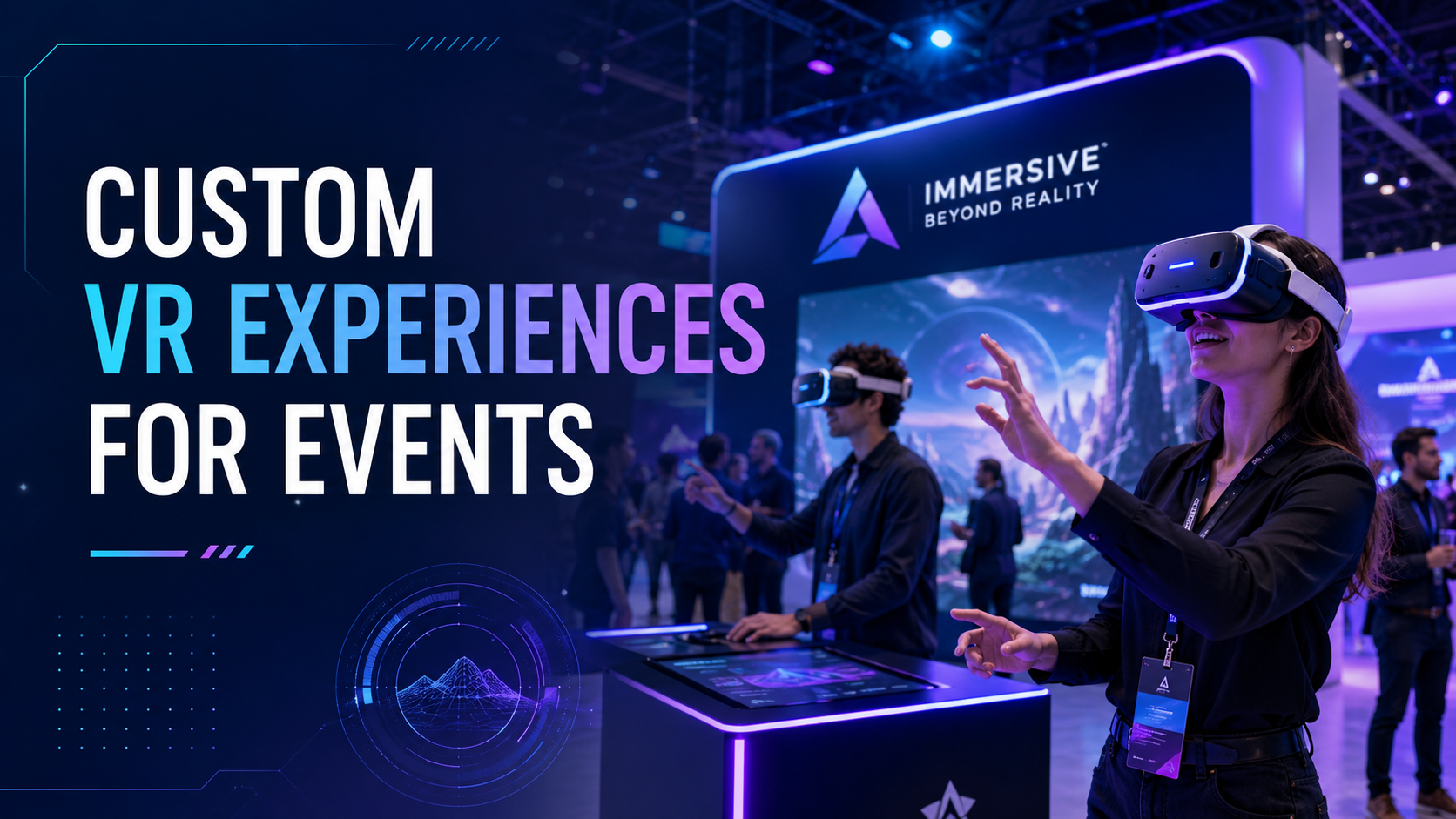
Virtual reality has evolved from a novelty attraction to a strategic tool for meaningful engagement at events. Whether you’re planning a trade show booth, corporate training session, or brand activation, custom VR experiences deliver measurable results when properly aligned with your objectives. This guide explores how to design, implement, and measure custom VR solutions that move beyond generic demos to create lasting impressions.
What Makes VR Experiences Truly Custom (Beyond Just Content Selection)
Custom VR experiences go beyond choosing from a content library. They involve tailoring the entire activation to your event goals, audience demographics, and operational constraints. Here’s how customization works across hardware selection, content curation, physical setup, and support levels.
True customization starts with understanding your event’s unique requirements. A pharmaceutical company demonstrating a new drug’s mechanism of action needs different hardware and content than a real estate developer showcasing luxury properties. The customization process considers participant throughput, physical space limitations, brand guidelines, and specific messaging objectives.
Hardware Configurations for Different Event Types
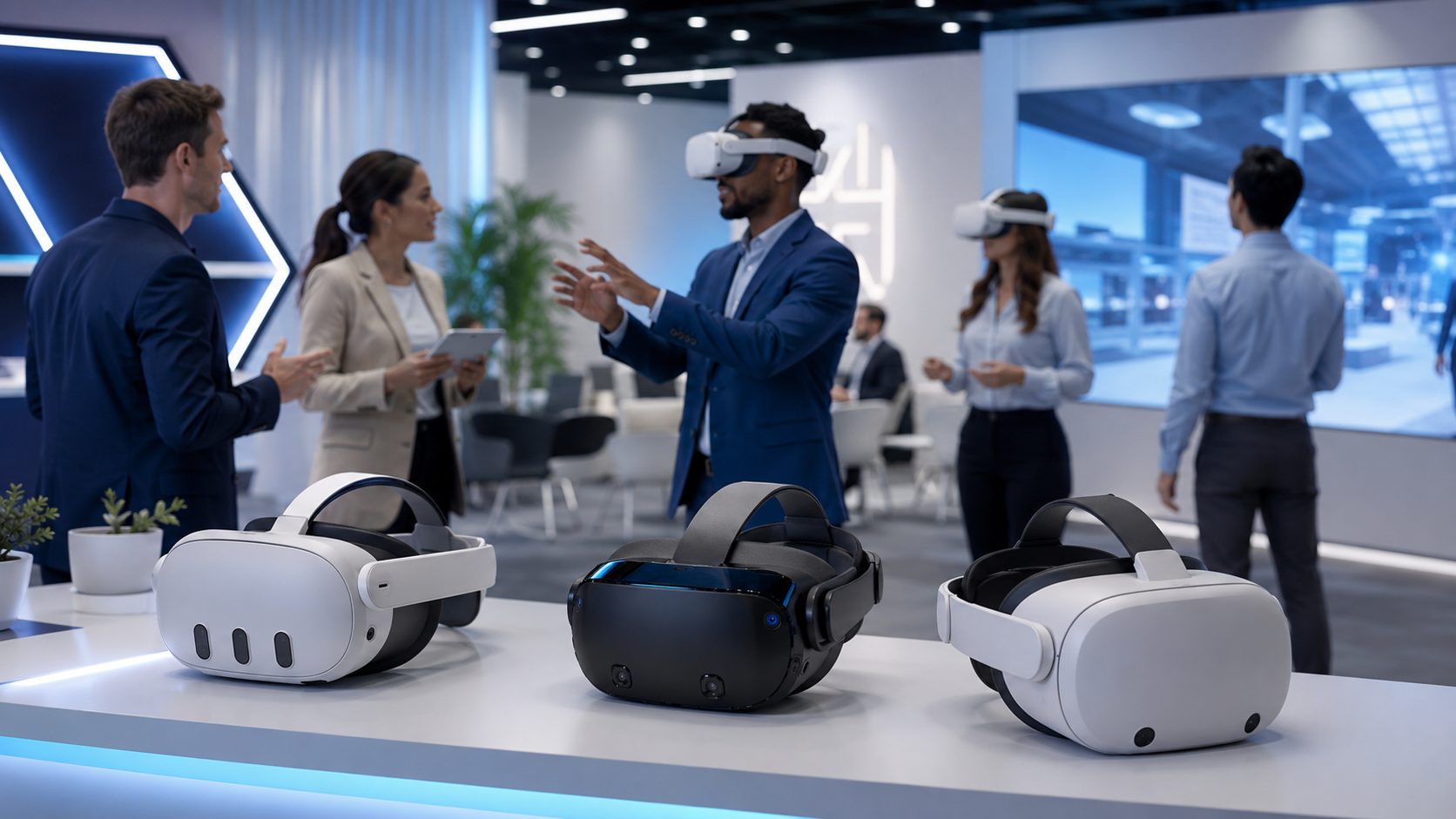
The foundation of any custom VR experience begins with selecting appropriate hardware for your venue and audience. Trade show booths with limited space and high traffic benefit from standalone headsets like the Meta Quest 3 or Pico 4 Enterprise. These wireless systems eliminate trip hazards and allow for quick setup between booth reconfigurations. Each headset handles 40-60 sessions per day with proper rotation and charging protocols.
PC-tethered systems using HTC Vive Pro or Varjo Aero headsets deliver superior graphics for architectural visualizations or detailed product demonstrations. These configurations work best in controlled environments with dedicated space and technical support. The trade-off between visual fidelity and operational complexity determines which path serves your objectives.
Multi-user synchronized experiences transform individual VR sessions into shared moments. Up to 20 participants can explore the same virtual environment simultaneously, seeing each other as avatars and interacting with shared objects. This configuration excels for team building exercises or collaborative training scenarios. Network infrastructure becomes critical, requiring dedicated routers and bandwidth allocation to maintain synchronization.
Wireless setups maximize flexibility but require careful frequency management in crowded venues. Convention centers with hundreds of wireless devices create interference that disrupts VR experiences. Professional rental providers conduct site surveys to identify potential conflicts and implement solutions like 5GHz channel isolation or wired fallback options.
Content Customization Levels
Content customization exists on a spectrum from light branding to full custom development. Understanding each level helps align expectations with budgets and timelines.
Off-the-shelf experiences with branded overlays represent the fastest path to deployment. Your logo appears in loading screens, virtual environments include branded elements, and color schemes match corporate guidelines. This approach works for companies needing professional VR content without development lead times. A automotive parts manufacturer might use an existing factory tour experience with their branding, achieving deployment in under two weeks.
Modified existing content takes pre-built experiences and adapts specific elements to your needs. A generic safety training module becomes industry-specific through custom scenarios, terminology changes, and relevant hazard examples. The underlying mechanics remain unchanged, but the context aligns with your training objectives. This middle ground balances customization with proven functionality.
Fully custom-developed VR applications start from your specific requirements. Every interaction, visual element, and narrative beat serves your communication goals. A medical device company might commission a VR experience showing how their implant works inside the human body, with accurate 3D models and procedural animations. Custom development requires 8-12 weeks minimum and budgets starting at $15,000.
The cost implications scale with complexity. Branded overlays add $500-1,500 to rental packages. Modified content ranges from $3,000-8,000 depending on the extent of changes. Full custom development varies widely based on scope, from $15,000 for simple experiences to $100,000+ for complex simulations with multiple scenarios.
Custom VR for Trade Shows and Brand Activations
Trade show booths need VR experiences that balance wow-factor with throughput. Your custom setup should handle 50-200 participants per day while maintaining consistent quality and minimal downtime.
Trade show VR differs fundamentally from permanent installations. Every element must pack efficiently, deploy quickly, and survive three days of continuous use. The experience itself needs to communicate value within minutes while leaving participants wanting more. Success requires orchestrating technology, content, and human factors into a seamless activation.
Designing for Booth Traffic Flow
The 3-5 minute experience sweet spot for trade shows balances engagement with efficiency. Shorter experiences feel rushed and fail to communicate complex messages. Longer sessions create bottlenecks that frustrate waiting attendees and reduce total reach. Professional VR experiences include natural breakpoints where users can exit gracefully if needed.
Queue management starts before visitors put on headsets. Digital displays showing the VR perspective create anticipation and educate waiting participants. Some setups include “spectator mode” where queued visitors see a curated view of the current user’s experience on external monitors. This transforms waiting time into preview time while building social proof as crowds gather to watch.
Physical booth layout influences throughput as much as content duration. VR stations positioned at booth corners pull traffic from aisles while maintaining clear sightlines to other displays. Raised platforms elevate participants above crowd level, creating visual interest while preventing collisions. Stanchions and rope barriers define personal space without creating claustrophobic enclosures.
Hygiene protocols protect participants while maintaining flow. Disposable face masks create barriers between users and headset padding. UV-C sanitization stations clean headsets between sessions during natural transition periods. Staff members wearing branded shirts guide participants through pre-experience briefings that include hygiene information, setting professional expectations while addressing concerns.
Headset rotation systems prevent overheating and extend battery life. A six-headset configuration might use four active units while two charge and cool. Quick-release mounting systems enable 30-second swaps without disrupting the experience flow. Backup headsets remain configured and ready to replace any unit showing problems.
Product Demonstration VR Experiences
Virtual factory tours transport trade show visitors behind the scenes without leaving the booth. A chemical manufacturer might showcase their production facility’s safety systems, quality control processes, and sustainability initiatives. The VR experience compresses a two-hour physical tour into five minutes of highlights, with interactive elements letting users explore areas of specific interest.
Interactive product configurators in VR surpass traditional displays by showing products in context. A commercial furniture manufacturer lets visitors design office spaces using their product line, immediately seeing how different configurations affect traffic flow and collaboration zones. Users email themselves configuration codes that sales teams reference during follow-up conversations.
Before/after scenarios demonstrate service value through visceral experiences. A cybersecurity firm might simulate a ransomware attack on a virtual office, showing cascading system failures and business disruption. The “after” scenario demonstrates how their solution prevents or mitigates the attack. This emotional journey creates urgency that spec sheets cannot match.
Industrial equipment demonstrations benefit from VR’s ability to show internal operations. A pump manufacturer reveals fluid dynamics inside their products, with cutaway views impossible in physical demos. Users adjust operating parameters and immediately see efficiency impacts through color-coded flow visualizations and real-time performance metrics.
Lead Capture Integration
Pre-experience registration workflows capture contact information while maintaining momentum. Tablets at VR stations collect basic details through progressive forms that request only essential information upfront. Additional fields populate during natural waiting periods, with gamified elements encouraging completion. Integration with CRM systems like Salesforce or HubSpot eliminates manual data entry.
Post-VR follow-up sequences trigger automatically based on experience interactions. A visitor who spent extra time exploring sustainability features receives targeted content about environmental initiatives. Someone who configured a specific product combination gets pricing information for that exact setup. This behavioral targeting improves conversion rates by 40% compared to generic follow-ups.
Analytics and engagement metrics prove booth ROI through quantifiable data. Heat maps show which virtual areas attracted the most attention, informing future content priorities. Completion rates indicate whether experiences maintain engagement throughout. Interaction logs reveal which features resonated with specific audience segments, enabling personalized sales conversations.
Lead scoring algorithms weight VR engagement alongside traditional metrics. A prospect who completes the full experience and explores multiple product options scores higher than someone who removes the headset after 30 seconds. Sales teams prioritize follow-up based on these engagement scores, focusing resources on highly qualified leads.
Corporate Event and Training Custom VR Solutions
Corporate VR experiences serve different masters than public-facing activations. They need to balance engagement with learning objectives, team dynamics with individual experiences, and entertainment with professional development.
Internal corporate events leverage VR to create shared experiences that transcend physical limitations. Remote team members participate alongside in-person colleagues, experiencing the same virtual environment regardless of location. This equality of experience strengthens team cohesion when hybrid work models create natural divisions.
Team Building VR Experiences
Collaborative puzzle-solving environments require teams to communicate and coordinate within virtual spaces. An escape room scenario might split team members across different virtual rooms, each containing clues that others need to progress. Success requires clear communication of visual information, delegation of tasks based on individual strengths, and collective problem-solving under time pressure.
Competitive team challenges with leaderboards inject energy into corporate events. Departments compete in virtual obstacle courses, with times posted on displays visible throughout the venue. The shared physical space amplifies virtual competition as teams cheer for colleagues currently in VR. This blend of virtual challenge and physical presence creates memorable experiences that strengthen departmental bonds.
Shared virtual spaces for remote teams eliminate geographical barriers to collaboration. A global sales meeting brings together representatives from 20 countries in a virtual conference center. Attendees customize avatars, explore vendor booths, and attend presentations together. Spatial audio enables natural conversations as participants move through the environment, recreating the serendipitous encounters that define in-person events.
Creative collaboration exercises use VR’s unique capabilities to unlock innovation. Teams might build virtual Rube Goldberg machines, with each member contributing components that must integrate seamlessly. The impossibility of these constructions in physical reality frees participants from practical constraints, encouraging bold thinking that transfers to real-world problem-solving.
Training and Simulation Customization
Safety training scenarios specific to your industry replace generic content with relevant situations. A construction company’s VR training includes their actual job sites, captured through photogrammetry and enhanced with hazard scenarios. Workers identify risks in familiar environments, with mistakes triggering consequences that reinforce learning without physical danger.
Manufacturing safety protocols come alive through interactive VR simulations. Workers practice lockout/tagout procedures on virtual equipment identical to their workplace machinery. The VR system tracks proper sequence completion, identifying knowledge gaps that additional training addresses. This precision targeting reduces workplace accidents by up to 43% compared to traditional training methods.
Soft skills practice in controlled environments addresses interpersonal challenges without real-world consequences. Managers practice difficult conversations with virtual employees exhibiting various personality types and emotional responses. AI-driven characters adapt their reactions based on the manager’s approach, providing dynamic scenarios that build confidence through repetition.
Customer service training through VR exposes representatives to challenging situations before they encounter real customers. A virtual retail environment presents various customer personalities, from patient browsers to aggressive complainers. Representatives practice de-escalation techniques, with the system providing real-time feedback on tone, body language, and resolution effectiveness.
Onboarding experiences for new employees accelerate integration through immersive orientation. Instead of watching videos about company culture, new hires explore a virtual headquarters, meeting virtual representations of key personnel and discovering resources through interactive exploration. This active learning increases retention of orientation information by 75% compared to traditional presentations.
Planning Your Custom VR Experience: Timeline and Budget
Custom VR experiences require 2-12 weeks of planning depending on complexity. Understanding the timeline helps you work backward from your event date and make informed decisions about customization depth.
Planning begins with a discovery phase where objectives, constraints, and success metrics are defined. This foundation influences every subsequent decision, from hardware selection to content development. Rushing this phase to save time inevitably creates problems that consume more time during implementation.
Quick Customization (2-3 Weeks)
Selecting from existing content libraries provides professional VR experiences without development delays. Rental providers maintain catalogs of proven experiences across industries and use cases. A two-week timeline allows for content review, branding integration, and basic modifications to align with your messaging.
Basic branding overlays and intro screens establish ownership without extensive development. Your logo, color scheme, and key messages appear at strategic points throughout the experience. This light customization maintains professional appearance while meeting aggressive timelines. Most providers include basic branding in rental packages without additional charges.
Standard hardware configurations leverage pre-tested setups that deploy reliably. Rental providers maintain equipment pools configured for common scenarios, eliminating setup uncertainties. Standard configurations include all necessary accessories, from headsets and controllers to charging stations and transport cases.
Typical budget range of $2,000-5,000 covers equipment rental, basic customization, and remote support for 1-3 day events. This price point makes VR accessible for smaller events or companies testing VR engagement before larger investments. Volume discounts apply for multiple events or extended rental periods.
Moderate Customization (4-6 Weeks)
Modified existing experiences with custom elements blend proven foundations with unique touches. Starting from functional experiences reduces development risk while allowing meaningful customization. A generic product showcase becomes industry-specific through custom 3D models, modified interactions, and targeted messaging.
Branded environments and waypoints create cohesive experiences that reinforce corporate identity. Virtual spaces incorporate architectural elements from real facilities, product displays featuring actual inventory, and navigation systems using company terminology. These touches create familiarity that increases engagement and message retention.
Custom audio narration or messaging replaces generic soundtracks with targeted communication. Professional voice talent delivers scripts that align with brand voice and event objectives. Background music matches corporate audio branding, creating subconscious connections to other marketing materials.
Typical budget range of $5,000-15,000 reflects increased development effort and testing requirements. This investment level suits companies with specific communication goals that generic content cannot achieve. The resulting experience often serves multiple events, improving cost-per-engagement over time.
Full Custom Development (8-12 Weeks)
Ground-up VR application development starts from blank canvases to create unique experiences. Every element serves specific objectives without compromise. This approach suits companies with complex products, unique value propositions, or regulatory requirements that existing content cannot address.
Company-specific 3D assets and environments require careful modeling and optimization. CAD files convert to VR-ready models through processes that balance visual quality with performance requirements. Photogrammetry captures real locations for virtual recreation, while artists create imaginative environments that transcend physical limitations.
Custom interaction mechanics differentiate your experience from generic VR demos. A medical device company might develop hand-tracking interactions that mirror actual surgical techniques. An architectural firm creates tools for real-time building modifications during client presentations. These specialized interactions require extensive testing to ensure intuitive operation.
Typical budget range of $15,000-50,000+ reflects the complexity of custom development. Higher budgets enable multiple scenarios, branching narratives, and sophisticated interactions. The resulting intellectual property belongs to the commissioning company, enabling deployment across multiple platforms and events without ongoing licensing fees.
Development timelines extend beyond initial deployment to include post-event updates. User feedback from early events informs refinements that improve subsequent deployments. This iterative approach transforms custom VR from one-time expenses into evolving assets that appreciate through continuous improvement.
Setup, Support, and Day-of Execution
The best custom VR experience fails without proper execution. Your rental partner should provide setup guidance, on-site support options, and contingency planning for technical issues.
Professional execution distinguishes memorable VR activations from frustrating technology demonstrations. Every technical element must function flawlessly while remaining invisible to participants. This orchestration requires planning, practice, and partnerships with experienced providers.
Pre-Event Testing and Setup
Venue site surveys and power requirements prevent day-of surprises that derail events. Professional providers visit venues weeks before events, identifying power outlet locations, measuring spaces, and testing wireless frequencies. This reconnaissance informs equipment selection and setup procedures, eliminating guesswork during installation.
Power calculations ensure circuits handle equipment loads without tripping breakers. A six-headset configuration with charging stations, displays, and networking equipment draws 15-20 amps continuously. Venues often restrict power access or charge premium rates for additional circuits. Early identification of power constraints enables solutions like battery backup systems or load distribution across multiple circuits.
Internet connectivity needs for cloud-based content vary dramatically between experiences. Streaming VR content requires 25-50 Mbps per headset with low latency. Convention center WiFi rarely meets these requirements, necessitating dedicated connections or local content hosting. Fallback options like mobile hotspots provide contingency for connectivity failures.
Staff training on basic troubleshooting empowers on-site teams to resolve common issues without external support. Two-hour training sessions cover headset operation, content launching, and first-level problem resolution. Laminated quick-reference guides provide step-by-step instructions for common procedures. This preparation reduces downtime and improves participant experiences.
On-Site Support Levels
Self-service with remote support suits experienced teams or simple deployments. Rental providers remain available via phone or video call to guide troubleshooting. Screen-sharing software enables remote technicians to see issues and guide resolution. This support level reduces costs while maintaining safety nets for technical problems.
Dedicated VR technician presence ensures smooth operation for high-stakes events. Technicians arrive early for setup, remain throughout the event, and handle breakdown. Their expertise prevents small issues from becoming major problems. Technicians also gather analytics, manage equipment rotation, and provide participant guidance that improves experience quality.
Full production teams for large activations coordinate complex multi-station deployments. Project managers oversee setup, technicians maintain equipment, and brand ambassadors guide participants through experiences. This white-glove service ensures flawless execution for enterprise events where failure carries significant consequences.
Support level selection depends on event importance, team experience, and risk tolerance. A startup’s first trade show might require full support to ensure success, while experienced teams handle routine deployments independently. Cost-benefit analysis should consider potential revenue loss from technical failures against support investment.
Measuring Success: Analytics and ROI for Custom VR
Custom VR experiences generate unique data about participant engagement, completion rates, and interaction patterns. This data proves ROI and informs future activations.
VR analytics surpass traditional event metrics by capturing granular behavioral data. Every head movement, controller action, and navigation decision creates data points that reveal participant interests and engagement levels. This richness enables insights impossible with passive displays or traditional demonstrations.
Engagement Metrics That Matter
Average session duration and completion rates indicate content effectiveness. Experiences maintaining 80%+ completion rates successfully balance challenge with achievement. Drop-off points identify where content loses audience attention, informing refinements for future deployments. Session duration variations between audience segments reveal different engagement patterns worth exploring.
Heat maps of where users look and interact reveal attention patterns across virtual environments. Products or features attracting extended gaze time warrant emphasis in follow-up communications. Areas ignored despite design prominence need repositioning or enhanced visual attraction. This objective data eliminates guesswork about what resonates with audiences.
Social sharing and word-of-mouth indicators measure experience memorability. Participants photographing friends in VR or posting about experiences on social media amplify event reach beyond direct participants. Tracking hashtags and mentions quantifies this organic promotion value. Experiences generating high social sharing justify premium investment through extended reach.
Interaction logs detail how users navigate virtual environments and engage with features. Path analysis reveals whether users explore freely or follow intended routes. Feature usage statistics identify which interactive elements provide value versus decorative additions. This behavioral data informs content optimization and feature prioritization for future development.
Converting VR Engagement to Business Outcomes
Lead quality scores from VR participants consistently exceed traditional booth visitors. The investment of time and attention required for VR participation indicates genuine interest rather than casual browsing. Sales teams report 3x higher conversion rates for VR-engaged leads compared to standard booth interactions.
Training retention rates vs traditional methods demonstrate VR’s learning advantages. Studies show VR training participants retain 75% of information after one year, compared to 10% for traditional lectures. This dramatic improvement justifies VR investment through reduced retraining costs and improved workplace performance.
Brand recall and sentiment studies reveal VR’s impact on perception. Participants remember brand messages from VR experiences 9x longer than traditional presentations. Emotional engagement during VR experiences creates positive associations that influence purchasing decisions months after events. These lasting impressions provide value beyond immediate lead generation.
Performance improvements in trained skills validate VR’s practical impact. Employees trained in VR make 40% fewer errors during real-world task execution. This reduction in mistakes translates directly to cost savings through reduced waste, fewer accidents, and improved quality. Manufacturing companies report ROI within six months through error reduction alone.
Frequently Asked Questions
How much does a custom VR experience cost to develop?
Custom VR development costs range from $15,000 for simple branded experiences to $100,000+ for complex simulations. Factors affecting price include content complexity, interaction sophistication, number of scenarios, and visual fidelity requirements. Many companies start with modified existing content ($5,000-15,000) before investing in full custom development.
Can we use our own 3D models and branding in the VR experience?
Yes, existing 3D models and brand assets integrate into custom VR experiences with proper optimization. CAD files, architectural models, and product designs convert to VR-ready formats through optimization processes. Brand guidelines ensure consistent visual identity across virtual environments. Asset preparation typically requires 1-2 weeks of technical work.
What’s the minimum rental period for custom VR packages?
Most providers offer single-day rentals for events, though 3-day minimums are common for trade shows. Weekly and monthly rates provide better value for extended deployments. Custom content development often includes usage rights beyond the initial rental period, enabling future deployments at reduced costs.
How many headsets do we need for a 3-day trade show?
A successful 3-day trade show deployment typically uses 4-6 headsets to maintain flow while managing equipment rotation. This configuration serves 150-300 participants across the event. Factors including booth size, experience duration, and attendance expectations influence optimal headset quantities. Most providers recommend starting conservatively and adding units if demand exceeds capacity.
Can custom VR experiences work without internet connectivity?
Yes, most custom VR content runs locally on headsets or connected computers without internet requirements. This approach ensures reliability in venues with poor connectivity. Cloud-based features like real-time analytics or remote content updates require internet, but core experiences function offline. Providers pre-load all content during setup to eliminate connectivity dependencies.
What happens if the VR equipment fails during our event?
Professional rental packages include backup equipment and support protocols for equipment failures. On-site technicians swap failed units within minutes when present. Self-service rentals include spare headsets and remote support for guided replacement. Reputable providers maintain 99%+ uptime through redundancy and preventive maintenance.
How do we handle hygiene concerns with shared headsets?
Modern VR hygiene protocols include disposable face masks, antibacterial wipes between users, and UV-C sanitization during breaks. Silicone face cushions enable thorough cleaning without damage. Staff training emphasizes hygiene procedures that maintain safety without disrupting experience flow. These measures reduce transmission risk below that of typical trade show interactions.
Can we get the custom VR content to use after the rental period?
Content ownership depends on development arrangements. Fully custom-developed content typically transfers to the client after project completion. Modified existing content may include licensing restrictions. Clarify ownership rights during initial negotiations to avoid surprises. Many companies negotiate perpetual licenses for successful experiences to enable future deployments.
Custom VR experiences transform events from passive presentations into active engagements that participants remember. The key to success lies in aligning technology capabilities with business objectives while maintaining flawless execution. Whether you’re seeking to generate qualified leads at trade shows, deliver impactful training, or create memorable brand activations, custom VR provides measurable advantages over traditional approaches.
The investment in custom VR extends beyond individual events. Content developed for one activation often serves multiple purposes across departments and venues. Training simulations debut at corporate events before deploying across facilities. Trade show experiences evolve into sales tools for client presentations. This versatility multiplies ROI through extended utility.
Start planning your custom VR experience by defining clear objectives and success metrics. Work backward from your event date to determine feasible customization levels within timeline constraints. Partner with experienced providers who understand both technology and event dynamics. Their expertise prevents common pitfalls while maximizing impact within budget parameters.
Ready to explore custom VR for your next event? Contact our team for a consultation about your specific needs. We’ll assess your objectives, recommend appropriate customization levels, and provide detailed proposals with timelines and budgets. Let’s create VR experiences that deliver measurable results while leaving lasting impressions on your audience.