What Immersive Storytelling Actually Means for Business Events and Activations
Immersive storytelling is not a production style or a creative trend—it is a deliberate decision to replace passive brand communication with an experience the audience inhabits. In a corporate context, that means designing a narrative that unfolds inside a VR headset or AR overlay, where the attendee is not watching your brand story but moving through it. [6, 9] This approach transforms marketing into a memorable event, creating a deeper emotional connection with the audience. [6, 14] For marketing leaders and event planners evaluating it as a deployment option, understanding this distinction is the first step toward leveraging its power.
The difference between immersive content and immersive storytelling
Immersive content is any 360-degree or spatial media; immersive storytelling adds a narrative arc with a beginning, tension, and resolution that the participant experiences from inside the scene. [25] For brand activations, the distinction matters because immersive content can be passive, like a 360-degree video loop, while immersive storytelling requires the participant to make choices or move through a sequence, turning them from a viewer into a participant. [28]
Most VR rental deployments at events use immersive storytelling formats—product origin stories, facility walkthroughs with guided narration, or safety scenario simulations—rather than passive 360 content. [14, 21] This active engagement is what drives measurable results.
Why marketers and event planners are evaluating this now
Attention at trade shows and brand activations is fragmenting. Immersive storytelling creates a contained, distraction-free environment where the brand controls the full sensory context for 3 to 8 minutes. [1] This captive audience engagement is a significant advantage in a noisy event hall. [30] Studies show that visitors typically spend 3–5 minutes in a VR experience, compared to just 20–30 seconds at a standard booth. [1]
A key inflection point for event planners has been the rise of standalone wireless VR headsets. [2] These devices have removed the tethered setups that previously made immersive experiences impractical at live events. Product launches, trade show booths, and brand activations are the three highest-volume use cases driving current demand for these immersive storytelling deployments. [2, 14]
Designing the Narrative Arc for a VR or AR Brand Experience
The most common mistake in immersive storytelling deployments is treating the VR headset as a screen and loading it with a passive video. Effective immersive narratives are designed around the participant’s point of view, the duration of the experience, and the emotional or informational outcome the brand needs to achieve. This section walks through the core design decisions before any hardware is selected.
Defining the experience objective before the story
Start with the outcome. Is the goal to create emotional resonance with a brand origin story, to demonstrate a product in a context the attendee cannot physically visit, or to simulate a scenario that changes behavior (e.g., safety, compliance, onboarding)? [21, 30]
The objective determines the narrative format:
- Linear guided story: A controlled, consistent narrative perfect for brand messaging.
- Branching scenario: An interactive experience where user choices affect the outcome, ideal for training.
- Environmental exploration: A self-guided journey through a virtual space, great for virtual tours. [14]
For trade shows and product launches, linear guided stories with a 3-to-5-minute runtime perform best because they fit typical booth dwell times and allow for high attendee throughput. [1, 44]
Structuring the narrative for spatial media
Spatial narratives require a different structure than traditional stories. They need an establishing moment (Where am I?), a guided focus point (What should I look at?), and a resolution beat (What did I just experience?). This replaces the conventional opening-body-close format.
Audio narration carries more weight in VR storytelling than in video because the participant controls their gaze. The narration must guide the experience and deliver key messages independently of where the viewer is looking at any given moment.
For AR overlays, such as those deployed with AR glasses, the narrative is layered onto a physical environment. [36] This means the story must be designed around what the participant will actually see in the room or at the booth, augmenting reality rather than replacing it.
Matching story length to event context
The optimal duration of an immersive experience is dictated by the event logistics. [5, 12]
- Trade show booths: 3 to 5 minutes is the maximum to maintain queue flow and allow multiple attendees per hour per headset. [1, 44] A four-minute experience can easily become a seven-minute total session time when you factor in setup and cleaning. [5]
- Brand activations with dedicated experience zones: 5 to 10 minutes are feasible, allowing for deeper narrative immersion and a post-experience conversation.
- Product launch demos: 4 to 7 minutes, structured to mirror a sales conversation: problem, solution, and proof.
- Training and onboarding scenarios: 8 to 20 minutes are common, often with branching decision points that reinforce learning outcomes. [12, 42] Headset manufacturers often recommend breaks for sessions longer than 30 minutes. [12]
Choosing the Right Hardware Format for Your Immersive Story
The hardware you select is not a technical afterthought—it is a core design constraint that shapes the story you can tell, how many people can experience it, and how complex your event logistics become. For most corporate events, the choice is between standalone wireless VR headsets and AR glasses. [31]
Standalone wireless VR headsets for events and activations
Standalone headsets (no PC, no cables) are the default choice for trade shows, brand activations, and product launches. [2, 40] Models like the Meta Quest 3 are the most rented for corporate events because they eliminate setup complexity and allow for flexible booth placement. [2]
Content is preloaded onto the headsets before delivery, meaning the experience is ready to run without on-site technical configuration. [2, 32] Rental packages typically include multiple headsets configured identically, allowing for parallel attendee experiences and higher throughput at busy events. [39] Battery life and headset hygiene are key operational constraints that must be factored into event staffing plans. [29, 30]
AR glasses for field service, operations, and hybrid activations
AR glasses overlay digital narrative elements onto the physical environment. [36] This makes them ideal for facility tours, product demonstrations in a real space, and field service training. For brand activations, AR glasses can layer product information or animated brand elements onto a physical display. [36] BWS Trailers, for example, used AR at a trade show to allow attendees to view 3D models of their trailers via QR codes on their smartphones, increasing interaction. [36] AR deployments often require more on-site configuration than standalone VR and are better suited to controlled environments.
When to use preloaded industry-specific scenarios versus custom content
Preloaded scenarios, such as manufacturing safety or OSHA compliance training, are available through rental packages and significantly reduce content development time and cost. [2, 3] For events with short planning cycles, these libraries can be adapted with branded elements more quickly than commissioning a fully custom production. [43]
Custom brand narratives require a content development lead time of 4 to 12 weeks, depending on complexity. [41] This should be scoped and confirmed with a rental provider to ensure compatibility with the chosen headset fleet.
Deploying Immersive Storytelling at Live Events: Logistics and Operations
The gap between a compelling immersive story and a successful event deployment is almost always operational. Hardware must arrive configured and tested. Staff need to know how to guide attendees. Throughput must be calculated against booth traffic. This section covers the deployment decisions that determine whether the story reaches your audience.
Planning headset quantity for your event footprint
Calculate your headset needs based on experience duration, expected booth traffic, and desired wait time. A 5-minute experience with 4 headsets can support approximately 48 attendees per hour at full utilization. [5] It’s wise to build in a 10-15% buffer for headset downtime, including battery swaps, cleaning, and occasional resets. [29] For a standard 10×20 booth, a four-headset package is often the sweet spot. [39]
Nationwide delivery services can ensure headsets arrive pre-configured and ready to use, so confirm timing relative to your event setup window when booking. [2, 41]
Staffing the immersive experience zone
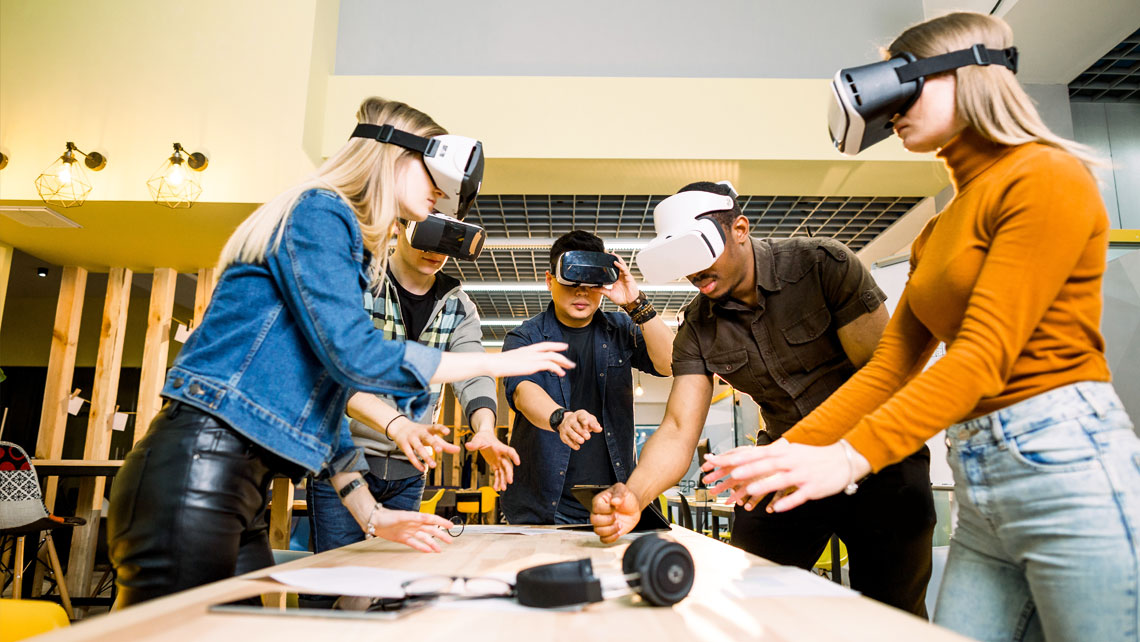
Dedicated staff are crucial for improving throughput and reducing attendee confusion. [29] They guide attendees during headset fitting and removal and can prime them before the experience begins. The conversation that follows the VR experience is often where the brand message is reinforced, making a well-briefed staff member invaluable. [1]
For large-scale activations, consider a two-person station: one person to manage the queue and headset hygiene, and another to facilitate the post-experience conversation. [29] Some rental providers offer optional on-site event support to manage this. [2, 37]
On-site technical considerations
- Connectivity: Standalone wireless headsets do not require venue WiFi for playback since content is preloaded. [32] However, WiFi may be needed for fleet management software if your rental package includes remote monitoring.
- Power: Designate a charging station for battery rotation. [29] For events longer than four hours, plan for at least one full spare battery cycle per headset.
- Hygiene: A strict hygiene protocol is non-negotiable. Use medical-grade silicone face covers that can be swapped, and clean headsets and controllers with non-abrasive, alcohol-free antibacterial wipes between each use. [19, 20, 39] Never use alcohol-based cleaners on lenses. [19, 33]
- Venue Rules: Confirm venue rules on headset use, especially in convention centers with their own AV policies.
Measuring the Impact of an Immersive Storytelling Deployment
Immersive storytelling investments require justification through measurable outcomes. The metrics that matter depend on whether the deployment serves a marketing objective (brand recall, lead quality) or a training objective (knowledge retention, behavior change). [7, 10]
Marketing and activation metrics
- Engagement Time: Track the average duration of headset use per attendee. [14] A significant drop-off before completion can indicate a narrative pacing issue.
- Attendee Throughput: Measure the total number of experiences delivered versus your projected capacity. [5] Gaps often point to operational bottlenecks like staffing or queue management.
- Post-Experience Conversion: Track how many attendees who completed the VR experience took a desired next action (e.g., scanned a QR code, booked a demo) compared to those who did not.
- Brand Recall Lift: For activations with a research budget, pre/post surveys can measure unaided brand recall among VR participants versus non-participants. Studies suggest people remember information from immersive experiences far more effectively than from traditional advertising. [1]
Training and onboarding metrics
- Scenario Completion Rate: The percentage of participants who completed the full training scenario is a primary indicator of engagement. [4]
- Knowledge Check Scores: For scenarios with embedded assessments, track correct response rates on key safety or compliance questions. [4, 10]
- Behavioral Transfer: Follow-up observation or incident data can measure whether the immersive scenario changed on-the-job behavior. VR safety training has been linked to significant reductions in workplace injuries. [3, 16, 17]
- Time-to-Competency: Compare the time required to reach a defined performance standard for VR-trained groups versus traditionally trained groups. Studies have shown VR can accelerate training by up to four times. [3, 15]
Immersive Storytelling Use Cases: What Works by Deployment Context
Not every immersive storytelling format works in every context. The use case—trade show, product launch, training, or brand activation—determines the narrative format, hardware configuration, and success metrics.
Trade shows and conference booths
- Best format: A short, linear narrative (3-5 minutes) that places the attendee inside a product use case or brand environment they cannot otherwise experience on the show floor. [1, 14]
- Hardware: 4 to 8 standalone wireless headsets per booth, preloaded with a single curated experience to maximize consistency and throughput. [39, 40]
- Differentiator: Immersive storytelling at a trade show creates a physical reason to stop at a booth and provides a memorable anchor for post-show follow-up conversations. [14, 30]
Product launches
- Best format: A guided product narrative that places the participant in the context where the product is used—a factory floor, a hospital room, a construction site. [21, 44]
- Hardware: Standalone VR for individual experiences or AR glasses for group demonstrations where multiple stakeholders view the same overlay simultaneously.
- Differentiator: Immersive storytelling allows prospects to experience a product’s value proposition before it physically exists or is available for a hands-on demo. [21]
Brand activations and experiential marketing
- Best format: Environmental exploration or a branching narrative that gives participants agency within the brand world—choosing a path, interacting with elements, or unlocking content. [6]
- Hardware: Standalone VR headsets in a dedicated experience zone, with optional AR overlays for the surrounding physical space.
- Differentiator: Brand activations with immersive storytelling generate social sharing behavior and achieve longer dwell times than passive installations. [1, 26]
Safety training and compliance scenarios
- Best format: A branching scenario where the participant makes decisions and experiences the consequences—the core mechanic of effective VR safety training. [15]
- Hardware: Standalone wireless headsets with preloaded, OSHA-aligned, or manufacturing safety scenarios, often available through curated rental packages. [3]
- Differentiator: Immersive safety training creates an emotional engagement with risk that written or video-based training cannot replicate, leading to better retention and behavioral transfer. [3, 15] Studies have shown VR can improve knowledge retention by up to 75%. [3, 18]
How to Rent Immersive Storytelling Hardware for Your Next Event
For most corporate deployments, purchasing VR or AR hardware is not the right move. The technology evolves rapidly, and the operational overhead of owning and maintaining a fleet of headsets is significant. [39] Renting configured hardware with preloaded content and optional event support is the practical path for teams who need immersive storytelling capabilities without a capital investment. [38]
What a curated VR rental package includes
A comprehensive rental package is a turnkey solution. It typically includes:
- Pre-configured standalone wireless headsets with your content preloaded before shipping. [2, 41]
- Nationwide delivery timed to your event setup window, with return logistics handled post-event. [2, 32]
- Optional on-site event support for staffing and technical troubleshooting. [2, 37]
- Access to preloaded industry-specific scenario libraries for training deployments. [2, 41]
- All necessary accessories, including charging systems, sanitization supplies, and transport cases. [38]
Planning timeline for a rental-based immersive storytelling deployment
- Custom Content Production: Allow 4 to 12 weeks, depending on complexity. Confirm content specifications with the rental provider before production begins to ensure hardware compatibility.
- Preloaded Scenario Deployments: A 1-to-2-week lead time is often sufficient for configuration and delivery scheduling. [1]
- Hardware Quantity Confirmation: Finalize your headset count at least 2 weeks before the event to allow for proper configuration and testing.
- Post-Event: Headsets are simply returned via prepaid shipping, removing any burden of storage, maintenance, or firmware updates from your team. [41]
Practical Planning Checklist
- Define Your Objective: Is it marketing (brand recall, leads) or training (retention, compliance)?
- Select Narrative Format: Choose between a linear story, branching scenario, or exploration.
- Determine Story Length: Align the duration with the event context (e.g., 3-5 mins for a trade show).
- Choose Hardware: Select standalone VR for immersion or AR for augmenting a physical space.
- Decide on Content: Will you use a preloaded scenario or develop custom content? Factor in lead times.
- Calculate Headset Quantity: Base the number on experience length, traffic, and desired throughput.
- Plan Staffing: Assign dedicated staff for queue management, hygiene, and attendee guidance.
- Verify On-Site Logistics: Plan for a charging station, hygiene protocol, and check venue AV rules.
- Define Success Metrics: Establish the KPIs you will use to measure ROI (e.g., throughput, conversion, completion rates).
- Book Your Rental: Confirm hardware, content, and delivery dates with your rental partner.
FAQs
What is immersive storytelling in a business context?
In a business context, immersive storytelling uses technologies like VR and AR to place an audience inside a narrative, making them active participants rather than passive viewers. [25] It’s used for brand experiences, product demonstrations, and training to create a stronger emotional connection and improve message retention. [6, 14]
How is immersive storytelling different from a 360-degree video?
A 360-degree video is a passive, spherical recording. Immersive storytelling adds a narrative structure and often interactivity, requiring the participant to move through a sequence, make choices, or engage with elements in the virtual environment. [25, 28]
What hardware do I need to run an immersive storytelling experience at a trade show?
For most trade show applications, standalone wireless VR headsets like the Meta Quest 3 are the standard choice. [2, 40] They are self-contained, eliminating the need for external PCs or cables, which simplifies booth setup and improves safety. [29]
How many VR headsets do I need for a brand activation?
The number depends on your expected traffic and the experience’s length. A common formula is to calculate how many sessions one headset can run per hour (a 4-minute experience is about 8 sessions/hour) and scale up to meet your visitor goals. [5] A 4-headset setup is a popular starting point for a 10×20 booth. [39]
Can I rent VR headsets with preloaded brand content for an event?
Yes, most VR rental companies for events offer to preload your custom brand content or applications onto the headsets before they are shipped. [2, 32, 43] This ensures they arrive at your venue ready to use out of the box. [41]
How long should a VR brand experience be at a trade show or product launch?
To manage attendee queues and maximize throughput, a VR experience at a trade show should be between 3 and 5 minutes long. [1, 44]
What is the difference between VR storytelling and AR storytelling for events?
VR (Virtual Reality) storytelling immerses the user in a completely digital world, replacing their physical surroundings. AR (Augmented Reality) storytelling overlays digital information onto the real world, enhancing the user’s physical environment. [36] VR is for creating self-contained worlds, while AR is for augmenting a physical space or product.
How do I measure the ROI of an immersive storytelling activation?
For marketing, measure metrics like attendee throughput, engagement time, post-experience lead conversion rates, and brand recall lift. [1, 14] For training, track KPIs like scenario completion rates, knowledge check scores, and observed changes in on-the-job behavior. [4, 7, 10]
Do I need WiFi at my event venue to run a VR experience?
No, if you are using standalone headsets with preloaded content, you do not need WiFi for the experience to run. [32] WiFi might only be necessary if your rental package includes a remote fleet management or analytics platform.
How far in advance do I need to book VR headset rentals for an event?
If you are using preloaded scenarios from a rental library, 1-2 weeks is often enough lead time. If you are developing custom content, you should start the process 4-12 weeks in advance and finalize your hardware booking at least 2 weeks before the event.