Why Industrial Safety Teams Choose VR Training Over Traditional Methods
Industrial accidents cost U.S. businesses $171 billion annually, with most incidents stemming from inadequate hazard recognition training. VR safety training delivers 4x better retention rates than classroom instruction while eliminating the risk of training in actual hazardous environments.
Forward-thinking safety managers are discovering that virtual reality transforms how workers learn to identify and respond to workplace hazards. Instead of passive PowerPoint presentations or risky hands-on training with live equipment, VR places employees directly into realistic scenarios where they can make mistakes without consequences—and learn from them before entering actual danger zones.
The Business Case: Injury Reduction and Compliance ROI
VR safety training delivers measurable financial returns through multiple channels. Organizations implementing comprehensive VR safety programs report 43% fewer OSHA citations within the first year, primarily due to enhanced documentation capabilities and demonstrable competency testing. Every training session in VR generates detailed performance data, creating an audit trail that satisfies regulatory requirements while identifying workers who need additional support.
The numbers speak volumes: companies using VR for high-risk training scenarios experience a 75% reduction in training-related incidents compared to those using live equipment for instruction. This dramatic decrease stems from the ability to repeat dangerous scenarios without exposing workers to actual hazards. A worker can practice confined space entry procedures 50 times in VR without consuming a single tank of breathing air or risking atmospheric exposure.
Insurance carriers increasingly recognize VR training as a risk mitigation factor, with some providers offering 15-25% premium reductions for companies with documented VR safety programs. When calculating total cost of ownership, VR rental programs typically cost 60% less than maintaining dedicated training facilities with mock equipment setups. A single confined space training prop can cost $50,000-100,000 to construct and maintain, while VR delivers unlimited scenarios for a fraction of that investment.
The financial equation becomes even more compelling when factoring in indirect costs. Traditional safety training often requires shutting down production equipment, traveling to off-site facilities, or bringing in specialized instructors. VR training happens on-demand, at any location, without disrupting operations. One manufacturing client reduced annual training costs by $450,000 simply by eliminating travel to their regional training center.
Training Retention: Why Immersive Learning Sticks
The science behind VR’s effectiveness lies in how our brains process immersive experiences. When workers physically perform safety procedures in virtual environments—reaching for shut-off valves, selecting correct PPE, or identifying hazards—they develop muscle memory that transfers directly to real-world situations. This kinesthetic learning creates neural pathways that passive observation cannot achieve.
Emotional engagement amplifies retention further. Workers who experience a virtual fall from height or witness a simulated explosion caused by improper lockout procedures develop visceral understanding of consequences. This emotional imprint, created safely in VR, triggers the same neurological responses as real danger, embedding safety protocols at a deeper level than traditional training methods achieve.
Performance tracking in VR surpasses subjective observation-based assessments. Every head movement, hand gesture, and decision point generates data. Safety managers can identify exactly where workers hesitate, which hazards they miss, and how quickly they respond to emergencies. This granular insight enables targeted remediation and validates competency with objective metrics rather than instructor opinion.
Studies from major industrial firms show workers trained in VR demonstrate 40% better hazard recognition six months post-training compared to traditional methods. More importantly, they maintain consistent performance over time, while traditionally trained workers show significant skill degradation after 90 days without practice.
Critical Safety Scenarios Perfect for VR Rental Programs
Not every safety training needs VR, but high-risk, low-frequency scenarios deliver exceptional ROI through virtual simulation. These industrial safety applications consistently show 60-80% improvement in hazard recognition.
The sweet spot for VR safety training lies in situations that are either too dangerous, too expensive, or too infrequent to practice regularly with traditional methods. Emergency response procedures that might occur once per year—or hopefully never—stay fresh when workers can rehearse them monthly in VR without mobilizing resources or creating actual hazards.
Confined Space Entry and Rescue
OSHA 1910.146 permit-required confined space training presents unique challenges that VR addresses comprehensively. Workers must master atmospheric testing, ventilation procedures, communication protocols, and emergency extraction—all while managing claustrophobia and maintaining situational awareness. VR enables repeated practice of these complex procedures without the logistical nightmare of setting up actual confined spaces.
Multi-user VR scenarios revolutionize rescue team coordination training. Attendants, entrants, and rescue personnel can practice together from different locations, experiencing realistic communication challenges and time pressures. Teams learn to coordinate rescue operations when an entrant loses consciousness, dealing with limited visibility, tight spaces, and the critical decision-making required when every second counts.
Atmospheric hazard simulation in VR provides invaluable experience without gas exposure risks. Workers learn to recognize symptoms of oxygen deficiency, toxic atmospheres, and explosive conditions through visual and audio cues. They practice proper meter reading, understand sensor cross-sensitivities, and experience the disorientation that precedes dangerous exposure levels—all while breathing normal air in a safe training room.
Lock Out Tag Out (LOTO) Procedures
Equipment-specific LOTO sequences vary dramatically across industrial facilities, making standardized training insufficient. VR enables custom modeling of actual plant equipment, allowing workers to practice isolation procedures on virtual versions of the exact machines they’ll encounter. This specificity reduces the primary cause of LOTO failures: confusion about energy isolation points on unfamiliar equipment.
Consequence simulation for missed steps provides powerful learning moments. Workers who forget to verify zero energy state in VR experience virtual arc flashes, unexpected machine startups, or pressure releases. These safe failures create lasting memories that reinforce the critical nature of each verification step. One food processing client reported 90% reduction in LOTO violations after implementing consequence-based VR training.
Custom industrial equipment modeling options mean facilities don’t need generic training content. Modern VR platforms can import CAD files or use photogrammetry to create accurate digital twins of specific equipment. Workers practice on virtual replicas of their actual hydraulic presses, conveyor systems, or electrical panels, eliminating the “that’s not how our equipment works” disconnect common with generic training materials.
Fall Protection and Working at Heights
Harness inspection and attachment point selection becomes second nature through VR repetition. Workers learn to identify damaged equipment, understand weight ratings, and recognize approved anchor points without accessing actual elevated work areas. They practice calculating fall distances, selecting appropriate lanyards, and understanding swing fall hazards in various configurations.
Leading edge and scaffold scenarios prepare workers for specific elevation challenges. VR simulates wind conditions, surface instability, and visual disorientation associated with height exposure. Workers who’ve never been above ground level can acclimatize gradually, building confidence before their first actual elevated assignment. This preparation dramatically reduces freeze-ups and panic responses that cause many elevation incidents.
Vertigo acclimatization for new workers addresses a critical safety gap. Studies show 30% of workers experience some height-related anxiety that impairs judgment and reaction time. VR exposure therapy allows gradual height introduction, starting at comfortable elevations and progressively increasing as workers adapt. This systematic desensitization reduces turnover and improves safety outcomes for height-sensitive workers.
Hazardous Material Handling
Chemical spill response procedures in VR eliminate the waste and risk of live drills. Workers practice containment, absorption, and neutralization techniques on virtual spills that behave realistically based on chemical properties. They learn to assess spill size, select appropriate response materials, and execute containment strategies without consuming expensive absorbents or creating actual contamination.
PPE selection and donning/doffing sequences require precise execution to prevent exposure. VR training allows unlimited practice of these critical procedures, including timed scenarios that replicate emergency response pressure. Workers learn the consequences of improper seal checks, understand breakthrough times, and practice buddy checks—all without consuming disposable PPE or risking actual contamination.
Emergency decontamination protocols become muscle memory through VR repetition. Workers practice both self-decontamination and assisting others, learning proper rinse sequences, contamination zone management, and emergency shower procedures. They experience simulated chemical burns or respiratory distress when procedures aren’t followed correctly, creating powerful motivation for proper execution.
VR Safety Training Rental Packages: Configuration and Pricing
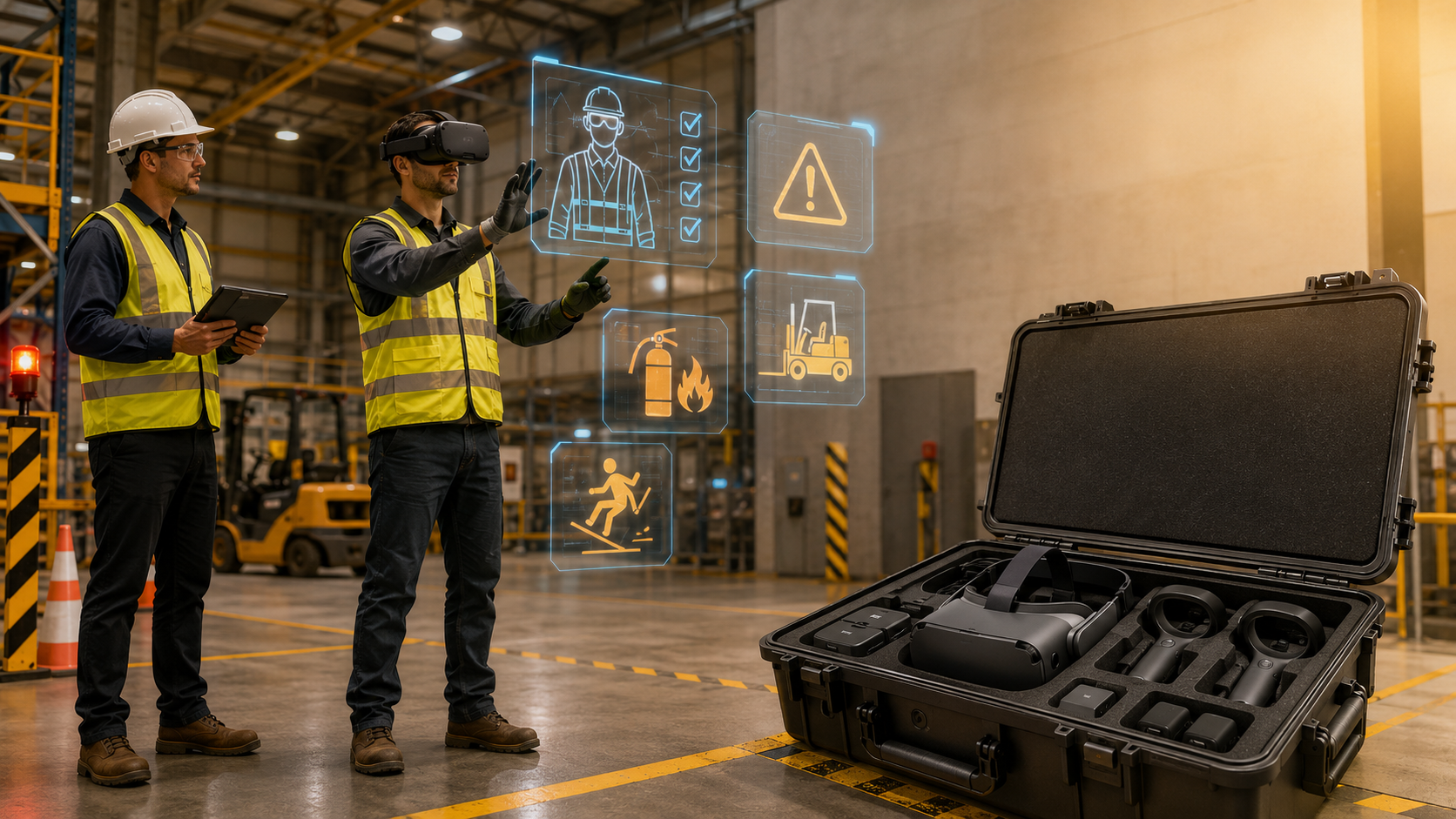
IGIVU’s industrial safety rental packages include pre-loaded safety content, multi-user capabilities for team training, and setup support for non-technical safety managers. Packages scale from single-site pilots to enterprise deployments.
The rental model eliminates the capital expenditure barriers that prevent many organizations from adopting VR training. Instead of $100,000+ upfront investments, companies can validate VR effectiveness with monthly operational expenses that fit within existing training budgets. This approach also ensures access to the latest hardware and software updates without obsolescence concerns.
Pilot Program Package (5-10 Headsets)
The 30-day pilot rental serves as a proof-of-concept vehicle, allowing safety teams to validate VR effectiveness with minimal commitment. This package includes 5-10 wireless VR headsets pre-configured with OSHA-aligned training modules covering the most common industrial safety scenarios. At $2,500-4,500 per month, pilots cost less than sending a single employee to off-site safety certification.
Pre-loaded content libraries contain 40+ safety scenarios developed with industrial safety experts and validated against OSHA standards. Modules range from 5-minute hazard hunts to 45-minute emergency response simulations. Content covers general industry, construction, and maritime applications, with automatic updates as regulations change.
Remote setup support ensures non-technical safety managers can deploy VR training without IT involvement. IGIVU’s support team provides video walkthrough sessions, troubleshooting assistance, and best practice guidance throughout the pilot period. Most organizations have their first training session running within 48 hours of equipment arrival.
Performance analytics dashboards provide real-time visibility into training effectiveness. Safety managers can track completion rates, identify common error patterns, and generate compliance reports without manual data compilation. These insights prove particularly valuable when building the business case for program expansion.
Site Training Package (15-30 Headsets)
Quarterly rental terms with swap-out options provide flexibility for varying training demands. During peak hiring periods or annual recertification pushes, sites can temporarily increase headset counts. Equipment refresh options every 12 months ensure access to improving VR technology without additional investment.
Custom scenario development services transform site-specific procedures into immersive training modules. IGIVU’s development team can create digital twins of actual equipment, model specific facility layouts, and incorporate company-specific safety protocols. These custom scenarios typically require 4-6 weeks from initial consultation to deployment.
On-site setup and train-the-trainer sessions ensure sustainable program adoption. IGIVU’s implementation specialists spend 2-3 days on-site, configuring equipment, training safety personnel, and establishing best practices for ongoing program management. This hands-on support dramatically accelerates time to value and ensures proper utilization.
Multi-language support addresses workforce diversity challenges. All standard content includes English, Spanish, and French audio with additional languages available. Custom scenarios can incorporate site-specific terminology and dialect preferences, ensuring clear communication regardless of worker background.
Enterprise Safety Program
Distributed shipping to multiple facilities simplifies large-scale deployments. IGIVU manages logistics for organizations with dozens of locations, ensuring consistent equipment and content across all sites. Centralized billing and asset tracking reduce administrative burden while maintaining local flexibility.
The centralized content management platform enables headquarters-level oversight while preserving site autonomy. Corporate safety teams can mandate specific training modules, track enterprise-wide completion rates, and identify best practices across facilities. Local managers retain ability to schedule sessions and add site-specific content.
LMS integration synchronizes VR training records with existing learning management systems. Completion data, assessment scores, and competency validations flow automatically into corporate training databases. This integration eliminates duplicate data entry and ensures VR training receives equal weight with traditional certification programs.
Dedicated account management provides strategic guidance beyond technical support. Account managers conduct quarterly business reviews, identify expansion opportunities, and ensure programs evolve with changing safety requirements. They serve as liaisons between customer needs and IGIVU’s product development roadmap.
Implementation Roadmap: From Pilot to Full Deployment
Successful VR safety training programs follow a phased approach, starting with high-impact scenarios and expanding based on measured results. Most organizations see positive ROI within the first quarter.
The key to successful VR safety training implementation lies in choosing the right initial use cases. Organizations that start with their highest-risk, highest-frequency training needs see immediate impact that builds momentum for broader adoption. This strategic approach contrasts with technology-first implementations that struggle to demonstrate value.
Phase 1: Scenario Selection and Pilot Setup (Weeks 1-2)
Incident history analysis identifies priority training needs by examining past safety events, near-misses, and OSHA citations. This data-driven approach ensures VR training addresses actual risk factors rather than perceived problems. Safety teams typically discover 2-3 critical scenarios that account for 60-70% of their safety incidents.
Content library mapping connects available VR modules to specific equipment and procedures. IGIVU’s implementation team reviews existing training materials, SOPs, and equipment specifications to identify which pre-built scenarios apply directly and where customization might be needed. This mapping exercise often reveals training gaps that traditional methods weren’t addressing.
Pilot group selection requires balancing representation with manageability. Successful pilots include 20-30 workers across different shifts, experience levels, and job functions. Including both VR-enthusiastic early adopters and skeptical veterans ensures feedback represents the full workforce spectrum. Baseline assessments before VR training establish clear performance benchmarks for ROI calculation.
IT requirements and network setup prove simpler than most organizations expect. Modern VR headsets operate independently without constant internet connectivity. Training areas need only basic WiFi for content updates and data synchronization. Most industrial facilities can repurpose break rooms or conference spaces without infrastructure modifications.
Phase 2: Pilot Execution and Data Collection (Weeks 3-6)
Training session scheduling requires balancing operational needs with learning objectives. Most organizations find 30-minute sessions work best, allowing workers to complete meaningful training without extended absence from duties. Scheduling 4-6 workers per session creates peer learning opportunities while maintaining social distancing capabilities.
Performance metric tracking happens automatically through VR systems, but human observation adds context. Safety managers should document worker reactions, common questions, and implementation challenges. This qualitative data proves invaluable when scaling programs beyond the pilot phase.
User feedback collection through structured surveys and focus groups identifies both technical and cultural barriers to adoption. Workers often provide practical suggestions that improve program effectiveness—from headset hygiene protocols to optimal session timing. Their input transforms skeptics into champions when implemented visibly.
Safety incident correlation analysis begins immediately but requires patience for statistical significance. While dramatic improvements sometimes appear within weeks, most organizations need 60-90 days to establish clear trend lines. Tracking both leading indicators (near-misses, hazard reports) and lagging indicators (actual incidents) provides comprehensive program validation.
Phase 3: Scale Decision and Rollout (Weeks 7-12)
ROI calculation based on pilot metrics typically shows 3-5x returns within the first year. Direct cost savings from reduced incidents, avoided fines, and decreased training expenses provide clear financial justification. Indirect benefits like improved worker confidence and reduced anxiety around dangerous tasks add substantial but harder-to-quantify value.
Expansion planning for additional sites or scenarios follows a hub-and-spoke model for most organizations. Successful pilot sites become regional training centers, with traveling VR equipment serving satellite locations. This approach balances equipment utilization with accessibility while building internal expertise gradually.
Train-the-trainer program development ensures sustainable program growth without vendor dependence. IGIVU certifies internal safety personnel to manage VR training sessions, troubleshoot basic technical issues, and identify opportunities for content expansion. This knowledge transfer typically requires 16-20 hours of instruction spread across the implementation period.
Long-term rental versus purchase evaluation depends on multiple factors beyond simple cost comparison. Technology refresh cycles, content update requirements, and organizational change velocity all influence the optimal acquisition model. Most organizations benefit from 12-18 months of rental experience before making purchase decisions.
Measuring Success: KPIs and ROI Calculation
VR safety training delivers measurable improvements across leading and lagging indicators. Track these metrics to justify program expansion and demonstrate compliance enhancement.
Establishing clear success metrics before implementation prevents post-hoc rationalization and ensures objective program evaluation. The most successful VR safety programs track a balanced scorecard of quantitative and qualitative measures that capture both immediate training improvements and long-term safety culture evolution.
Leading Indicators
Hazard recognition test scores show immediate and dramatic improvement with VR training, typically increasing 40% within the first training cycle. Unlike traditional multiple-choice assessments, VR testing places workers in realistic scenarios where they must physically identify and respond to hazards. This performance-based assessment provides far more accurate competency validation than paper tests.
Training completion rates and time-to-competency metrics demonstrate VR’s engagement advantage. Organizations report 95%+ voluntary completion rates for VR safety modules compared to 60-70% for traditional e-learning. More importantly, workers achieve competency 50% faster through VR’s immersive practice compared to classroom instruction followed by supervised field training.
Near-miss reporting increases significantly as workers become better at recognizing hazards through VR training. One manufacturing client saw near-miss reports triple within six months of VR implementation—not because conditions worsened, but because workers developed heightened hazard awareness. This increased reporting enables proactive risk mitigation before incidents occur.
Safety observation quality scores improve as workers learn to identify subtle hazard indicators through VR scenarios. Behavioral-based safety programs report more detailed, actionable observations from VR-trained workers. They notice not just obvious violations but also systemic issues and degraded conditions that traditionally-trained workers overlook.
Lagging Indicators and Cost Savings
Recordable incident rates provide the ultimate validation of safety training effectiveness. Organizations implementing comprehensive VR safety programs report 43-76% reduction in OSHA recordable incidents within 12 months. The variation depends on baseline performance and implementation thoroughness, but even modest programs show 25%+ improvements.
Workers compensation claim decreases follow incident reductions but with additional benefits from reduced severity. VR-trained workers who do experience incidents typically suffer less severe injuries because they’ve practiced emergency responses. One construction company reported average claim costs dropped 60% even as claim frequency decreased 45%.
OSHA citation and fine avoidance creates immediate ROI through both direct savings and prevented operational disruptions. VR training documentation satisfies OSHA requirements for demonstrable competency validation. During inspections, companies can show detailed performance data rather than just training attendance records, often converting potential citations into recognition for exemplary programs.
Training travel and facility cost elimination provides predictable, substantial savings. A single regional training center can cost $500,000+ annually in facility, equipment, and instructor expenses. VR training eliminates these fixed costs while providing superior training access. Remote sites that previously sent workers hundreds of miles for training now conduct all safety education on-site.
Case Studies: Industrial Safety Training Transformations
Manufacturing, construction, and energy companies using VR rental programs report 50-70% reduction in safety incidents within the first year. These examples show practical implementation paths.
Real-world success stories demonstrate that VR safety training isn’t theoretical—it’s delivering measurable results across diverse industrial settings. These case studies represent different industries, company sizes, and implementation approaches, but all share common themes: dramatic safety improvements, strong ROI, and cultural transformation around safety awareness.
Manufacturing: Automotive Parts Supplier
The challenge facing this Tier 1 automotive supplier was stark: 12 LOTO violations in 18 months, including two serious injuries and $180,000 in OSHA fines. Traditional LOTO training clearly wasn’t working, with workers consistently missing energy verification steps on complex stamping equipment. The safety director faced potential plant shutdown if improvements didn’t materialize quickly.
The solution involved deploying a 20-headset VR rental package with custom scenarios modeled on their actual stamping presses and robotic cells. IGIVU’s team spent three days on-site photographing and measuring equipment to create accurate digital twins. Within six weeks, every maintenance technician and operator had completed VR LOTO training specific to their assigned equipment.
The results exceeded expectations: zero LOTO incidents for 14 consecutive months following VR implementation. Beyond incident elimination, the program generated unexpected benefits. Maintenance procedures became 30% faster as technicians developed muscle memory for isolation sequences. New employee onboarding time decreased by two weeks since they could practice on virtual equipment before touching actual machines.
The ROI calculation showed $340,000 in avoided OSHA fines and injury costs, plus $125,000 in reduced training time and improved maintenance efficiency. The company transitioned from rental to purchase after 18 months, expanding VR training to include confined space entry and chemical handling procedures.
Construction: Commercial General Contractor
This ENR Top 100 contractor faced a different challenge: providing consistent fall protection training for 500+ workers across eight active job sites spanning three states. Traditional training required either bringing workers to a central facility or rotating instructors through sites—both options proved logistically complex and expensive.
The solution leveraged a rotating 15-headset rental package that moved between sites on a scheduled basis. Each site received the VR equipment for one week per month, during which all workers completed required fall protection modules. The VR scenarios included site-specific elements like the actual scaffolding systems and fall protection equipment used by the company.
Results materialized quickly with a 65% reduction in fall-related incidents within the first year. More importantly, the program identified that 40% of experienced workers had been using fall protection incorrectly for years—errors that observation-based training never caught. The VR system’s data analytics revealed common misconceptions about swing fall distances and anchor point strength requirements.
The financial impact was substantial: $1.2 million in insurance premium reductions based on demonstrated safety improvements, plus $300,000 in eliminated travel costs for centralized training. The company now requires VR fall protection certification for all workers before site access and includes VR training requirements in subcontractor agreements.
Frequently Asked Questions
How many VR headsets do I need for effective safety training?
The optimal headset count depends on workforce size, training frequency, and operational constraints. Most facilities find success with one headset per 15-20 workers for monthly training cycles. A 200-person facility typically needs 10-12 headsets to avoid scheduling bottlenecks. Consider peak training periods like new hire onboarding or annual recertification when determining quantities.
Can we use our own safety training content with rental headsets?
Yes, IGIVU’s rental headsets support custom content deployment alongside pre-loaded safety modules. You can upload existing 360-degree videos, import custom VR scenarios, or work with IGIVU’s development team to create bespoke training content. The content management platform allows mixing standard and custom modules within the same training session.
What’s the typical rental period for industrial safety training programs?
Most organizations start with 30-day pilots, then transition to quarterly or annual terms based on results. Seasonal operations might opt for month-to-month rentals during peak periods. The sweet spot for most industrial facilities is annual rentals with quarterly payment terms, providing budget predictability while maintaining flexibility to adjust quantities.
How do VR safety training costs compare to traditional training methods?
VR rental programs typically cost 40-60% less than traditional hands-on training when factoring in all expenses. A comprehensive VR safety training program runs $30,000-50,000 annually for a 200-person facility, compared to $75,000-125,000 for traditional training including instructor costs, travel, equipment, and lost productivity. The gap widens further when considering incident reduction benefits.
Do rental packages include technical support for non-VR-savvy safety managers?
All IGIVU rental packages include comprehensive technical support designed specifically for non-technical users. This includes initial setup assistance, ongoing troubleshooting via phone/video, and access to a library of how-to resources. Most safety managers become proficient with VR training management within 2-3 hours of hands-on experience.
Can VR training satisfy OSHA documentation requirements?
VR training exceeds OSHA documentation requirements by providing detailed performance data for every training session. The system automatically generates training records including completion times, assessment scores, and specific actions taken during scenarios. These records integrate with existing safety management systems and provide superior audit trails compared to traditional sign-in sheets.
What happens if equipment is damaged during industrial training use?
IGIVU’s rental agreements include damage protection covering normal wear and tear plus accidental damage. The program includes replacement headsets shipped overnight for minimal training disruption. Intentional damage or gross negligence may incur charges, but standard industrial use is fully covered. Most damage involves minor cosmetic issues that don’t affect functionality.
Conclusion: Taking the Next Step Toward VR Safety Excellence
The evidence is clear: VR safety training delivers superior outcomes across every meaningful metric—from injury reduction and compliance improvement to cost savings and worker engagement. Industrial organizations can no longer afford to rely solely on traditional training methods when facing increasingly complex safety challenges and evolving workforce expectations.
The rental model eliminates traditional barriers to VR adoption, allowing safety teams to validate effectiveness without capital investment or long-term commitments. Starting with a focused pilot program targeting your highest-risk scenarios provides a low-risk path to transformation. Within 90 days, you’ll have concrete data demonstrating VR’s impact on your specific safety challenges.
Success with VR safety training requires more than just technology—it demands commitment to implementation best practices and continuous improvement. Organizations that approach VR as a strategic safety initiative rather than a tactical training tool see the greatest returns. This means involving workers in program design, using data to drive decisions, and maintaining momentum through visible leadership support.
The question isn’t whether to implement VR safety training, but how quickly you can begin capturing its benefits. Every day of delay represents continued exposure to preventable incidents, missed opportunities for cost savings, and competitive disadvantage versus early adopters.
Ready to transform your industrial safety training? Contact IGIVU today to discuss a pilot program tailored to your specific safety challenges. Our safety training specialists will analyze your incident history, recommend optimal scenarios, and design an implementation roadmap that delivers measurable results within 90 days.
Don’t wait for the next incident to drive change. The future of industrial safety training is here, it’s proven, and it’s accessible through flexible rental programs that fit your budget and operations. Join the hundreds of industrial organizations already using VR to protect their workers, improve their bottom line, and build a culture of proactive safety excellence.