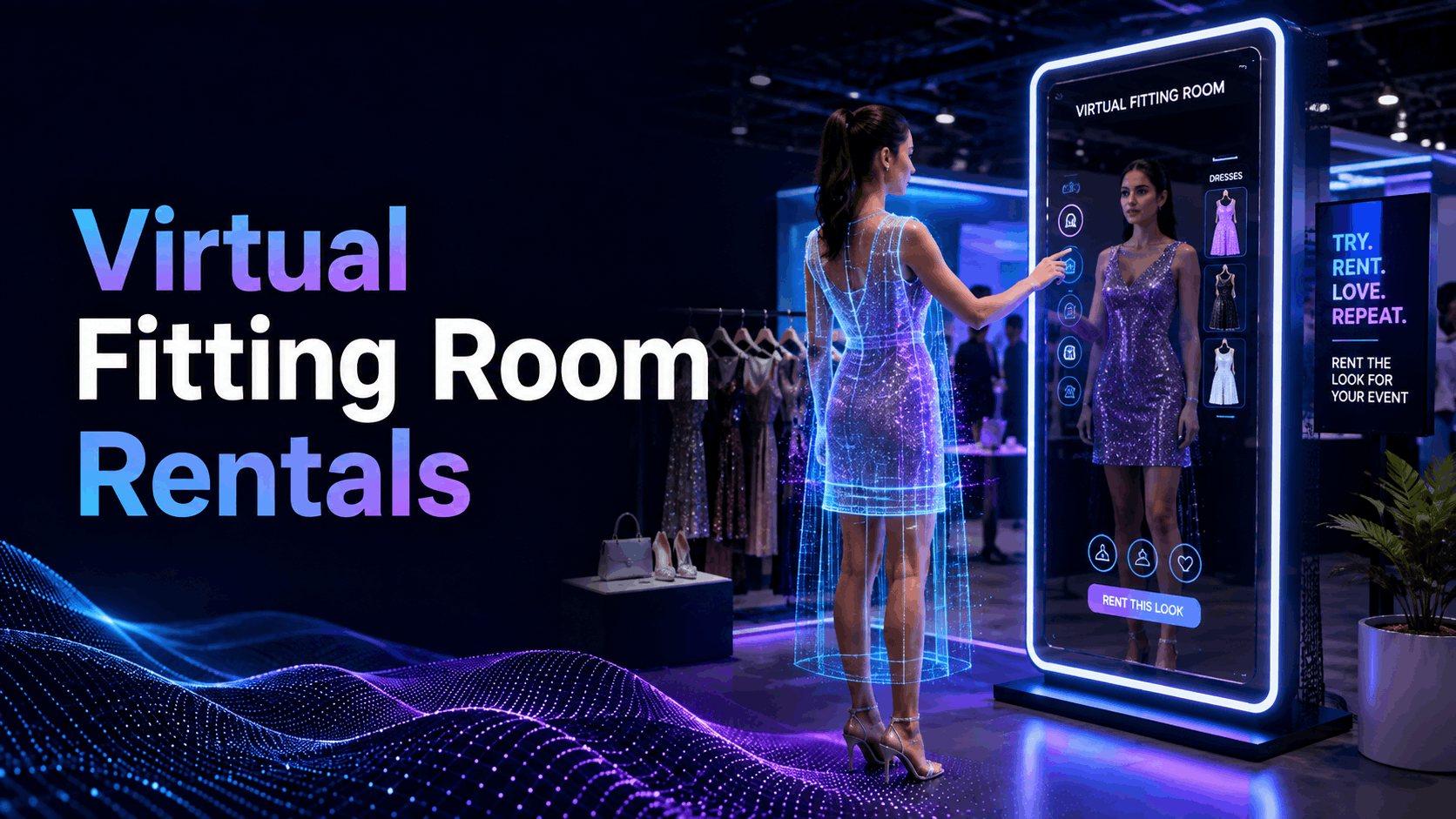
In the fast-paced world of experiential retail, creating memorable and engaging customer interactions is paramount. Virtual fitting room (VFR) rentals have emerged as a powerful tool for brands to captivate audiences at pop-up shops, trade shows, and launch events. These turnkey solutions offer a complete virtual reality (VR) try-on system, allowing customers to explore entire collections without the need for physical inventory. Rental packages provide the hardware, software, and expert support necessary to deploy a high-impact activation, tailored to your specific event timeline and venue.
This guide provides a comprehensive overview for retail brands, event planners, and marketing teams on how to successfully implement virtual fitting room rentals. We will explore the components of rental packages, compelling use cases, technical requirements, and the measurable return on investment (ROI) these experiences can deliver.
Virtual Fitting Room Rental Packages: What’s Included
Virtual fitting room rentals are designed to be an all-in-one solution, eliminating the significant upfront investment and technical complexities of purchasing a permanent system. A typical rental package bundles cutting-edge hardware, sophisticated software, and essential on-site support to ensure a seamless and engaging experience for your customers.
Hardware Components in Virtual Fitting Room Rentals
The physical elements of the rental are crucial for creating an immersive and user-friendly experience. Key hardware components include:
- VR Headsets: Modern headsets like the Meta Quest 3 or Pico 4 are frequently used for their high-resolution displays and advanced hand-tracking capabilities, which allow for intuitive, gesture-based navigation and clothing selection.
- Tracking Sensors: While many modern headsets offer inside-out tracking, some setups may incorporate external sensors for enhanced full-body tracking, providing a more realistic representation of a user’s movements.
- Display Monitors: Large screens are essential for spectator viewing, allowing those waiting in line to see the experience, which helps manage queues and build anticipation.
- Physical Setup: Rental providers can offer options ranging from simple open-floor setups to fully branded physical fitting room structures that create a more private and immersive environment.
Pre-Loaded Virtual Fitting Room Software Options
The software is the core of the virtual try-on experience, and rental packages can offer varying levels of customization:
- Generic vs. Custom Platforms: Some rentals utilize a generic platform where your 3D clothing assets are uploaded. Others offer the development of a custom-branded experience with unique user interfaces and environments that align with your brand’s aesthetic.
- 3D Clothing Catalogs: You will need to provide 3D models of your garments. These digital assets must meet specific requirements for file formats (like FBX, OBJ, or GLTF) and polygon counts to ensure smooth, real-time rendering.
- Real-Time Rendering: The software must be capable of rendering fabric textures, draping, and fit adjustments in real-time to provide a realistic and interactive experience.
- E-commerce Integration: Many platforms can integrate with your existing e-commerce system, allowing customers to add items to a cart and make purchases directly from the virtual experience.
Setup and Support Services
Reliable technical support is a cornerstone of a successful rental, ensuring the technology works flawlessly throughout your event:
- On-Site Technicians: For multi-day events like trade shows or week-long pop-ups, an on-site technician is invaluable for setup, calibration, and immediate troubleshooting.
- Remote Support: For shorter activations, providers may offer dedicated remote support during event hours to resolve any technical issues that may arise.
- Pre-Event Testing: Rental companies will work with you to test the experience with your 3D assets and calibrate the hardware before the event begins.
- Backup Equipment: To prevent downtime at high-traffic events, reputable rental services will have backup headsets and other critical components on hand.
Virtual Fitting Room Use Cases: Pop-Ups, Trade Shows, and Flagship Events
Retail brands are leveraging virtual fitting room rentals at temporary activations to achieve a variety of strategic goals. These immersive experiences allow brands to showcase extensive collections without the logistical burden of physical inventory, capture valuable customer data, and generate shareable social media moments that amplify the event’s reach.
Pop-Up Store Virtual Fitting Rooms
Pop-up shops are an ideal setting for VFR rentals, offering a novel way to engage customers in a temporary retail space.
- Rental Duration: Packages are commonly available for 2-4 week periods to align with the typical duration of a pop-up store.
- Space Requirements: Plan for a minimum of an 8×8 ft area for each virtual fitting station to ensure users have enough room to move safely.
- Customer Throughput: A single headset station can typically accommodate 15-20 customers per hour, a key metric for planning your staffing and queue management.
- Data Capture: The experience provides a natural opportunity to collect valuable data, including customer style and size preferences, as well as contact information for post-event marketing.
Trade Show Virtual Try-On Activations
At bustling trade shows, a VR try-on experience can be a powerful tool for attracting attention and generating qualified leads.
- Rental Duration: Short-term rentals of 3-5 days are perfect for trade show booth deployments.
- Lead Generation: By offering a unique and memorable experience, you can draw attendees to your booth and capture their information for your sales pipeline.
- Competitive Differentiation: In a crowded exhibition hall, a virtual fitting room can make your brand stand out and create a lasting impression.
- Data-Driven Follow-Up: The data collected during the virtual fitting sessions can be used to personalize post-show follow-up communications.
Fashion Week and Launch Event Deployments
For high-profile events like fashion week presentations or product launches, VFRs can create an exclusive and shareable experience for press, influencers, and VIPs.
- Rental Duration: Single-day rental options are well-suited for these short, high-impact events.
- High-Volume Setups: Multiple fitting stations can be deployed to accommodate a large number of guests and minimize wait times.
- Custom Branded Environments: The virtual environment can be customized to match the theme of your new collection, creating a cohesive and immersive brand story.
- Social Media Integration: Features that allow users to instantly share photos or videos of their virtual avatars on social media can dramatically increase the event’s online visibility.
Virtual Fitting Room Technology Requirements and Venue Considerations
A successful virtual fitting room deployment hinges on specific technical and environmental factors at your event venue. Unlike standard retail setups, VR experiences have unique requirements for space, network infrastructure, and lighting that must be addressed during the planning phase.
Space and Layout Requirements
Properly planning the physical space is critical for both user safety and the overall guest experience.
- Clear Space: Each user requires a minimum of a 6×6 ft clear area to allow for safe movement while wearing the headset.
- Safety Boundaries: A “guardian” or “chaperone” boundary system must be set up within the VR software to alert users if they are getting too close to walls or other obstacles.
- Queue and Viewing Areas: Designate specific areas for guests who are waiting their turn and for spectators to watch the experience on display monitors. This helps manage foot traffic and builds interest.
- Privacy: If your activation includes body scanning features to create personalized avatars, ensure the scanning area is private and that you are compliant with all data privacy regulations.
Network and Power Infrastructure
Consistent and reliable network and power are the lifeblood of a smooth virtual reality experience.
- Wi-Fi Requirements: For cloud-based fitting room platforms, a stable Wi-Fi 6 connection is often recommended to handle the data streaming.
- Offline Options: In venues with unreliable internet, discuss local server options with your rental provider. An offline deployment can ensure the experience runs without interruption.
- Power Outlets: Ensure there are enough power outlets for all the headsets, computers, and display monitors. Plan your cable management strategy in advance to prevent tripping hazards.
- Bandwidth Needs: A general guideline is to have at least 50 Mbps of dedicated bandwidth per concurrent headset to avoid lag and ensure a high-quality visual experience.
Lighting and Environmental Factors
The surrounding environment can significantly impact the performance of the VR tracking technology.
- Optimal Lighting: Modern VR headsets with inside-out tracking rely on cameras to “see” the room. Avoid very dark or excessively bright environments, as these can interfere with tracking accuracy.
- Reflective Surfaces: Large mirrors or highly reflective surfaces can sometimes confuse the headset’s tracking sensors. It’s best to position the activation away from these surfaces or cover them if necessary.
- Temperature Control: VR headsets can generate heat, especially during extended use. A well-ventilated and climate-controlled space will ensure user comfort.
- Acoustics: If the experience includes voice guidance or audio elements, consider the ambient noise level of your venue. In loud environments, noise-canceling headphones can improve the user’s immersion.
Virtual Fitting Room ROI: Metrics and Business Impact
Deploying a virtual fitting room at an event is more than just a novelty; it’s a strategic investment that can generate a significant and measurable return. The business impact extends beyond the immediate “wow” factor, providing valuable data, driving sales, and enhancing brand perception.
Engagement and Conversion Metrics
Virtual try-on experiences consistently outperform traditional fitting rooms in key engagement metrics:
- Average Session Time: Users typically spend 8-12 minutes in a virtual fitting room, compared to just 3-4 minutes in a physical one, offering more time for brand immersion.
- Items Tried Per Session: The virtual format allows customers to experiment with 15-20 different items on average, a substantial increase from the 3-5 items in a traditional fitting room.
- Increased Purchase Intent: After engaging with a virtual try-on, purchase intent can increase by as much as 40-60%.
- Social Sharing: A significant portion of users, often around 35%, will share content from their virtual fitting room experience on social media, amplifying your brand’s reach organically.
Cost Comparisons: Rental vs. Purchase vs. Physical Inventory
When evaluating the financial viability, it’s important to compare the cost of a rental to other potential expenses.
- Pop-Up Rental Cost: A complete rental package for a 30-day pop-up can range from $8,000 to $15,000, depending on the level of customization and support.
- Permanent Installation Cost: In contrast, purchasing and permanently installing a virtual fitting room system can cost between $50,000 and $150,000, plus ongoing software and maintenance fees.
- Physical Inventory Savings: A key benefit is the ability to showcase your entire collection without needing to ship and manage physical sample stock for hundreds of SKUs, representing significant savings.
- Staffing Efficiency: A single brand ambassador or technician can typically manage 3-4 virtual fitting stations simultaneously, making it a cost-effective solution from a staffing perspective.
Data Collection and Post-Event Value
The data gathered from a virtual fitting room activation is one of its most valuable assets, providing insights that can inform future business decisions.
- Size and Fit Data: Collecting information on the sizes and styles that customers are trying on can help with inventory planning and product development.
- Personalized Marketing: By understanding individual style preferences, you can create highly targeted and personalized marketing campaigns after the event.
- High Contact Capture Rates: With a compelling experience as an incentive, opt-in rates for email or contact information capture are often very high, in the range of 70-80%.
- Retargeting Opportunities: The history of what a customer tried on can be used for sophisticated e-commerce retargeting ads, reminding them of the items they loved.
Choosing Between Virtual Fitting Room Rental and Purchase
The decision to rent or buy virtual fitting room technology is a strategic one that depends on your brand’s event schedule, budget, and long-term goals. While renting offers flexibility and lower upfront costs, purchasing provides greater control and customization for brands with a high frequency of activations.
When to Rent Virtual Fitting Rooms
Renting is the ideal choice for brands under the following circumstances:
- Infrequent Activations: If you plan on holding fewer than six events or pop-ups per year, the cost-effectiveness of renting is hard to beat.
- Market Testing: A rental allows you to test the technology and gauge customer response before committing to the significant capital expenditure of a permanent installation.
- Seasonal Campaigns: For limited-time campaigns or seasonal pop-up stores, renting provides the perfect temporary solution.
- Multi-City Tours: If you are planning a roadshow or a series of events in different cities, a rental provider can offer localized setup and support, simplifying logistics.
When to Purchase Virtual Fitting Room Systems
Investing in your own VFR system makes more sense for brands with these characteristics:
- Permanent Installations: For flagship stores or permanent brand showrooms, a purchased system offers a consistent and integrated brand experience.
- Frequent Activations: If your marketing calendar includes monthly or even weekly events, the cost of purchasing will likely be lower than repeated rentals over the long term.
- Deep Customization: Brands that require a highly customized experience with proprietary software and unique features will benefit from the control that ownership provides.
- In-House Technical Team: If you have an in-house IT or technology team that can manage the system, troubleshoot issues, and handle ongoing maintenance, purchasing can be a viable option.
Virtual Fitting Room Content Creation and 3D Asset Requirements
The realism and success of a virtual try-on experience are entirely dependent on the quality of the 3D content. High-quality 3D models of your clothing, accurate fabric simulations, and inclusive avatar systems are essential for creating a believable and engaging experience for your customers.
3D Clothing Model Specifications
Creating digital versions of your garments requires adherence to specific technical standards to ensure they look and move realistically in the virtual environment.
- File Formats: Standard formats like FBX, OBJ, or GLTF are typically required for their compatibility across different 3D software and virtual reality platforms.
- Polygon Count: Each 3D garment model should have a polygon count between 10,000 and 50,000. This range provides enough detail for a realistic appearance without being so complex that it slows down the real-time rendering process.
- Texture Resolution: High-resolution textures, typically between 2K and 4K, are necessary to accurately represent the details of the fabric, such as weave, pattern, and color.
- Physics Simulation: The 3D models must be created with cloth dynamics in mind, allowing the software to simulate how the fabric would drape, stretch, and move on the avatar’s body.
Avatar Systems and Body Scanning
The avatars that “wear” the virtual clothing are just as important as the garments themselves. They need to be relatable and accurately represent a diverse range of body types.
- Avatar Options: Your rental provider may offer a library of pre-set avatars with various body shapes and sizes. For a more personalized experience, some systems incorporate body scanning technology to create a custom avatar for each user.
- Inclusivity: It is crucial to offer a wide range of avatar sizes and body types to ensure an inclusive and positive experience for all customers.
- Realistic Movement: Advanced systems use motion capture data to simulate realistic human movements, showing how the clothes will look when walking, turning, or gesturing.
- Data Privacy: If you are using body scanning technology, it is imperative to be transparent with customers about how their data is being collected and used, and to comply with all relevant privacy laws like GDPR or CCPA.
Conclusion: Elevate Your Next Event with a Virtual Fitting Room
Virtual fitting room rentals offer a dynamic and powerful way for retail brands to engage customers, showcase products, and drive business results at events, pop-ups, and trade shows. By eliminating the barriers of physical inventory and providing a novel, shareable experience, VFRs can create a significant competitive advantage. The ability to capture rich data on customer preferences provides invaluable insights that extend far beyond the event itself, informing everything from product design to personalized marketing.
As you plan your next brand activation, consider the strategic benefits of integrating a virtual try-on experience. Whether you aim to generate leads at a trade show, create buzz at a product launch, or offer a unique retail experience at a pop-up, a VFR rental is a flexible, cost-effective, and high-impact solution.
Ready to explore the possibilities of a virtual fitting room for your next event? Contact a VFR rental specialist today to get a customized quote and learn how this innovative technology can transform your brand’s experiential marketing strategy.
Frequently Asked Questions (FAQs)
How much does it cost to rent a virtual fitting room for a pop-up store?
The cost for a pop-up store rental can vary based on duration, software customization, and level of on-site support. A typical 30-day rental package can range from approximately $8,000 to $15,000. For a basic setup at a shorter event, costs may be around $10,000-$30,000, which can include 3D modeling.
What’s the minimum space needed for a virtual fitting room activation?
A minimum clear space of 6×6 feet is required per user to allow for safe movement. For a complete station that includes a queue and viewing area for spectators, a footprint of at least 8×8 feet per headset is recommended.
Can virtual fitting rooms work with existing e-commerce platforms?
Yes, many virtual fitting room software platforms are designed to integrate with major e-commerce systems like Shopify, Magento, and WooCommerce. This allows for a seamless transition from virtual try-on to purchase.
How many clothing items can be loaded into a virtual fitting room?
The number of items is virtually unlimited, which is a key advantage over physical activations. The capacity is determined by the software and the amount of 3D asset preparation done before the event.
Do virtual fitting rooms require internet connectivity?
It depends on the platform. Many modern VFRs are cloud-based and require a stable, high-speed internet connection (Wi-Fi 6 is often recommended). However, for venues with unreliable connectivity, some providers offer offline deployments that run on a local server.
What’s the typical setup time for a virtual fitting room rental?
A basic setup can be completed in a few hours. For more complex activations with multiple stations and custom branding, it may take a full day. A standard implementation can take around 30 days for a basic AR fitting room.
Can multiple people use virtual fitting rooms simultaneously?
Yes, you can rent multiple VR stations to run simultaneously. This is highly recommended for high-traffic events like trade shows and flagship store activations to manage guest flow and minimize wait times.
How accurate is virtual fitting room sizing compared to physical try-on?
The accuracy of sizing has improved significantly with the use of AI and advanced body measurement algorithms. While it aims to provide a highly accurate size recommendation to reduce returns, it is best used to visualize the style and drape of a garment.