If you are researching virtual tour pricing for a business project, you have already discovered the problem: most vendor websites either hide their rates entirely or offer a range so wide it tells you nothing. This guide fixes that. It is structured around the two variables that actually determine your quote what you need the tour to do and how it will be delivered and gives you real market numbers for each combination.
Whether you are pricing a single-location property tour, a multi-site employee training environment, or a trade show activation, the sections below will tell you what the market charges, what drives costs up or down, and what questions to ask before you sign anything.
Virtual Tour Pricing at a Glance: What Businesses Actually Pay
Before diving into the variables, here is a realistic pricing snapshot for business virtual tours in 2026. Costs range from under $500 for a basic photo-stitched tour of a single location to $15,000 or more for a fully branded, measured 3D environment with custom hosting and multi-site deployment.
That range is wide because “virtual tour” covers fundamentally different products. A 360-degree photo tour of a hotel lobby and a VR-delivered safety training environment are both called virtual tours — but they have almost nothing in common technically, operationally, or financially. The table below gives you the summary. The rest of this guide explains what moves each number.
Pricing Summary Table by Format
| Format | Typical Price Range | Best For |
|---|---|---|
| Basic 360-degree photo tour (self-capture or photographer) | $300–$1,200 per location | Property listings, venue showcases, low-interactivity use cases |
| Matterport-style measured 3D scan | $800–$3,500 per location | Real estate, architecture, facilities management |
| Branded interactive tour with custom UI, hotspots, and logo integration | $2,500–$8,000 | Hospitality, retail, B2B sales |
| WebAR-enabled virtual tour (no app required) | $3,000–$10,000 | Trade shows, product launches, marketing activations |
| Enterprise multi-location platform with hosting and analytics | $8,000–$25,000+ annually | Multi-site retail, franchise, corporate training |
Note: These are current market ranges, not IgivU-specific quotes. Request a quote for your specific use case to get an accurate number.
What These Numbers Do Not Include
The figures above cover production and initial setup. Before finalizing any budget, account for the following line items that are frequently omitted from initial proposals:
- Ongoing hosting fees: Typically $50–$300/month depending on platform, traffic volume, and number of active spaces
- Content updates or re-scans: When a space changes — renovation, rebranding, new product line — re-scanning or updating assets is a separate cost
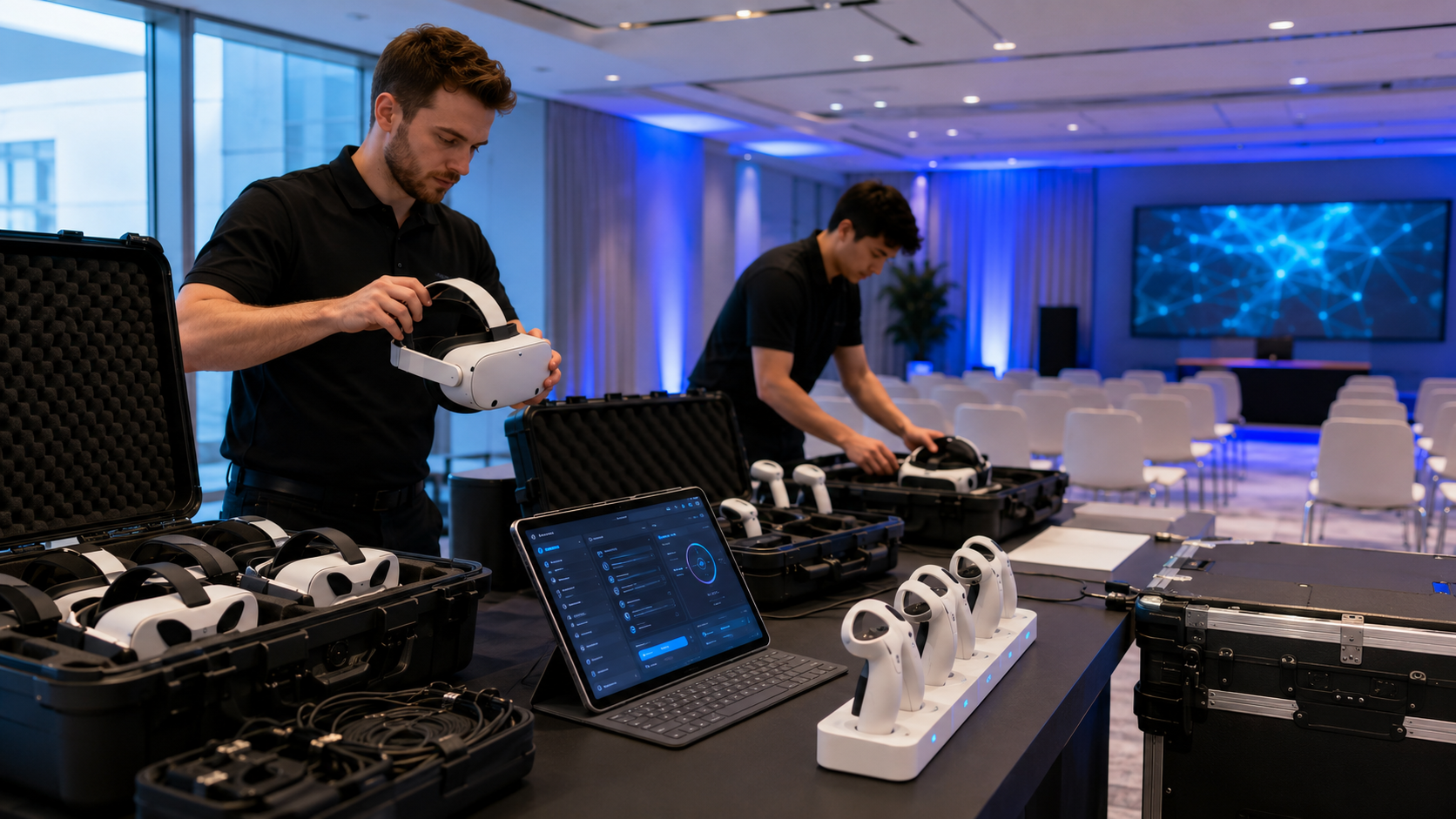
- Staffing for live event deployments: If headsets are involved, plan for 1–2 operators per activation
- Headset or device rental: If the tour is delivered in VR rather than browser-based, hardware rental runs $150–$400 per headset per day for managed rentals
- System integrations: Connecting the tour to a CRM, booking engine, or LMS is typically billed as a separate development item
Virtual Tour Pricing by Business Use Case
The single biggest driver of virtual tour cost is not square footage or camera quality — it is what you need the tour to do. A real estate listing tour, a trade show activation, and an employee onboarding environment are all called virtual tours, but they have completely different technical requirements, hosting needs, and production timelines. Here is how pricing breaks down across the most common business use cases.
Property and Venue Tours (Real Estate, Hospitality, Retail)
Typical range: $800–$5,000 per location
This is the most established virtual tour use case, and pricing is the most standardized as a result. Matterport or an equivalent 3D scanning platform is the market standard for this category — the measured spatial data it produces enables floor plan exports, embed options, and accurate square footage documentation that a 360-photo tour cannot match.
Key pricing variables in this category:
- Hospitality buyers (hotels, event venues, wedding venues) typically need multi-room tours with branded overlays and embedded booking CTAs. Expect to add $1,000–$2,500 for custom branding and CTA integration on top of the base scan cost.
- Retail use cases may require product hotspots linked directly to e-commerce product pages. Each shoppable hotspot adds $500–$2,000 in development depending on the number of SKUs and the complexity of the integration.
- Ongoing hosting is a recurring cost in this category: budget $50–$150/month per location for cloud hosting on platforms like Matterport or Kuula. For a 10-location retail chain, that is $6,000–$18,000 per year in hosting alone — a number that should be in your initial business case.
Employee Training and Onboarding Tours
Typical range: $3,000–$12,000 for a single training environment with interactive elements
Training and onboarding tours are significantly more expensive than property tours because interactivity is not optional — it is the entire point. A training environment that a user can passively watch through is not a training environment; it is a video. The cost of building meaningful decision points, assessment checkpoints, and completion tracking is what drives this category’s price floor above $3,000.
Key pricing variables:
- Number of interactive decision points: Each branching scenario or assessment question adds production time. Budget $200–$500 per complex interaction node.
- LMS integration and SCORM compliance: If your organization needs to track completion for compliance purposes — OSHA training, safety certifications, onboarding documentation — LMS integration is not optional. Expect $1,000–$4,000 for this work depending on your existing platform.
- Browser-based vs. VR headset delivery: Browser-based (WebGL or WebXR) tours are substantially cheaper to deploy at scale. Eliminating headset logistics removes both hardware cost and the operational overhead of managing devices across multiple locations or employees.
- VR headset delivery adds rental or purchase cost: $150–$400/headset/day for managed event rentals, or $400–$600/headset to purchase Meta Quest hardware outright for a permanent training installation.
For organizations planning a full VR onboarding deployment, the production cost of the tour is often the smaller line item compared to hardware procurement and IT management.
Trade Show and Event Activations
Typical range: $2,500–$10,000 for a single-event activation, not including hardware rental
Event virtual tours have a different set of constraints than any other use case. The tour needs to work in a loud, crowded environment, load instantly, require no explanation, and generate a measurable lead or engagement outcome — all within the 30–90 seconds you have a visitor’s attention.
Key pricing variables:
- Browser-based or WebAR delivery is strongly preferred for events. Headsets create queues, require staffing, and are restricted or prohibited at some convention centers. A QR code that launches a WebAR experience on a visitor’s own phone eliminates all of those friction points.
- Lead capture integration: If the tour is meant to generate leads, embedding a form or CRM integration into the experience adds $500–$1,500 depending on the platform.
- Post-event reuse: A tour built for a trade show can be embedded on your website, sent to leads as a follow-up, and used in sales calls for months afterward. Building this reuse into the initial production budget is one of the strongest ROI arguments for event virtual tours — the per-impression cost drops dramatically when the asset has a 12-month life rather than a 3-day one.
- Venue restrictions: Some convention centers restrict headset use or require liability waivers for immersive technology. Confirm venue policy before committing to a VR-based activation.
Sales Demos and Product Visualization Tours
Typical range: $4,000–$15,000 for a custom product visualization tour with interactive configuration
This category covers manufacturing, construction, automotive, and high-ticket B2B sales scenarios where the product cannot be physically transported to every prospect meeting. A virtual tour of a custom-configured industrial machine, a not-yet-built commercial property, or a vehicle interior is a sales tool, not a marketing asset — and it is priced accordingly.
Key pricing variables:
- Existing 3D assets: If your engineering team already has CAD files or product renders, production cost drops significantly. Building 3D assets from scratch for a complex product can add $3,000–$8,000 to a project budget.
- Configuration interactivity: A tour that lets a prospect change colors, swap components, or view different model variants requires substantially more development than a static walkthrough.
- Delivery format: A tablet-based WebAR demo costs less to deploy than a full VR headset experience but may have lower perceived impact in a high-stakes enterprise sales context. The right choice depends on your sales cycle and buyer expectations.
Virtual Tour Pricing by Delivery Format
Beyond use case, the format you choose — how the tour is actually experienced — is the second biggest cost lever. Each format has a different production cost, hosting model, and hardware dependency. Here is what each format costs and when it makes sense for a business buyer.
Browser-Based 360 Photo Tours
Price range: $300–$1,500 per location
This is the lowest-cost entry point for business virtual tours. A photographer captures a space with a 360-degree camera, images are stitched and uploaded to a hosting platform (Kuula, Roundme, or a custom embed), and the result is a navigable panoramic tour that works on any device with a browser — no app download, no headset required.
Best for: Property listings, venue showcases, restaurant and retail spaces, any use case where the primary goal is spatial orientation rather than deep interactivity.
Limitations: No spatial measurement data, limited interactivity beyond basic hotspots, and lower immersion than a true 3D scan. If your buyer needs to measure a room or understand spatial relationships accurately, this format is not sufficient.
Matterport-Style 3D Scanned Tours
Price range: $800–$5,000 for scan, processing, and hosting setup
Matterport is the dominant platform in this category, though alternatives including iStaging, Cupix, and Leica RTC360 exist at different price points and capability levels. What distinguishes a 3D scanned tour from a 360-photo tour is the spatial data — a Matterport scan produces a navigable 3D dollhouse view, an accurate floor plan, and dimensional measurements that can be used for architecture, real estate documentation, and facilities management.
Ongoing hosting on Matterport: $69–$309/month depending on plan tier and number of active spaces. This is a significant ongoing cost for multi-location deployments and should be factored into any multi-year business case.
Best for: Real estate, architecture, hospitality, facilities management, any use case where spatial accuracy matters beyond visual navigation.
WebAR Virtual Tours
Price range: $3,000–$10,000 depending on asset complexity and interactivity
WebAR tours are accessed via a URL or QR code and run directly in a mobile browser — no app install required, compatible with modern iOS and Android devices. This format is increasingly the default choice for trade show activations and product marketing because it eliminates every hardware and logistics barrier.
Cost drivers in this format:
- Number and complexity of 3D assets
- Animation and interaction complexity
- Tracking type: image-based tracking (triggered by scanning a printed image) is simpler and cheaper than surface-based tracking (which places objects in the user’s real environment)
- Lead capture or CRM integration
Best for: Trade shows, product launches, packaging interactions, any activation where zero friction and instant access are the primary requirements.
VR Headset-Delivered Tours
Price range: $5,000–$20,000+ for production, plus hardware costs
VR headset delivery offers the highest level of immersion and is the appropriate choice for training environments where spatial presence matters, high-stakes sales demos where impact justifies the logistics, and premium event activations where the experience itself is the differentiator.
Hardware options and costs:
- Meta Quest 3: $499 retail per headset for purchase
- Managed rental: $150–$400/headset/day including support
- White-glove event rental with staffing: priced per event, typically $2,000–$6,000/day for a 4–6 headset setup with an operator
The honest assessment: VR headset delivery is not always the right choice. Browser-based or WebAR delivery frequently achieves 80% of the business outcome at 30% of the cost. The cases where VR headsets are clearly justified are training environments requiring genuine spatial presence, sales demos for products where immersion directly influences purchase decisions, and events where the headset experience is itself the marketing story.
What Drives Virtual Tour Costs Up (and Down)
Once you understand base pricing by use case and format, the next step is identifying which specific decisions will move your quote in either direction. These are the variables that vendors will ask about when you request a proposal — understanding them in advance puts you in a stronger negotiating position.
Cost Drivers That Increase Price
- Custom branding: Replacing a platform’s default UI with your logo, color palette, and navigation design adds $500–$2,500 in development depending on complexity.
- Interactive hotspots and embedded media: Each clickable element — video, PDF, product link, embedded form — adds production time. Budget $100–$300 per hotspot for complex interactions; simpler text-and-image hotspots are cheaper.
- Multi-location deployment: Per-location costs decrease at scale, but total project cost and ongoing hosting fees multiply. A 20-location deployment at $800/location is $16,000 before hosting.
- LMS or CRM integration: Connecting tour completion data or lead capture to your existing systems requires API development work — typically $1,000–$4,000 depending on the platform and integration complexity.
- Measured spatial data: If you need accurate floor plans or room dimensions from the scan, this requires specialized equipment and post-processing time that a standard 360-photo shoot does not include.
- Rush timelines: Expedited production (under 2 weeks from shoot to delivery) typically carries a 20–40% premium. If your event date is fixed, build adequate lead time into your planning.
Cost Drivers That Decrease Price
- Existing 3D assets: If you already have CAD files, product renders, or prior scan data, production cost drops significantly. Always disclose existing assets when requesting a quote.
- Self-capture with provided equipment: Some platforms allow clients to capture their own spaces with a 360 camera and upload directly — this reduces photographer fees but requires training and quality control.
- Browser-based delivery over VR: Eliminating headset hardware removes the largest single cost variable in many projects. If your use case does not require full immersion, browser-based delivery is almost always the right financial decision.
- Reuse across multiple channels: A tour built for a trade show that is also embedded on your website, sent to leads post-event, and used in sales calls amortizes its production cost across many more impressions. Build reuse into the initial brief to justify a higher production budget.
- Template-based builds: If your use case fits a standard template — property listing, showroom walkthrough, basic onboarding tour — you avoid custom development costs entirely.
How to Evaluate a Virtual Tour Quote
When you receive a proposal from a virtual tour vendor, the line items matter less than the questions you ask before signing. Here is what to verify before committing budget, based on the operational details that most buyers miss until after the project starts.
Questions to Ask Before You Sign
On hosting and ownership:
- Is hosting included in the quote, and for how long? What happens to the published tour if you stop paying hosting fees — does it go offline, or do you retain access to the files?
- Who owns the raw scan data and 3D assets — you or the vendor? This matters significantly if you want to switch platforms, update the tour with a different vendor, or use the assets in other projects.
On updates and maintenance:
- What is the update or re-scan policy if your space changes? Is there a per-update fee, or is maintenance included in a service plan?
- Does the quote include mobile optimization and cross-device testing, or is that a separate line item?
On events and staffing:
- If this is for an event, does the quote include on-site staffing, or is that billed separately? What is the staffing rate if needed?
On analytics and reporting:
- What analytics are included — view counts, dwell time, hotspot interaction rates, lead capture? Are these accessible in a real-time dashboard, or are they delivered as periodic vendor reports?
- Can analytics data be exported to your existing BI or CRM tools?
Red Flags in Virtual Tour Proposals
Watch for these warning signs when reviewing vendor proposals:
- Pricing quoted only per square foot with no mention of interactivity, hosting, or delivery format. This is a photography rate card, not a business solution quote.
- No mention of file ownership or data portability. If a vendor cannot clearly state who owns the assets, assume the answer is not in your favor.
- Hosting fees buried in fine print or described vaguely as “platform fees” without a clear monthly rate and escalation policy.
- No delivery timeline or revision rounds specified. A professional vendor will define both in the proposal.
- Vendor cannot demonstrate a live example in your specific use case category. Asking to see a comparable project in production is a reasonable and standard request.
Virtual Tour Pricing vs. Augmented Reality: When to Choose Each
Business buyers frequently compare virtual tours and augmented reality experiences when planning a marketing activation or technology initiative. They serve different purposes and have different cost structures — here is a direct comparison to help you allocate budget correctly rather than defaulting to the more familiar option.
When a Virtual Tour Is the Right Investment
- You need to showcase a physical space — a property, venue, facility, showroom, or campus — to an audience that cannot visit in person
- Your audience needs to navigate freely through an environment rather than interact with a single product or object
- You want a persistent asset that lives on your website, generates ongoing organic traffic, and works as a long-term lead generation tool
- Your use case is training or onboarding where spatial familiarity with an environment is the learning objective — understanding where exits are, how a production floor is laid out, or how a facility is organized
When AR Is a Better Fit (and What It Costs)
- You need to overlay digital content onto a real-world environment the user is already standing in — a retail store, a trade show floor, a customer’s home
- Your use case is product visualization at point of sale — letting a customer see how furniture looks in their room, how a machine fits in their facility, or how a vehicle looks in their driveway
- You want zero hardware friction — WebAR runs on any modern smartphone via a URL, with no app download and no headset
- You are planning a short-duration marketing activation rather than a persistent hosted asset
AR pricing context: Custom WebAR builds typically start at $5,000–$15,000 for a single campaign experience, though template-based WebAR tools can bring simple product visualization experiences in at $1,500–$4,000. The key distinction is that AR is generally the right choice when the user’s real environment is part of the experience, and a virtual tour is the right choice when the environment you are showcasing is the experience.
Frequently Asked Questions
How much does a virtual tour cost for a small business?
For a small business a single retail location, restaurant, medical office, or service space — a functional virtual tour typically costs $500–$2,500. A basic 360-photo tour hosted on a platform like Kuula or Roundme sits at the lower end ($300–$800). A Matterport-style 3D scan with basic branding and a standard hosting plan runs $800–$2,500 for a single location. Custom branding, interactive hotspots, or e-commerce integration push the cost higher.
What is the difference between a 3D scan and a 360 photo tour in terms of price?
A 360-photo tour captures panoramic images stitched together for navigation — typically $300–$1,200 per location. A 3D scan (Matterport or equivalent) captures spatial geometry in addition to imagery, producing measured floor plans, a dollhouse view, and accurate dimensions — typically $800–$3,500 per location. The 3D scan costs more because the equipment, processing time, and hosting infrastructure are more complex. If you need accurate measurements or floor plan exports, the 3D scan is worth the premium. If you only need visual navigation, a 360-photo tour may be sufficient.
Does virtual tour pricing include hosting, or is that extra?
In most cases, hosting is a separate ongoing cost. Some vendors include 3–12 months of hosting in the initial production quote, but this is the exception rather than the rule. Matterport charges $69–$309/month depending on plan tier. Third-party platforms like Kuula charge $16–$50/month for business plans. Always ask whether hosting is included in the quote, for how long, and what the monthly rate is after the included period ends.
How much does a Matterport virtual tour cost per square foot?
Matterport pricing from third-party service providers (photographers and scanning companies) typically runs $0.10–$0.25 per square foot for the scan itself, with a minimum charge of $300–$500 for small spaces. A 2,000 sq ft retail space might cost $400–$600 to scan. A 20,000 sq ft commercial facility might cost $2,000–$5,000 depending on complexity, number of floors, and scan density required. Matterport’s own hosting fees are separate from the scanning service cost.
Can I get a virtual tour for a trade show or event, and what does it cost?
Yes — event virtual tours are a well-established use case. A single-event activation typically costs $2,500–$10,000 for production, not including hardware rental. Browser-based or WebAR delivery is strongly recommended for events to avoid headset logistics and venue restrictions. If you are renting VR headsets for a managed activation, budget an additional $150–$400 per headset per day plus staffing. The strongest ROI argument for event virtual tours is post-event reuse — build a tour that can be embedded on your website and sent to leads after the show, and the per-impression cost drops significantly.
What is the cheapest way to create a virtual tour for my business?
The lowest-cost approach is a self-captured 360-photo tour using a consumer 360 camera (Ricoh Theta or Insta360, priced at $300–$600 to purchase) and a free or low-cost hosting platform. This approach can produce a functional tour for under $500 total if you are willing to do the capture yourself. The tradeoff is lower image quality, no spatial data, and limited interactivity. For businesses where the tour is a primary sales or marketing asset, professional capture and production is worth the additional investment.
How long does it take to produce a virtual tour, and does rush delivery cost more?
A standard timeline from shoot to published tour is 1–3 weeks for a single-location project. Multi-location or complex interactive projects typically run 3–8 weeks. Rush delivery (under 2 weeks) is available from most professional vendors and typically carries a 20–40% premium. If you have a fixed event date or launch deadline, communicate it at the start of the engagement — vendors can often accommodate tight timelines if they know in advance rather than at the revision stage.
Do I own the virtual tour files, or does the vendor retain them?
This varies by vendor and should be explicitly addressed in your contract before signing. Many platform-based vendors (Matterport, Kuula, iStaging) retain the processed tour files on their platform — you have access as long as you pay hosting fees, but you do not receive exportable raw files. Independent production vendors may deliver source files and 3D assets to you directly. If data portability matters to your organization — for switching platforms, using assets in other projects, or internal archiving — negotiate file ownership explicitly in the contract.
Get a Virtual Tour Quote in Under 24 Hours
IgivU provides pricing for virtual tour projects within 24 hours. Whether you are planning a single-location property tour, a multi-site training environment, or a trade show activation, the fastest path to an accurate number is to describe your use case directly.
The variables covered in this guide — format, use case, interactivity level, hosting requirements, timeline, and existing assets are exactly what goes into a quote. The more context you provide upfront, the more precise and actionable the estimate you receive.
No sales call required to get a number. Describe your project, and you will have a detailed proposal within one business day.
Pricing ranges in this guide reflect current market rates as of 2026 and are based on industry benchmarks across multiple vendors and platforms. Individual quotes will vary based on project scope, timeline, and specific technical requirements. All IgivU pricing is provided on a per-project basis following a brief consultation.