Why Traditional Compliance Training Software Falls Short
Most compliance training software delivers the same click-through modules that employees rush to complete without retention. We’ll examine the engagement crisis in compliance training and why immersive alternatives are gaining traction among forward-thinking HR teams.
The 17% Retention Problem with Traditional E-Learning
Traditional compliance training faces a stark reality: employees retain only 17% of information from standard e-learning modules after 30 days. This retention crisis translates directly into organizational risk, with companies spending an average of $14 million annually on compliance failures despite maintaining 98% training completion rates.
The disconnect between completion certificates and actual behavior change stems from passive learning formats. Employees click through slides, answer predictable quiz questions, and receive their compliance checkmark—all without meaningful engagement or skill development. Recent surveys show 67% of employees admit to multitasking during compliance training, while 43% report completing modules without reading the content.
Employee feedback reveals deep frustration with traditional module fatigue. Common complaints include irrelevant scenarios, outdated interfaces, and the perception that compliance training exists solely to protect the company rather than develop employee capabilities. This negative association creates resistance to future training initiatives and undermines the cultural importance of compliance.
Where Click-Through Training Creates Risk
Safety scenarios demand spatial awareness and muscle memory that PowerPoint slides cannot develop. Workers need to physically practice lockout/tagout procedures, experience the weight of safety equipment, and develop automatic responses to hazardous situations. Traditional software showing safety procedures through videos or animations fails to create the neural pathways required for emergency response.
Harassment prevention training requires emotional intelligence development that transcends intellectual understanding. Employees may comprehend harassment policies intellectually while lacking the emotional skills to recognize subtle situations or intervene effectively. Click-through modules presenting simplified scenarios cannot replicate the social complexity and emotional pressure of real workplace interactions.
Emergency response protocols need practiced decision-making under stress. Reading about evacuation procedures differs fundamentally from navigating smoke-filled corridors or triaging multiple safety threats simultaneously. Traditional software cannot simulate the physiological stress response that affects decision quality during actual emergencies.
VR Compliance Training: The Immersive Alternative
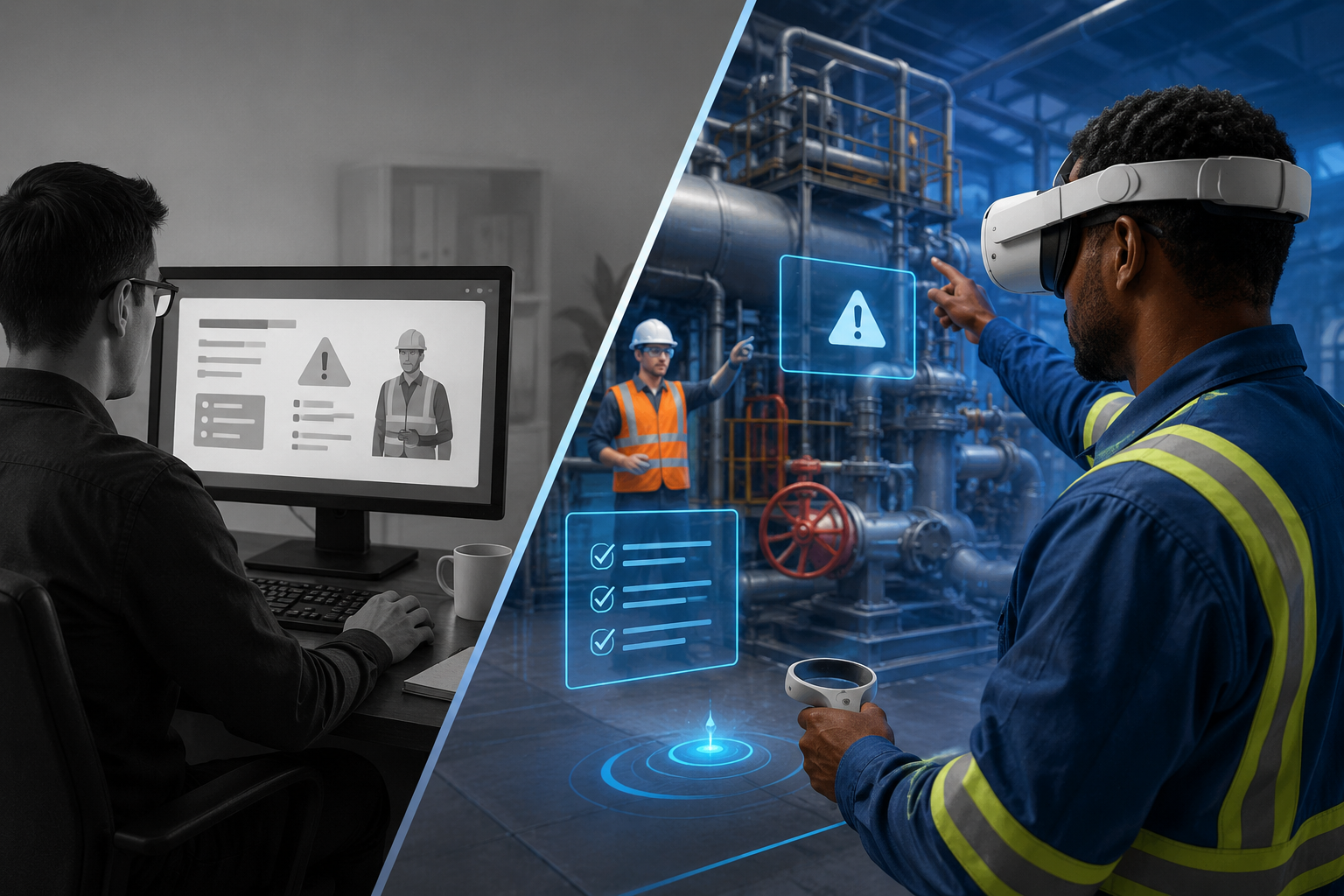
Virtual reality transforms compliance training from passive viewing to active practice. Here’s how VR rental packages deliver compliance training without the complexity of traditional software procurement.
How VR Changes Compliance Training Delivery
VR compliance training places employees directly into realistic workplace scenarios where their actions have immediate consequences. Instead of watching a video about proper lifting technique, employees practice lifting virtual objects with real-time feedback on their form. Rather than reading about bystander intervention, they experience the social pressure of witnessing inappropriate behavior and must choose how to respond.
Emotional engagement through presence and consequence drives retention rates to 75% after 30 days—a 340% improvement over traditional e-learning. The brain processes VR experiences as real memories, creating stronger neural pathways for recall during actual workplace situations. Employees report feeling personally responsible for their training outcomes rather than simply completing requirements.
Measurable behavior tracking extends beyond completion rates to include reaction times, decision patterns, and physiological responses. VR systems capture where employees look, how quickly they respond to hazards, and which safety steps they skip under pressure. This granular data enables targeted remediation and validates training effectiveness through observable behavior change rather than quiz scores.
VR Rental vs Software Licensing Economics
Per-session VR rental eliminates the front-loaded costs of annual software licenses while providing flexibility to scale training initiatives. Organizations typically spend $50-100 per employee for annual compliance software licenses regardless of actual usage. VR rental models charge $30-50 per training session, aligning costs directly with training delivery and eliminating waste from unused licenses.
No IT infrastructure or integration requirements accelerates deployment from months to days. Traditional compliance software requires LMS integration, user provisioning, security reviews, and ongoing IT support. VR rental packages arrive pre-configured with compliance content loaded, requiring only space and power outlets. This infrastructure independence particularly benefits organizations with complex IT environments or limited technical resources.
Scale up or down based on training calendar needs without penalty. Seasonal workforce fluctuations, acquisition integrations, and regulatory change cycles create variable training demand that fixed software licenses cannot accommodate efficiently. VR rental agreements adjust monthly, enabling organizations to increase capacity for new hire onboarding or reduce costs during slow periods.
Compliance Scenarios That Work Better in VR
Not all compliance training benefits equally from VR. We’ll identify the high-impact scenarios where immersive training delivers measurable improvements over traditional software.
Workplace Safety and OSHA Compliance
Hazard recognition in realistic work environments reduces workplace incidents by 43% compared to traditional training methods. VR places employees in detailed recreations of actual work areas where they must identify and address safety hazards before proceeding. Unlike static images in traditional training, VR hazards exist in three-dimensional space with realistic lighting, shadows, and environmental distractions that mirror real workplace conditions.
Equipment operation and lockout/tagout procedures benefit from muscle memory development impossible through traditional software. Employees practice the physical sequence of isolating energy sources, applying locks, and verifying zero-energy states. The spatial reasoning required to trace power sources through complex machinery develops through repeated VR practice, creating automatic safety behaviors that persist under workplace pressure.
Fall protection and confined space entry training eliminates the risks associated with live training while maintaining experiential learning benefits. Employees experience height-induced stress responses and practice harness inspection procedures without actual elevation exposure. Confined space scenarios simulate restricted movement and limited visibility while teaching atmospheric testing protocols and emergency extraction procedures.
Harassment Prevention and DEI Training
Bystander intervention practice in realistic scenarios develops the social courage required for real-world action. VR training places employees in uncomfortable situations where they witness inappropriate behavior and must decide whether and how to intervene. The emotional discomfort of these scenarios, combined with safe practice opportunities, builds intervention skills that transfer to actual workplace situations.
Perspective-taking exercises for empathy building allow employees to experience workplace situations from different demographic perspectives. A senior executive might experience a meeting as a junior female employee facing interruption and dismissal. These perspective shifts, impossible through traditional training, create visceral understanding of workplace dynamics that intellectual learning cannot achieve.
De-escalation techniques with emotional presence prepare employees for charged interpersonal conflicts. VR scenarios present angry customers, frustrated colleagues, or distressed employees requiring careful communication and emotional regulation. Employees practice maintaining composure, using calming language, and recognizing escalation triggers while experiencing realistic stress responses.
Data Security and Privacy Compliance
Social engineering attack simulations expose employees to sophisticated manipulation tactics in safe environments. VR scenarios present friendly strangers requesting building access, urgent phone calls demanding password resets, and convincing phishing attempts requiring immediate response. Employees who experience these attacks in VR show 61% better threat recognition in real-world testing.
Clean desk policy walkthroughs transform abstract policies into practiced behaviors. Employees navigate virtual offices identifying and securing sensitive information before leaving for the day. The spatial memory developed through VR practice creates automatic scanning behaviors that traditional training cannot instill.
Incident response decision trees become intuitive through repeated scenario practice. Employees face data breach discoveries, suspicious network activity, and potential insider threats requiring immediate decision cascades. VR training develops the rapid assessment and escalation skills that reading incident response procedures cannot create.
Implementation Roadmap: From Pilot to Program
Moving from traditional compliance software to VR training doesn’t require wholesale replacement. Here’s the phased approach our enterprise clients use to test, validate, and scale VR compliance training.
Phase 1: Pilot Program Setup (Weeks 1-4)
Selecting the right compliance scenario for proof of concept requires balancing impact potential with implementation complexity. Organizations typically choose scenarios with measurable outcomes, high incident costs, and clear behavior change requirements. Workplace safety training for high-risk areas, harassment prevention for customer-facing teams, or emergency response for facility staff provide strong pilot candidates.
Rental package configuration for 25-50 employees establishes sufficient sample size for meaningful comparison while limiting initial investment. This scale enables A/B testing between VR and traditional training methods while maintaining operational continuity. Standard rental packages include 5-10 headsets, enabling 40-50 employees to complete 30-minute training sessions across two days.
Baseline metrics establishment for comparison requires documenting current training costs, completion rates, retention scores, and incident frequencies. Organizations should conduct pre-training assessments, 30-day retention tests, and behavior observations for both control and pilot groups. These baseline measurements enable objective ROI calculation and inform scaling decisions.
Phase 2: Measurement and Iteration (Weeks 5-8)
Retention testing methodology at 30/60/90 days validates long-term learning outcomes beyond immediate post-training scores. Surprise scenario tests, where employees encounter compliance situations during regular work, provide authentic retention measurement. VR-trained employees typically demonstrate 70% appropriate response rates at 90 days versus 25% for traditional training.
Behavior observation protocols document actual workplace behavior changes rather than self-reported compliance. Supervisors use standardized checklists to track safety procedure adherence, intervention behaviors, and policy compliance. These observations, conducted without employee awareness, reveal true training transfer and identify areas requiring reinforcement.
Cost-per-outcome calculations vs traditional training establish clear ROI metrics for executive decision-making. Organizations calculate the total training cost divided by the number of employees demonstrating sustained behavior change. VR training typically achieves cost-per-outcome rates 40% lower than traditional software despite higher per-session costs.
Phase 3: Scale Decision Framework
ROI thresholds for expansion typically require 25% improvement in key metrics to justify broader deployment. Organizations consider retention improvements, incident reduction, training time efficiency, and employee satisfaction scores. Meeting three of four threshold metrics generally supports expansion recommendation.
Hybrid model design combining VR and traditional methods optimizes resource allocation across different training needs. High-impact scenarios migrate to VR delivery while policy updates and information transfer remain in traditional formats. This hybrid approach typically allocates 30% of compliance training to VR experiences and 70% to traditional methods.
Annual training calendar integration requires scheduling VR sessions during facility downtime and coordinating headset availability across locations. Organizations typically establish quarterly VR training cycles aligned with shift schedules and seasonal workforce patterns. Centralized VR equipment pools rotate between facilities, maximizing utilization while minimizing rental costs.
VR Equipment and Content Selection for Compliance Training
The right hardware and content library determines training effectiveness. We’ll cover the specific VR rental configurations that work for compliance scenarios and how to evaluate content options.
Headset Requirements for Enterprise Compliance Training
Standalone vs PC-tethered considerations for training rooms depend on available space and IT infrastructure. Standalone headsets like Meta Quest 3 or Pico 4 Enterprise enable flexible training locations without computer requirements. PC-tethered systems provide higher visual fidelity for complex simulations but require dedicated training spaces with gaming-capable computers.
Hygiene and multi-user setup requirements demand wipeable materials, replaceable face cushions, and rapid reset procedures. Enterprise rental packages include UV sanitization cases, disposable face covers, and multi-user management software. Sessions should schedule 5-minute buffers between users for equipment sanitization and account switching.
Minimum specs for compliance training applications include 90Hz refresh rates to prevent motion sickness, 2K per eye resolution for text readability, and 6DOF tracking for natural movement. Hand tracking capabilities enhance training realism but aren’t essential for most compliance scenarios. Battery life should support minimum 2-hour continuous use for back-to-back training sessions.
Compliance Training Content Libraries
Pre-built scenario availability by compliance category varies significantly across vendors. Safety training offers the most extensive libraries with 200+ scenarios covering construction, manufacturing, and healthcare settings. Harassment prevention and DEI content typically includes 20-30 scenarios with customization options for company-specific policies.
Custom content development vs off-the-shelf options depends on industry specificity and competitive advantage. Generic compliance scenarios cost $0 through rental packages while custom development ranges from $25,000-100,000 per scenario. Organizations typically start with pre-built content and develop custom scenarios for unique equipment or procedures.
Content update cycles for regulatory changes require vendor commitments to maintain compliance currency. Leading providers update content quarterly for regulatory changes and annually for best practice evolution. Service agreements should specify update responsibilities and timelines for critical compliance requirements.
Cost Comparison: VR Rental vs Compliance Software Platforms
Understanding the true cost requires looking beyond sticker price to include implementation, engagement, and outcome metrics. Here’s the financial framework for comparing VR rental to traditional compliance training software.
Direct Cost Analysis
VR rental rates for quarterly training sessions average $2,000-4,000 for 50-employee cohorts completing 30-minute experiences. This includes equipment delivery, setup support, and standard compliance content libraries. Annual costs for 200 employees trained quarterly total $16,000-32,000 depending on location and support requirements.
Traditional software licensing and per-seat costs range from $30-150 annually per employee for comprehensive compliance platforms. A 200-employee organization typically spends $10,000-30,000 annually on software licenses plus $5,000-10,000 for implementation and support. Hidden platform switching costs and multi-year contracts often lock organizations into underperforming solutions.
Hidden costs for traditional software include IT support averaging 40 hours annually, LMS integration projects costing $10,000-25,000, and content customization fees of $500-2,000 per module. VR rental eliminates these hidden costs through turnkey delivery models requiring no IT involvement or system integration.
Outcome-Based ROI Calculation
Cost per retained learning outcome provides the clearest comparison metric between training methods. Traditional software achieving 17% retention at $50 per employee yields $294 per retained outcome. VR training with 75% retention at $80 per employee session achieves $107 per retained outcome—a 64% improvement in training efficiency.
Incident reduction value modeling demonstrates substantial returns from improved training effectiveness. A single OSHA recordable incident costs organizations an average of $42,000 in direct and indirect expenses. Reducing incident rates by 40% through VR training saves $168,000 annually per 100 employees in high-risk environments.
Time-to-competency improvements accelerate productive workforce deployment. VR-trained employees reach performance standards 35% faster than traditionally trained peers. For roles with $50,000 annual compensation, this acceleration saves $4,375 per employee in productivity costs during onboarding.
FAQs
How many employees can complete VR compliance training per day?
A single VR headset can train 12-15 employees per day in 30-minute sessions with 10-minute transition buffers. A 5-headset rental package enables 60-75 employees to complete training daily. Organizations typically complete 200-employee training initiatives across 3-4 days using 5-10 headsets with staggered scheduling.
What compliance standards can VR training help meet?
VR training directly supports OSHA safety requirements, EEOC harassment prevention guidelines, GDPR privacy training, and ISO certification requirements. Documented VR training completion satisfies audit requirements when combined with proper record-keeping and assessment protocols. Specific industry standards including MSHA, DOT, and Joint Commission requirements have approved VR training pathways.
Do employees need VR experience to complete compliance training?
No prior VR experience is required. Modern compliance training applications include 5-minute comfort tutorials that teach basic navigation and interaction. 95% of employees successfully complete VR training on their first attempt, with the remaining 5% requiring minimal additional support. Age and technical proficiency show minimal correlation with VR training success rates.
How do you track and report VR training completion for audits?
VR training platforms generate detailed completion certificates including timestamps, scenario details, performance metrics, and behavioral assessments. These reports export to standard formats compatible with LMS platforms and compliance tracking systems. Audit trails capture more granular data than traditional training, including time-in-scenario, interaction patterns, and decision pathways.
Can VR compliance training integrate with existing LMS platforms?
Most enterprise VR training solutions support SCORM, xAPI, and LTI standards for LMS integration. Completion data automatically syncs to platforms like Cornerstone, SAP SuccessFactors, and Workday Learning. For organizations preferring standalone tracking, VR platforms provide dedicated dashboards with API access for custom reporting needs.
Conclusion
The shift from traditional compliance training software to VR-based immersive compliance training solutions represents more than a technology upgrade—it’s a fundamental reimagining of how organizations develop workforce capabilities and maintain regulatory compliance. While traditional software will continue serving basic information transfer needs, VR rental models now offer accessible, measurable, and cost-effective alternatives for high-impact compliance scenarios.
Organizations ready to explore VR compliance training should start with focused pilots in areas where traditional training shows the largest gaps between completion and actual behavior change. Safety compliance training VR applications, in particular, demonstrate immediate ROI through incident reduction and accelerated skill development. The rental model eliminates technology risk while providing flexibility to scale based on proven results.
The evidence is clear: employees retain 4x more information, develop real behavioral skills, and report higher satisfaction with VR compliance training compared to traditional click-through modules. For HR and L&D teams tired of checking compliance boxes without creating real capability, VR rental packages offer a practical path to training that actually works.
Ready to transform your compliance training from obligation to opportunity? Contact our team to design a custom VR pilot program for your highest-impact compliance challenge. We’ll help you select the right scenarios, configure rental packages, and establish measurement frameworks that prove ROI within 90 days.