Why Traditional Onboarding Software Falls Short for Engagement
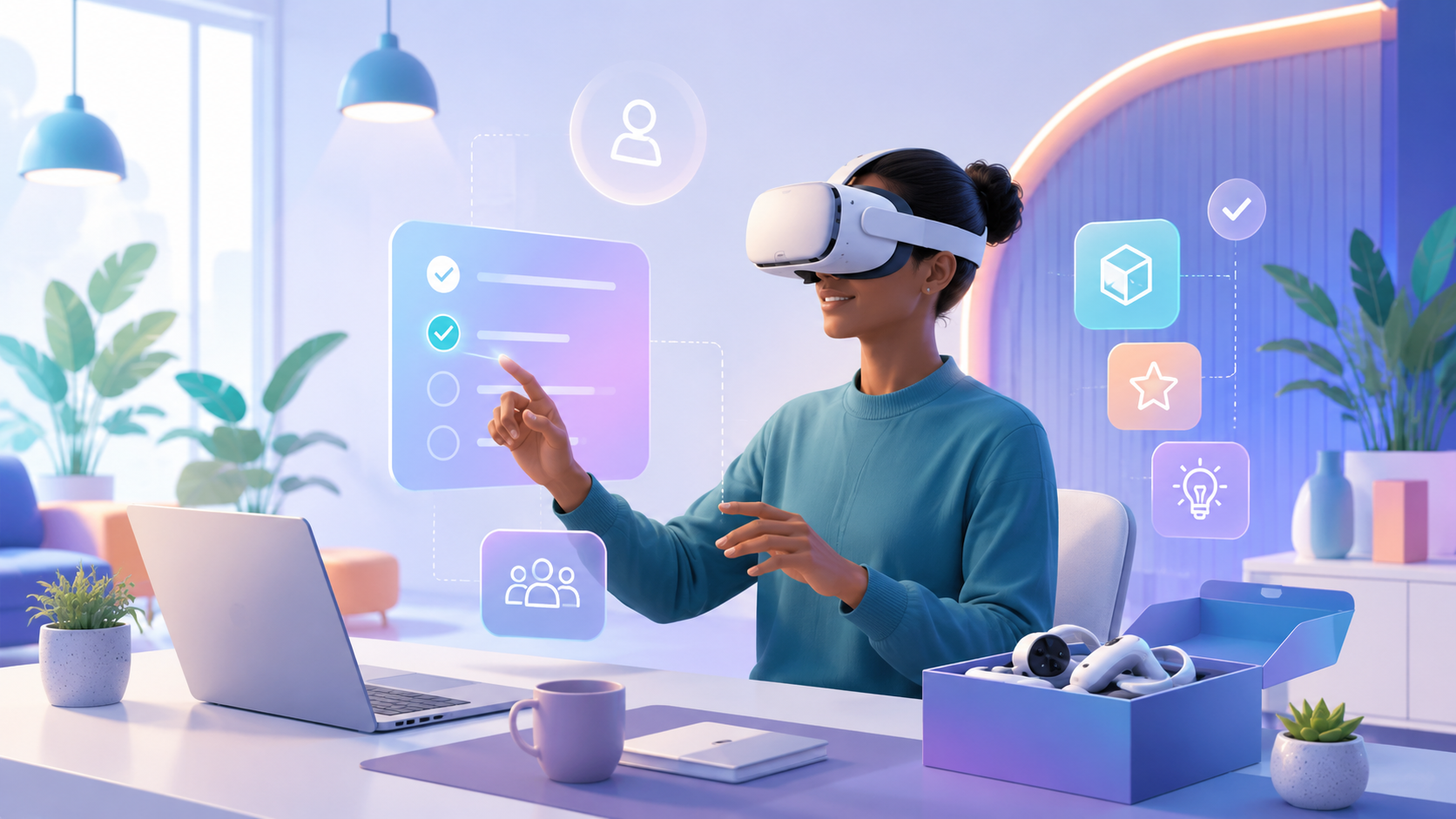
Most onboarding platforms deliver the same passive experience: video libraries, document repositories, quiz modules. New hires click through screens alone at their desks. VR onboarding transforms this into active participation – employees practice customer interactions, explore virtual offices, and complete hands-on safety training in simulated environments.
The shift from passive consumption to active participation fundamentally changes how new employees absorb and retain critical information during their first weeks. Instead of watching a video about company culture, they walk through a virtual recreation of headquarters. Rather than reading safety protocols, they practice emergency procedures in risk-free simulations. This experiential learning approach addresses the core weakness of traditional digital onboarding: engagement through action rather than observation.
The Retention Problem with Screen-Based Training
Edgar Dale’s Cone of Experience demonstrates a stark reality: people retain 90% of what they practice versus only 10% of what they read. Traditional onboarding software, despite sophisticated learning management systems and interactive elements, still primarily delivers information through passive consumption. The statistics paint a concerning picture for HR teams relying on conventional digital training methods.
Average onboarding software sees 60-70% completion rates, with engagement dropping significantly after the first week. Employees multitask during video modules, skip through documentation, and complete assessments through trial and error rather than genuine comprehension. The result is a workforce that technically completed onboarding but lacks practical readiness for their roles.
VR training studies reveal dramatic improvements: learners complete training 4x faster than classroom sessions while demonstrating 275% more confidence in applying skills. PwC’s 2020 study found VR learners were 3.75x more emotionally connected to content than classroom learners and 2.3x more than e-learners. These aren’t marginal improvements – they represent fundamental shifts in training effectiveness that directly impact time-to-productivity and early employee performance.
The neuroscience behind VR’s effectiveness stems from presence and embodiment. When employees perform tasks in virtual environments, their brains process the experience similarly to real-world activities. This creates stronger neural pathways and muscle memory that traditional screen-based training cannot replicate. A warehouse worker who practices forklift operation in VR develops spatial awareness and procedural memory that transfers directly to the physical equipment.
What VR Onboarding Actually Looks Like
Virtual facility tours give remote employees spatial context impossible through video walkthroughs. New hires explore their future workspace, locate departments, and familiarize themselves with layouts before their first day on-site. They navigate from the parking lot to their desk, find conference rooms, and identify emergency exits – building mental maps that reduce first-week anxiety and disorientation.
Hands-on equipment training eliminates safety risks while providing realistic practice opportunities. Manufacturing employees operate virtual machinery, learning correct sequences and safety protocols without endangering themselves or damaging expensive equipment. Healthcare workers practice using medical devices on virtual patients, making mistakes without consequences while building confidence for real-world application.
Role-playing customer scenarios with AI avatars develops soft skills through repetition and variation. Retail employees encounter difficult customers, practice de-escalation techniques, and receive immediate feedback on their responses. The AI adapts to create progressively challenging situations, ensuring employees face diverse scenarios before their first customer interaction.
Spatial memory formation through VR significantly improves procedure retention. When employees learn multi-step processes by physically performing them in virtual space, they create embodied memories that persist longer than information learned through observation. A technician who assembles components in VR remembers the sequence through muscle memory, not just cognitive recall.
VR Onboarding Use Cases by Industry
Different sectors leverage VR onboarding for specific training challenges. Manufacturing companies use it for equipment operation, healthcare for patient interaction, retail for customer service scenarios. Here’s what works for each industry based on IGIVU’s rental deployments.
The versatility of VR training allows organizations to address industry-specific onboarding challenges that traditional methods struggle to solve. Remote employees can access hands-on training previously requiring physical presence. Dangerous procedures become safe learning opportunities. Expensive equipment gets virtualized for unlimited practice without wear or downtime.
Manufacturing and Warehouse Operations
Forklift operation training through VR eliminates equipment scheduling conflicts and safety concerns during initial learning phases. New operators practice basic controls, load handling, and navigation in virtual warehouses matching their actual work environment. They experience common hazards like blind corners, unstable loads, and pedestrian interactions without real-world risks.
Safety protocol walkthroughs in hazardous zones prepare employees for dangerous environments before exposure. Workers navigate virtual chemical plants, identify hazards, practice lockout/tagout procedures, and respond to emergency scenarios. They learn spatial awareness around dangerous equipment and practice proper PPE usage in context rather than through static demonstrations.
Assembly line procedure practice develops muscle memory and sequence recognition before production floor placement. Employees rehearse complex assembly steps, learn quality control checkpoints, and understand workflow timing without slowing actual production. VR training reduces defect rates during the learning curve period when new workers typically make the most errors.
Typical rental packages for manufacturing onboarding include 10-20 Quest 3 headsets for 2-week training cycles. Companies often stagger cohorts through VR stations while others complete classroom portions, maximizing headset utilization. IGIVU’s manufacturing clients typically see 50% reduction in on-floor training time and 70% fewer safety incidents during employees’ first 90 days.
Healthcare and Medical Training
Patient interaction scenarios develop bedside manner and communication skills crucial for healthcare roles. Nurses practice difficult conversations, learn to recognize non-verbal distress signals, and develop empathy through perspective-taking exercises. VR scenarios include diverse patient populations with varying cultural backgrounds, ages, and medical conditions.
Medical device operation training provides unlimited practice without tying up expensive equipment or risking patient safety. Technicians learn to operate ventilators, infusion pumps, and diagnostic equipment through realistic simulations. They troubleshoot common errors, practice emergency protocols, and build confidence before touching actual devices.
Emergency response drills in virtual hospitals prepare staff for high-stress situations without disrupting patient care. Teams practice code blue responses, mass casualty protocols, and evacuation procedures in realistic hospital environments. The immersive nature of VR creates stress inoculation that better prepares staff for actual emergencies than tabletop exercises.
Healthcare organizations typically rent 5-10 headsets for monthly cohort training, aligning with nursing orientation schedules and residency programs. The controlled environment allows standardized training across multiple facilities, ensuring consistent care standards regardless of location. IGIVU’s healthcare clients report 40% faster competency achievement and significantly higher confidence scores among VR-trained staff.
Retail and Customer Service
Store layout familiarization before location opens solves the challenge of training staff for stores still under construction. Employees explore virtual versions of their future workplace, learning product locations, register operations, and traffic flow patterns. This pre-opening preparation reduces the chaos of launch weeks and improves customer experience from day one.
Difficult customer de-escalation practice builds confidence through repetition without risking real customer relationships. Employees encounter angry customers, handle returns, and manage complaints in safe virtual environments. AI-driven customers provide consistent training scenarios while adapting responses based on employee actions, creating realistic conversation flows.
Product knowledge through 3D interaction surpasses traditional catalog training by allowing employees to examine products from all angles, understand features through manipulation, and practice demonstrations. Luxury retail staff learn to showcase high-value items, electronics employees explore internal components, and furniture retailers practice explaining assembly.
Seasonal hiring surges require typical rentals of 15-30 headsets to onboard temporary staff quickly. Black Friday preparation, back-to-school seasons, and holiday hiring benefit from VR’s ability to compress training timelines while maintaining quality. IGIVU’s retail clients achieve full productivity 60% faster with VR-trained seasonal employees compared to traditional training methods.
Renting vs Buying VR Hardware for Onboarding Programs
Most HR teams testing VR onboarding start with rentals to prove ROI before hardware investment. IGIVU’s rental model includes setup support, content recommendations, and return logistics – removing IT burden from your learning team.
The decision between renting and purchasing VR equipment depends on usage patterns, budget constraints, and organizational readiness for VR adoption. Rentals provide flexibility to scale up or down based on hiring needs while avoiding capital expenditure requirements. Organizations can test different headset models, experiment with various content platforms, and refine their VR training approach without long-term commitments.
When Renting Makes Sense
Pilot programs testing VR effectiveness benefit from 3-6 month rental periods that allow comprehensive evaluation without major investment. HR teams can measure engagement, track performance improvements, and gather employee feedback before requesting budget approval for permanent equipment. This data-driven approach builds stronger business cases for VR training expansion.
Seasonal hiring surges requiring temporary capacity make rentals economically advantageous over purchasing equipment that sits idle most of the year. Retail organizations rent additional headsets for holiday onboarding, returning them after peak season. Construction companies scale VR training capacity for summer hiring without maintaining year-round inventory.
Multi-location training without shipping owned devices simplifies logistics for distributed organizations. IGIVU ships directly to training locations, eliminating internal shipping coordination and equipment tracking. Remote employees receive headsets at home addresses, complete training, and return equipment via prepaid shipping labels.
Budget constraints preventing $500-1000 per headset purchases don’t preclude VR training adoption through rentals. Organizations can implement VR onboarding immediately while building the case for future equipment purchases. The operational expense model of rentals often fits within existing training budgets more easily than capital requests.
Cost Comparison: Rental vs Purchase
Quest 3 rentals range from $150-200 monthly versus $650 purchase price, making the break-even point typically 4-5 months of continuous use. However, this simple calculation overlooks hidden ownership costs that shift the economic advantage toward rentals for many use cases.
Storage requirements for VR equipment between training sessions require secure, climate-controlled space. Headsets need proper organization systems, charging infrastructure, and inventory management. Organizations often underestimate the logistics burden of maintaining VR equipment fleets.
Maintenance and replacement costs accumulate over time. Straps wear out, lenses scratch, controllers break. IT departments spend hours troubleshooting software issues, updating firmware, and managing user accounts. IGIVU’s rental model includes maintenance, replacement, and technical support within the monthly fee.
Technology obsolescence makes 2-3 year replacement cycles necessary for optimal training experiences. Today’s cutting-edge headset becomes outdated as new models offer better resolution, comfort, and features. Rentals allow organizations to upgrade equipment without disposing of owned assets or managing depreciation.
Setting Up Your First VR Onboarding Session
Running VR onboarding doesn’t require technical expertise. IGIVU’s rental packages include pre-configured headsets, training content recommendations, and remote support. Here’s the typical setup process for a 10-person onboarding cohort.
The perceived complexity of VR implementation often delays adoption despite strong interest from HR teams. In reality, modern VR systems are designed for enterprise deployment with minimal technical requirements. IGIVU’s turnkey rental approach further simplifies implementation by handling configuration, content curation, and technical support.
Space and Equipment Requirements
Each participant needs 6×6 feet of clear space for safe movement during VR sessions. This guardian boundary prevents collisions with walls, furniture, or other users. Mark spaces with tape or portable barriers to maintain safe distances between simultaneous users.
Standard conference rooms accommodate 4-6 simultaneous VR users comfortably. Larger training rooms can support more participants, but consider supervision ratios – one facilitator can effectively monitor 4-6 VR users. Stagger sessions rather than cramming too many users into limited space.
WiFi infrastructure requires 50 Mbps bandwidth for cloud-based content streaming. Most corporate networks handle this easily, but verify capacity before session dates. Downloaded content reduces bandwidth requirements but requires advance preparation. IGIVU provides guidance on network optimization and content pre-loading strategies.
IGIVU’s rental packages include essential accessories beyond headsets. Charging stations keep equipment ready between sessions. Hygiene covers protect against disease transmission between users. Setup guides walk facilitators through equipment preparation, troubleshooting, and session management. Cable management systems prevent tripping hazards in training spaces.
Content Selection for Onboarding
Off-the-shelf training applications like Immerse, Strivr, and Transfr provide immediate content libraries covering common training scenarios. These platforms offer customer service simulations, safety training modules, and technical skill development programs. Subscription costs typically range from $50-150 per user monthly, with volume discounts available.
Custom content development creates organization-specific training aligned with unique processes, branding, and culture. Development timelines range from 2-6 months depending on complexity, with costs from $25,000 for simple scenarios to $250,000 for comprehensive training programs. Consider custom development after proving VR effectiveness with off-the-shelf content.
IGIVU’s curated onboarding experience library provides starting points for common training needs. Pre-selected applications match industry requirements, reducing research time for HR teams. The library includes free experiences, trial versions of premium platforms, and exclusive discounts for IGIVU rental customers.
Mixing VR modules with traditional training components creates blended learning programs that maximize both mediums’ strengths. Use VR for hands-on skill development and dangerous scenario training. Maintain traditional methods for policy review, company culture discussions, and team building activities. This hybrid approach typically achieves better outcomes than pure VR or traditional training alone.
Measuring VR Onboarding Success
VR platforms provide engagement analytics impossible with traditional onboarding software: gaze tracking, interaction heatmaps, completion times, error rates in simulated tasks. Use these metrics to demonstrate ROI to leadership.
The data richness from VR training transforms how organizations evaluate onboarding effectiveness. Instead of completion certificates and quiz scores, HR teams access behavioral data showing how employees actually perform tasks. This granular insight enables continuous improvement of training programs based on actual performance patterns rather than subjective feedback.
Key Performance Indicators
Time-to-productivity reduction typically reaches 40-60% with VR onboarding. New employees achieve performance benchmarks weeks faster than traditionally trained peers. Manufacturing workers reach quality standards sooner, sales representatives close deals faster, and customer service agents handle complex issues earlier.
Knowledge retention scores at 30, 60, and 90-day intervals demonstrate VR training’s lasting impact. Traditional training often shows steep knowledge decay curves, requiring refresher sessions. VR-trained employees maintain higher retention rates due to embodied learning and emotional engagement with content.
New hire satisfaction ratings consistently improve with VR onboarding programs. Employees appreciate the engaging, modern training approach that respects their time and accelerates their contribution to teams. Higher satisfaction correlates with reduced early turnover, saving recruitment and training costs.
Safety incident reduction in the first 90 days provides compelling evidence for VR training value. Organizations typically see 50-70% fewer accidents among VR-trained employees during their highest-risk period. This reduction translates directly to lower workers’ compensation costs, reduced downtime, and improved workplace morale.
Building the Business Case
Training hour reduction multiplied by hourly wages creates immediate cost savings. If VR reduces onboarding from 40 to 25 hours, organizations save 15 hours of wages per employee. For companies hiring 100 employees annually at $25/hour average wage, this represents $37,500 in direct savings.
Travel cost elimination for remote employees attending centralized training adds significant savings. Flying employees to headquarters for onboarding costs $1,500-3,000 per person including airfare, hotels, and meals. VR training eliminates these expenses while providing comparable hands-on experience.
Reduced trainer time through self-guided VR modules frees experienced employees for productive work. Instead of senior staff spending days conducting repetitive training sessions, they focus on revenue-generating activities while new hires learn through VR. Calculate the opportunity cost of trainer time to quantify this benefit.
Lower turnover from engaging onboarding experiences provides the highest ROI despite being harder to measure immediately. Replacing an employee costs 50-200% of annual salary including recruitment, training, and productivity loss. If VR onboarding reduces first-year turnover by even 10%, the savings dwarf all other benefits combined.
Frequently Asked Questions
How many VR headsets do I need for employee onboarding?
Calculate headset requirements based on cohort size and training schedule. For weekly cohorts of 10 employees completing 8 hours of VR training over 2 days, 5 headsets suffice with staggered sessions. Larger cohorts or compressed timelines require proportionally more equipment. IGIVU consultants help optimize headset quantities based on your specific onboarding structure.
Can remote employees use rented VR equipment at home?
Yes, IGIVU ships headsets directly to employee addresses with return labels included. Remote workers complete training at their own pace within designated timeframes. The rental includes technical support via phone or video chat to assist with setup and troubleshooting. Employees return equipment after completing onboarding modules.
What’s included in IGIVU’s onboarding rental packages?
Standard packages include Meta Quest 3 headsets, elite straps for comfort, hygiene covers, charging cables, carrying cases, setup guides, and technical support. Premium packages add wireless charging stations, prescription lens inserts, and dedicated account management. All rentals include shipping, return logistics, and equipment insurance.
How long should I rent VR headsets for a pilot program?
Most organizations run 3-month pilots to gather sufficient data across multiple training cohorts. This duration allows testing with different employee groups, refining facilitation approaches, and measuring retention impact. Shorter 1-month rentals work for proof-of-concept demonstrations, while 6-month rentals better support comprehensive program development.
Do employees need prior VR experience?
No prior VR experience is necessary. Modern headsets include built-in tutorials that teach basic controls within minutes. First-time users typically feel comfortable within 15-20 minutes. IGIVU provides facilitator guides with tips for supporting VR newcomers and managing common first-time user concerns like motion sensitivity.
Can we use our existing training content in VR?
Some existing content translates to VR through 360-video platforms or document viewers, but these passive experiences don’t leverage VR’s interactive capabilities. Better results come from purpose-built VR content or adapting existing scenarios into interactive simulations. IGIVU consultants help evaluate content transformation options.
What happens if equipment breaks during rental?
IGIVU’s rental agreements include damage protection covering normal wear and accidental damage. Report issues immediately for rapid replacement shipment. Intentional damage or loss incurs replacement fees. Most common issues like dead pixels or controller drift trigger immediate replacements without charges or rental extensions.
How do you sanitize headsets between users?
IGIVU provides UV-C sanitization cases and antibacterial wipes with rental packages. Between users, wipe facial interfaces with provided cleaners and run 5-minute UV sanitization cycles. Disposable hygiene covers create barriers between users and equipment. These protocols exceed CDC recommendations for shared device sanitization.
Conclusion
VR employee onboarding represents a fundamental shift from passive information consumption to active skill development. The combination of higher retention rates, faster time-to-productivity, and improved employee satisfaction creates compelling ROI for organizations willing to embrace immersive training technologies.
Renting VR equipment removes the primary barriers to adoption: high upfront costs, technical complexity, and uncertainty about effectiveness. IGIVU’s turnkey rental model allows HR teams to launch VR onboarding programs within days, not months, while maintaining flexibility to scale or pivot based on results.
The data is clear: employees trained in VR perform better, stay longer, and feel more confident in their roles. As remote work becomes permanent and hiring competition intensifies, organizations that provide engaging, effective onboarding experiences will attract and retain top talent.
Start your VR onboarding journey with a risk-free rental pilot. Contact IGIVU today to discuss your training objectives, receive personalized recommendations, and schedule your first headset delivery. Transform your onboarding from a checkbox exercise into a competitive advantage that new hires remember and appreciate.
Ready to revolutionize your employee onboarding? Visit IGIVU.com to speak with a VR training specialist about custom rental packages for your organization.