
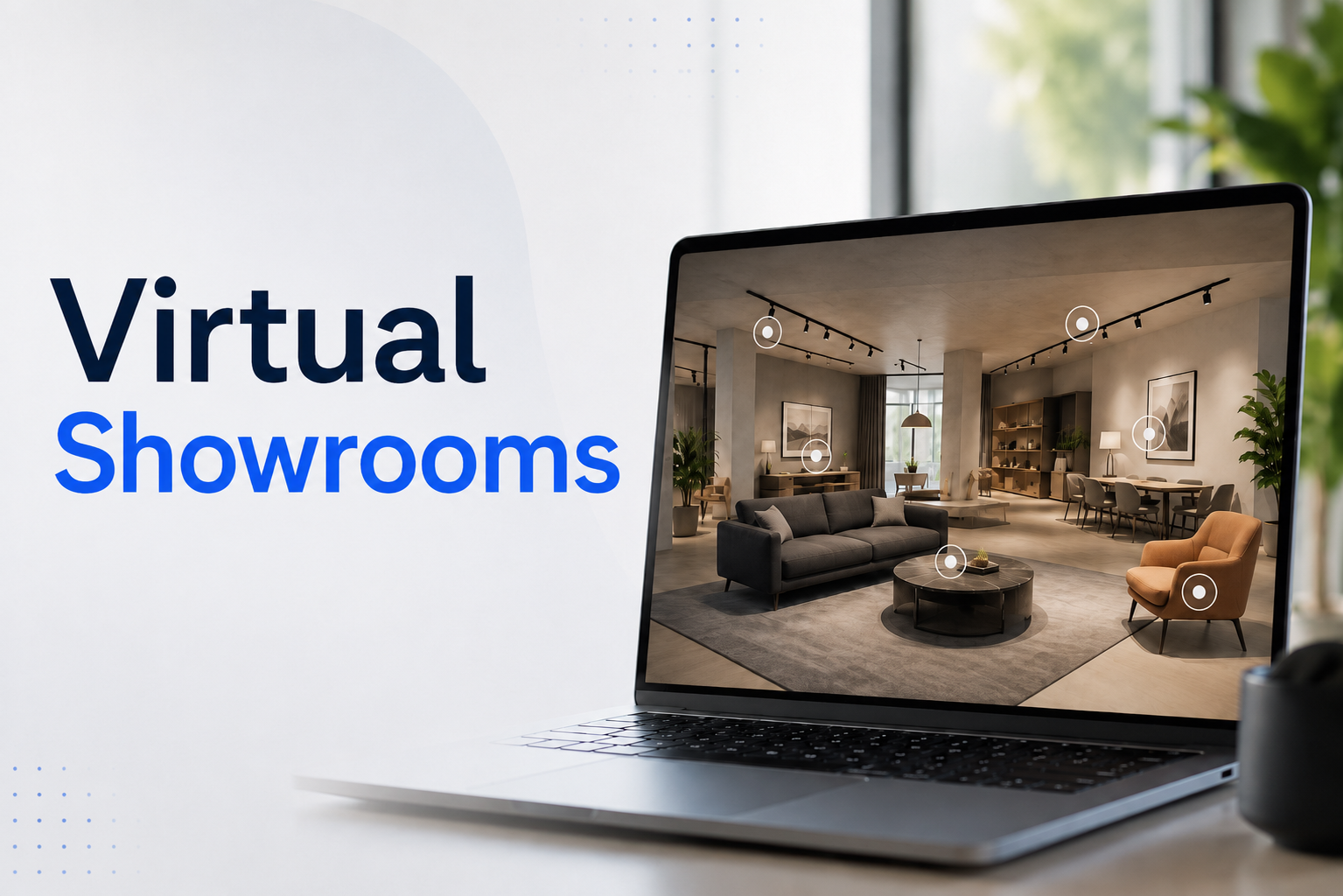
The B2B sales landscape has fundamentally shifted. Today’s buyers expect immersive, self-guided product experiences that match consumer-grade digital interactions. Virtual showrooms deliver exactly that transforming how companies showcase complex products, engage remote buyers, and accelerate sales cycles. This comprehensive guide explores how to leverage virtual showroom platforms to create compelling digital sales experiences that drive measurable business results.
What Are Virtual Showrooms and Why B2B Companies Need Them Now
Virtual showrooms represent the evolution of B2B sales presentations interactive digital spaces where products come alive through 3D visualization, real-time customization, and live collaboration features. Unlike static catalogs or basic video calls, virtual showrooms create immersive buying experiences that mirror in-person interactions while delivering data-driven insights.
These platforms combine the visual impact of physical showrooms with the scalability and analytics of digital channels. Buyers can explore products from every angle, customize configurations in real-time, and collaborate with sales teams through integrated communication tools all within a single browser window.
The urgency for B2B virtual showroom adoption stems from changing buyer expectations. Research indicates that 70% of B2B buyers now prefer remote or digital self-service throughout their purchasing journey. Virtual showrooms meet this demand by providing rich, interactive experiences that buyers can access on their own schedule, from any location.
The Shift from Physical to Virtual Selling Environments
The economics of virtual versus physical showrooms present a compelling case for digital transformation. Physical showrooms require substantial ongoing investments lease payments averaging $30-50 per square foot annually, utilities, staffing, and regular renovations. A mid-sized showroom spanning 5,000 square feet can easily cost $250,000-$500,000 per year to maintain.
Virtual showroom platforms, by contrast, operate on subscription models typically ranging from $2,000-$10,000 monthly, depending on features and scale. This represents a 60-80% reduction in total showroom operating costs while dramatically expanding reach.
Global accessibility transforms market coverage. Physical showrooms serve limited geographic areas typically drawing visitors within a 100-mile radius. Virtual showrooms eliminate these constraints, enabling companies to engage buyers across continents simultaneously. A manufacturer in Ohio can demonstrate products to prospects in Singapore, London, and São Paulo within the same day, without anyone boarding a plane.
The 24/7 availability factor particularly benefits international B2B sales. When your Singapore office closes, buyers in California are just starting their workday. Virtual showrooms remain accessible around the clock, allowing prospects to explore products during their optimal buying windows. This asynchronous engagement model increases qualified leads by 40% on average, as buyers can thoroughly research products before initiating sales conversations.
Core Components of Effective Virtual Showrooms
3D Product Visualization and Configuration Tools
The foundation of any virtual showroom is photorealistic 3D product representation. Modern platforms render products with such detail that buyers can inspect surface textures, examine component assemblies, and visualize products in different environments. Configuration tools allow real-time customization changing colors, materials, dimensions, and features while instantly seeing results and updated pricing.
Advanced visualization includes exploded views showing internal components, animated demonstrations of product operation, and augmented reality modes that place products in the buyer’s actual environment using smartphone cameras. These capabilities prove especially valuable for complex industrial equipment, where understanding internal mechanisms directly impacts purchase decisions.
Real-time Collaboration Features
Virtual showrooms excel when they facilitate live interaction between buyers and sellers. Screen sharing with synchronized views ensures both parties examine the same product details simultaneously. Annotation tools allow sales reps to highlight specific features during presentations, while guided tour functionality lets sellers lead buyers through curated product experiences.
Video conferencing integration within the showroom environment maintains personal connection without switching platforms. Some advanced systems support multi-user sessions, enabling entire buying committees to explore products together, regardless of their physical locations.
Integration with CRM and Sales Enablement Platforms
Seamless CRM integration transforms virtual showrooms from standalone tools into integral sales infrastructure. Every interaction products viewed, configurations saved, documents downloaded automatically logs to the customer record. This behavioral data reveals buying intent with unprecedented granularity.
Sales enablement features include dynamic content delivery based on visitor profiles, automated follow-up triggers when prospects reach engagement thresholds, and personalized showroom experiences that adapt to industry, role, or account history.
Analytics Dashboards for Buyer Engagement Tracking
Virtual showrooms generate rich engagement data impossible to capture in physical spaces. Analytics dashboards reveal which products attract most attention, where buyers spend time, and what configurations they prefer. Heat maps show interaction patterns, while funnel analysis tracks progression from initial browse to purchase inquiry.
These insights inform product development, marketing messaging, and sales training. When data shows buyers consistently examining specific product features, companies can emphasize these differentiators in marketing campaigns and sales presentations.
Building Your Virtual Showroom Strategy
Successful virtual showroom deployment requires aligning technology choices with your specific sales process, buyer journey, and product complexity. Start by mapping your current sales interactions to identify which touchpoints benefit most from virtualization.
Begin with a sales process audit. Document every customer interaction from initial interest through purchase decision. Identify friction points where buyers struggle to understand products or where sales cycles stall. These pain points often indicate prime opportunities for virtual showroom implementation.
Consider your product characteristics. Complex products with multiple configurations benefit most from interactive 3D visualization. Products requiring customization or those sold as systems rather than individual units see particular value from virtual showroom capabilities. Simple, standardized products may not justify the investment unless sold in high volumes where self-service efficiency provides competitive advantage.
Buyer personas shape platform requirements. Technical buyers want detailed specifications and CAD file downloads. Executive stakeholders prefer high-level benefit visualization and ROI calculators. Design teams need aesthetic customization tools. Your virtual showroom must serve all these audiences within a unified experience.
Choosing Between Platform Types
Browser-based vs App-based Experiences
Browser-based virtual showrooms offer maximum accessibility. Buyers access showrooms through standard web browsers without downloading software, reducing friction and IT security concerns. Modern WebGL technology enables sophisticated 3D rendering directly in browsers, supporting experiences nearly indistinguishable from native applications.
App-based solutions provide superior performance for extremely complex visualizations or when offline access is required. However, the download requirement creates a barrier that can reduce visitor engagement by 50% or more. Reserve app-based approaches for scenarios where performance requirements absolutely demand native processing power.
Self-service Exploration vs Guided Selling Approaches
Self-service showrooms empower buyers to explore independently, accessing products 24/7 without sales rep involvement. This model suits transactional sales, standard products, and early-stage research. Implement progressive disclosure—revealing deeper information as buyers demonstrate interest through their interactions.
Guided selling approaches maintain sales rep control while leveraging virtual showroom capabilities. Reps schedule virtual appointments, leading buyers through customized presentations within the showroom environment. This model works best for complex, high-value sales requiring consultative expertise.
Hybrid models combine both approaches. Buyers begin with self-service exploration, with options to request live assistance when needed. AI-powered chatbots can answer basic questions, escalating to human reps for complex inquiries.
Standard Templates vs Custom-built Environments
Template-based platforms accelerate deployment and reduce costs. Vendors provide pre-built showroom layouts, navigation systems, and interaction patterns. You customize branding, upload product models, and configure features within established frameworks. Templates suit companies with standard product lines and conventional sales processes.
Custom-built environments offer complete control over user experience but require significant investment typically $100,000-$500,000 for initial development plus ongoing maintenance. Custom development makes sense for companies with unique products, specialized sales processes, or when virtual showrooms represent core competitive differentiation.
Content Requirements and Production
3D Modeling Approaches: CAD Conversion vs Photogrammetry
CAD conversion leverages existing engineering files to create 3D showroom models. If your company already uses CAD for product design, this approach offers the fastest path to 3D visualization. Conversion processes transform CAD geometry into optimized web-ready formats, typically requiring 2-8 hours per product depending on complexity.
The challenge lies in optimization. Engineering CAD files contain excessive detail unnecessary for sales visualization—every screw thread, internal component, and manufacturing tolerance. Effective conversion requires selective simplification, maintaining visual fidelity while ensuring smooth performance across devices.
Photogrammetry creates 3D models from photographs, ideal for products lacking CAD files or featuring complex organic shapes difficult to model traditionally. The process involves capturing 50-200 photos from multiple angles, which specialized software combines into textured 3D models.
Photogrammetry excels for existing products where CAD files are unavailable or outdated. The technique captures real-world wear, patina, and surface characteristics that enhance authenticity. However, the process requires physical product access and produces less flexible models compared to CAD-based approaches.
Interactive Hotspots and Information Layers
Hotspots transform static 3D models into information-rich experiences. Click or hover over product features to reveal specifications, benefits, videos, or comparison data. Layer information progressively—showing high-level benefits initially, with technical details available on demand.
Effective hotspot strategy balances information density with visual clarity. Too many hotspots create clutter; too few miss educational opportunities. Focus hotspots on differentiating features, common questions, and value drivers identified through sales team feedback.
Video Integration and Live Streaming Capabilities
Video content within virtual showrooms demonstrates products in action, provides expert explanations, and showcases customer testimonials. Embed videos contextually—triggered when buyers explore relevant features rather than forcing linear viewing.
Live streaming capabilities enable real-time product demonstrations, virtual trade show presentations, and interactive training sessions. Streaming directly within the virtual showroom maintains engagement while providing two-way interaction through chat, polls, and Q&A features.
Virtual Showroom Technology Stack
The technical foundation of your virtual showroom determines its capabilities, performance, and scalability. Understanding the core technologies helps you evaluate vendors and plan integration with existing systems.
Modern virtual showrooms rely on cloud infrastructure for global content delivery, real-time rendering, and seamless scaling. Content delivery networks (CDNs) ensure fast loading regardless of visitor location, while cloud computing handles processor-intensive tasks like real-time configuration calculations and collaborative sessions.
Rendering and Visualization Technologies
WebGL and Three.js for Browser-based 3D
WebGL provides the foundation for browser-based 3D graphics, enabling hardware-accelerated rendering without plugins. This technology runs natively in all modern browsers, ensuring broad compatibility across devices and operating systems.
Three.js, a JavaScript library built on WebGL, simplifies 3D development while providing sophisticated capabilities. Features include realistic lighting, shadows, reflections, and particle effects that bring products to life. The library’s extensive ecosystem accelerates development through pre-built components and community contributions.
Performance optimization remains critical. Techniques include level-of-detail (LOD) systems that adjust model complexity based on viewing distance, texture compression to reduce bandwidth requirements, and instancing for efficient rendering of repeated elements.
AR/VR Compatibility Considerations
Augmented reality extends virtual showrooms into physical spaces. Buyers use smartphones or tablets to visualize products in their actual environments—placing industrial equipment on factory floors or furniture in offices. WebXR APIs enable AR experiences directly through web browsers, eliminating app downloads.
Virtual reality provides maximum immersion for high-value products warranting the additional hardware investment. VR showrooms allow buyers to walk around products at true scale, operate controls, and experience spatial relationships impossible to convey through screens.
Design showrooms with progressive enhancement—functioning excellently on standard screens while offering enhanced experiences when AR/VR hardware is available. This approach maximizes reach while accommodating early adopters of immersive technologies.
Performance Optimization for Various Devices
Virtual showrooms must perform consistently across diverse hardware from powerful workstations to mobile devices. Adaptive quality settings automatically adjust rendering quality based on device capabilities, maintaining smooth interaction while maximizing visual fidelity.
Mobile optimization requires particular attention. Touch-friendly interfaces, simplified navigation, and reduced polygon counts ensure positive experiences on smartphones and tablets. Progressive loading strategies prioritize visible content, loading additional detail as needed rather than requiring complete downloads before interaction begins.
Integration Points with Sales Infrastructure
CRM Synchronization for Lead Capture and Tracking
Bidirectional CRM integration transforms virtual showrooms into lead generation engines. Visitor registration forms populate CRM records automatically, while existing customer data personalizes showroom experiences. Every interaction products viewed, configurations saved, documents downloaded enriches customer profiles.
Real-time synchronization enables immediate sales follow-up. When prospects reach engagement thresholds, alerts notify assigned reps who can initiate contact while interest remains high. Historical interaction data provides conversation starters and insight into buyer priorities.
Marketing Automation Platform Connections
Marketing automation integration enables sophisticated nurture campaigns based on showroom behavior. Visitors who explore specific products receive targeted content about those solutions. Abandoned configurations trigger reminder emails with saved links for easy continuation.
Lead scoring algorithms incorporate showroom engagement metrics. Time spent, return visits, and configuration complexity indicate buying intent more accurately than traditional email and web metrics. This behavioral intelligence prioritizes sales efforts on most-likely-to-convert prospects.
E-commerce and CPQ System Integration
For companies offering online purchasing, virtual showrooms can connect directly to e-commerce platforms. Configured products transfer seamlessly to shopping carts with accurate pricing, reducing errors and accelerating transactions.
Configure, Price, Quote (CPQ) integration ensures pricing accuracy for complex products with multiple options. As buyers customize products, CPQ engines calculate prices in real-time, considering volume discounts, regional variations, and current promotions. Generated quotes include visual representations from the showroom, improving clarity and reducing revision cycles.
Measuring Virtual Showroom ROI
Virtual showrooms generate rich behavioral data that traditional sales channels cannot match. Track engagement metrics that directly correlate with purchase intent and sales velocity.
Establish baseline metrics before virtual showroom deployment. Document current sales cycle length, average deal size, conversion rates, and cost per lead. These benchmarks enable accurate ROI calculation and continuous optimization.
Key Performance Indicators
Dwell Time per Product and Feature Interaction Rates
Average session duration indicates overall engagement, but product-specific dwell time reveals genuine interest. Buyers spending 5+ minutes examining particular products demonstrate serious consideration. Track which features attract most interaction rotating views, configuration changes, or specification reviews.
Feature interaction rates identify compelling differentiators. When 80% of visitors explore a specific capability, that feature clearly resonates with your market. Conversely, ignored features might need better presentation or may not provide expected value.
Configuration Saves and Sharing Frequency
Saved configurations represent high buying intent. Prospects who invest time creating custom specifications are actively evaluating purchase decisions. Track save rates by product line and configuration complexity to identify sweet spots in your offering portfolio.
Sharing frequency measures viral potential. When buyers share configured products with colleagues, they’re building internal consensus for purchase. Implement easy sharing mechanisms and track both direct shares and unique visitors from shared links.
Conversion Rates from Browse to Inquiry
Monitor progression through your virtual showroom funnel. Track conversion from initial visit to registered user, from browser to configurator, and from configuration to inquiry. Identify drop-off points for optimization opportunities.
Benchmark conversion rates by traffic source. Visitors from targeted campaigns should convert higher than organic traffic. If not, messaging misalignment may exist between marketing and showroom experience.
Sales Cycle Compression Metrics
Virtual showrooms accelerate sales cycles by providing information buyers previously obtained through multiple interactions. Measure time from first showroom visit to closed deal, comparing against traditional sales cycles.
Track reduction in sales meetings required per deal. When buyers thoroughly explore products independently, sales conversations become more focused and productive. Many companies report 30-40% fewer meetings needed to close deals after virtual showroom implementation.
Cost Savings and Revenue Impact
Reduction in Physical Sample Shipping
Calculate savings from eliminated sample shipments. Include shipping costs, packaging materials, labor for preparation and processing returns, and sample inventory carrying costs. For companies shipping large industrial equipment samples, savings can exceed $100,000 annually.
Factor in environmental benefits increasingly important to corporate buyers. Eliminated shipping reduces carbon footprint—a measurable sustainability metric for corporate responsibility reporting.
Travel Cost Elimination for Product Demonstrations
Document travel expenses for product demonstrations flights, hotels, meals, and opportunity cost of sales rep time. Virtual showrooms eliminate many on-site demonstrations, particularly for initial product education and standard configurations.
Calculate productivity gains from travel time reallocation. Sales reps conducting virtual demonstrations can engage multiple prospects daily versus one or two when traveling. This efficiency multiplies effective sales capacity without adding headcount.
Increased Deal Sizes Through Better Product Understanding
Virtual showrooms enable buyers to explore complete product lines and discover complementary solutions. Track average order value before and after implementation. Many companies report 15-25% increases as buyers identify additional products meeting their needs.
Monitor upsell and cross-sell rates. When buyers understand product capabilities thoroughly, they’re more likely to select higher-tier options and complementary products. Configuration tools that suggest optimized bundles further increase transaction values.
Implementation Roadmap for B2B Companies
Rolling out virtual showrooms requires coordinated effort across sales, marketing, and IT teams. A phased approach minimizes risk while building internal capabilities and buyer adoption.
Begin with stakeholder alignment. Secure executive sponsorship by presenting the business case cost savings, revenue potential, and competitive advantages. Identify champions in sales, marketing, and IT who will drive adoption and provide ongoing feedback.
Phase 1: Pilot Program Design
Select High-value Product Lines for Initial Virtualization
Choose products that balance complexity with volume. Ideal pilot products have enough configurability to showcase virtual showroom capabilities while generating sufficient traffic to gather meaningful data. Avoid starting with your most complex products build expertise with moderately complex offerings first.
Consider market dynamics when selecting pilot products. New product launches benefit from virtual showroom excitement. Mature products with declining physical demonstration ROI offer clear cost-saving opportunities. Products facing aggressive competition can differentiate through superior digital experiences.
Identify Champion Sales Reps for Testing
Select tech-savvy, innovative sales reps eager to try new approaches. These champions provide honest feedback, identify practical improvements, and become internal evangelists promoting broader adoption.
Involve 3-5 reps representing different territories, market segments, or product specializations. This diversity ensures pilot feedback addresses various use cases and selling scenarios. Document their current sales processes to measure virtual showroom impact accurately.
Define Success Criteria and Measurement Framework
Establish specific, measurable pilot objectives. Examples include: “Reduce sample shipping costs by 50%,” “Increase qualified leads by 30%,” or “Compress sales cycles by 20%.” Clear targets maintain focus and justify expansion investment.
Implement comprehensive tracking from day one. Configure analytics platforms, establish reporting cadences, and assign ownership for data collection and analysis. Weekly pilot team meetings review metrics, share learnings, and iterate quickly based on feedback.
Phase 2: Scale and Optimize
Expand Product Catalog Coverage
After successful pilot validation, systematically expand product coverage. Prioritize based on pilot learnings—products similar to successful pilot offerings transition smoothly. Develop efficient content production workflows to accelerate 3D model creation and showroom configuration.
Consider product relationships when planning expansion. Complete product families enable effective cross-selling. Complementary products that buyers frequently purchase together should launch simultaneously to maximize bundle opportunities.
Train Full Sales Team on Platform Usage
Develop comprehensive training programs covering both technical platform usage and evolved selling strategies. Include hands-on workshops where reps practice conducting virtual demonstrations and responding to common scenarios.
Create role-specific training paths. Inside sales reps focus on conducting remote demonstrations. Field reps learn to use virtual showrooms for pre-meeting preparation and post-meeting follow-up. Customer success teams understand how to provide virtual product training.
Implement Buyer Feedback for Experience Refinement
Establish formal feedback mechanisms surveys, user testing sessions, and analytics review. Pay particular attention to abandonment points and feature requests. Buyers provide invaluable perspective on usability and missing capabilities.
Iterate continuously based on feedback and data. Monthly optimization sprints address quick wins while quarterly planning tackles larger enhancements. Share improvements with buyers to demonstrate responsiveness and maintain engagement.
Future-Proofing Your Virtual Showroom Investment
Virtual showroom technology evolves rapidly. Artificial intelligence increasingly personalizes experiences, automatically highlighting relevant products based on visitor behavior. Machine learning algorithms optimize 3D model loading and rendering performance. Natural language processing enables voice-controlled navigation and conversational product exploration.
Stay informed about emerging capabilities through vendor roadmaps, industry conferences, and peer networks. However, avoid chasing every new feature. Focus on capabilities that directly address your specific sales challenges and buyer needs.
Build flexibility into your virtual showroom strategy. Choose platforms with open APIs enabling custom integrations. Maintain product content in standard formats facilitating platform migration if needed. Document processes and learnings to preserve institutional knowledge as team members change.
Frequently Asked Questions
How much does a virtual showroom platform cost?
Virtual showroom platform costs vary significantly based on features, scale, and deployment model. Entry-level SaaS platforms start around $500-$2,000 monthly for basic functionality and limited products. Mid-tier solutions range from $2,000-$10,000 monthly, including advanced features, broader product catalogs, and integration capabilities. Enterprise platforms can exceed $10,000 monthly or require one-time licenses of $100,000+ plus annual maintenance. Factor in additional costs for 3D content creation ($500-$5,000 per product), integration development, and training.
Can virtual showrooms integrate with Salesforce?
Yes, most enterprise virtual showroom platforms offer native Salesforce integration or provide APIs enabling custom integration. Standard integrations synchronize visitor data with Salesforce leads and contacts, log engagement activities to opportunity records, and trigger workflows based on showroom interactions. Advanced integrations enable Salesforce users to launch virtual showroom sessions directly from opportunity records and access showroom analytics within Salesforce dashboards.
What’s the difference between virtual showrooms and 3D product configurators?
While overlapping in functionality, virtual showrooms and 3D configurators serve different primary purposes. Virtual showrooms create comprehensive digital selling environments featuring multiple products, educational content, and collaboration tools—essentially replacing physical showrooms. 3D configurators focus specifically on product customization, allowing buyers to modify options and see real-time visual updates. Many virtual showrooms incorporate 3D configurators as one component of the broader experience.
Do buyers need special software to access virtual showrooms?
Modern virtual showrooms typically require only a standard web browser, eliminating software installation barriers. Chrome, Firefox, Safari, and Edge all support WebGL technology powering browser-based 3D visualization. Mobile devices access showrooms through responsive web design or dedicated apps for enhanced performance. Some advanced features like VR support require specific hardware, but core functionality remains accessible through standard devices.
How long does it take to create 3D models for a virtual showroom?
3D model creation timelines depend on product complexity, source materials, and quality requirements. Simple products with existing CAD files can be converted in 2-4 hours. Moderate complexity products require 1-3 days for modeling, texturing, and optimization. Highly complex products with numerous configurations might need 1-2 weeks. Photogrammetry-based modeling typically requires 1-2 days for capture and processing. Plan for additional time to integrate models into the showroom platform and configure interactions.
Virtual showrooms represent more than technological advancement they’re becoming essential B2B sales infrastructure. As buyer preferences shift toward digital self-service and remote collaboration becomes permanent, companies without virtual showroom capabilities risk competitive disadvantage.
The investment case is compelling. Virtual showrooms reduce costs while expanding market reach, accelerate sales cycles while improving buyer experience, and generate actionable data while building deeper customer relationships. Early adopters are already seeing 20-40% improvements in key sales metrics.
Success requires more than technology deployment. Organizations must reimagine sales processes, develop new content capabilities, and cultivate digital selling skills. But companies making this transformation position themselves for sustainable growth in an increasingly digital B2B landscape.
Ready to transform your B2B sales with a virtual showroom platform? Start by auditing your current sales process to identify high-impact virtualization opportunities. Evaluate platform vendors against your specific requirements. Launch a focused pilot program to validate ROI. Most importantly, begin now your competitors are already building their virtual showroom capabilities.
The future of B2B sales is immersive, interactive, and intelligent. Virtual showrooms deliver all three, providing the foundation for modern sales excellence. The question isn’t whether to implement virtual showrooms, but how quickly you can deploy them to capture competitive advantage.