
When VR Headset Leasing Makes Operational Sense
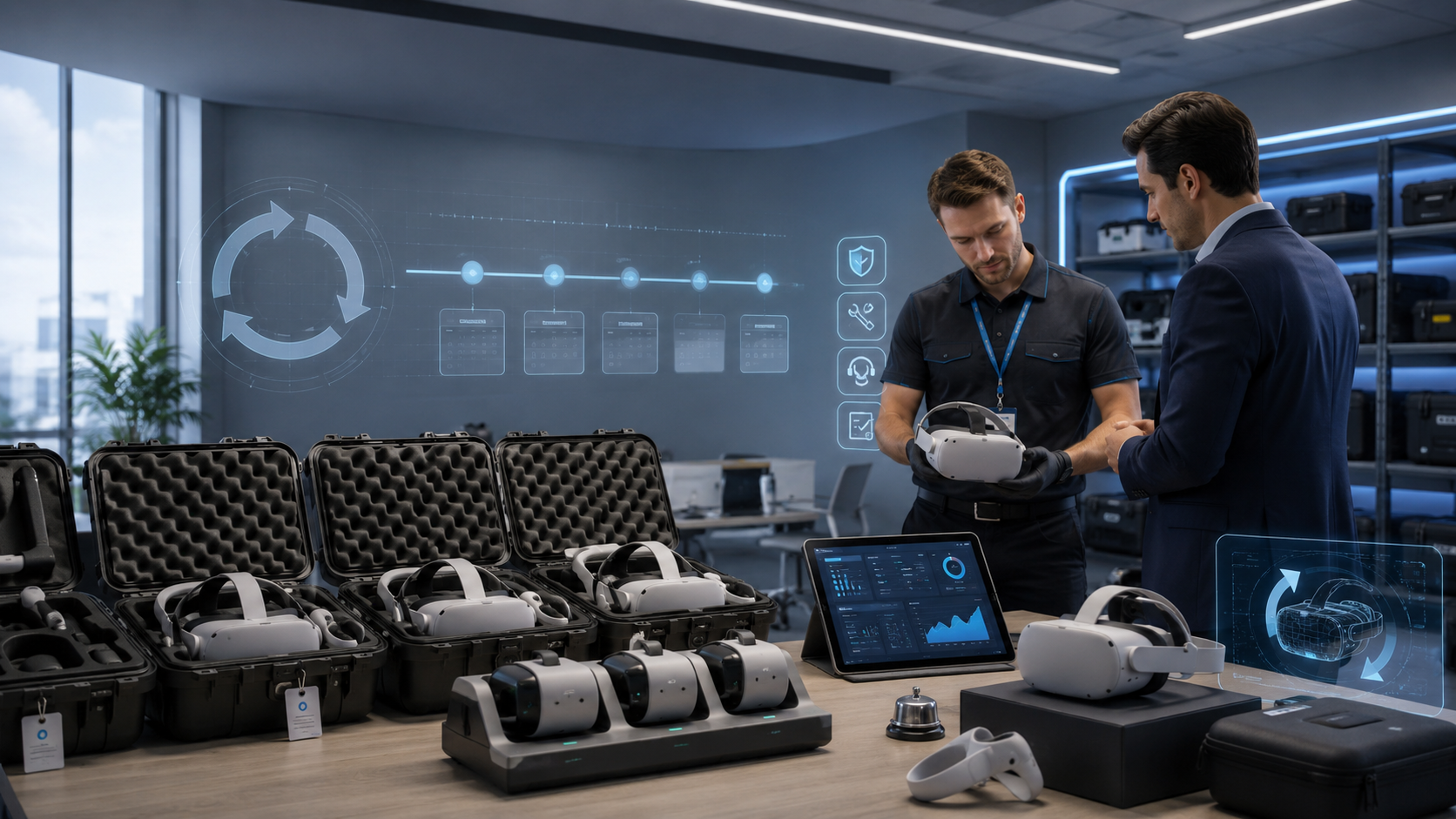
Leasing VR headsets fills the gap between event rentals and outright purchases when your company needs equipment for 3-12 months. This model works for quarterly training cycles, multi-phase pilot programs, and distributed teams that need consistent hardware without capital expenditure.
Quarterly Training Programs That Need Fresh Equipment
Companies running regular training cohorts face a common challenge: maintaining 20-50 headsets that see intensive use for 4-6 weeks, then sit idle until the next quarter. Leasing solves this operational inefficiency through structured refresh cycles.
New hire onboarding programs typically require headsets for 30-40 hours of use per cohort. After three months, these devices accumulate 120+ hours of wear, requiring deep cleaning, foam replacement, and firmware updates. Leasing agreements include equipment refresh between cohorts, eliminating the hygiene concerns and maintenance overhead that come with owned equipment.
The financial impact becomes clear when considering depreciation. A $30,000 investment in 50 Quest 3 headsets loses 40% of its value in year one, whether the equipment runs continuously or sits in storage for half the year. Leasing converts this capital expense into predictable operational costs that align with actual usage patterns.
Multi-Location Deployments With Staggered Rollouts
Regional VR deployments rarely launch simultaneously. A typical enterprise rollout might start with headquarters in January, expand to East Coast offices in March, and reach West Coast locations by May. Purchasing all equipment upfront means paying for hardware months before it’s needed.
Leasing enables phased acquisition that matches your deployment schedule. Start with 15 headsets for the pilot location, add 20 units two months later for the second site, and scale to 50 total units by month four. This approach preserves cash flow and reduces the risk of overbuying before validating the program’s effectiveness.
Centralized billing through a single lease agreement simplifies procurement compared to location-specific purchase orders. Finance teams appreciate the consolidated invoicing, while IT departments benefit from standardized hardware and unified support contracts across all sites.
Pilot Programs Before Full Investment
Six-month pilot programs represent the sweet spot for VR leasing. With 10-15 headsets, you can validate training effectiveness, measure engagement metrics, and calculate ROI before committing to a full-scale deployment.
Most lease providers offer lease-to-own provisions that convert successful pilots into permanent programs. These agreements typically credit 50-75% of lease payments toward the purchase price if you decide to buy within the first year. This structure protects against two risks: paying full price for equipment that doesn’t meet expectations, and losing pilot investment if the program succeeds.
Exit flexibility matters when testing new training methodologies. Month-to-month extensions after the initial term let you continue successful programs without long-term commitment. Early termination clauses, typically requiring 30-60 days notice, provide an escape route if VR training doesn’t deliver expected results.
VR Lease Contract Structures and Payment Models
VR leasing contracts range from simple monthly payments to managed service agreements with support included. Understanding these structures helps you negotiate terms that match your deployment timeline and support requirements.
Operating Lease vs. Capital Lease for VR Equipment
Operating leases keep VR headsets off your balance sheet, treating monthly payments as operational expenses. This structure appeals to companies managing debt-to-equity ratios or preserving capital budgets for other investments. Payments typically run 3-4% of equipment value monthly, meaning a $600 Quest 3 costs $18-24 per month on a 24-month operating lease.
Capital leases function more like loans, with the intent to own equipment at lease end. These agreements often include $1 buyout options, essentially spreading the purchase cost over 12-24 months. While monthly payments run higher than operating leases, you build equity in the equipment and can depreciate the assets according to standard schedules.
Tax implications vary significantly between lease types. Operating lease payments are fully deductible as business expenses in the current year. Capital leases require depreciating the equipment value over time, typically following a 5-year schedule for computer equipment. Consult your tax advisor to determine which structure optimizes your specific situation.
Managed Service Layers in VR Leasing
Basic hardware-only leases provide headsets with standard warranties but leave setup and management to your IT team. This bare-bones approach costs the least but requires internal expertise for device enrollment, app deployment, and user support.
Managed leases include Mobile Device Management (MDM) enrollment and initial app deployment. The lease provider configures headsets with your chosen MDM platform (ArborXR, ManageXR, or Workspace ONE), installs required applications, and ships ready-to-use devices. This service layer typically adds $10-15 per headset monthly but saves 2-3 hours of IT time per device.
Full-service agreements encompass on-site support, content management, and help desk services. These comprehensive packages include quarterly on-site visits for maintenance, remote troubleshooting for end users, and content updates as new training modules become available. While adding $25-40 per headset monthly, full service makes sense for organizations without dedicated VR support staff.
Equipment Refresh Provisions
Annual refresh cycles keep your VR fleet current with the latest hardware releases. Meta typically announces new Quest models each October, making annual refresh provisions valuable for multi-year leases. These clauses allow swapping older equipment for new models at predetermined rates, usually adding 10-15% to monthly payments.
Mid-lease upgrades provide flexibility when manufacturers release significant improvements. The Quest 3’s mixed reality capabilities represented a substantial advance over Quest 2, justifying mid-cycle upgrades for many training programs. Negotiate upgrade rights that cap additional costs at 20% above current payments.
Trade-in credits reduce costs when transitioning between lease terms. Previous generation hardware retains 40-60% of its value after 12 months, which lease providers can credit toward new equipment. Structure agreements to maximize these credits, particularly for large deployments where trade-in values represent significant savings.
Cost Analysis: Leasing vs. Renting vs. Buying VR Headsets
The financial breakpoint between leasing, renting, and buying depends on usage frequency, support needs, and equipment lifecycle. Here’s how to model total cost of ownership across different scenarios.
Monthly Cost Breakdown by Acquisition Model
Short-term VR rentals command premium prices due to logistics and preparation costs. Quest 3 rentals typically run $200-300 monthly, including shipping, pre-loaded content, and technical support. These rates make sense for week-long events or single training sessions but become prohibitive for ongoing programs.
Lease rates for Quest 3 headsets range from $75-125 monthly on 12-24 month terms. The variation depends on quantity, service level, and lease structure. A 12-month operating lease for 25 Quest 3 units might cost $95 per headset monthly, including basic support and warranty coverage.
Purchasing Quest 3 headsets requires $500-650 upfront, depending on accessories and volume discounts. Add $10-20 monthly for MDM licensing, $5-10 for insurance, and factor 1-2 hours of IT time monthly for management. The true monthly cost of ownership approaches $45-60 when amortized over 24 months.
Hidden Costs in Each Model
Rental agreements often include surprise charges that inflate total costs. Premium fees for specific content ($50-100 per title), expedited shipping ($200-500 per order), and damage waivers (15-20% of rental value) can double the quoted monthly rate. Always request comprehensive quotes including all potential fees.
Lease agreements may include early termination penalties equal to 3-6 months of remaining payments. Damage beyond normal wear triggers replacement fees, typically 50-75% of equipment value. Some providers charge “remarketing fees” of $50-100 per unit at lease end, ostensibly for preparing equipment for the next customer.
Purchase costs extend beyond the initial investment. Budget for replacement foam interfaces ($30 per headset annually), spare controllers ($150 each), carrying cases ($40 per unit), and eventual battery degradation requiring device replacement after 18-24 months of heavy use.
Break-Even Analysis for Your Use Case
Rental becomes cost-prohibitive after 2-3 months of continuous use. At $250 monthly rental rates, three months equals $750—more than the purchase price. Reserve rentals for true short-term needs: trade show demos, one-time training events, or evaluation periods before committing to lease or purchase.
Leasing optimizes costs for 3-18 month deployments. At $100 monthly lease rates, you’ll pay $1,200 over 12 months—reasonable for a program that might not continue beyond initial implementation. The flexibility to return equipment or upgrade to newer models justifies the premium over purchasing.
Purchasing makes financial sense at 18+ months of continuous use. The total cost of a $600 headset plus 24 months of management expenses ($480) equals $1,080—less than leasing at $100 monthly ($2,400 over 24 months). However, this calculation assumes continuous use and doesn’t account for obsolescence or support requirements.
VR Headset Models Available for Leasing
Not all VR hardware is available through leasing programs. Enterprise-focused models from Meta, Pico, and HTC offer the most flexible lease terms, while consumer headsets typically require purchase or rental.
Meta Quest 3 and Quest Pro Lease Programs
Quest 3 leases run $75-100 monthly with 12-month minimum terms through authorized enterprise resellers. The 512GB model costs slightly more but provides necessary storage for multiple training applications. Most lease providers require minimum quantities of 10 units, though some accommodate smaller deployments at higher rates.
Quest Pro leases range from $150-200 monthly, justified only for specialized use cases requiring face and eye tracking. Architecture firms using VR for design reviews or medical training programs needing precise hand tracking benefit from Pro’s advanced features. The higher resolution and improved comfort matter less for standard training applications.
Meta for Business accounts come included with enterprise leases, providing centralized management, bulk app purchasing, and priority support. These accounts normally cost $15 per device monthly when purchased separately, making lease bundles more attractive for managed deployments.
Pico 4 Enterprise Leasing Options
Pico 4 Enterprise leases cost $60-85 monthly, offering a budget alternative to Quest hardware. The built-in enterprise features include kiosk mode, preventing users from accessing consumer apps or settings. This lockdown capability proves valuable for training deployments where content control is paramount.
Custom launcher configurations ship pre-installed on leased Pico devices. Your training app launches automatically on startup, eliminating navigation confusion for non-technical users. The simplified interface reduces support tickets and improves training session efficiency.
Direct support from Pico accompanies enterprise lease agreements. Unlike consumer purchases routed through general support channels, enterprise customers receive dedicated account management and priority technical assistance. Response times average 4-6 hours for critical issues, compared to 2-3 days for consumer support.
HTC Vive Focus 3 Lease Terms
Vive Focus 3 leases range from $125-175 monthly, targeting location-based entertainment and specialized training deployments. The hot-swappable battery system enables continuous operation in high-usage environments where charging downtime isn’t acceptable.
ArborXR management platform inclusion adds significant value to Vive leases. This enterprise-grade MDM normally costs $15-20 per device monthly but comes bundled with most Vive Focus 3 lease agreements. The platform provides remote management, usage analytics, and automated updates across your fleet.
Location-based deployment support distinguishes Vive’s lease program. HTC provides specialized assistance for arcade, museum, and training center installations requiring robust hardware and commercial licensing. This support includes on-site setup assistance and ongoing optimization consulting.
Managing Leased VR Equipment at Scale
Leasing 20+ headsets requires operational processes for deployment, maintenance, and return logistics. These management practices prevent equipment loss and maximize lease value.
MDM Setup for Leased Headsets
Enroll every leased headset in your MDM platform on day one, before distributing to end users. ArborXR and ManageXR both support bulk enrollment through CSV import, processing 50+ devices in under an hour. This immediate enrollment prevents devices from disappearing into the organization without tracking.
Remote app deployment eliminates the need to physically handle each headset after initial setup. Push training applications, updates, and configuration changes to all devices simultaneously. Schedule deployments for overnight hours to avoid disrupting active training sessions.
Usage analytics from MDM platforms justify lease renewals or returns. Track metrics like daily active headsets, session duration, and app engagement to demonstrate ROI. Low utilization rates (under 10 hours monthly per device) suggest reducing fleet size at lease renewal.
Equipment Tracking and Asset Management
Maintain a serial number database linking each headset to its assigned user or location. Include lease start dates, contract terms, and return deadlines. This database becomes critical for audit compliance and end-of-lease returns.
Implement check-in/check-out procedures for shared equipment pools. Training centers using 20 headsets across multiple daily sessions need systematic tracking to prevent loss. Simple solutions like sign-out sheets work for small deployments, while larger operations benefit from asset management software with barcode scanning.
Conduct quarterly audits to physically locate all leased devices. Missing equipment discovered early can be recovered or reported to insurance. Waiting until lease-end to discover missing headsets triggers expensive replacement fees and potential legal issues.
End-of-Lease Return Procedures
Factory reset requirements protect your data and proprietary content. Begin the reset process 2-3 weeks before lease end, allowing time to backup necessary data and confirm deletion. Most lease agreements specify data deletion procedures and may require certification of completion.
Document equipment condition before return to dispute unfair damage claims. Photograph each headset, controller, and accessory, noting existing wear. Normal wear includes minor scratches, foam compression, and strap stretching. Excessive damage triggering fees includes cracked lenses, broken controllers, or water damage.
Coordinate bulk returns through your lease provider’s logistics partner. Most agreements include prepaid return shipping for 10+ units. Schedule pickup during business hours when staff can properly package equipment and obtain detailed receipts. Track all shipments until the lease provider confirms receipt.
Negotiating VR Lease Agreements
VR leasing contracts have negotiable terms beyond monthly payments. Understanding these leverage points helps secure better rates and more flexible terms for your deployment.
Volume Discounts and Tier Pricing
Standard rates apply to 10-25 unit leases, typically matching published prices. This tier serves small pilot programs and single-location deployments. Expect minimal negotiation flexibility unless committing to extended terms or bundled services.
25-50 unit leases unlock 10-15% discounts from standard rates. Lease providers value these mid-size accounts for their stability and growth potential. Negotiate based on total contract value rather than monthly payments—a 24-month commitment for 30 units represents $72,000 in revenue.
Custom enterprise pricing for 50+ unit deployments can reduce costs by 20-30%. Large accounts justify dedicated support resources and streamlined logistics. Request proposals from multiple providers and use competing offers to negotiate better terms. Consider multi-year agreements for maximum savings.
Flexibility Clauses Worth Requesting
Quantity adjustment provisions allow increasing or decreasing fleet size by 20% without penalty. Training programs often scale unexpectedly based on business needs or initial results. This flexibility prevents overcommitting to unnecessary equipment or scrambling to add capacity.
Seasonal pause provisions benefit education and training organizations with cyclical schedules. Universities might need 100 headsets during fall and spring semesters but only 20 during summer sessions. Negotiate reduced payments during low-usage periods rather than returning equipment entirely.
Technology refresh rights ensure access to new hardware as it becomes available. Include specific terms for upgrading to next-generation equipment at predetermined rates. Without these clauses, you’re locked into aging hardware while competitors deploy newer technology.
Service Level Agreements for Support
24-hour replacement guarantees for defective units prevent training disruptions. Enterprise lease agreements should specify next-business-day replacement for hardware failures. Some providers maintain local inventory for immediate swaps in major markets.
Dedicated account management becomes essential for 25+ unit leases. Your account manager should provide quarterly business reviews, coordinate support issues, and facilitate equipment changes. Specify minimum response times and escalation procedures in the agreement.
On-site support options add value for critical deployments. Negotiate annual or quarterly on-site visits for preventive maintenance, training, and optimization. These visits identify issues before they impact operations and ensure maximum value from your lease investment.
Frequently Asked Questions
What’s the minimum lease term for VR headsets?
Most providers require 12-month minimum terms for VR headset leases. Some offer 6-month terms at higher monthly rates, typically 15-20% above annual pricing. Month-to-month options exist but cost nearly as much as short-term rentals.
Can we lease-to-own VR equipment?
Yes, many lease agreements include purchase options. Fair market value buyouts let you purchase equipment at depreciated values (typically 30-50% of original price after 12 months). $1 buyout leases function as financing, with ownership transferring at lease end.
Do VR leases include insurance coverage?
Basic lease agreements rarely include comprehensive insurance. Most provide warranty coverage for defects but exclude accidental damage, theft, or loss. Purchase separate insurance or add damage waiver provisions for $10-15 monthly per headset.
How does VR leasing affect our IT budget vs. capital budget?
Operating leases hit IT operational budgets as monthly expenses. Capital leases may require capital budget allocation depending on your accounting treatment. Consult your finance team early in the evaluation process to ensure proper budget alignment.
Can we add more headsets mid-lease?
Most agreements allow adding equipment at the same terms as your original lease. New additions typically create a separate lease schedule (coterminous with the original) or extend the master agreement. Volume discounts usually apply to the total fleet size.
What happens if leased VR equipment gets damaged?
Minor damage falls under fair wear and tear provisions. Significant damage triggers repair or replacement fees, typically 50-75% of equipment value. Document all damage immediately and work with your provider to minimize costs through repair rather than replacement.
Do lease agreements include software licenses?
Hardware leases rarely include application licenses beyond basic MDM platforms. Budget separately for training software, typically $20-100 per user monthly. Some providers offer bundled hardware and software leases for complete solutions.
Can we return leased headsets early?
Early termination usually triggers penalties equal to 3-6 months of remaining payments. Some agreements offer early buyout options at depreciated values plus a processing fee. Negotiate early termination terms upfront if your deployment timeline remains uncertain.
Are refurbished VR headsets available for leasing?
Refurbished equipment leases cost 20-30% less than new hardware. These units undergo factory reconditioning and carry full warranties. Refurbished leases work well for budget-conscious deployments where latest features aren’t critical.
Conclusion
VR headset leasing bridges the gap between expensive short-term rentals and capital-intensive purchases, providing flexibility for evolving training programs. The optimal acquisition strategy depends on your deployment timeline, support requirements, and financial constraints.
For deployments lasting 3-18 months, leasing offers the best balance of cost control and operational flexibility. Structure agreements with built-in adjustment provisions, technology refresh rights, and appropriate service levels for your organization’s capabilities.
Success with leased VR equipment requires proactive management from day one. Implement robust tracking systems, maintain detailed documentation, and negotiate comprehensive agreements that anticipate program changes.
Ready to explore VR leasing for your organization? Start by documenting your deployment timeline, user requirements, and support needs. Request proposals from 3-4 enterprise VR lease providers, comparing not just monthly costs but total program value including services, flexibility, and upgrade paths. Most providers offer 30-day pilot programs that let you test equipment and support quality before committing to longer terms.