

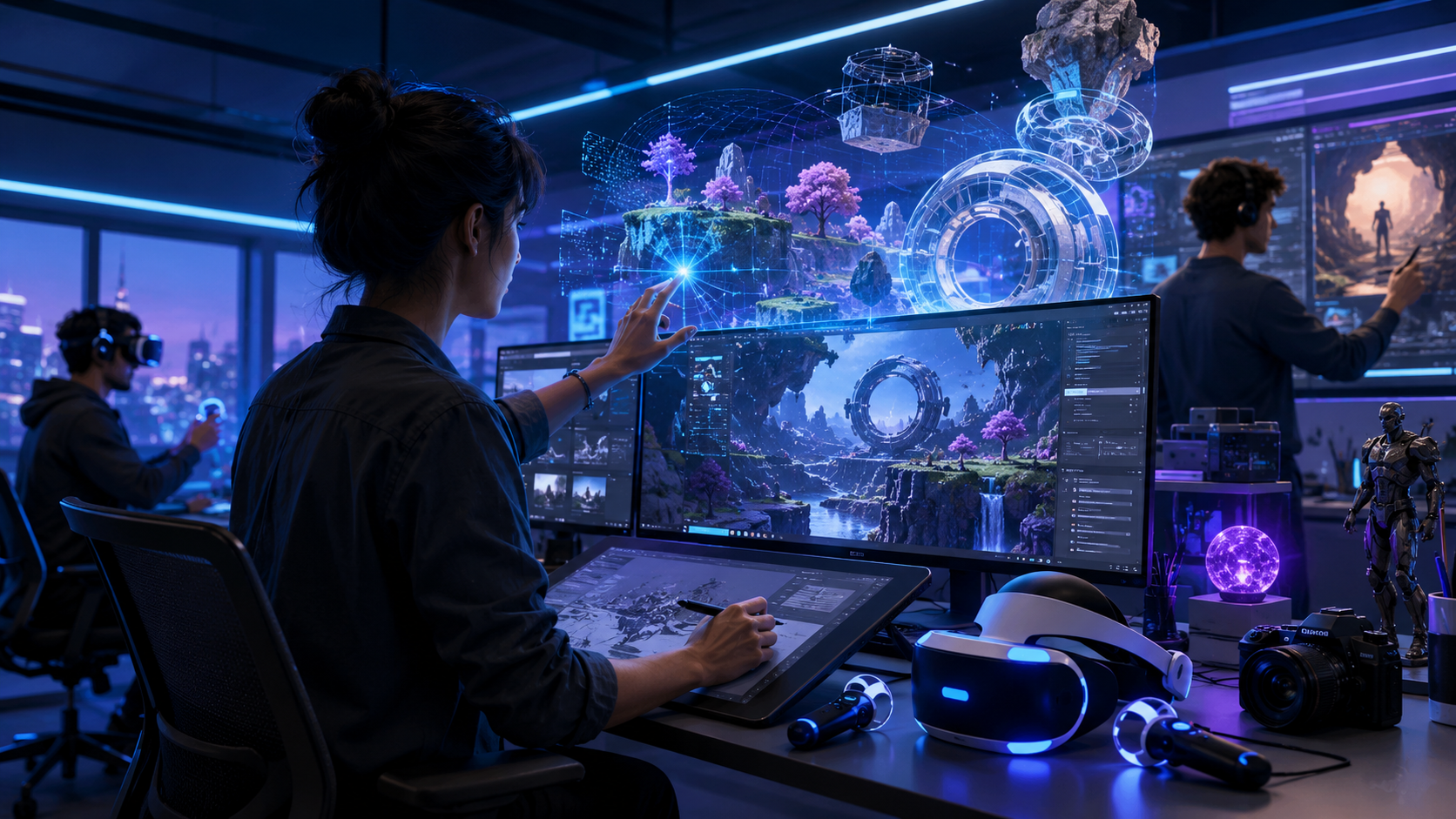
VR Content Creation Equipment: What You Actually Need vs What You Think You Need
Most VR content creation guides start with $50,000 camera rigs and enterprise software licenses. The reality: 80% of commercial VR content gets produced with rental equipment, from brand activations to training modules. Here’s the actual hardware stack for different content types and why renting changes the production economics.
360 Video Production Equipment Stack
The foundation of 360 video production starts with camera selection, where two systems dominate professional productions. The Insta360 Pro 2 delivers 8K resolution at 30fps with built-in stabilization, making it ideal for documentary-style shoots and real estate tours. For higher-end commercial work requiring 10-bit color depth and professional codec support, the Z CAM K2 Pro provides superior dynamic range and post-production flexibility.
Support gear often gets overlooked in budget planning but proves critical for professional results. A carbon fiber tripod rated for 360-degree cameras runs $800-1,200, while specialized 360 dollies for smooth motion shots cost $2,500-4,000. Lighting presents unique challenges—traditional setups create shadows visible in spherical footage. Professional 360 productions use overhead silk diffusion systems ($1,500) or multiple LED panels positioned outside the camera’s field of view.
Post-production hardware requirements scale dramatically with resolution. Stitching 8K footage demands workstations with minimum RTX 4080 GPUs ($2,000), 64GB RAM, and NVMe storage arrays capable of 3,500MB/s read speeds. A properly configured stitching workstation costs $8,000-12,000, yet most productions need this capability for only 2-3 days per project.
The rental advantage becomes clear when comparing $800/day rates against $40,000 purchase costs for occasional productions. A typical 5-day commercial shoot renting an Insta360 Pro 2, support gear, and post-production workstation totals $4,000—one-tenth the purchase price. This model allows producers to bill equipment costs directly to projects while avoiding depreciation and maintenance overhead.
Interactive VR Experience Development Hardware
Development teams require different hardware configurations than video producers, with headset diversity being paramount. The Quest 3 serves as the baseline development platform at $649, offering standalone capability and PC tethering for high-fidelity testing. PICO 4 Enterprise units ($899) provide business-focused features including kiosk mode and device management tools essential for commercial deployments.
Motion capture equipment transforms character animation workflows but carries substantial costs. Entry-level Rokoko Smartsuit Pro systems start at $2,495, while professional OptiTrack configurations with 8 cameras reach $25,000. Most studios producing fewer than 10 character-driven experiences annually find weekly rentals at $1,500 more economical than ownership.
Haptic feedback devices and specialized controllers expand interaction possibilities but fragment the hardware landscape. Ultraleap hand tracking modules ($189), bHaptics TactSuit vests ($499), and Virtuix Omni treadmills ($2,595) each serve specific use cases. Development teams rent these peripherals during prototyping phases to validate interaction concepts before committing to specific hardware dependencies.
Testing across multiple headset models prevents market fragmentation issues. Professional studios maintain libraries of 8-12 different headsets, representing a $15,000 investment that depreciates rapidly. Rental packages at $500/week provide access to current-generation devices plus legacy models for backward compatibility testing, eliminating storage and maintenance burdens.
Volumetric Capture and Photogrammetry Setups
Volumetric capture represents the highest tier of VR content creation equipment, with multi-camera arrays starting at 32 synchronized units for basic human capture. Professional volumetric stages use 106 cameras or more, each requiring precise calibration and genlock synchronization. A minimal viable volumetric capture system costs $180,000, making project-based rental at $5,000/week the only practical option for most producers.
LIDAR scanning equipment democratizes environment capture, with the iPhone 15 Pro’s built-in sensor handling basic scans while professional Leica BLK360 units ($18,000) deliver survey-grade accuracy. Photogrammetry workflows using DSLR cameras and Agisoft Metashape provide middle-ground solutions, though processing times stretch to 48-72 hours for detailed environments.
Processing workstations for volumetric data require exceptional specifications: dual RTX 4090 GPUs, 256GB RAM, and 100TB storage arrays. These $25,000 systems sit idle between captures, making cloud rendering services or short-term rentals more economical. AWS EC2 P4d instances cost $32/hour but complete processing 10x faster than local hardware, often proving cheaper for project-based work.
The project-based rental model transforms volumetric capture from an enterprise-only technology to an accessible tool. A one-week rental including cameras, processing hardware, and technical support costs $5,000-8,000 versus $200,000 for permanent installation. This pricing enables experimental projects and proof-of-concepts that wouldn’t justify capital investment.
Production Workflows by Content Type: From Brand Activations to Training Modules
VR content creation isn’t monolithic—a trade show experience requires different production approaches than employee training content. Each workflow has distinct equipment needs, timeline considerations, and rental strategies that can save 60-80% versus purchasing.
Brand Activation and Marketing Content
Pre-production for brand activations demands specialized storyboarding accounting for 360-degree viewer agency. Traditional boards fail to communicate spatial relationships, requiring either VR previsualization tools like Quill ($29.99) or physical mockups using 360 cameras. This phase typically spans 2-3 weeks, with rental equipment enabling rapid iteration on creative concepts.
Production phases juggle multiple camera positions simultaneously, often capturing 4-6 angles for post-production flexibility. A single shooting day might generate 500GB of raw footage, requiring on-set data wranglers and redundant storage systems. Professional productions budget $800/day for data management equipment including RAID arrays and backup drives.
Post-production workflows encompass stitching, color grading, and spatial audio mixing across 3-4 weeks. Stitching alone consumes 40-60 hours of processing time for a 5-minute experience. Color grading in 360 space requires specialized monitors and calibration tools, while spatial audio mixing demands binaural rendering capabilities. Software licenses for Mistika VR ($175/month) or Cara VR for Nuke ($599/month) add to production costs.
Distribution optimization targets different headset specifications through adaptive streaming. Content must render at multiple resolutions (4K to 8K) and frame rates (30-90fps) while maintaining consistent quality. Cloud-based encoding services process these variants in parallel, reducing delivery timelines from weeks to days.
A typical rental package for brand activation content includes 5-day production kit at $4,000 total: Insta360 Pro 2 camera, support gear, on-set monitoring system, and post-production workstation. This approach reduces capital requirements by 85% compared to equipment purchase while maintaining professional production values.
Corporate Training and Simulation Content
Scenario planning for training content involves branching narratives and interaction points mapped through flowcharts and decision trees. Unlike linear video, training modules require 3-5x more content to accommodate different learning paths. Development teams use rental headsets during stakeholder reviews, avoiding $10,000 investments in devices used only during approval cycles.
Asset creation workflows balance 3D modeling versus photogrammetry based on fidelity requirements and budget constraints. Manufacturing training might demand CAD-accurate models, while soft skills training accepts stylized representations. Photogrammetry scanning of real environments costs $2,000-5,000 per location using rental equipment, compared to $15,000-25,000 for detailed 3D modeling.
Testing protocols validate learning objectives across target headset models, requiring access to enterprise-grade devices like HoloLens 2 ($3,500) and Magic Leap 2 ($3,299). Month-long testing phases benefit from rental agreements at $1,500/month versus purchasing devices that depreciate 40% annually.
LMS integration packages content for enterprise platforms like Cornerstone or SAP SuccessFactors. This requires SCORM compliance testing and multi-device optimization, often necessitating specialized development kits. Rental packages including development hardware and testing devices cost $2,500/month, providing flexibility to scale with project demands.
Long-term rental models suit training content development’s extended timelines. Monthly development kits at $2,500/month include 4 headsets, development workstation, and hand tracking sensors. Over 6-month projects, this saves $45,000 versus equipment purchase while ensuring access to latest hardware revisions.
Event and Experience Content
Live streaming VR demands specialized equipment handling 360-degree capture, encoding, and distribution simultaneously. Professional streaming rigs combine Insta360 Pro 2 cameras with LiveU units for cellular bonding, plus dedicated encoding servers. These $50,000 configurations rent for $2,000/day, making them accessible for single-event productions.
Multi-user experiences require server infrastructure supporting 20-100 concurrent users with sub-20ms latency. Cloud platforms like Amazon GameLift or Microsoft PlayFab provide scalable backends, while on-premise solutions demand $30,000 server configurations. Event producers typically rent server hardware at $500/day plus bandwidth costs.
Content localization adapts experiences for different venues through modular design systems. A trade show activation might deploy across 10×10 booths and 40×40 pavilions, requiring flexible tracking configurations. Rental packages include multiple tracking system options (inside-out, outside-in, markerless) allowing venue-specific optimization.
On-site support needs extend beyond equipment to include technicians managing headset hygiene, troubleshooting, and crowd flow. Professional VR event services provide staffing at $500-800/day per technician, plus backup equipment ensuring 99.9% uptime. A typical 3-day trade show deployment costs $15,000 including equipment, staff, and logistics—fraction of purchasing and training permanent resources.
Rental Economics: When Renting VR Production Equipment Makes Business Sense
The math on VR equipment ownership rarely works for content creators producing fewer than 20 projects annually. Between depreciation, maintenance, and rapid hardware evolution, rental provides financial flexibility and access to current-generation equipment without capital risk.
Project-Based Cost Analysis
Break-even analysis reveals rental advantages at different production volumes. A VR production studio creating monthly content reaches ownership break-even around 18 projects annually. Below this threshold, rental delivers 40-60% cost savings while eliminating capital requirements.
Hidden ownership costs compound equipment expenses beyond purchase price. Storage runs $200-500/month for climate-controlled facilities protecting sensitive electronics. Insurance adds 2-3% annually for replacement coverage. Maintenance contracts cost 10-15% of purchase price yearly, while calibration services for volumetric capture systems reach $5,000 per session.
Tax implications favor rental for most production companies. Operating expenses provide immediate deductions versus 5-7 year depreciation schedules for capital equipment. Section 179 deductions help but cap at $1,050,000, often consumed by other business investments. Rental expenses flow directly to project budgets, simplifying accounting and improving cash flow.
Consider an agency producing 8 VR campaigns annually, each requiring 5-day equipment access. Purchasing a complete production kit costs $65,000 with $8,000 annual maintenance. Renting the same equipment for 40 production days costs $32,000 yearly. Over three years, the agency saves $120,000 through rental while avoiding obsolescence risk and maintaining financial flexibility.
Equipment Evolution and Upgrade Cycles
Hardware refresh rates accelerate as VR technology matures. New headset generations launch every 18-24 months, each delivering 30-50% resolution improvements and novel interaction capabilities. The Quest 2 to Quest 3 transition added mixed reality features that fundamentally changed content possibilities, obsoleting Quest 2-only development strategies.
Software compatibility issues plague older hardware as platforms prioritize current-generation features. Unity 2023 LTS drops support for mobile VR SDKs older than 2019, while Unreal Engine 5.3 requires Vulkan support absent from pre-2018 headsets. Content creators maintaining legacy hardware face mounting technical debt and limited feature access.
Client expectations track consumer hardware releases, demanding experiences leveraging latest capabilities. Brand activations targeting Quest 3’s mixed reality features can’t deliver comparable experiences on Quest 2 hardware. Rental ensures access to client-requested specifications without speculative hardware investments.
The rental advantage provides automatic access to newest equipment releases through fleet refresh programs. Rental companies typically acquire new models within 30 days of launch, making them available to producers immediately. This eliminates the 6-12 month procurement cycles common in corporate purchasing while ensuring competitive capability.
Scale and Surge Capacity
Large productions requiring 50+ headset deployments for events strain ownership models. Purchasing 50 Quest 3 headsets costs $32,500 plus accessories, storage, and maintenance. These devices see utilization only during events, sitting idle 300+ days annually. Rental at $50/day per headset costs $2,500 for single-day events, reducing capital requirements by 92%.
Geographic flexibility enables productions across multiple locations without equipment shipping logistics. Rental companies maintain inventory in major markets, providing local pickup and reducing transportation costs. International productions avoid customs complications through local rental partners, eliminating equipment carnets and temporary import procedures.
Backup equipment ensures production continuity without duplicate purchases. Professional productions budget 20% redundancy for critical components—cameras, headsets, tracking systems. Owning backup equipment doubles capital requirements while rental packages include hot-swappable replacements at no additional cost.
Seasonal demand fluctuations make ownership particularly challenging. Holiday campaigns concentrate 40% of annual VR production between October and December. Rental scales seamlessly with demand, while owned equipment sits idle during slow periods. Production companies report 60% higher equipment utilization through rental versus ownership models.
Content Creation Software Stack and Pipeline Integration
While hardware gets the attention, VR content creation lives or dies on software pipeline efficiency. The tools you choose determine rendering times, iteration speed, and final output quality—and many have rental or subscription models that align with project-based production.
Creation and Development Platforms
Unity and Unreal Engine dominate interactive VR development with different strengths. Unity’s lightweight runtime and mobile optimization suit Quest standalone experiences, while Unreal Engine’s photorealistic rendering excels for PC VR showcases. Both offer free tiers with revenue sharing above $100,000, though professional teams typically purchase Pro licenses ($2,040/year Unity Pro, $1,500/year Unreal Enterprise).
360 video editing workflows split between Adobe Premiere Pro and DaVinci Resolve based on existing infrastructure. Premiere Pro’s Creative Cloud integration streamlines asset management for agencies already using Adobe tools. DaVinci Resolve Studio ($295 perpetual) provides superior color grading tools and includes Fusion for VFX work. Both support essential 360 plugins like Mettle SkyBox Suite ($189) for title insertion and transitions.
Spatial audio tools determine immersion quality yet remain overlooked in many productions. Facebook 360 Spatial Workstation (free) integrates with major DAWs for ambisonic mixing. dearVR PRO ($349) provides comprehensive binaural rendering within standard workflows. Professional productions employ Dolby Atmos Production Suite ($795/year) for theatrical-quality spatial audio.
Cloud rendering services eliminate local hardware bottlenecks for final output. AWS Deadline ($0.48/hour) distributes rendering across hundreds of nodes, completing overnight what takes weeks locally. Chaos Cloud ($0.40/GHz hour) specifically optimizes for V-Ray scenes common in architectural visualization. These services include software licenses, eliminating additional procurement complexity.
Testing and Quality Assurance Tools
Performance profiling across target devices requires specialized analysis tools beyond standard game profilers. Oculus Performance Profiler (free) provides frame timing analysis for Quest optimization. RenderDoc (open source) enables GPU debugging across platforms. Professional teams employ Unity Profiler Analytics ($35/month) or Unreal Insights for deep performance investigation.
User testing platforms facilitate remote feedback collection without shipping hardware. Spatial.io enables multi-user testing sessions with screen recording and analytics. Maze ($99/month) supports VR prototype testing with heat mapping and user journey analysis. These platforms reduce testing costs by 70% compared to in-person sessions while expanding participant pools.
Analytics integration tracks engagement metrics essential for content iteration. Cognitive3D provides VR-specific analytics including gaze tracking and interaction heat maps. Unity Analytics (free tier available) captures standard metrics while custom implementations using Segment or Amplitude provide deeper insights. Professional productions budget $500-1,000/month for analytics infrastructure.
Automated testing frameworks reduce QA overhead for interactive content. Unity Test Framework enables unit and integration testing within the editor. Airtest ($0/month basic) provides image recognition-based testing across devices. These tools catch 60% of bugs before manual testing, reducing QA timelines by 30-40%.
Setting Up Your VR Production Space: Temporary vs Permanent Solutions
A VR content creation space requires more than just headsets and computers. From tracking systems to green screens to audio isolation, the physical setup impacts production quality. Rental packages can include full studio configurations for temporary productions.
Physical Space Requirements
Minimum room dimensions vary by content type and tracking technology. Room-scale VR demands 3m x 3m minimum play areas with 2.5m ceiling height for overhead tracking. Volumetric capture stages need 5m x 5m x 3m minimum volumes with controlled lighting. Mixed reality productions require 4m x 4m spaces with consistent lighting for computer vision tracking.
Tracking system installation presents permanent versus temporary tradeoffs. Lighthouse base stations for SteamVR require wall mounting at 2m height with 120-degree coverage overlap. Inside-out tracking eliminates mounting but demands consistent visual features—blank walls confuse SLAM algorithms. Temporary productions use tripod-mounted base stations ($200/pair) or apply removable tracking markers ($50/room).
Green screen and lighting configurations enable mixed reality capture without dedicated studios. Portable green screens ($300-500) provide 3m x 2.5m coverage suitable for seated experiences. LED panel lighting ($800-1,200) ensures even illumination without hot spots. Complete portable mixed reality kits rent for $200/day, including screens, lights, and tracking markers.
Audio treatment impacts spatial sound recording quality and user comfort. Acoustic panels ($50/square meter) reduce reflections that confuse spatial audio algorithms. Portable vocal booths ($2,000-3,000) create isolated recording environments for voiceover work. Most productions find temporary acoustic treatment rental at $500/week more practical than permanent installation.
Temporary Production Studio Packages
Pop-up studio rentals deliver complete configurations installed by technicians within 4 hours. Standard packages include tracking systems, lighting grids, green screens, and workstations preconfigured for immediate production. These turnkey solutions cost $2,000-3,500/week versus $25,000 for permanent buildout.
Mobile production units bring studio capabilities to location shoots. Converted sprinter vans equipped with workstations, headsets, and generators enable on-site post-production and client reviews. Daily rental rates of $800-1,200 include vehicle, equipment, and driver/technician, eliminating complex logistics coordination.
Convention and trade show production spaces require rapid setup/strike capabilities. Modular booth designs incorporating tracking systems, displays, and crowd management systems deploy in 2-3 hours. Rental packages at $5,000 for 3-day shows include equipment, installation, and on-site support, compared to $40,000 purchase plus storage and transportation.
Week-long rental packages optimize for intensive production sprints. Complete studio configurations including 6 headsets, 2 workstations, tracking systems, and support equipment cost $8,000/week. This model suits agencies concentrating VR production into dedicated sessions rather than maintaining permanent capabilities.
Conclusion: Strategic Equipment Decisions for Sustainable VR Production
The VR content creation landscape rewards flexibility over fixed investment. Successful studios recognize that equipment excellence matters less than production efficiency and creative execution. Rental models align costs with revenue, reduce technical risk, and provide access to capabilities beyond purchase reach.
Smart producers start with rental to validate workflows, understand actual versus perceived equipment needs, and build client relationships before considering ownership. This approach has enabled hundreds of agencies to enter VR production without massive capital requirements or technical debt from obsolete hardware.
The rental ecosystem continues evolving with production needs. Subscription models for high-frequency users, try-before-buy programs, and rent-to-own options provide stepping stones from project work to dedicated capabilities. These flexible arrangements recognize that VR production requirements change faster than traditional video production, demanding adaptive business models.
Ready to start your VR content creation journey without the capital investment? Connect with specialized VR equipment rental providers who understand production workflows and can recommend optimal configurations for your specific content types. Most offer consultation services helping you spec appropriate packages while avoiding unnecessary equipment that inflates budgets without improving outcomes.
Frequently Asked Questions
What’s the minimum equipment needed to start creating VR content?
Basic VR content creation requires a VR-ready computer ($1,500), development headset ($649 for Quest 3), and content creation software (Unity free tier). This $2,200 investment enables simple interactive experiences. For 360 video, add an entry-level 360 camera ($400) and editing software ($300/year for Adobe Premiere Pro).
How much does it cost to rent VR production equipment for a week?
Weekly VR production equipment rental ranges from $2,000 for basic packages to $8,000 for comprehensive studio setups. Basic packages include 2 headsets and a workstation. Professional packages add 360 cameras, tracking systems, and specialized software licenses. Volumetric capture systems rent for $5,000-10,000/week.
Can I rent VR cameras for 360 video production?
Yes, professional 360 cameras rent for $150-800/day depending on specifications. Insta360 Pro 2 units rent for $200/day or $800/week. Higher-end systems like Z CAM K2 Pro cost $400/day. Rental packages often include memory cards, spare batteries, and protective cases.
What’s the difference between VR content creation and 360 video production?
VR content creation encompasses interactive experiences requiring real-time rendering and user input processing. 360 video production captures spherical footage for passive viewing. VR content demands game engines and programming, while 360 video uses traditional production techniques adapted for spherical capture.
Do I need special computers for VR content development?
VR development requires VR-ready computers meeting minimum specifications: GTX 1660 or better GPU, Intel i5-9400 or AMD Ryzen 5 3500 CPU, 16GB RAM, and USB 3.0 ports. Professional development benefits from RTX 3080 or better GPUs and 32GB RAM. Workstation rentals cost $300-500/week.
How do I choose between renting and buying VR production equipment?
Calculate annual production volume and equipment utilization. Renting makes sense for fewer than 20 projects yearly or sub-50% utilization. Consider depreciation (30-40% annually), maintenance costs (10-15% of purchase price), and obsolescence risk. Most studios save 40-60% through rental below 15 projects annually.
What software licenses come with VR equipment rentals?
Software inclusion varies by rental provider. Basic packages include OS licenses and drivers. Professional packages may include Unity Pro, Adobe Creative Cloud, or specialized tools like Mistika VR. Clarify software licensing during rental negotiation as some providers charge separately for premium applications.
Can I rent motion capture equipment for VR animation?
Motion capture equipment rents for $1,500-3,000/week for suit-based systems or $5,000-10,000/week for optical systems. Packages include suits/markers, cameras, tracking software, and basic support. Some providers offer operator services for additional $800-1,200/day ensuring proper calibration and data capture.
How do I test VR content across different headset models?
Rental providers offer testing packages including 6-12 different headset models for $500-1,000/week. These packages typically include Quest 2/3, PICO 4, HTC Vive Pro 2, and Valve Index. Cloud-based testing services like BrowserStack now support WebXR testing across virtual devices.
What support is included with VR production equipment rentals?
Standard rental support includes equipment orientation, basic troubleshooting, and replacement for defective units. Premium support adds on-site technicians, same-day replacement, and production consulting. Support levels range from email-only (included) to dedicated technicians ($500-800/day additional).

