What’s Actually Included in Business VR Headset Bundles
Business VR bundles extend beyond multiple headsets to include charging infrastructure, transport cases, device management software, content licenses, and deployment support. Understanding bundle components helps you evaluate whether packaged solutions or à la carte purchasing better fits your deployment timeline and budget.
Core Hardware Components
The foundation of any business VR headset bundle starts with the headsets themselves, but the supporting hardware often determines deployment success. Most enterprise bundles include 10-30 units of current-generation headsets like the Meta Quest 3 ($499 per unit retail), PICO 4 Enterprise ($899 per unit), or HTC Vive Focus 3 ($1,300 per unit).
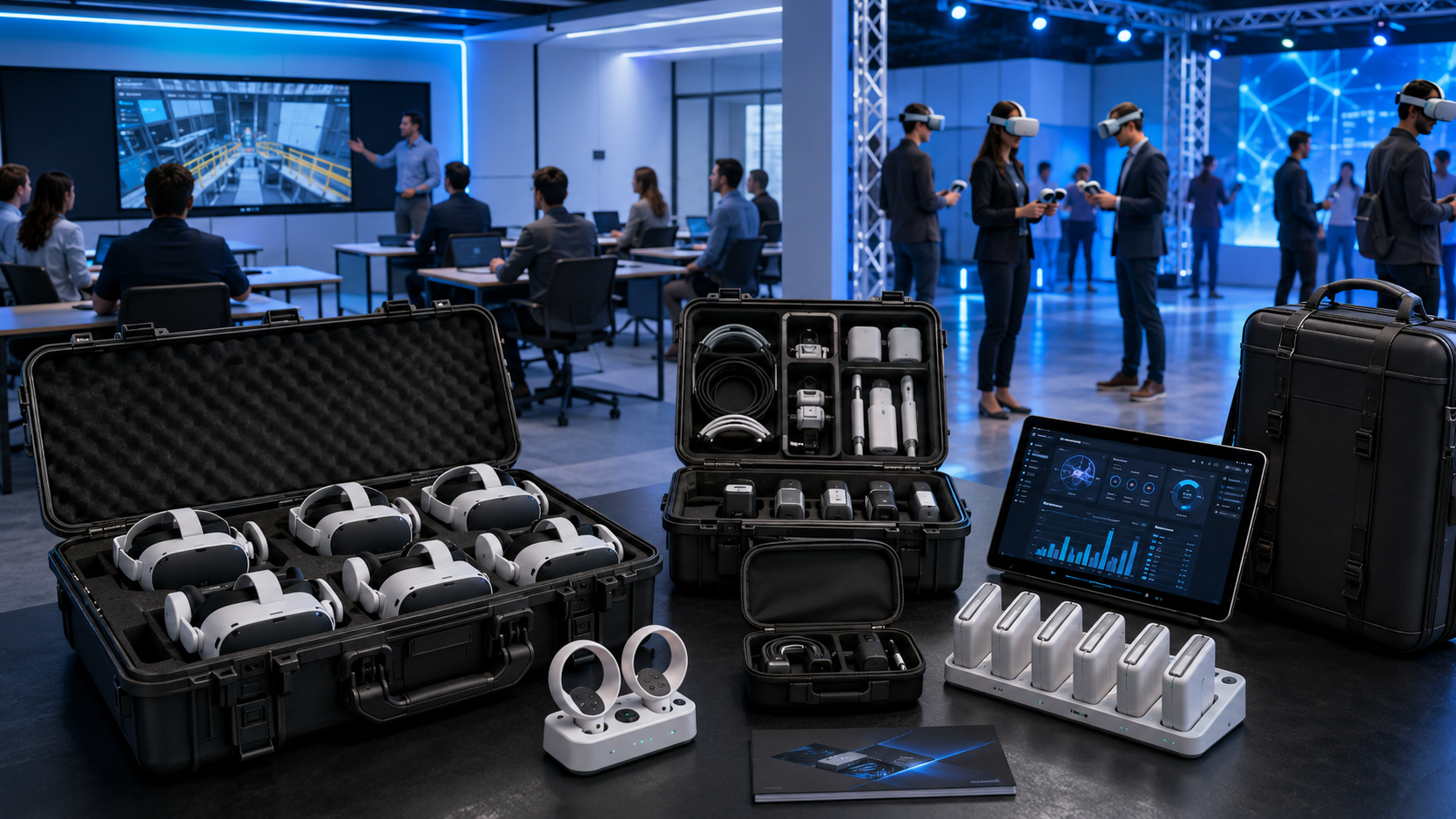
Charging infrastructure varies significantly between bundles. Entry-level packages include individual USB-C chargers requiring multiple power strips and manual cable management. Professional bundles upgrade to charging carts accommodating 10-15 headsets simultaneously, with built-in cable management and lockable storage. High-volume deployments benefit from rapid charging stations that can restore 80% battery in 30 minutes between sessions.
Transport cases protect your investment during storage and transportation. Soft-sided cases work for occasional transport between offices, costing $30-50 per headset. Pelican-style hard cases with custom foam inserts ($150-200 per headset) suit frequent travel and event deployments. Some bundles include wheeled cart systems that double as charging stations and transport solutions.
Hygiene supplies have become non-negotiable for shared headset deployments. Standard bundles include 100-500 disposable face covers ($0.50 each), antibacterial wipes, and lens cleaning cloths. Premium packages add UV-C sanitizing cabinets ($500-1,500) that disinfect headsets between users in 60 seconds. Consider bundles with silicone face interfaces ($25 each) that withstand repeated cleaning better than foam padding.
Software and Content Licensing
Device management platforms transform individual headsets into coordinated business tools. ArborXR and ManageXR lead the market, typically adding $10-15 per headset monthly to bundle costs. These platforms enable remote app deployment, usage monitoring, kiosk mode configuration, and device lockdown. Some bundles include 12-month platform subscriptions, while others offer perpetual licenses with limited features.
Content licensing models vary by use case and vendor. Training-focused bundles often include libraries of 20-50 pre-built modules covering safety procedures, soft skills, and equipment operation. Each module typically costs $500-2,000 for unlimited deployment across your headset fleet. Event activation bundles prioritize branded experiences and interactive demos, often requiring custom development at $10,000-50,000 per experience.
Multi-user licensing affects simultaneous usage capabilities. Standard bundles support concurrent users equal to headset count, but collaboration platforms may limit simultaneous sessions to 50-75% of total licenses. Cloud-based content requires 5-10 Mbps bandwidth per active headset, while offline content deployment eliminates network dependencies but complicates version management.
Custom content deployment varies between bundle providers. Enterprise bundles include sideloading capabilities for proprietary applications, private app stores for controlled distribution, and developer modes for testing. Consumer-focused bundles may restrict sideloading or charge additional fees for custom content deployment.
Support and Services Layer
Documentation quality separates professional bundles from consumer packages. Comprehensive bundles include quick-start guides for facilitators, troubleshooting flowcharts for common issues, and video tutorials for setup procedures. Look for bundles with role-specific documentation: IT setup guides, facilitator handbooks, and end-user instruction cards.
Remote support tiers typically follow standard SLA structures. Basic bundles offer email support with 24-48 hour response times. Professional packages add phone support during business hours and screen-sharing capabilities for remote troubleshooting. Enterprise bundles guarantee 4-hour response times and include dedicated account managers.
On-site setup services prove valuable for first deployments. Standard bundles include 4-8 hours of remote setup assistance via video call. Premium packages send technicians for 1-2 day on-site installations, including network configuration, device enrollment, and staff training. Budget $2,000-5,000 for comprehensive on-site setup beyond basic bundle inclusion.
Replacement guarantees protect against hardware failures and damage. Entry bundles offer standard manufacturer warranties requiring device shipping for repairs. Professional bundles include advanced replacement programs shipping replacement units within 24-48 hours. Some providers offer damage protection plans covering accidental drops and liquid damage for 10-20% annual premiums.
Bundle Configurations by Business Use Case
Standard VR bundles align with three primary business deployments: training labs that need 10-15 headsets with management software, event activations requiring 20-30 units with rapid setup, and sales demo kits with 3-5 devices plus presentation tools.
Training Lab Bundles (10-15 Headsets)
Training lab configurations center on reliable, manageable deployments for recurring sessions. The typical 12-headset Meta Quest 3 bundle includes a 15-bay charging cart ensuring all devices stay ready between training cohorts. ManageXR or ArborXR licenses enable instructors to launch training modules simultaneously across all headsets, monitor progress in real-time, and lock devices to prevent distraction.
Content libraries for training bundles emphasize repeatability and measurement. Standard packages include 10-15 foundational modules covering workplace safety, diversity training, and customer service scenarios. Advanced bundles add industry-specific content: medical procedure simulations, manufacturing assembly training, or retail transaction practice. Each module includes performance analytics tracking completion rates, error frequency, and time-to-competency metrics.
Infrastructure requirements for training labs extend beyond the bundle contents. Dedicated training rooms need minimum dimensions of 15×20 feet for 12 simultaneous users with 6-foot safety boundaries. WiFi 6 routers included in professional bundles support 15-20 concurrent VR streams without latency issues. Some bundles include boundary marking tape, foam floor tiles for standing comfort, and wall-mounted storage for accessories.
Pricing for training lab bundles ranges from $15,000-25,000 for purchase options, including first-year software licenses and basic support. Rental programs average $2,500 monthly with quarterly commitment minimums. The purchase break-even point typically occurs at 8-10 months of continuous use, making rental attractive for pilot programs or seasonal training initiatives.
Event Activation Bundles (20-30 Headsets)
Event activation bundles prioritize rapid deployment and minimal technical overhead. A standard 25-headset configuration includes quick-swap battery packs maintaining continuous operation during 8-hour events. Pre-configured content launches automatically on startup, eliminating menu navigation for attendees. Auto-reset functions return headsets to starting states after each 3-5 minute experience.
Rapid charging becomes critical for high-throughput event activations. Professional bundles include 5-10 spare headsets enabling rotation while others charge. Quick-charge stations restore 50% battery in 15 minutes, supporting 100+ sessions per headset daily. Some bundles include portable power banks for untethered charging station placement.
Staff training components prepare non-technical facilitators for event management. Bundles include laminated troubleshooting cards covering the five most common issues: headset won’t start, tracking lost, controller disconnection, low battery warnings, and content freezing. Video training modules (30-45 minutes) cover hygiene protocols, crowd management, and basic technical support. Some providers offer on-site staff for the first event deployment.
Event bundle pricing reflects higher wear expectations and support needs. Purchase prices range $30,000-45,000 including rugged transport cases and event-specific software licenses. Weekly rentals average $4,000 with delivery, setup, and retrieval included. Many providers offer decreasing rates for extended rentals: $3,500 for week two, $3,000 for subsequent weeks.
Sales Demo Kits (3-5 Headsets)
Sales demo kits optimize for portability and presentation impact. The standard 5-headset configuration fits in airline-compliant cases weighing under 50 pounds. Each kit includes a mobile hotspot eliminating venue WiFi dependencies, portable projector or 55″ TV for spectator viewing, and backup tablets for presentation control.
Presentation tools differentiate sales kits from basic headset collections. Wireless casting dongles enable real-time streaming of the VR view to external displays. Presenter tablets run companion apps controlling content flow, bookmarking key moments, and annotating the experience. Some bundles include portable green screens for mixed reality demonstrations combining presenter and virtual content.
Content management for sales demos requires flexibility and reliability. Cloud synchronization ensures all headsets access the latest product demonstrations and marketing experiences. Offline backup modes store complete experiences locally, preventing connectivity issues from disrupting presentations. Version control systems track which demos were shown to which prospects.
Sales kit pricing reflects lower headset quantities but higher per-unit features. Complete 5-headset kits range $5,000-8,000 including presentation accessories and first-year software. Monthly rentals average $800 with flexible terms allowing single-month commitments. Many providers offer try-before-buy programs crediting rental fees toward purchases.
Bundle Pricing Models and Total Cost of Ownership
VR bundle pricing extends beyond hardware costs to include software subscriptions, content licensing, support contracts, and refresh cycles. Understanding total cost of ownership over 24-36 months helps compare bundle purchases against rental programs.
Upfront Purchase Bundles
Hardware depreciation follows standard technology curves with 40% first-year depreciation, 30% second-year, and minimal residual value after 36 months. A $20,000 hardware investment effectively costs $667 monthly over 30 months of useful life. This calculation assumes no trade-in value, though some vendors offer 20-30% credit toward next-generation bundles.
Annual software licensing adds predictable ongoing costs. Device management platforms average $50-150 per headset yearly depending on feature tiers. Content subscriptions for training libraries run $1,000-5,000 annually for unlimited users. Custom content hosting and delivery platforms add $200-500 monthly for cloud storage and bandwidth.
Support contracts protect against unexpected repair costs and downtime. Basic warranties included with bundles cover manufacturing defects but exclude accidental damage. Extended support contracts costing 10-20% of hardware value annually add accidental damage protection, advanced replacement, and priority technical support. Self-insurance through spare headset purchases offers an alternative for organizations comfortable managing repairs internally.
Refresh cycles align with major platform updates typically occurring every 18-24 months. Planning for 30-month replacement cycles balances technology advancement with investment protection. Some vendors offer graduated trade-in programs: 40% credit at 12 months, 30% at 18 months, 20% at 24 months. These programs reduce effective ownership costs for organizations committed to staying current.
Subscription and Lease Models
Monthly subscription bundles combine hardware, software, and support into predictable operational expenses. Entry-level subscriptions start at $150 per headset monthly for basic configurations. Professional bundles with premium support and unlimited content updates average $200-250 per headset monthly. Enterprise subscriptions including on-demand hardware refresh and white-glove support reach $300-400 per headset monthly.
Lease-to-own options balance cash flow management with eventual ownership. 12-month leases typically cost 110% of retail price, 24-month leases 120%, and 36-month leases 135%. Early buyout options at 6 or 12 months reduce total costs for organizations deciding to commit after pilot periods. End-of-lease purchase options at 10-20% of original value provide flexibility for extending deployments.
Scaling flexibility represents the primary subscription advantage. Month-to-month agreements allow adding headsets for specific projects or events without long-term commitment. Seasonal businesses can suspend subscriptions during slow periods, paying small holding fees to maintain configurations. Technology refresh provisions ensure automatic upgrades to new hardware generations without renegotiation.
Break-even analysis reveals subscription costs exceed purchase prices after 10-14 months for basic bundles, 14-18 months for professional packages. However, subscriptions make sense for deployments under 12 months, uncertain usage patterns, or when including support and refresh values. Organizations with predictable multi-year needs benefit from purchasing unless cash flow constraints mandate operational expense treatment.
Vendor Comparison: Business VR Bundle Providers
Five primary vendors offer business-focused VR bundles with different strengths: some excel at hardware variety, others at managed services or content libraries. Direct comparison helps identify which vendor aligns with your deployment needs and support requirements.
Hardware-First Providers
Meta for Business leads market share with Quest 3 bundles leveraging consumer volume pricing for business value. Standard bundles include Quest for Business software enabling device management without third-party platforms. Pricing starts at $599 per headset in 10-unit minimums, with volume discounts reaching 20% at 100+ units. Meta’s strength lies in hardware affordability and extensive content library, though enterprise support remains limited compared to dedicated B2B providers.
HTC Vive Business positions Focus 3 bundles for professional deployments requiring maximum performance and reliability. Bundles include ArborXR integration, two-year warranties, and priority support. The Focus 3’s hot-swappable batteries and enhanced comfort for extended wear justify premium pricing starting at $1,300 per unit. HTC excels at custom configuration and white-label options for branded deployments.
PICO Enterprise targets price-conscious businesses wanting professional features without premium costs. PICO 4 Enterprise bundles start at $899 per headset including business software licenses and dedicated support channels. Unique features include built-in eye tracking for analytics and China deployment capabilities through parent company ByteDance. PICO struggles with content library depth but offers aggressive pricing for hardware-centric deployments.
Managed Service Providers
Specialized VR deployment companies offer hardware-agnostic bundles focusing on services over specific devices. These providers source headsets based on client requirements, adding value through deployment expertise and ongoing management. Typical bundles include device procurement, configuration, content deployment, and managed support services.
Management platform integration becomes the core value proposition for these providers. They maintain enterprise accounts with ArborXR, ManageXR, and proprietary platforms, passing volume savings to clients. Pre-configuration services eliminate IT setup burden, delivering plug-and-play bundles ready for immediate deployment. Remote monitoring and proactive maintenance prevent issues before they impact operations.
White-glove setup services differentiate managed providers from hardware vendors. Comprehensive bundles include site surveys assessing infrastructure readiness, on-site installation with network optimization, staff training workshops, and ongoing success management. These services add $5,000-10,000 to bundle costs but accelerate time-to-value and improve adoption rates.
Custom content development capabilities allow managed providers to offer complete solutions. In-house development teams create branded experiences, modify existing training content, and integrate VR deployments with enterprise systems. Development costs range from $25,000 for simple customizations to $250,000 for complex training simulations. Some providers offer content-as-a-service models with monthly fees instead of upfront development costs.
Deployment Planning for VR Bundle Implementation
Successful VR bundle deployment requires infrastructure assessment, staff training, content preparation, and pilot program design before full rollout. A phased approach reduces risk and improves adoption rates.
Infrastructure Requirements Checklist
Network capacity planning prevents the most common deployment failures. Each active VR headset requires 10-25 Mbps bandwidth for cloud content streaming, 5-10 Mbps for multiplayer experiences, and 2-5 Mbps for device management. WiFi 6 access points support 20-30 concurrent headsets per access point with proper configuration. Dedicated VLANs isolate VR traffic from corporate networks, improving performance and security.
Physical space requirements extend beyond square footage to include ceiling height, lighting, and obstacles. Training labs need 8-foot minimum ceilings for arm movements, controlled lighting avoiding infrared interference, and clear sight lines between headsets and tracking beacons if using outside-in tracking. Mark 6×6 foot boundaries per user with floor tape or foam tiles. Position charging stations within 6 feet of power outlets to avoid extension cord hazards.
Power infrastructure often requires upgrades for larger deployments. Charging 20 headsets simultaneously draws 400-600 watts, potentially overloading single circuits. Professional installations distribute charging across multiple circuits or install dedicated 20-amp circuits for charging stations. Uninterruptible power supplies prevent training disruptions from brief outages and protect equipment from power surges.
IT integration touches security, management, and support systems. Firewall rules must allow headset communication with management platforms (typically ports 443, 8883 for MQTT). Mobile device management integration enables single sign-on and compliance monitoring. Help desk ticketing systems need VR-specific issue categories and escalation paths. Document MAC addresses for network registration and asset tracking.
Pilot Program Structure
Starting with 3-5 headset pilots validates assumptions before committing to full bundles. Select pilot participants representing diverse user groups: technical and non-technical staff, different age ranges, varying comfort with technology. This diversity surfaces issues that homogeneous groups might miss. Pilot groups of 10-15 people per headset ensure sufficient usage data while maintaining manageable scope.
Success metrics must balance quantitative measurements with qualitative feedback. Usage rates below 50% indicate adoption barriers requiring investigation. Session duration averages reveal whether experiences engage users or frustrate them. Technical issue logs identify recurring problems requiring infrastructure changes or additional training. User satisfaction scores above 4.0/5.0 suggest readiness for expansion.
The 30-60-90 day framework structures pilot expansion systematically. Days 1-30 focus on technical validation: confirming infrastructure stability, resolving setup issues, and establishing support procedures. Days 31-60 expand to additional user groups while refining content and training materials based on initial feedback. Days 61-90 test full-scale operations including peak concurrent usage and edge cases.
Documentation during pilot phases creates institutional knowledge for full deployment. User guides evolve from vendor documentation to organization-specific procedures including local WiFi passwords, room booking processes, and content access instructions. Troubleshooting guides capture solutions to company-specific issues like proxy authentication or single sign-on integration. Best practice documents share lessons learned about session scheduling, hygiene protocols, and facilitator techniques.
Bundle vs À La Carte: Decision Framework
Bundles make sense for rapid deployment and predictable costs, while à la carte purchasing offers customization and gradual scaling. Your decision depends on deployment timeline, internal technical expertise, and budget flexibility.
When Bundles Make Sense
Rapid deployment requirements favor pre-configured bundles eliminating procurement complexity. Bundles arrive ready for deployment within 5-10 business days versus 4-6 weeks for custom configurations. Pre-negotiated pricing avoids lengthy vendor negotiations for each component. Integrated testing ensures compatibility between headsets, software, and accessories.
Limited internal VR expertise makes comprehensive bundles attractive. Vendors handle complex decisions about hardware compatibility, software licensing models, and accessory selection. Single-source support eliminates finger-pointing between multiple vendors when issues arise. Turnkey solutions include documentation and training materials proven across similar deployments.
Predictable usage patterns align with bundle economics. Training programs with defined cohort sizes can right-size bundles precisely. Regular event schedules justify investing in owned equipment versus repeated rentals. Standardized use cases benefit from pre-configured content and workflows included in bundles.
Single vendor relationships simplify procurement and support. Consolidated invoicing reduces accounting complexity. Master service agreements cover all bundle components. Account managers understand complete deployment context when providing support. Volume purchasing power extends across entire solution rather than individual components.
When À La Carte Works Better
Specific hardware requirements across different use cases prevent standardized bundles from meeting all needs. Engineering teams might require PC-tethered headsets for CAD visualization while sales teams need standalone units for portability. Mixed reality deployments combining VR headsets with AR glasses require careful component selection. Specialized peripherals like haptic gloves or motion platforms aren’t included in standard bundles.
Existing device management infrastructure reduces bundle value propositions. Organizations already using MDM platforms can extend them to VR headsets without dedicated VR management software. In-house IT teams comfortable with consumer electronics can handle setup and support without vendor assistance. Established help desk procedures may conflict with vendor support requirements.
Gradual rollout timelines allow spreading costs and learning across extended periods. Purchasing 2-3 headsets monthly enables testing different models before committing to large quantities. Phased deployments reveal actual versus projected usage patterns. Delayed purchasing benefits from declining hardware prices and next-generation releases.
Custom content development focus makes hardware secondary to software investment. Organizations building proprietary training simulations or branded experiences allocate most budget to development. Specific headset features like hand tracking or eye tracking might be required for custom applications. Development partnerships often include hardware procurement as part of project scope.
Conclusion
VR headset bundles for business streamline deployment complexity while providing predictable costs for training labs, events, and sales demonstrations. The right bundle configuration depends on your specific use case, with training labs benefiting from 10-15 headset packages with robust management software, event activations requiring 20-30 units with rapid setup capabilities, and sales teams needing portable 3-5 headset kits.
Total cost of ownership analysis reveals that bundles make economic sense for deployments exceeding 10-14 months of continuous use. However, subscription models provide valuable flexibility for uncertain usage patterns or when technology refresh and comprehensive support justify higher monthly costs.
Success requires careful planning beyond bundle selection. Infrastructure readiness, pilot program structure, and clear success metrics determine whether your VR deployment delivers expected value. Organizations with rapid deployment needs and limited VR expertise benefit most from comprehensive bundles, while those with specific technical requirements or gradual rollout plans might prefer à la carte purchasing.
Ready to deploy VR at scale? Start by documenting your use case requirements, expected usage patterns, and infrastructure constraints. Request quotes from at least three bundle providers, comparing not just pricing but included services and support terms. Consider starting with a rental or pilot bundle to validate assumptions before committing to large purchases. Most importantly, engage your IT, training, and operations teams early to ensure organizational readiness for successful VR deployment.
Frequently Asked Questions
Can I customize what’s included in a VR headset bundle?
Most providers offer semi-custom bundles allowing substitutions within categories. You can typically choose different headset models, upgrade charging solutions, or adjust software licenses. However, deeply customized bundles often lose volume pricing advantages. Expect 10-20% price increases for significant customization beyond standard configurations.
What’s the typical lead time for business VR bundle delivery?
Standard bundles ship within 5-10 business days from major providers maintaining inventory. Custom configurations require 3-4 weeks for assembly and testing. International shipments add 5-10 days for customs clearance. Event rentals need 2-week advance booking during peak seasons (September-November, March-May).
Do VR bundles include insurance for damaged headsets?
Basic bundles include manufacturer warranties covering defects but not accidental damage. Protection plans adding drop/spill coverage cost 10-15% of hardware value annually. Event bundles often include damage waivers for $50-100 per headset per event. Self-insurance through spare headsets provides an alternative for large deployments.
Can I mix different headset models in one bundle?
Mixed bundles are possible but complicate management and support. Different headsets require separate software configurations, charging solutions, and troubleshooting procedures. Most providers discourage mixing unless use cases specifically require different capabilities. When mixing is necessary, maintain separate bundles for each model.
What happens when new VR headset models release?
Purchase bundles don’t automatically upgrade to new models. Some vendors offer trade-in programs providing 20-40% credit toward upgrades. Subscription bundles may include automatic refresh provisions at 18-24 month intervals. Lease agreements typically specify whether upgrades are included or require contract renegotiation.
Are content licenses transferable between headsets in a bundle?
Most enterprise content licenses attach to organizations rather than specific devices, allowing transfer between headsets within your bundle. However, some specialized training content uses per-device licensing requiring additional fees for transfers. Verify licensing models before purchasing content for shared headset deployments.
Do bundles include on-site setup and training?
Entry-level bundles typically include remote setup assistance via video call. Professional bundles may include 1-2 days of on-site setup for first deployment. Comprehensive training usually requires additional fees ranging from $2,000-5,000 per day. Some providers offer train-the-trainer programs enabling internal capability development.
What’s the minimum order quantity for business VR bundles?
Minimum quantities vary by provider and bundle type. Hardware manufacturers typically require 10-unit minimums for business pricing. Managed service providers may offer bundles starting at 5 units. Event rental minimums can be as low as 3 headsets but pricing efficiency improves significantly at 10+ units.