Why VR Transforms Soft Skills Training: The Science of Immersive Practice
Traditional soft skills training relies on role-play and discussion, but VR creates emotionally authentic scenarios where learners practice difficult conversations, public speaking, and conflict resolution in psychologically safe environments. Research from Stanford’s Virtual Human Interaction Lab shows VR training increases retention by 75% compared to lecture-style learning.
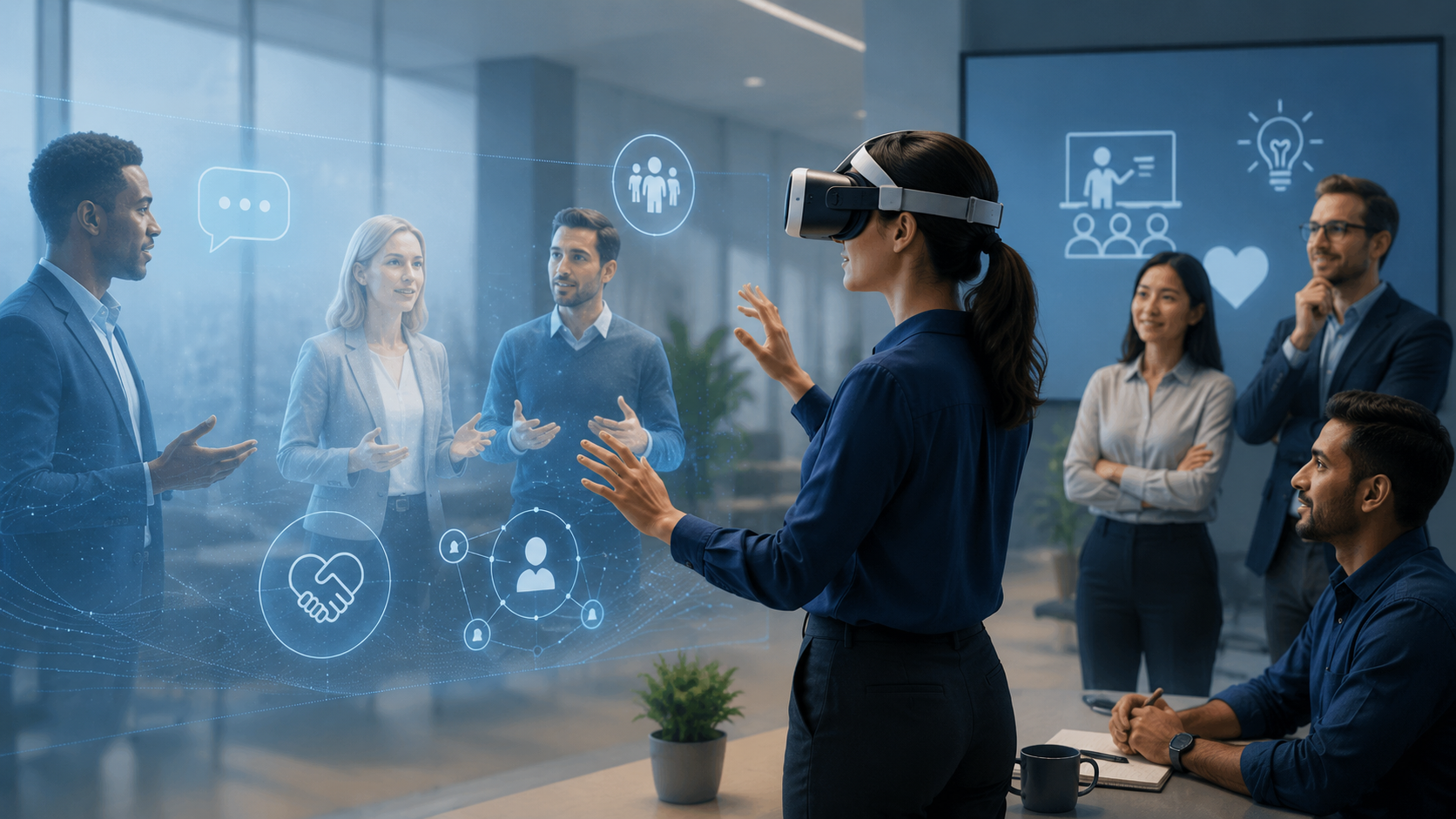
The shift from passive learning to active practice fundamentally changes how professionals develop interpersonal capabilities. When a manager puts on a VR headset to practice delivering termination news, their heart rate increases, palms sweat, and voice wavers—physiological responses identical to real-world situations. This emotional authenticity, combined with unlimited practice opportunities, accelerates skill development beyond what traditional workshops achieve.
The Presence Effect: Why VR Feels Real Enough to Change Behavior
VR triggers genuine emotional responses through embodied cognition—the psychological phenomenon where our brains interpret virtual experiences as real when sensory inputs align with expectations. When you see a virtual hand move as your physical hand moves, hear spatial audio that changes with head position, and experience consistent physics, your amygdala activates stress responses despite conscious awareness of the simulation.
This presence effect creates a safe failure environment crucial for soft skills development. Learners can botch a negotiation, freeze during a presentation, or mishandle conflict without real-world consequences. Each failure becomes data for improvement rather than career-limiting mistakes.
The repeatability advantage over one-time workshop experiences cannot be overstated. Where traditional training might offer two or three role-play opportunities in a half-day session, VR enables dozens of practice runs with varying difficulty levels, emotional intensities, and cultural contexts. A learner can practice the same difficult conversation with an angry customer twenty times, each iteration building muscle memory for de-escalation techniques.
Soft Skills That VR Trains Most Effectively
Public speaking and presentation anxiety reduction tops the effectiveness list. VR audiences provide realistic eye contact, body language, and even distractions like phone checking or side conversations. Speakers practice maintaining composure when virtual audience members appear bored, ask difficult questions, or create disruptions. The platform Ovation reports 87% of users show measurable confidence improvements after eight VR practice sessions.
Difficult conversation practice encompasses terminations, performance feedback, and negotiations. VR scenarios present defensive employees who interrupt, argue, or become emotional. Managers practice staying calm, using specific language frameworks, and managing their own emotional responses. The ability to restart conversations immediately after mistakes accelerates learning curves from months to weeks.
Empathy building through perspective-taking scenarios leverages VR’s unique ability to embody different viewpoints. Learners experience workplace situations as employees with disabilities, different cultural backgrounds, or varying seniority levels. This first-person perspective shift creates lasting attitude changes more effectively than diversity training videos or discussions.
Leadership presence and executive communication develops through scenarios requiring authoritative yet approachable delivery. VR training places leaders in board rooms, all-hands meetings, and crisis communications where they practice body language, voice modulation, and message clarity while managing stress responses.
Active listening and emotional intelligence development improves through scenarios requiring attention to verbal and non-verbal cues. VR characters express subtle frustrations through posture changes, delayed responses, or tone shifts. Learners practice recognizing these signals and responding appropriately, with immediate feedback on their observation accuracy.
Building Your VR Soft Skills Training Program: Equipment and Content Decisions
Launching a VR soft skills program requires choosing between standalone headsets like Meta Quest 3 or PC-tethered systems, selecting training content libraries or custom scenarios, and determining whether to rent equipment for pilots or purchase for ongoing programs.
The technology landscape for VR soft skills training has matured significantly since 2020. Enterprise-ready platforms now offer cloud-based content delivery, centralized device management, and detailed analytics dashboards. However, success depends on matching technical specifications to training objectives while considering practical factors like IT support availability and learner technical proficiency.
Hardware Requirements for Soft Skills Training
Standalone headsets work best for soft skills training due to their portability and ease of setup. The Meta Quest 3 and PICO 4 Enterprise eliminate cable management issues that create safety hazards and limit movement during role-play scenarios. These devices boot directly into training applications, reducing technical friction for non-technical HR teams.
Minimum specifications for effective soft skills training include hand tracking for natural gesture communication, spatial audio for realistic conversation dynamics, and 90Hz refresh rates to minimize motion sickness. Resolution matters less than tracking accuracy—learners need responsive avatar movements more than photorealistic graphics.
Multi-user considerations become critical for group training sessions. Synchronous scenarios where managers practice team meetings or conflict mediation require stable network connections and identical hardware across participants. Budget 20% above single-user requirements for network infrastructure upgrades and backup headsets to handle technical failures during group sessions.
Hygiene protocols demand structured approaches to face cushion management. Silicone covers enable quick sanitization between users, while disposable face masks provide individual barriers. Organizations typically purchase 1.5x face cushions relative to headset quantities, enabling rotation during cleaning cycles. UV sanitization cabinets, though expensive at $2,000-3,000, prove cost-effective for programs with daily usage.
Content Platforms and Scenario Libraries
Ovation specializes in public speaking practice with AI-powered audience feedback. Virtual audiences range from supportive small groups to hostile boardrooms. The platform analyzes filler words, pacing, eye contact distribution, and gesture effectiveness. Pricing starts at $50 per user monthly for standard scenarios, with custom audience creation available at enterprise tiers.
Strivr’s enterprise soft skills modules focus on customer service, leadership development, and safety conversations. Their Walmart partnership validated effectiveness at scale—training 1.2 million associates with 70% improvement in confidence scores. Annual licenses start at $100,000 for 500 users, including quarterly content updates and dedicated success management.
Virti’s healthcare communication scenarios address patient interaction, breaking bad news, and informed consent conversations. Medical professionals practice empathy while maintaining clinical accuracy. The platform includes assessment tools mapping to healthcare competency frameworks. Pricing ranges from $75-150 per user annually depending on scenario complexity.
Custom scenario development costs range from $25,000 for simple branching conversations to $250,000 for complex multi-character interactions with emotional AI. Development timelines span 3-6 months, including script writing, voice acting, animation, and testing phases. Custom development makes sense when organization-specific situations, terminology, or compliance requirements exceed generic scenario capabilities.
SCORM compliance for LMS integration varies by platform. Strivr and Virti offer full SCORM 2004 support, enabling progress tracking within existing learning management systems. Smaller platforms may only provide CSV exports requiring manual grade entry. Verify integration capabilities during vendor evaluation to avoid data silo creation.
Rent vs Buy Decision Framework
Rental advantages for pilot programs include minimal capital investment and easy exit strategies if adoption fails. Three to six-month trials cost $150-250 monthly per headset including support and insurance. This approach validates training effectiveness before committing to purchase decisions.
Break-even analysis typically shows purchase advantages at 12-month horizons for programs with weekly usage. A $500 Meta Quest 3 pays for itself versus rental in 3-4 months of regular use. However, this calculation must include hidden costs: IT support time, storage solutions, replacement planning, and technology refresh cycles every 2-3 years.
Setup support importance for non-technical HR teams cannot be underestimated. Rental providers typically include white-glove setup, troubleshooting hotlines, and replacement shipping for failed devices. Internal IT departments often lack VR expertise, creating support bottlenecks that reduce program effectiveness. Budget $5,000-10,000 annually for external support contracts when purchasing equipment.
Scalability considerations favor purchase at 50+ headset deployments. Volume discounts, centralized device management platforms, and dedicated vendor support become available at enterprise scales. Organizations planning expansion should negotiate volume pricing upfront even if purchasing in phases.
Designing Effective VR Soft Skills Scenarios
The most impactful VR soft skills training recreates workplace situations with emotional authenticity—from defensive employees during performance reviews to hostile customer interactions. Design principles from behavioral psychology ensure scenarios trigger real learning rather than just entertainment.
Effective scenario design balances realism with learning objectives. Overly complex scenarios overwhelm learners, while oversimplified interactions fail to prepare them for real-world nuance. The sweet spot creates sufficient emotional activation to encode memories while maintaining clear cause-effect relationships between actions and outcomes.
Scenario Architecture for Maximum Transfer
Branching dialogue trees must respond to both word choice and delivery tone. A phrase like “I understand your concern” delivered sarcastically triggers different character responses than sincere delivery. Advanced platforms use voice analysis to detect emotional undertones, adjusting NPC reactions accordingly. Each branch point should represent realistic conversation pivots rather than obvious right/wrong choices.
Emotional escalation patterns mirror real conflict dynamics. Characters don’t immediately explode in anger but show progressive frustration through shortened responses, increased interruptions, and defensive body language. This graduated intensity helps learners recognize early warning signs and practice de-escalation before situations become unrecoverable.
Non-verbal cue integration differentiates professional VR training from gaming experiences. Crossed arms, backward leans, and broken eye contact signal disengagement requiring strategy adjustments. Effective scenarios teach learners to monitor these signals while managing their own verbal delivery—a dual-task challenge mirroring real conversation cognitive load.
Difficulty progression follows instructional design principles starting with single-issue conversations before introducing multiple stakeholders, time pressure, and emotional complexity. A customer service progression might begin with product questions, advance to billing disputes, then culminate in discrimination complaints requiring legal awareness alongside interpersonal skills.
Cultural and Diversity Considerations
Avatar diversity requirements extend beyond surface-level representation to behavioral patterns and communication styles. Scenarios should include characters exhibiting high-context communication preferences, varying personal space comfort levels, and different conflict resolution approaches. This diversity prepares learners for global workforce realities.
Cross-cultural communication scenario variations address misunderstandings arising from different business etiquette expectations. A negotiation scenario might include Japanese partners expecting relationship building before business discussion, German colleagues preferring direct feedback, and American counterparts comfortable with simultaneous talking. Each variation teaches cultural intelligence alongside core communication skills.
Accessibility features ensure inclusive training experiences. Subtitles support hearing-impaired learners and non-native speakers. Seated mode accommodates wheelchair users. Color-blind friendly interfaces prevent confusion in feedback systems. Voice-over narration assists visually impaired participants in navigation. These features often require 20-30% additional development investment but expand program reach significantly.
Language localization for global teams involves more than translation. Scenarios must reflect local workplace norms, legal frameworks, and cultural expectations. A performance review conversation designed for U.S. audiences requires substantial modification for deployment in countries with different employment law structures and feedback cultures.
Implementation Roadmap: From Pilot to Scale
Most successful VR soft skills programs start with a 20-person pilot focused on one specific skill gap, then expand based on measured outcomes. This phased approach minimizes risk while building internal champions who advocate for broader rollout.
The journey from pilot to enterprise deployment typically spans 12-18 months. Organizations that rush scaling without proper foundation building experience 3x higher failure rates. Patient, methodical expansion creates sustainable programs delivering consistent ROI across business units.
Phase 1: Pilot Program Structure (Months 1-3)
Selecting pilot participants requires balancing skeptics with enthusiasts. Include 30% technology skeptics to surface adoption barriers early. Mix seniority levels to understand different generation comfort levels with VR. Ensure representation from various departments to identify use cases beyond initial focus areas.
Pre-training baseline assessments establish measurable starting points. Use 360-degree feedback tools rating specific behaviors like “maintains composure during conflict” or “demonstrates active listening.” Video record role-plays for comparison with post-training performance. Conduct validated assessments like the Emotional Intelligence Appraisal for quantitative benchmarks.
Session frequency and duration optimize for 30-minute weekly sessions rather than intensive workshops. This spacing leverages memory consolidation between practices while preventing VR fatigue. Schedule sessions during low-energy periods like post-lunch slots when traditional training struggles to maintain engagement. Build buffer time for technical issues—assume 20% of sessions will experience some disruption initially.
Facilitator training requires 8-12 hours covering technical troubleshooting, learning theory application, and debrief techniques. Facilitators need comfort managing both technology and emotional responses as learners may experience genuine stress during scenarios. Create facilitator guides mapping specific scenarios to learning objectives with suggested discussion prompts.
Data collection protocols must balance comprehensiveness with participant burden. Automate quantitative metrics through platform analytics while limiting qualitative surveys to bi-weekly intervals. Track both in-VR metrics (completion rates, response times, choice patterns) and real-world application through manager observations and peer feedback.
Phase 2: Validation and Refinement (Months 4-6)
ROI measurement frameworks for soft skills require creative metrics beyond traditional training evaluation. Track behavioral change through pulse surveys measuring team satisfaction with manager communication. Monitor HR ticket reductions for interpersonal conflicts. Analyze performance review language for increased specificity and constructiveness. Calculate time savings from faster conflict resolution and reduced escalations.
360-degree feedback integration provides external validation of skill improvements. Compare pre-pilot ratings with 90-day post-training assessments focusing on specific behaviors practiced in VR. Weight feedback from frequent interaction partners higher than occasional contacts. Look for convergence between self-assessment improvements and observer ratings to validate genuine change versus perception shifts.
Scenario customization based on pilot feedback typically identifies 3-5 organization-specific situations requiring custom development. Common requests include industry-specific compliance conversations, company culture elements like specific meeting formats, and regional communication patterns. Budget $50,000-75,000 for customization even when using platform libraries.
IT infrastructure considerations surface during scaled pilots. Cloud-based platforms require 25 Mbps per concurrent user for smooth streaming. On-premise deployments need dedicated servers with GPU capabilities for rendering. Mobile device management systems must accommodate VR headsets’ Android-based operating systems. Plan network upgrades 60 days before scaling beyond pilot groups.
Phase 3: Enterprise Rollout Planning
Headset fleet management at scale requires dedicated systems for deployment, tracking, and maintenance. Implement check-out procedures through existing IT asset management systems. Create headset kits including carrying cases, hygiene supplies, and quick-start guides. Establish refresh cycles replacing devices every 24-30 months to maintain performance standards.
Training coordinator certification programs develop internal expertise reducing vendor dependence. Coordinators complete 40-hour programs covering scenario selection, session facilitation, data interpretation, and basic troubleshooting. Certified coordinators can train additional facilitators, creating scalable support structures. Budget $5,000-8,000 per coordinator for certification including travel and materials.
Integration with existing L&D curricula positions VR as complementary rather than replacement training. Map VR modules to competency frameworks showing how immersive practice reinforces workshop concepts. Create blended learning paths alternating VR practice with traditional instruction. Design pre-work and follow-up activities maximizing VR session value.
Budget allocation typically follows 40-30-30 split: 40% for hardware and software, 30% for content development and customization, 30% for program management and support. Annual budgets range from $250,000 for 100-person programs to $2 million for 1,000+ person enterprise deployments. Secure multi-year funding commitments to avoid program disruption from budget cycles.
Measuring VR Soft Skills Training Impact
Unlike technical training where you can measure task completion, soft skills require behavioral observation, self-assessment, and manager feedback to demonstrate improvement. VR platforms provide unique metrics like gaze patterns and voice analysis that traditional training cannot capture.
The measurement challenge for soft skills has historically limited investment in development programs. VR’s data capture capabilities transform vague concepts like “executive presence” into measurable behaviors: sustained eye contact percentages, gesture frequency, and voice modulation patterns. This quantification enables precise improvement tracking and targeted coaching.
VR-Specific Analytics and Insights
Eye contact duration during conversations reveals confidence and engagement levels. Effective communicators maintain eye contact 60-70% of conversation time, breaking appropriately to avoid staring. VR tracking shows learners typically start at 30-40% eye contact, improving to target ranges within 5-6 practice sessions. Heat maps identify whether learners scan all audience members or fixate on friendly faces.
Voice pitch and pace analysis indicates emotional regulation under pressure. Stressed speakers show 15-20% pitch increases and 25% pace acceleration compared to baseline readings. VR platforms track these changes in real-time, providing immediate feedback through visual indicators. Learners develop awareness of stress responses and practice breathing techniques to maintain vocal control.
Decision timing in conflict scenarios differentiates experienced managers from novices. Veterans pause 2-3 seconds before responding to emotional outbursts, while inexperienced managers react immediately, often escalating tensions. VR scenarios track response latency, teaching optimal pause lengths for different situation types.
Replay analysis enables self-reflection impossible in real conversations. Learners review their performance from third-person perspectives, observing body language and facial expressions invisible during first-person experience. This outside view creates powerful learning moments as people recognize unconscious behaviors undermining their communication effectiveness.
Business Impact Metrics
Manager satisfaction scores show 20-35% improvements within 90 days of VR training completion. Direct reports rate managers higher on empathy, clarity, and conflict resolution capabilities. The most significant improvements appear in “difficult conversation” categories where traditional training provides limited practice opportunities.
Employee engagement surveys reveal secondary benefits beyond direct skill improvement. Teams whose managers complete VR training report feeling more heard, understood, and supported. Engagement scores increase 8-12 points on 100-point scales, with particular gains in “manager effectiveness” and “career development” dimensions.
HR escalation reductions provide quantifiable cost savings. Organizations report 25-40% fewer formal complaints requiring HR intervention after manager VR training. Each prevented escalation saves 20-40 hours of HR time plus potential legal costs. A 500-manager organization typically saves $200,000-400,000 annually through reduced escalations alone.
Promotion readiness assessments show VR-trained employees advancing 6-9 months faster than peers. The combination of technical competence with demonstrated soft skills creates compelling promotion candidates. This acceleration improves retention as high-performers see clear advancement paths.
Customer satisfaction correlations appear strongest in service-facing roles. Call center representatives practicing empathy and de-escalation in VR show 15-20 point NPS improvements. Retail managers trained in VR demonstrate better customer recovery skills, turning complaints into loyalty-building interactions.
Common Challenges and Solutions
VR soft skills training faces unique adoption barriers from motion sickness concerns to skepticism about virtual interaction authenticity. Addressing these proactively ensures higher participation rates and better outcomes.
Organizations underestimate change management requirements for VR adoption. Unlike traditional e-learning launched through email links, VR requires physical presence, equipment comfort, and psychological readiness to engage with immersive content. Success depends on addressing both technical and cultural barriers systematically.
Technical and Comfort Issues
Motion sickness affects 15-20% of first-time VR users but reduces to 5% with proper mitigation strategies. Start with stationary scenarios avoiding virtual walking. Limit initial sessions to 15 minutes, gradually extending as comfort increases. Provide ginger candies or peppermint tea before sessions. Enable comfort settings like peripheral vision reduction during movement. Most importantly, never push through nausea—immediate removal prevents negative associations.
Headset fit challenges arise from anthropometric diversity. Standard straps don’t accommodate all head sizes, hairstyles, or religious headwear. Invest in alternative strap systems like elite straps with battery packs that distribute weight better. Provide headband cushions for hijab-wearing users. Stock multiple face cushion sizes ensuring proper eye alignment with lenses.
Vision correction for glasses wearers requires prescription lens inserts or contact lens policies. Prescription inserts cost $80-150 but provide superior comfort and field of view compared to wearing glasses inside headsets. Alternatively, provide daily contact lenses for training sessions. Never force glasses-wearers to train without correction as eye strain causes headaches and reduces learning effectiveness.
Network bandwidth limitations create frustrating lag and disconnections. Cloud-streaming platforms require dedicated 25 Mbps per headset with sub-50ms latency. Test network capacity during peak usage periods, not quiet mornings. Consider local content caching for frequently used scenarios. Implement quality-of-service rules prioritizing VR traffic during training windows.
Organizational Resistance Points
The “video game” perception persists among senior leaders unfamiliar with professional VR applications. Counter with ROI data: PwC studies show VR soft skills training delivers 4x faster learning at scale compared to classroom instruction. Arrange executive demos focusing on business scenarios rather than technical capabilities. Share case studies from respected companies in your industry.
Privacy concerns about behavioral data collection require transparent communication. Clearly explain what data is collected (performance metrics, not biometric identification), how it’s stored (encrypted and anonymized), and who has access (L&D teams, not direct managers). Provide opt-out alternatives ensuring no career penalties for privacy-conscious employees. Consider European GDPR requirements even for U.S.-based programs as privacy expectations globalize.
Union considerations arise when VR data might influence performance evaluations. Engage union representatives early, positioning VR as skill development rather than assessment. Agree on data usage limitations—training metrics improve programs but don’t factor into individual reviews. Create joint labor-management committees overseeing program implementation and addressing concerns collaboratively.
Change management for traditional training teams requires reskilling support. Veteran facilitators may feel threatened by technology replacing their expertise. Reframe VR as amplifying rather than replacing human facilitation. Invest in train-the-trainer programs helping facilitators leverage their experience in new mediums. Create hybrid roles combining virtual and in-person instruction.
Frequently Asked Questions
How much does VR soft skills training cost per employee?
Total costs range from $200-500 per employee annually including hardware amortization, software licenses, and program management. High-usage programs achieve lower per-employee costs through economies of scale. Initial implementations cost more due to setup and customization investments.
Can VR really improve emotional intelligence?
Yes, through perspective-taking exercises and emotion recognition practice. VR scenarios present subtle emotional cues requiring interpretation and appropriate response. Studies show 23% improvement in emotion recognition accuracy after VR training compared to 8% for traditional methods.
What’s the minimum number of headsets needed to start?
Pilot programs succeed with 5-10 headsets supporting 20-30 participants through scheduled sessions. This ratio assumes 2-3 training sessions weekly per headset. Scale headset quantities based on concurrent usage rather than total participant numbers.
How do you handle employees who get motion sick in VR?
Provide alternative training methods for the 2-3% who cannot adapt to VR despite mitigation strategies. Record VR sessions for desktop viewing, enabling participation without immersion. Never mandate VR participation without accommodation options.
Which soft skill shows the most improvement from VR training?
Public speaking consistently shows the highest measurable improvements—70-80% confidence increases and 50% reduction in filler words. The ability to practice repeatedly with varied audiences accelerates improvement beyond other training methods.
How long does it take to see behavioral change from VR training?
Initial confidence improvements appear within 2-3 sessions. Observable behavioral changes in workplace interactions typically emerge after 6-8 sessions over 4-6 weeks. Sustained change requires periodic refresher sessions every quarter.
Can VR soft skills training work remotely?
Yes, with proper setup support. Ship headsets to remote employees with detailed setup guides and video support. Cloud-based platforms enable consistent experiences regardless of location. Remote deployment actually reduces facility costs compared to in-person training.
Do you need dedicated training rooms for VR?
Ideally yes, but not required. Dedicated spaces need 6×6 feet per user, minimal furniture, and controlled lighting. Alternatively, book conference rooms or use open office areas during off-hours. Mark boundaries with tape to prevent collisions.
How do you ensure training transfers to real workplace situations?
Design scenarios matching actual workplace contexts including specific locations, stakeholder types, and common situations. Implement post-training action planning where learners identify real conversations to practice. Manager involvement in debrief sessions reinforces application expectations.
What happens if employees refuse to use VR headsets?
Respect refusal while understanding reasons—fear, privacy concerns, or physical discomfort. Offer desktop alternatives for content viewing. Share peer success stories reducing anxiety. Never make VR training mandatory without providing equivalent alternatives.
Conclusion
VR soft skills training represents a fundamental shift in professional development methodology. The combination of emotional authenticity, unlimited practice opportunities, and detailed behavioral analytics solves historical challenges in developing interpersonal capabilities at scale.
Success requires thoughtful implementation balancing technology adoption with human-centered change management. Organizations that approach VR training as transformation rather than simple tool deployment see 3-4x better outcomes. The investment in proper setup, facilitator training, and cultural preparation pays dividends through improved manager effectiveness, reduced conflicts, and accelerated leadership development.
The technology continues evolving rapidly. Haptic feedback gloves enabling handshake practice, AI-powered conversation partners with unlimited variation, and photorealistic avatars reducing uncanny valley effects will expand training possibilities. However, current platforms already deliver measurable ROI for organizations willing to embrace immersive learning.
Ready to transform your soft skills training with VR? Start with a focused pilot targeting your most pressing capability gap. Whether that’s new manager communication, customer service excellence, or executive presence, VR provides the practice environment necessary for genuine behavior change. Contact VR training providers for demos, but more importantly, experience the technology yourself. Put on a headset, face a virtual audience, and feel your heart rate rise. That physiological response—impossible to replicate in traditional training—demonstrates VR’s unique power to prepare professionals for high-stakes human interactions.
The question isn’t whether VR will transform soft skills training, but whether your organization will lead or follow that transformation. Early adopters are already building competitive advantages through superior interpersonal capabilities. The time for experimentation has passed. The time for implementation is now.