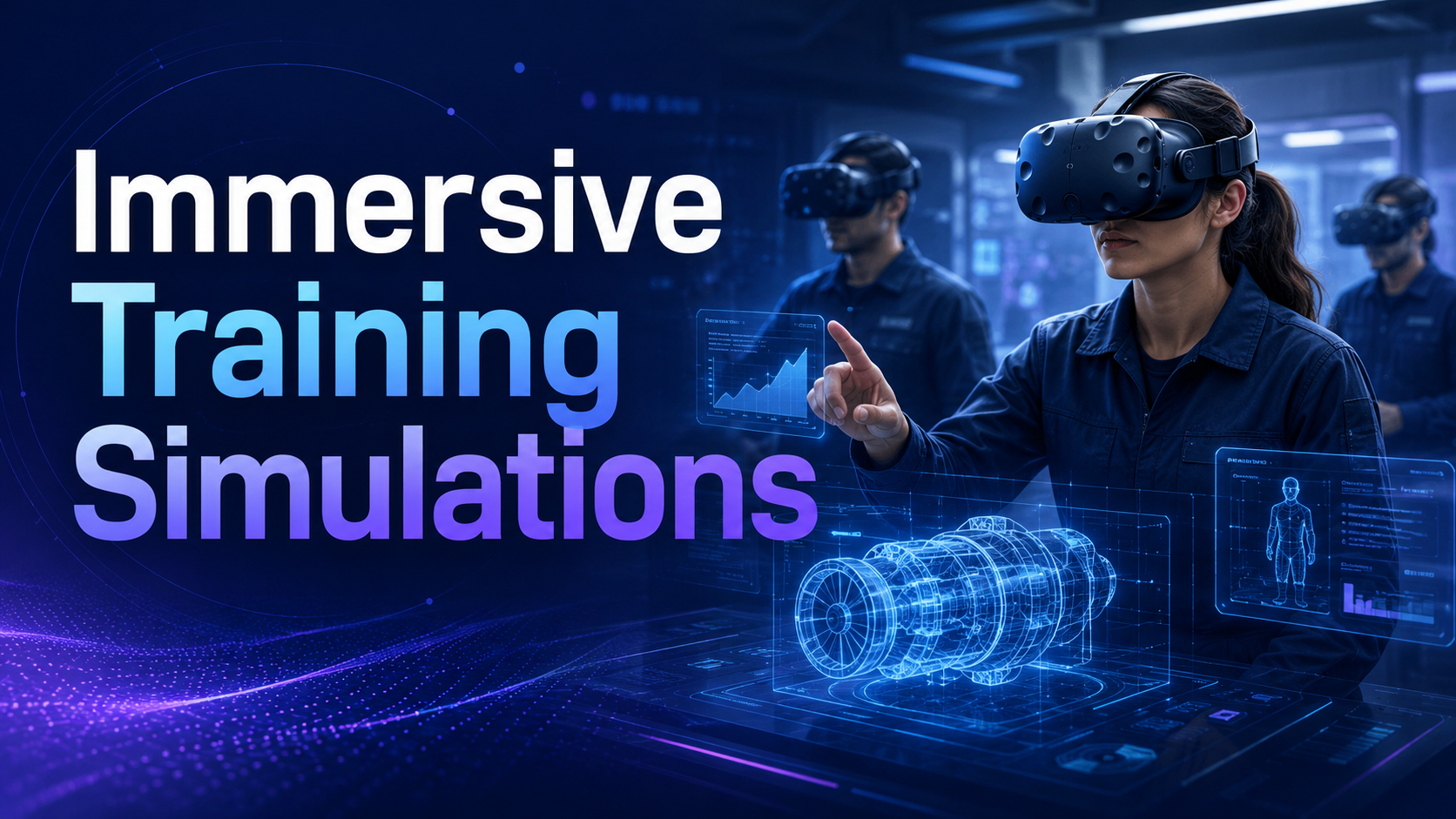
Traditional corporate training relies on passive consumption – employees watch videos, click through slides, or listen to lectures. Immersive training simulations flip this model by placing learners inside realistic scenarios where they practice skills, make decisions, and experience consequences in safe virtual environments. This fundamental shift from passive observation to active participation represents the most significant advancement in corporate learning methodology in decades.
Why Immersive Training Simulations Outperform Traditional Learning Methods
The gap between knowing and doing has plagued corporate training for generations. Employees can ace a multiple-choice quiz about safety procedures yet freeze when facing real hazards. They memorize customer service scripts but stumble through actual difficult conversations. Immersive training simulations close this gap by creating experiential learning environments where knowledge transforms into muscle memory and decision-making becomes instinct.
The Science Behind Immersive Learning: Active vs Passive Retention
Edgar Dale’s Cone of Experience, first published in 1946, predicted what neuroscience now confirms: humans retain 90% of what they practice doing versus only 10% of what they read. Virtual reality immersive training amplifies this effect by engaging multiple brain regions simultaneously. When learners physically move through a virtual warehouse conducting safety inspections, their motor cortex, visual processing centers, and spatial reasoning areas activate together, creating stronger neural pathways than any PowerPoint could achieve.
Recent fMRI studies from Stanford’s Virtual Human Interaction Lab demonstrate that immersive simulation training triggers the same neurological responses as real-world experiences. The amygdala fires during high-stress VR scenarios, cementing emotional memory. The hippocampus maps virtual spaces as if they were physical locations. This neurological engagement explains why employees who complete immersive training simulations demonstrate skill retention rates of 75% after one year, compared to 5% retention from traditional lecture-based training.
Fortune 500 companies have documented these differences at scale. Verizon reported that employees trained in VR completed modules 4x faster while scoring 10-15% higher on assessments. PwC’s VR soft skills training study found that VR-trained employees were 275% more confident applying skills post-training compared to classroom learners. These aren’t marginal improvements – they represent fundamental changes in learning efficacy.
Real-World Impact: Companies Seeing 4x Faster Training Times
Walmart’s deployment of immersive learning simulations across 4,700 stores demonstrates enterprise-scale impact. Their VR training program, covering everything from Black Friday crowd management to active shooter response, has trained over 1.5 million associates. Training time for their pickup tower operation decreased from 8 hours to 15 minutes using VR, while improving accuracy rates by 10-15%.
UPS transformed driver safety training through immersive simulations that place trainees in a virtual delivery truck navigating hazardous conditions. Trainees identify road hazards, practice defensive driving techniques, and experience consequences of unsafe decisions without risking actual vehicles or lives. The result: 50% reduction in training time and measurable decreases in first-year driver incidents.
Healthcare organizations report even more dramatic results. Osso VR’s surgical training platform demonstrates that surgeons trained in VR complete procedures 230% faster with 6x fewer errors compared to traditional training methods. Johnson & Johnson Institute reduced orthopedic surgery training time from months to weeks while maintaining skill proficiency standards.
Cost-per-trainee calculations reveal the economic advantage. Traditional safety training requiring physical props, dedicated facilities, and instructor travel averages $1,500-3,000 per employee. Equivalent VR immersive training costs $150-300 per employee after initial setup, with the ability to repeat training unlimited times without additional expense.
5 Categories of Immersive Training Simulations Transforming Corporate Learning
Not all training benefits equally from immersive simulation. Certain skill categories see dramatic improvements when employees can practice in realistic virtual environments. Understanding these categories helps L&D teams identify high-impact opportunities within their organizations.
High-Risk Safety Training Without Real-World Consequences
Construction workers can fall from virtual scaffolding, experience near-miss incidents with heavy machinery, and identify OSHA violations without physical danger. Immersive training simulations place workers on active job sites where they spot hazards like unsecured loads, missing guardrails, and improper ladder placement. Each identified hazard reinforces safety protocols through experience rather than memorization.
Chemical plant operators practice spill response procedures in virtual facilities where mistakes don’t create environmental disasters. They navigate toxic vapor clouds, operate emergency shutdown systems, and coordinate evacuation procedures. The simulation tracks response time, proper PPE selection, and containment effectiveness – metrics impossible to measure safely in real-world drills.
Mining companies use VR to train equipment operators before they touch multi-million dollar machinery. Operators learn blind spot awareness, load balancing, and emergency procedures in photorealistic mine environments. One mining company reported 43% reduction in equipment damage incidents after implementing VR operator training.
Emergency evacuation simulations prepare employees for scenarios they hope never to face. Virtual fires spread realistically based on response decisions. Smoke obscures vision. Exit routes become blocked. Employees learn to navigate by touch, assist colleagues with disabilities, and make split-second decisions that could save lives.
Soft Skills Practice in Emotionally Charged Scenarios
Customer service representatives practice de-escalation techniques with AI-driven virtual customers who respond to tone, body language, and word choice. Unlike role-play with colleagues, virtual customers maintain emotional authenticity – they don’t break character or pull punches. Representatives handle racist remarks, threats of violence, and personal attacks in safe environments where mistakes become learning opportunities.
Diversity, equity, and inclusion training moves beyond awareness to experience. Employees inhabit avatars of different races, genders, and abilities, experiencing workplace scenarios from new perspectives. A white male engineer experiences a meeting where his ideas are ignored until repeated by someone else. A non-disabled employee navigates an office in a wheelchair. These perspective-taking experiences create empathy that lectures cannot achieve.
Leadership crisis simulations test decision-making under pressure. Managers face virtual employees announcing pregnancies before layoffs, whistleblowers reporting safety violations, and teams in conflict. The simulation branches based on responses, showing immediate and long-term consequences of leadership choices. One pharmaceutical company credits VR leadership training with 23% improvement in employee satisfaction scores under new managers.
Performance review conversations rank among the most avoided managerial tasks. Immersive simulations let managers practice delivering difficult feedback to virtual employees who cry, argue, or shut down. Managers learn to maintain composure, stick to facts, and guide conversations toward improvement plans. Post-training surveys show 82% of managers feel more confident conducting real performance reviews.
Technical Procedure Training with Haptic Feedback
Medical device companies use haptic-enabled VR to train technicians on equipment maintenance without shipping expensive machines to training facilities. Trainees feel resistance when turning screws, vibration from properly calibrated components, and clicks from successful connections. This tactile feedback creates muscle memory that transfers directly to real equipment.
Manufacturing assembly procedures that traditionally required weeks of supervised practice now happen in virtual factories. Workers learn complex assembly sequences, quality checkpoints, and error recovery procedures. BMW reduced assembly training time by 75% using VR while maintaining quality standards. Trainees practice until movements become automatic, then transfer seamlessly to production lines.
Equipment maintenance training eliminates costly downtime. Technicians disassemble virtual turbines, diagnose electrical faults, and replace components in immersive simulations. They learn to identify wear patterns, unusual sounds, and performance degradation indicators. One energy company reduced mean time to repair by 35% after implementing VR maintenance training.
Quality control inspectors develop pattern recognition through repetitive practice impossible with physical products. They examine hundreds of virtual products with subtle defects – hairline cracks, color variations, dimensional tolerances. The simulation tracks eye movement, inspection time, and accuracy, providing objective performance metrics that identify inspection blind spots.
Spatial and Environmental Familiarization
Retail chains train store associates on layouts before locations open. Employees navigate virtual stores, learning product locations, emergency exits, and customer flow patterns. They practice stocking procedures, conduct inventory counts, and respond to customer requests. Target reduced new store opening delays by training staff in VR replicas weeks before physical stores were complete.
Offshore oil rig workers complete platform orientation before helicopter deployment. They learn evacuation routes, muster points, and equipment locations in exact virtual replicas of their assigned platforms. This pre-deployment training reduces orientation time from days to hours, saving thousands in offshore personnel costs.
Data center technicians navigate virtual facilities matching their assigned locations down to individual server serial numbers. They practice cable routing, hot-swap procedures, and emergency power transfers. Microsoft reports 40% reduction in new technician error rates after implementing VR data center training.
Hospital staff familiarize themselves with facility layouts during orientation rather than wandering halls during emergencies. They learn fastest routes between departments, location of crash carts, and evacuation procedures for different wings. Virtual hospital tours reduced new nurse orientation time by two full days at Cleveland Clinic.
Decision-Making Under Pressure
First responder triage training creates mass casualty scenarios impossible to simulate physically. Paramedics assess dozens of virtual patients simultaneously, making life-or-death prioritization decisions. Patient conditions deteriorate based on treatment delays. Resources deplete. Additional casualties arrive. The simulation measures decision speed, accuracy, and adherence to triage protocols under escalating pressure.
Cybersecurity teams practice incident response in virtual security operations centers. They detect breaches, coordinate containment, and communicate with stakeholders while attacks escalate. The simulation introduces cascading failures, insider threats, and media pressure. Teams learn to maintain systematic response procedures when every instinct screams for immediate action.
Supply chain managers navigate disruption scenarios in virtual command centers. Ports close, suppliers fail, demand spikes. They reroute shipments, negotiate with alternates, and communicate with customers. Each decision ripples through the virtual supply network, teaching systems thinking that spreadsheet exercises cannot convey.
Financial traders experience market volatility in virtual trading floors. They execute trades while news breaks, prices swing, and colleagues shout. The simulation recreates the sensory overload of real trading floors – multiple screens, competing information, time pressure. Traders develop the emotional regulation and rapid pattern recognition that separate profitable traders from washouts.
Building Your First Immersive Training Pilot: The Rental Advantage
Most L&D teams assume immersive training requires massive hardware investments and technical expertise. The rental model changes this equation. You can launch a pilot program in weeks, not months, with full setup support and beginner-friendly content. This approach eliminates the primary barriers that prevent organizations from exploring immersive learning simulations.
Pilot Program Structure: 30-60-90 Day Phases
Phase 1 (Days 1-30): Begin with a focused pilot involving 5-10 headsets for a single team or department. Select a high-impact use case where success metrics are clear – safety incident reduction, procedure completion time, or customer satisfaction scores. Rental packages for this phase typically cost $500-1,000 per headset per month, including content licenses and support.
During this phase, establish baseline metrics before training begins. Document current training time, error rates, and competency assessment scores. Train facilitators on equipment setup and troubleshooting. Run daily sessions with small groups, gathering immediate feedback on comfort, engagement, and perceived value. Technical issues surface quickly at this scale, allowing rapid resolution before expansion.
Phase 2 (Days 31-60): Expand to a second use case with the same equipment, demonstrating versatility and building cross-functional support. If Phase 1 focused on safety training, Phase 2 might address soft skills or technical procedures. This expansion costs nothing extra in hardware, only additional content licensing at $50-100 per module.
Compare results between departments, identifying which use cases generate highest ROI. Document setup time reductions as facilitators gain experience. Track voluntary re-engagement – employees asking to repeat simulations indicate genuine value. Gather testimonials from early adopters who become internal champions.
Phase 3 (Days 61-90): Make the scale decision based on accumulated data. Calculate total cost of ownership for purchase versus continued rental. Most organizations find that 20+ regular users justify purchase, while smaller deployments benefit from rental flexibility. Present findings to leadership with clear recommendations for enterprise deployment or program termination.
Budget allocation shifts through phases. Initial rental costs seem high compared to purchase prices, but include support, replacement, and upgrade options that reduce total risk. Organizations typically allocate $10,000-25,000 for 90-day pilots, generating enough data to justify $100,000+ enterprise deployments.
Hardware Requirements Without the Hardware Investment
Standalone headsets like Meta Quest 3 or Pico 4 Enterprise eliminate the need for gaming PCs, reducing setup complexity and cost. These devices deliver sufficient performance for 95% of training scenarios while remaining portable enough for conference room deployment. Rental packages include pre-configured devices with training content pre-installed, eliminating IT involvement.
Room-scale simulations require 6×6 feet minimum clear space per user, though seated experiences work in standard cubicles. Mark boundaries with tape during pilots to establish space requirements for permanent installations. Multi-user sessions need 10×10 feet per participant to prevent collisions during movement-heavy simulations.
Hygiene protocols for shared equipment include disposable face covers, UV sanitization between sessions, and personal foam replacements for frequent users. Rental providers typically include hygiene supplies and replacement parts, eliminating procurement complexity. Establish equipment check-out procedures similar to laptop management, assigning devices to individuals for multi-day training programs.
Network requirements remain minimal for standalone headsets running local content. Cloud-based simulations need 25 Mbps per headset for smooth performance. Most corporate WiFi handles 5-10 simultaneous headsets without issue. Rental providers include mobile hotspots for locations with limited connectivity.
Content Selection: Off-the-Shelf vs Custom Development
Over 50 ready-to-deploy training modules exist across safety, soft skills, and technical categories. Generic safety training covers ladder usage, fire extinguisher operation, and hazard identification applicable across industries. Soft skills modules address universal needs like public speaking, conflict resolution, and time management. These off-the-shelf options cost $500-2,000 per title for unlimited users, delivering immediate value during pilots.
Customization within existing simulations bridges the gap between generic and custom content. Add company logos to virtual environments, modify scenarios to match specific procedures, or adjust difficulty levels for different experience levels. These modifications typically cost $5,000-15,000 and complete within 2-4 weeks.
Custom development makes sense when training addresses unique equipment, proprietary processes, or competitive advantages. ROI threshold for custom development typically requires 100+ trainees or high-value outcomes like reduced equipment damage. Custom simulations cost $50,000-250,000 but become competitive advantages that generic content cannot provide.
Content licensing models for rental programs include per-seat monthly subscriptions ($50-100), per-module purchases ($500-2,000), or enterprise unlimited licenses ($10,000-50,000 annually). Start with monthly subscriptions during pilots, transitioning to enterprise licenses after proving value. Some providers offer “content buffets” where organizations access entire libraries for flat monthly fees.
Measuring Immersive Training ROI: Metrics That Matter to Leadership
L&D teams need concrete metrics to justify immersive training investments. Beyond engagement scores, immersive simulations generate measurable business outcomes that resonate with C-suite priorities. This framework helps you track, report, and optimize your program’s impact using language leadership understands.
Pre and Post Assessment Design for Skill Transfer
Baseline performance measurement must move beyond knowledge tests to skill demonstration. Before VR training, record employees performing actual tasks – conducting safety inspections, handling customer complaints, or operating equipment. Time their performance, document errors, and assess quality. These recordings become powerful before-and-after comparisons that prove skill transfer.
Design assessments that mirror real-world challenges rather than testing memorization. Instead of asking “What are the five steps of customer de-escalation?”, place employees in escalating scenarios and measure their response effectiveness. Track metrics like time to resolution, number of escalation triggers avoided, and customer satisfaction scores from standardized scenarios.
Time-to-competency tracking reveals training efficiency gains. Document how long employees take to reach defined proficiency levels – performing procedures without supervision, handling standard customer issues independently, or passing certification requirements. VR-trained employees typically achieve competency 40-60% faster than traditionally trained peers.
Error rate reduction in real-world application provides the ultimate validation. Track safety incidents, customer complaints, production defects, or procedure violations for VR-trained employees versus control groups. These real-world metrics carry more weight with leadership than any training assessment.
Cost-Per-Outcome Calculations
Training time reduction multiplied by hourly wages generates immediate ROI. If VR reduces training from 40 hours to 10 hours for employees earning $25/hour, each trainee saves $750 in wage costs alone. Multiply by hundreds of annual trainees, and savings reach six figures quickly. Include trainer wages for even more dramatic calculations.
Travel and facility cost elimination adds substantial value for distributed organizations. One hotel chain spent $2,000 per employee flying staff to regional training centers. VR eliminated these costs while allowing more frequent training. Calculate flight costs, hotels, meals, and lost productivity from travel time. Even local training incurs facility rental, equipment transportation, and instructor travel costs that VR eliminates.
Incident reduction value in safety training requires careful calculation but generates huge returns. OSHA reports average workplace injury costs of $42,000 for lost time incidents. If VR training prevents just two incidents annually, it pays for entire program deployment. Include workers compensation premium reductions, OSHA fine avoidance, and litigation prevention for complete pictures.
Customer satisfaction improvements from soft skills training translate directly to revenue. Calculate the lifetime value difference between satisfied and dissatisfied customers. If VR-trained service representatives improve satisfaction scores by 10%, and each point of satisfaction equals $100,000 in retained revenue, ROI becomes obvious. Include reduced complaint handling costs and positive review values.
Engagement and Completion Rate Improvements
Immersive training simulations achieve 95% completion rates compared to 25% for traditional e-learning. This 4x improvement means more employees actually receive training rather than clicking through to completion certificates. Calculate the value of 70% more employees being properly trained on safety procedures or customer service standards.
Voluntary re-engagement metrics indicate genuine learning value. Track how many employees request additional VR training sessions, practice scenarios multiple times, or recommend training to colleagues. When 60% of employees voluntarily repeat VR simulations versus 5% reviewing traditional materials, the engagement difference becomes undeniable.
Peer recommendation scores through Net Promoter Score (NPS) surveys quantify training satisfaction. VR training typically scores 70+ NPS compared to 20-30 for traditional methods. High NPS correlates with knowledge retention, skill application, and positive word-of-mouth that builds program momentum.
Training satisfaction compared to previous methods should be tracked longitudinally. Survey the same employees about VR training versus their previous training experiences. When 85% prefer VR to classroom training and 92% prefer it to e-learning, adoption resistance disappears. Include qualitative feedback about why employees prefer immersive simulations – the answers provide powerful testimonials for leadership presentations.
Implementation Roadmap: From Pilot to Enterprise-Wide Adoption
Successful immersive training programs follow a predictable path from experimental pilot to standardized practice. This roadmap, based on implementations at Fortune 500 companies, provides the timeline, milestones, and decision points for scaling your program.
Months 1-3: Proof of Concept Phase
Begin with stakeholder alignment meetings that establish success criteria before ordering equipment. Define specific metrics – 30% reduction in training time, 25% improvement in assessment scores, or 90% satisfaction ratings. Document current state baselines for these metrics. Secure budget approval for pilot phase with clear understanding that enterprise investment depends on achieving defined success criteria.
Vendor evaluation should compare 3-5 providers across hardware quality, content library depth, support responsiveness, and total cost. Request 2-week trial periods to test actual training scenarios with target learners. Evaluate setup complexity, learner comfort, and facilitator requirements. Select rental packages that include hardware, content, and support for true proof of concept.
Initial cohort selection determines pilot success. Choose enthusiastic early adopters who provide constructive feedback rather than skeptics who seek failure points. Include mix of technical comfort levels to understand broader deployment challenges. Run daily debriefs during first week to rapidly iterate on facilitation approach, session duration, and group sizes.
Success criteria measurement begins immediately. Track every metric defined during stakeholder alignment. Create weekly dashboards showing progress toward goals. Document unexpected benefits like reduced training space requirements or improved trainer satisfaction. Gather video testimonials from participants while enthusiasm remains high.
Months 4-6: Controlled Expansion
Second use case deployment demonstrates program versatility and builds broader organizational support. If initial pilot focused on individual skills, expand to team-based scenarios. If safety training succeeded, add customer service modules. This expansion leverages existing hardware investment while proving immersive training works across disciplines.
Cross-department learning exchanges accelerate adoption. Host “lunch and learn” sessions where pilot participants demonstrate VR training to curious colleagues. Create internal case studies showing before-and-after performance metrics. Facilitate discussions between departments about potential use cases. These peer-to-peer exchanges generate more buy-in than top-down mandates.
Technology infrastructure assessment prepares for scale. Document WiFi capacity, storage requirements, and device management needs for enterprise deployment. Identify integration points with existing learning management systems. Evaluate space requirements for dedicated VR training rooms versus mobile cart solutions. Calculate power and charging infrastructure needs for large headset fleets.
Budget modeling for scaled deployment requires detailed analysis. Compare three-year total cost of ownership for purchase versus rental. Include hardware refresh cycles, content licensing, support contracts, and facilitation costs. Model different deployment speeds – aggressive rollout versus gradual expansion. Present multiple scenarios to leadership with recommended approach based on pilot results.
Months 7-12: Standardization and Scale
Purchase versus rental decision framework depends on usage patterns discovered during pilot. Organizations training 20+ employees monthly should purchase hardware for lower per-use costs. Those with seasonal or sporadic training needs benefit from rental flexibility. Hybrid models work well – purchase core fleet for regular use, rent additional units for peak periods.
Content library development priorities emerge from pilot feedback. Identify top 10 training scenarios for custom development. Evaluate build-versus-buy for each scenario based on uniqueness and competitive advantage. Establish content review committees including subject matter experts, instructional designers, and end users. Create development roadmaps aligning content creation with business priorities.
Train-the-trainer programs ensure consistent facilitation quality as programs scale. Develop certification requirements for VR training facilitators. Create troubleshooting guides for common technical issues. Establish best practices for session management, learner support, and equipment maintenance. Build internal expertise rather than relying on external facilitators.
LMS integration enables seamless training administration. Configure automated enrollment based on role or tenure. Track completion and assessment scores alongside traditional training metrics. Generate compliance reports including VR training records. Create learning paths combining VR simulations with traditional materials for blended learning approaches.
Frequently Asked Questions
How much space do immersive training simulations require?
Minimum space requirements vary by training type. Seated experiences work in standard cubicles or conference room chairs. Standing simulations need 3×3 feet clear space. Room-scale training requiring physical movement needs 6×6 feet minimum, ideally 10×10 feet for comfortable movement. Mark boundaries with tape or foam mats. Consider dedicated VR training rooms for frequent use, or mobile carts for flexible deployment.
Can multiple employees train simultaneously in VR simulations?
Yes, multi-user simulations enable team training scenarios. Up to 20 learners can share virtual environments using networked headsets. Participants see each other as avatars, communicate via spatial audio, and collaborate on tasks. Team-based scenarios include emergency response coordination, surgical team procedures, and customer service role-play. Each participant needs their own headset and defined physical space to prevent collisions.
What’s the typical cost difference between VR training and traditional methods?
Initial VR setup costs $2,000-5,000 per headset including hardware and base content. However, per-training-session costs drop dramatically with scale. Traditional safety training costs $1,500-3,000 per employee including facilities, instructors, and materials. Equivalent VR training costs $150-300 per employee after setup. Break-even typically occurs at 20-30 trainees. Long-term savings reach 70-80% through eliminated travel, reduced training time, and infinite repeatability.
How do you handle motion sickness concerns in immersive training?
Motion sickness affects 15-20% of first-time VR users but decreases with exposure. Start with seated experiences, gradually introducing standing and movement. Limit initial sessions to 15-20 minutes. Ensure proper headset fit and interpupillary distance adjustment. Use comfort modes like teleportation instead of smooth locomotion. Provide ginger candy or seasickness bands for sensitive users. Most users develop “VR legs” within 3-4 sessions.
Which industries see the highest ROI from immersive training simulations?
Healthcare generates highest absolute ROI through reduced medical errors and accelerated procedure training. Manufacturing sees 50-70% reduction in training time for assembly procedures. Energy and utilities prevent high-cost safety incidents through hazard recognition training. Retail achieves 30% faster employee onboarding for seasonal workers. Financial services improves compliance training completion rates from 60% to 95%. Construction reduces workplace injuries by 40% through VR safety training.
How long does it take to deploy an immersive training pilot program?
Basic pilots launch within 2-3 weeks using rental hardware and off-the-shelf content. Week 1: stakeholder alignment and vendor selection. Week 2: equipment delivery and facilitator training. Week 3: first trainee cohorts and initial feedback. Custom content development adds 4-8 weeks. Enterprise deployments require 3-6 months for infrastructure preparation, content development, and train-the-trainer programs. Phased rollouts allow value delivery while building toward full scale.
Can immersive simulations integrate with existing learning management systems?
Modern VR training platforms offer LMS integration through SCORM, xAPI, or direct API connections. Integration enables automated enrollment, progress tracking, and completion recording. Assessment scores flow directly into learning records. Compliance reports include VR training alongside traditional methods. Popular LMS platforms like Cornerstone, SAP SuccessFactors, and Workday offer pre-built VR platform connectors. Custom integration typically requires 2-4 weeks of configuration.
Conclusion: The Active Learning Revolution Is Here
The shift from passive to active learning through immersive training simulations represents more than technological advancement – it’s a fundamental reimagining of how humans acquire and retain skills. Organizations implementing VR immersive training report transformational results: 4x faster training, 275% confidence improvements, and 90% retention rates that traditional methods cannot match.
The evidence is overwhelming. Walmart trained 1.5 million employees. UPS reduced driver incidents. Surgeons operate with 6x fewer errors. These aren’t experimental programs – they’re proven deployments generating measurable business value. The question isn’t whether immersive simulation training works, but how quickly your organization will adopt it.
The rental model eliminates traditional barriers. You can launch a pilot within weeks, test multiple use cases, and generate ROI data without major capital investment. Start with high-impact scenarios where success metrics are clear. Build from single-team pilots to enterprise deployment based on proven results, not vendor promises.
Your competitors are already moving. While you debate the merits of VR training, they’re deploying immersive learning simulations that accelerate onboarding, reduce incidents, and improve customer satisfaction. Every month of delay means employees trained less effectively, safety incidents that could be prevented, and competitive advantages lost.
Take action today. Request rental quotes for a 30-day pilot. Identify your highest-impact training challenge. Define success metrics. Build stakeholder support with this article’s data. The transformation from passive to active learning starts with a single decision to try something different. Your employees deserve training that engages, challenges, and prepares them for real-world success. Immersive training simulations deliver exactly that.