What VR Brand Experiences Are and Why Businesses Use Them
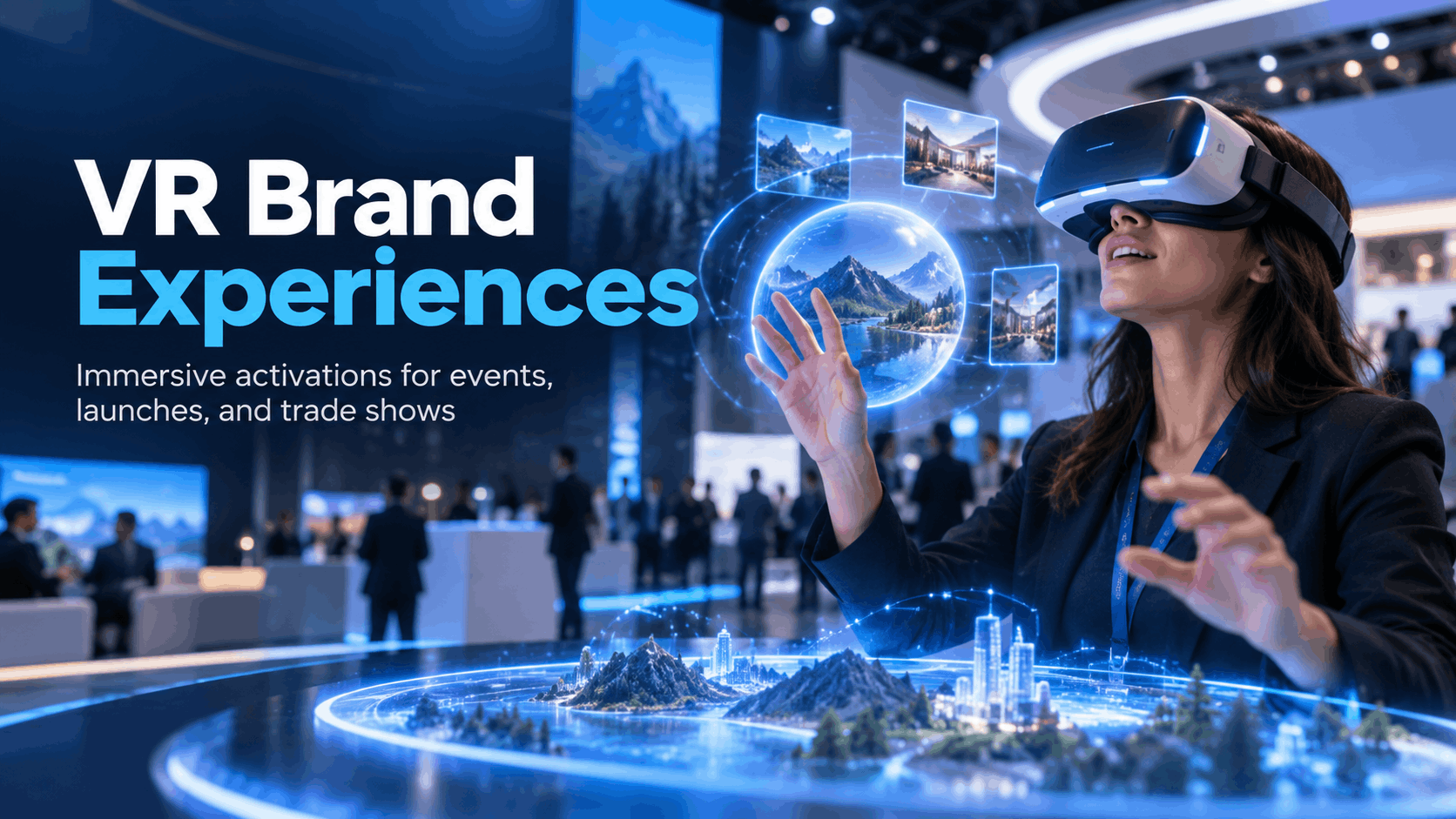
A VR brand experience is a structured, immersive interaction in which attendees use a virtual reality headset to engage with a brand’s message, product, or story. Unlike passive marketing formats, VR places the participant inside the experience. They are not watching a product video or reading a brochure. They are standing inside a product environment, walking through a simulated workflow, or witnessing a brand story unfold around them.
Companies use VR brand experiences because they solve a specific problem: how do you make a brand message stick in an environment full of competing messages? Events, trade shows, product launches, and corporate marketing programs all face the same challenge. Attention is scarce, and standard activations rarely produce the kind of emotional engagement that drives recall, lead quality, or downstream sales conversations.
VR addresses that problem directly. When a buyer spends four minutes inside a virtual product environment, they leave with a clearer understanding of what the product does and a stronger emotional connection to the brand than they would from a brochure, a video loop, or a brief conversation with a sales rep.
The business case is not about novelty. It is about outcomes: longer dwell time, higher lead quality, stronger recall, and more productive post-event conversations.
How VR Brand Experiences Differ from Standard Event Entertainment
Not all immersive technology at events is a brand experience. There is a meaningful difference between deploying VR as entertainment to draw a crowd and deploying it as a structured activation designed to move a buyer forward.
A well-designed VR brand experience is built around a specific business objective. The content is intentional. The narrative follows the product story. The interaction is designed to surface the features, benefits, or emotional associations that matter most to the target audience.
Standard event entertainment, by contrast, is designed to attract and amuse. It may generate foot traffic, but it rarely produces qualified leads or measurable brand recall tied to a specific message.
VR is the right choice when:
- The product is complex, large, or difficult to demonstrate physically
- The brand story benefits from environmental immersion
- The goal is to generate qualified leads, not just impressions
- The activation needs to be repeatable across multiple markets or venues
VR is not the right choice when:
- The audience is small and a live demo would be more direct
- The budget does not support content development and hardware deployment
- The event format does not allow for the space or time required for a headset session
Knowing the difference saves budget and prevents activations that look impressive but do not connect to a measurable goal.
Where VR Fits in the Customer Journey
VR brand experiences are not limited to one stage of the funnel. The format adapts to different objectives depending on where the buyer is in their decision process.
Top-of-funnel awareness is the most common deployment context. At trade shows, conferences, and public activations, VR draws attention, creates shareable moments, and introduces the brand to audiences who may not have engaged otherwise. Short, visually compelling experiences work best here. The goal is awareness and recall, not a detailed product walkthrough.
Mid-funnel product education is where VR becomes a genuine sales tool. Guided immersive demos allow buyers to explore a product’s features, understand its application in their specific context, and ask better questions during follow-up conversations. This is particularly valuable for enterprise buyers who need to understand a product before they can justify a purchase decision internally.
Internal enablement is an underused application. Sales teams, new hires, and distributed workforces can use VR for onboarding, safety training, product familiarization, and scenario-based learning. The same hardware and deployment infrastructure that supports a trade show activation can support a recurring internal training program.
The Main Types of VR Brand Experiences
The term “VR brand experience” covers several distinct formats. Matching the format to the goal, venue, and audience size is the first practical decision any team needs to make.
Product Launches and Reveal Moments
Product launches benefit from VR because the format gives brands control over the reveal environment. Instead of hoping a product speaks for itself on a display table, VR places the audience inside the product story. The reveal happens on the brand’s terms, in a visual environment designed to communicate exactly what the product does and why it matters.
Multi-location launches are a strong use case. When a brand needs to activate simultaneously in multiple cities, VR content can be preloaded and deployed consistently across every venue. Every attendee in every market sees the same story, delivered at the same quality level. This kind of consistency is difficult to achieve with live demos or physical installations.
VR launch moments also generate media coverage. A well-executed immersive reveal is more likely to be photographed, shared, and written about than a standard product table or video presentation.
Trade Show and Conference Activations
Trade show floors are competitive environments. Every exhibitor is competing for the same attendee attention, and most booths look similar. VR is one of the most reliable ways to stop traffic because it is visually distinctive and it creates a visible queue, which signals to other attendees that something worth experiencing is happening.
The operational considerations for trade show VR are specific. Throughput matters. If each headset session runs five minutes and you have four headsets, you can accommodate roughly 48 attendees per hour under ideal conditions. Planning for headset turnover, battery swaps, hygiene between users, and queue management is essential before the event, not during it.
Lead capture integrates naturally with VR activations. The moment before or after a headset session is a high-engagement touchpoint. Attendees who have just completed an immersive experience are more receptive to a follow-up conversation, a lead form, or a product brochure than they would be if approached cold on the floor.
Sales Demos and Product Education
Some products cannot be brought to a sales meeting. Industrial equipment, large-scale infrastructure, complex software environments, and custom-configured products all present the same challenge: the buyer cannot see what they are buying until they have already committed to a significant portion of the sales process.
VR solves this by bringing the product to the buyer. A sales team can deploy a headset in a conference room and walk a prospect through a full product environment, including features, configurations, and real-world applications, without shipping a single piece of equipment.
Immersive demos also support the sales conversation in a specific way. When a buyer has experienced a product virtually, they ask more specific questions. They have a reference point. The conversation moves faster and stays closer to the buyer’s actual use case.
For enterprise sales cycles, where multiple stakeholders need to align before a purchase decision, VR demos can be deployed across different meetings and locations to give each stakeholder the same foundational understanding of the product.
Brand Activations and Experiential Marketing Campaigns
VR is a flexible format for broader experiential marketing campaigns. Pop-up activations, retail experiences, sponsorship activations, and campaign-specific installations can all use VR to create a branded interaction that is repeatable across markets.
The key advantage of VR for campaign activations is consistency. A physical installation has to be rebuilt at each location. A VR experience is preloaded on hardware and deployed wherever the campaign travels. The brand message, visual environment, and interaction design remain identical whether the activation is in Chicago, Dallas, or Los Angeles.
Branded interactions can be customized to specific audiences. A VR experience designed for a consumer audience at a retail pop-up will look and feel different from one designed for enterprise buyers at an industry conference. The hardware is the same. The content is tailored to the context.
What You Need to Deploy a VR Brand Experience Successfully
Planning a VR brand experience involves more than selecting content. The operational requirements determine whether the activation runs smoothly or creates problems on the day of the event. This section covers the main deployment considerations in practical terms.
Hardware Selection and Headset Format
Standalone wireless VR headsets are the standard choice for event and activation deployments. They do not require a connected PC or external sensors, which significantly reduces setup complexity, cable management, and the risk of technical failure during an event.
Rental packages are the practical choice for most event, launch, and campaign deployments. Buying VR hardware makes sense when the use case is recurring and internal, such as a sales training program that runs weekly. For a product launch, a trade show, or a multi-city campaign, renting preconfigured hardware eliminates the capital cost, the logistics of storing and maintaining equipment, and the technical overhead of keeping devices updated and ready.
Device count should be calculated based on expected attendance, session length, and the number of hours the activation will run. Battery life is a real operational constraint. Most standalone headsets run two to three hours per charge under active use. Planning for battery rotation or charging stations is essential for full-day events.
Hygiene between users is a practical requirement that is easy to overlook. Disposable face gaskets or cleaning protocols between sessions keep the experience comfortable for attendees and protect the equipment.
Content, Preloading, and Scenario Design
The content is what the attendee actually experiences. Preloading content onto headsets before the event eliminates the need for internet connectivity at the venue and ensures that every device delivers the same experience without buffering or loading delays.
Guided experiences work better than open-ended environments for most brand activations. When an attendee has a clear path through the experience, they engage with the content the brand wants them to see, rather than exploring freely and potentially missing the core message.
Industry-specific scenarios improve relevance. A VR experience designed for a healthcare audience should reflect healthcare environments, workflows, and terminology. A VR experience for a construction or manufacturing audience should reflect the physical environments and operational contexts that audience works in every day.
The choice between custom-built and ready-to-deploy experiences depends on budget, timeline, and specificity. Custom content is built around a specific product, brand, or narrative. Ready-to-deploy scenarios cover common use cases such as safety training, onboarding, and product category education. Both have a role depending on the activation goal.
Venue Logistics, Staffing, and Support
Delivery, setup, and teardown are logistical requirements that need to be planned in advance. Hardware needs to arrive at the venue with enough lead time for setup and testing before attendees arrive. Teardown needs to be coordinated with venue schedules and return shipping requirements.
On-site support reduces risk for teams that do not have VR expertise. Having a trained operator present during the activation means that technical issues are resolved quickly, headsets are managed efficiently between users, and attendees receive a consistent guided experience rather than a self-directed one that may not land the intended message.
Venue planning should account for power access, available floor space, and attendee flow. A VR activation in a high-traffic area needs a queue management approach that keeps the line organized without blocking neighboring exhibitors or creating a safety issue. A dedicated activation zone with clear entry and exit points makes the experience better for attendees and easier to staff.
Nationwide Deployment and Multi-Location Consistency
Brands that run distributed campaigns, national roadshows, or simultaneous multi-city launches need a deployment partner with the logistics infrastructure to deliver hardware and support across multiple locations on a coordinated timeline.
Consistency is the operational challenge. When the same activation runs in ten cities over six weeks, the experience in each city needs to match the brand standard. Content should be identical. Hardware should be configured the same way. Staffing should follow the same protocols.
National delivery capability also matters for launch timing. A product launch that misses its activation window because hardware arrived late or was not properly configured is a preventable failure. Working with a partner that has established shipping, configuration, and support processes reduces that risk.
How to Choose the Right VR Brand Experience for Your Goal
The right VR format depends on what you are trying to achieve. This section maps common business objectives to the activation formats most likely to produce results.
If Your Goal Is Awareness
Prioritize experiences that are visually compelling, short enough to accommodate high throughput, and designed to create a memorable moment rather than deliver detailed information.
At trade shows and public events, the experience should be immediately engaging from the moment the headset goes on. Attendees in awareness-focused activations are often first-time encounters with the brand. The goal is to create a strong first impression and a reason to remember the brand after the event.
Shareability matters here. Activations that produce visible reactions, that are worth photographing or posting about, extend the reach of the event beyond the attendees who were physically present.
If Your Goal Is Product Education
Choose guided demos with a clear narrative structure. The experience should walk the buyer through the product’s key features, show the product in a realistic use context, and surface the information that is most relevant to the buyer’s specific situation.
Immersive visuals are particularly effective for explaining complex products. Spatial relationships, scale, workflow sequences, and operational environments are all easier to communicate in VR than in a slide deck or a product video.
Keep the experience aligned to the sales conversation that will follow. The VR demo should set up the questions the sales rep wants to answer, not replace the conversation entirely.
If Your Goal Is Training or Internal Alignment
Scenario-based content is the standard format for training applications. The learner moves through a simulated environment and makes decisions or completes tasks that mirror real-world workflows.
VR training is particularly effective for safety-critical environments, onboarding programs that need to be delivered consistently across a distributed workforce, and team experiences that benefit from shared context. The same hardware used for a trade show activation can support a recurring internal training program with different preloaded content.
Measurable learning outcomes are achievable with VR training. Completion rates, scenario performance, and knowledge retention can all be tracked and reported, giving training managers data to support program investment.
How IGIVU Supports VR Brand Experiences
IGIVU provides the hardware, logistics, and implementation guidance that marketing teams, event planners, and corporate training programs need to execute VR brand experiences without building infrastructure from scratch.
Curated Rental Packages for Events and Activations
IGIVU’s rental packages are preconfigured for common event and activation formats. Hardware arrives ready to deploy, with content preloaded and devices tested before shipment. This reduces the planning burden on marketing and event teams who need a reliable solution without a long procurement or setup process.
Packaged solutions are particularly useful for teams executing on tight timelines. A trade show activation that needs to be operational in 48 hours does not have room for hardware troubleshooting or content loading delays. Preconfigured bundles eliminate those risks.
Rental packages scale to the size of the activation. A small product demo for a sales meeting requires a different configuration than a trade show booth running eight headsets across a two-day event. IGIVU’s packages are designed to match the scope of the deployment.
Implementation Guidance for Business Teams
IGIVU works with business teams during the planning phase to help translate activation goals into operational requirements. This includes hardware selection, content format recommendations, venue logistics planning, and staffing guidance.
The practical value of this guidance is that it prevents common deployment failures. Teams that plan VR activations without operational experience often underestimate device count, overlook battery management, or choose content formats that do not match the venue or audience. IGIVU’s implementation support addresses those gaps before they become problems on the day of the event.
The goal is execution, not creative speculation. IGIVU helps teams understand what is required to run a specific activation successfully, then provides the hardware and support to deliver it.
Use-Case-Specific Scenarios Across Marketing, Sales, and Training
IGIVU’s content library covers the main business use cases for VR: brand activations, product launches, trade show experiences, sales demos, and internal training programs. Preloaded industry-specific scenarios are available for teams that need a ready-to-deploy experience without custom content development.
For teams with specific content requirements, IGIVU supports custom scenario integration. A brand with an existing VR experience can deploy it on IGIVU hardware. A team developing new content can work with IGIVU to ensure the content is formatted and preloaded correctly for the target devices.
IGIVU’s offering also extends to augmented reality, giving teams the option to combine VR and AR formats within a single campaign or activation program.
Common Questions Before You Launch a VR Brand Experience
How Much Space Do You Need?
Space requirements depend on the VR format and the number of headsets in the activation. Standalone wireless headsets used for seated or standing stationary experiences require significantly less space than room-scale setups that involve physical movement.
A practical baseline for a seated VR station is approximately 6 by 6 feet per headset, including space for the attendee, a staff member, and a queue position. A four-headset activation in a trade show booth would require a dedicated zone of roughly 150 to 200 square feet, depending on the booth layout and queue configuration.
Wireless standalone devices simplify footprint planning because they eliminate cable management and the need for a connected PC at each station.
Should You Rent or Buy Equipment?
Renting is the right choice for most event, launch, and campaign deployments. The reasons are straightforward: events are time-limited, hardware needs change between activations, and the cost of purchasing, storing, maintaining, and updating a fleet of VR headsets is not justified for occasional use.
Buying makes more sense when the use case is recurring and internal. A company running weekly VR safety training for a fixed workforce will reach a point where ownership is more cost-effective than renting. A marketing team running three trade shows per year will not.
The practical test is frequency and consistency of use. If the activation runs more than 20 to 30 times per year in a controlled internal environment, ownership may be worth evaluating. For everything else, rental is the more efficient option.
How Do You Measure Success?
Measurement should be tied to the business goal of the activation, not to a generic set of VR metrics.
For awareness activations, relevant metrics include the number of headset sessions completed, average dwell time, social shares or media mentions generated, and post-event brand recall scores if survey data is collected.
For product education and sales demo activations, relevant metrics include demo completion rates, lead quality scores, the number of post-event sales conversations initiated, and the conversion rate from demo to qualified opportunity.
For training activations, relevant metrics include scenario completion rates, performance scores within the VR environment, and knowledge retention measured through post-training assessments.
Dwell time is a useful cross-category metric. An attendee who spends four minutes in a VR experience is more engaged than one who spends 30 seconds at a display. Tracking session length gives event teams a baseline for comparing activation performance across events.
Frequently Asked Questions
What is a VR brand experience?
A VR brand experience is a structured, immersive interaction in which a participant uses a virtual reality headset to engage with a brand’s message, product, or story. It is designed to produce a specific business outcome, such as awareness, product education, or lead generation, rather than to entertain passively.
How are VR brand experiences used at events and trade shows?
At events and trade shows, VR brand experiences are used to attract booth traffic, deliver product demos, generate qualified leads, and create memorable brand interactions. They are particularly effective on crowded trade show floors where standing out from competing exhibitors is a primary challenge.
What equipment is needed for a VR brand activation?
A typical VR brand activation requires standalone wireless VR headsets, preloaded content, charging equipment for battery management, hygiene supplies for between-user cleaning, and on-site staff to guide attendees through the experience. Rental packages from providers like IGIVU include preconfigured hardware ready for deployment.
Are VR brand experiences better for launches or product demos?
Both are strong use cases, and the format adapts to each. Product launches benefit from VR’s ability to create a controlled, immersive reveal moment that can be deployed consistently across multiple locations. Product demos benefit from VR’s ability to show complex, large, or hard-to-transport products in a realistic use context. The right choice depends on the specific goal of the activation.
Should a company rent or buy VR hardware for brand activations?
For most event, launch, and campaign activations, renting is more practical than buying. Rental eliminates capital cost, storage, maintenance, and the technical overhead of keeping devices updated. Buying makes more sense for recurring internal programs where the same hardware is used frequently in a controlled environment.
How does IGIVU support VR brand experiences nationwide?
IGIVU provides preconfigured VR rental packages, implementation guidance, and logistics support for events, activations, and training programs across the United States. Hardware is shipped ready to deploy, with content preloaded and devices tested before delivery. IGIVU also offers on-site support options for teams that need operational assistance during the activation.
Conclusion
VR brand experiences work because they solve a real problem: how to create a brand interaction that is memorable, measurable, and repeatable in environments where attention is the scarcest resource.
The format is not a novelty. It is a practical activation tool with clear applications across product launches, trade shows, sales demos, experiential marketing campaigns, and internal training programs. The business case is built on outcomes, not technology: longer dwell time, stronger recall, higher lead quality, and more productive sales conversations.
Executing a VR brand experience successfully requires the right hardware, the right content, and the operational infrastructure to deploy both reliably. That is where most teams run into friction, and where a partner with established rental packages, logistics capability, and implementation experience makes the difference between an activation that performs and one that creates problems on the day of the event.
Ready to plan your next VR brand experience? Contact IGIVU to discuss your activation goals, get a rental quote, or explore use-case-specific scenarios for your industry. Whether you are planning a single trade show deployment or a national multi-city campaign, IGIVU provides the hardware, content, and support to execute without building infrastructure from scratch.