Why the “Can VR Replace This?” Question Is the Right Starting Point
Most VR training evaluations start in the wrong place. A vendor demo, a pilot program, or a budget conversation kicks off before anyone has answered the foundational question: which specific training requirements in your current inventory are actually candidates for VR, and which ones have regulatory or physical constraints that make full replacement impossible?
Skipping that question creates predictable problems. Training managers either over-invest — deploying VR for programs that still require physical practice, then discovering the compliance gap during an audit or they dismiss VR entirely for programs where it would meaningfully reduce cost, improve retention, and scale across locations without adding instructor hours.
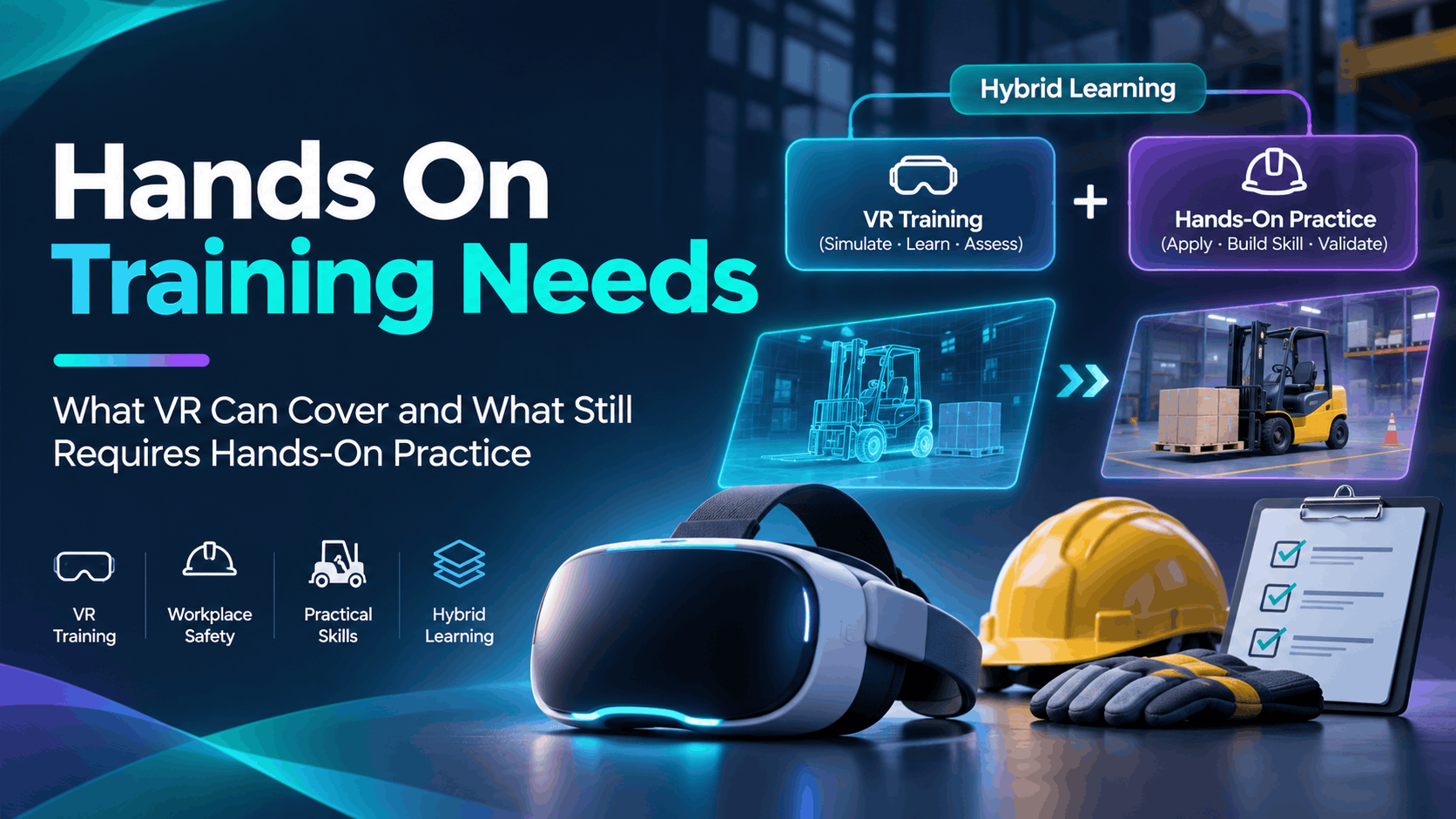
This guide is built around that foundational question. It works through the most common hands-on training categories, gives a direct verdict on what VR can and cannot cover in each, and closes with a practical framework for building a hybrid program that uses VR where it adds value and preserves physical practice where it is required.
No generic benefits section. If you are evaluating VR for hands-on training, you already know the general case for simulation-based learning. What you need is a decision framework specific to your training inventory.
The Three-Tier Framework: Full Coverage, Partial Coverage, and No Coverage
Before moving into specific training categories, it helps to define the three tiers clearly. Every program in your training inventory belongs in one of them.
Full VR coverage means the training objective can be met entirely in simulation without a required physical component under applicable standards. The learner completes the training, the competency is demonstrated in the VR environment, and no additional physical practice is needed to satisfy the regulatory, certification, or operational requirement. Facility orientation, hazard recognition, and procedural knowledge training often fall here.
Partial coverage means VR handles the cognitive, procedural, and decision-making components of the training — but a physical hands-on component is still required. That requirement may come from an explicit OSHA standard, a certification body’s assessment criteria, a manufacturer specification, or operational necessity. VR reduces the burden of the physical component (fewer supervised hours, better-prepared learners) but cannot eliminate it. Forklift operation, fall protection equipment fitting, and CPR certification fall here.
No coverage means the training objective is fundamentally physical and cannot be meaningfully simulated with current VR technology. Fine motor skill acquisition, equipment calibration requiring tactile feedback, and physical rescue techniques where the mechanics of body positioning and force application are the training objective — these do not belong in a VR program, at least not as the primary delivery method.
Most enterprise training inventories contain all three tiers. The planning task is sorting them correctly before scoping a VR program. Getting the sort wrong in either direction is expensive.
Safety and OSHA-Regulated Training: Where the Lines Are Drawn
OSHA-regulated training is the category where the hands-on question is most consequential. Assuming VR satisfies a standard that requires physical demonstration creates compliance exposure that is difficult to defend in an inspection or post-incident investigation. The good news is that OSHA standards are specific enough to give reasonably clear guidance on what VR can and cannot cover for most common safety training types.
Fall Protection Training: What VR Covers and What It Does Not
Applicable standard: OSHA 1926.503 (construction) and 1910.28–1910.30 (general industry)
OSHA 1926.503 requires that workers be trained to recognize fall hazards and understand the use of fall protection systems. The cognitive and recognition components of that requirement — identifying unprotected edges, understanding fall clearance calculations, recognizing improper anchor point selection, and making decisions about which system to use in a given scenario — are well within VR’s capability. VR allows workers to encounter dozens of fall hazard configurations in a single session, building pattern recognition that a brief classroom or toolbox talk cannot replicate.
What VR cannot cover: the physical fitting and inspection of harnesses, lanyards, and anchor points. A worker who has never physically donned a harness, adjusted the leg straps, connected a self-retracting lanyard, and inspected the hardware for wear and damage has not completed the hands-on component of fall protection training — regardless of how many VR scenarios they completed. Physical fitting also requires a trained observer to verify correct fit, which is an inherently in-person activity.
Verdict: Partial coverage.
Hybrid model: VR for hazard identification, scenario walkthroughs, rescue decision-making, and pre-task planning; physical session for equipment fitting, inspection sign-off, and anchor point selection on actual structures.
Forklift Operator Training: The OSHA Evaluation Requirement
Applicable standard: OSHA 1910.178(l)
This is one of the most commonly misunderstood VR training questions. OSHA 1910.178(l) is explicit: powered industrial truck operators must receive training that includes a practical evaluation — the operator must be observed operating the forklift. There is no regulatory pathway to satisfy that requirement in a VR headset. A VR forklift simulation, regardless of fidelity, does not constitute a practical evaluation under the standard.
What VR is highly effective for: everything that happens before the operator gets on the machine. Controls familiarization, load handling principles, load capacity and stability concepts, pedestrian awareness protocols, pre-operation inspection procedures, and hazard recognition in warehouse environments are all trainable in VR. Operators who complete structured VR pre-training typically require fewer supervised hours on the actual equipment to reach evaluation-ready proficiency — which reduces instructor time, fuel costs, and equipment wear during training.
The practical implication: VR does not replace the physical evaluation, but it makes the physical evaluation more efficient and the operator safer during supervised practice.
Verdict: Partial coverage — VR as preparation, physical evaluation still required.
Fire Extinguisher Training: The Discharge Requirement
Applicable standard: OSHA 1910.157(g); NFPA 10
OSHA 1910.157(g) requires that employees expected to use portable fire extinguishers be trained in their use. NFPA 10 and many commercial insurance carriers go further, expecting at least periodic live discharge practice to demonstrate that employees can actually operate a pressurized extinguisher under realistic conditions.
VR covers the cognitive and procedural components of fire extinguisher training effectively: the PASS technique (Pull, Aim, Squeeze, Sweep), extinguisher type selection by fire class, and the decision of when to fight a fire versus evacuate. These are trainable in VR with high fidelity, and VR allows workers to practice the decision-making component — which is often undertrained — in realistic scenarios.
What VR cannot replicate: the physical experience of operating a pressurized extinguisher. The weight of the unit, the recoil when the agent discharges, the noise, the visual feedback of agent hitting a real flame, and the physical management of the discharge arc are all elements that contribute to competent real-world performance. An employee who has only ever practiced PASS in VR may hesitate or fumble when encountering a real extinguisher under stress.
Verdict: Partial coverage.
Hybrid model: annual VR refresher for PASS technique, extinguisher selection, and fire class identification; live discharge practice every two to three years or per insurer requirement. This model reduces the cost and logistics of live discharge events while maintaining the physical competency component.
Lockout/Tagout, Confined Space Entry, and Other Permit-Required Procedures
Applicable standards: OSHA 1910.147 (LOTO); OSHA 1910.146 (confined space)
Both LOTO and confined space entry require authorized employees to demonstrate proficiency with specific equipment and procedures — and both involve site-specific elements that make generic training inherently incomplete.
VR is strong for the procedural and decision-making components: energy control sequence training, hazard identification in confined space environments, atmospheric hazard recognition, emergency response decision-making, and the consequences of procedure deviation. These are scenarios where VR’s ability to show the outcome of a wrong decision — without anyone getting hurt — is a genuine training advantage.
The limitation is site-specificity. LOTO procedures are written for specific pieces of equipment at specific facilities. An authorized employee must demonstrate proficiency with the actual locks, tags, hasps, and isolation points on the specific equipment they are authorized to work on. A VR simulation of a generic LOTO procedure does not satisfy that requirement. Similarly, confined space entry training must account for the specific atmospheric hazards, entry configurations, and rescue capabilities at the actual facility.
Verdict: Partial coverage — VR for procedure knowledge, hazard identification, and scenario practice; physical demonstration on actual equipment and in actual spaces required for authorization.
Equipment Operation and Technical Skills: Where VR Adds the Most Value
For equipment operation and technical skills training, the hands-on question depends on whether the training objective is knowledge and decision-making or physical skill acquisition. VR is most effective when the objective is the former and most limited when fine motor skill development is the actual goal.
High-Stakes, Low-Frequency Scenarios: VR’s Strongest Use Case
The clearest case for full or near-full VR coverage in equipment training is the category of high-stakes, low-frequency scenarios: equipment failure responses, emergency shutdowns, abnormal operating conditions, and fault isolation procedures.
These scenarios are difficult or impossible to practice on real equipment without creating actual risk. A chemical plant operator cannot practice an emergency shutdown of a live process train every quarter. An electrical maintenance technician cannot practice fault isolation on an energized panel as a training exercise. A crane operator cannot practice load failure response with a real suspended load.
VR allows unlimited repetition of exactly these scenarios. Learners can experience a compressor surge, a crane load shift, or an electrical fault — and practice the correct response — as many times as needed before the scenario occurs in real life. For these training objectives, VR often provides better training than infrequent real-world exposure, because the learner encounters the scenario multiple times in a compressed timeframe rather than once every several years.
Verdict: Full or near-full coverage for the decision-making and response components of high-stakes, low-frequency equipment scenarios.
Fine Motor Skill Acquisition: Where VR Reaches Its Limit
Skills that require precise physical feedback cannot be fully developed in current consumer-grade or enterprise VR. Welding requires the welder to feel the heat, manage the puddle, and develop hand steadiness that only comes from physical repetition with actual equipment. Instrument calibration requires the technician to develop tactile sensitivity to tool resistance and component feedback. Precision assembly in aerospace or medical device manufacturing requires spatial and tactile awareness that VR controllers cannot replicate.
Haptic feedback technology in enterprise VR is improving, and specialized surgical and industrial simulators with force feedback exist — but they are purpose-built, expensive, and not what most organizations mean when they evaluate “VR training.” For the broad category of fine motor skill development, VR can accelerate the early learning curve (tool identification, sequence knowledge, safety checks, spatial orientation) but physical practice on actual equipment is still required for proficiency development.
Verdict: Partial coverage at best — VR for procedural knowledge and early-stage learning; physical practice required for skill development to proficiency.
Emergency Response and First Aid Training
Emergency response training is one of the most debated categories for VR adoption. The stakes are high, the scenarios are difficult to practice safely in real life, and the decision-making component is significant — all of which favor VR. But physical skill execution in emergencies is also critical, which creates a clear boundary.
CPR and First Aid: The Physical Skill Problem
CPR certification is a clear partial-coverage case. The American Heart Association and Red Cross certification standards require demonstrated physical competency: correct hand placement, adequate compression depth (at least 2 inches for adult CPR), appropriate compression rate, and proper rescue breath technique. These cannot be assessed in a standard VR environment. Specialized haptic mannequins that integrate with VR systems exist, but they are not standard deployment equipment and add significant cost.
What VR does well in this category: recognition training. Identifying the signs of cardiac arrest, making the decision to call 911 and begin CPR, locating and deploying an AED, managing bystander coordination, and understanding the chain of survival are all trainable in VR. These recognition and coordination skills are often undertrained in traditional CPR courses, which spend most of their time on physical technique.
Verdict: Partial coverage — VR for recognition, AED deployment, and response coordination; physical mannequin practice required for certification.
Evacuation, Active Threat, and Mass Casualty Response
These scenarios represent one of the strongest cases for VR in emergency response training, for a simple reason: they are nearly impossible to practice at scale in real environments without significant disruption, cost, and in some cases, genuine risk of panic or injury.
Giving every employee in a 500-person facility repeated exposure to an active threat scenario, a mass casualty triage situation, or a complex multi-floor evacuation is not practical through physical drills alone. VR makes that exposure possible. Decision-making under stress, route selection when primary exits are blocked, communication protocols, and triage prioritization are all trainable in VR — and the stress inoculation effect of repeated VR exposure to high-stakes scenarios has documented benefits for real-world performance.
Physical evacuation drills are still required by many fire codes and insurance policies, and they serve a purpose VR cannot fully replace: building the physical muscle memory of moving through an actual space, operating actual door hardware, and coordinating with real colleagues in real time. But VR pre-training makes physical drills significantly more effective by ensuring that decision-making is already developed before the drill begins.
Verdict: Strong partial coverage — VR for scenario preparation, decision training, and stress inoculation; physical drills still required for compliance and spatial muscle memory.
Onboarding and Procedural Training: VR’s Clearest Win
For onboarding and procedural training that does not involve physical skill acquisition or regulatory certification, VR often achieves full coverage. This is the category where the hands-on requirement is lowest and the VR advantage — consistency, scalability, no physical facility access required — is highest.
Facility Orientation and Safety Culture Onboarding
Walking new employees through a facility before their first day on site is a strong, full-coverage VR use case. New hires can tour the facility virtually, identify safety zones, locate emergency exits and eyewash stations, understand traffic flow patterns, and recognize hazard areas — all before they set foot on the floor.
No physical component is required for orientation-level knowledge transfer. The training objective is familiarity and awareness, not physical skill. VR delivers that objective with higher engagement than a video tour and without requiring a trainer to be physically present or the facility to be accessible during onboarding.
This scales across multiple locations without requiring a trainer or physical access at each site — a meaningful operational advantage for organizations with distributed facilities or high new-hire volume.
Verdict: Full coverage.
Policy, Compliance, and Procedural Knowledge
HR compliance training, code of conduct, harassment prevention, standard operating procedure walkthroughs, and similar programs are well-suited to VR. The training objective is knowledge acquisition and decision-making, not physical skill. VR improves engagement and retention compared to e-learning for these topics — particularly for scenario-based compliance content where learners benefit from experiencing the consequences of decisions — without adding any hands-on requirement.
Verdict: Full coverage — no hands-on component required or expected.
How to Build a Hybrid Training Program: Mapping Your Inventory
Once you have sorted your training inventory into the three tiers, the planning task becomes designing a hybrid program that uses VR where it adds value and preserves physical practice where it is required. The goal is not to maximize VR usage. It is to reduce total training cost and time while meeting all compliance and proficiency requirements.
Step 1: Audit Your Training Inventory Against the Three-Tier Framework
Start with a complete list of your current training programs and their regulatory basis — the specific OSHA standard, certification body requirement, or internal policy that governs each program. For each program, identify whether the training objective is primarily cognitive and procedural or physical and motor.
Then flag any programs with explicit physical demonstration or evaluation requirements in the applicable standard. OSHA 1910.178(l)’s practical evaluation requirement for forklifts is an example. AHA’s physical competency requirement for CPR certification is another. These flags identify your partial-coverage programs.
The output of this audit is a prioritized list: VR candidates (full coverage), partial candidates requiring hybrid design, and non-candidates where VR adds little value. This list becomes the scope document for any VR vendor conversation.
Step 2: Design the Hybrid Touchpoints for Partial-Coverage Programs
For each partial-coverage program, define exactly what the VR component covers and what the physical component covers. Do not leave this ambiguous — ambiguity in a hybrid training design creates compliance gaps and learner confusion.
Determine whether the physical component can be shortened by the VR pre-training. If operators complete a structured VR preparation program before their supervised forklift hours, how many fewer supervised hours do they need to reach evaluation-ready proficiency? If workers complete VR fall protection scenario training before the physical equipment fitting session, can the physical session be shortened from two hours to forty-five minutes? These efficiency gains are where hybrid programs generate their ROI.
Document the hybrid model in your training records. If you are audited, you need to demonstrate that the physical component was completed and that the VR component was used as preparation, not as a replacement for a required physical demonstration.
Sequence matters: VR before physical practice is almost always more effective than the reverse. Learners who arrive at a physical training session with procedural knowledge and scenario experience already developed get more out of the hands-on time.
Step 3: Scope the VR Deployment — Headsets, Staffing, and Logistics
Determine whether you need a managed rental deployment or an owned headset fleet. The right answer depends on training frequency and learner volume. Organizations that train large cohorts infrequently — annual refreshers for a 200-person workforce, for example — often find that a managed rental model is more cost-effective than purchasing and maintaining a headset fleet. Organizations with ongoing, high-frequency training needs may find ownership more economical over a three-to-five year horizon.
For safety training programs, consider whether training happens at a fixed facility or across multiple sites. Multi-site deployment changes the logistics and cost model significantly — content must be accessible across locations, headsets must be transported or distributed, and facilitator coverage must be planned for each site.
On staffing: VR safety training sessions typically require one facilitator per four to six headsets for effective supervision, technical support, and post-session debrief. The debrief is not optional — it is where a significant portion of the learning consolidation happens, and it requires a facilitator who understands both the VR content and the physical training requirements it connects to.
Step 4: Get a Scoped Quote Before Committing to a Program Design
VR training costs vary significantly based on content customization level, headset count, session frequency, and whether content is licensed from an existing library or custom-built for your facility and equipment. A quote that does not specify all four of those variables is not a useful planning input.
A complete scoped quote should include: content development or licensing cost, hardware rental or purchase cost, facilitator support (if provided by the vendor), and platform or hosting fees for content management and completion tracking. It should also specify what the physical training supplement looks like and whether the vendor supports hybrid program design or only the VR component.
Getting a scoped quote early — before finalizing your hybrid program design — allows you to make cost-informed decisions about which partial-coverage programs to prioritize and whether to license existing content or invest in custom development for your highest-priority training needs.
Frequently Asked Questions
Can VR training satisfy OSHA hands-on requirements?
It depends on the specific OSHA standard. Some standards require physical demonstration or practical evaluation — OSHA 1910.178(l) for forklift operators is the clearest example — and VR cannot satisfy those requirements on its own. Other standards require training in hazard recognition and procedure understanding, which VR can address effectively. The answer is always standard-specific, not a blanket yes or no.
Which safety training programs still require physical practice even with VR?
Forklift operator certification (practical evaluation required), fall protection equipment fitting and inspection, CPR and first aid certification, site-specific lockout/tagout authorization, and confined space entry authorization all require physical practice components that VR cannot replace under current standards. Fire extinguisher training requires periodic live discharge practice per NFPA 10 and most insurer requirements.
How do I know if my training need is a good fit for VR?
Ask two questions: Is the primary training objective cognitive and procedural, or is it physical skill acquisition? And does the applicable standard or certification body require physical demonstration or evaluation? If the objective is primarily cognitive and no physical demonstration is required, VR is likely a strong fit. If physical skill acquisition or demonstrated physical competency is required, VR is a preparation tool, not a replacement.
What does a hybrid VR and hands-on training program look like in practice?
In a forklift program, for example: learners complete a VR module covering controls, load handling principles, and hazard recognition before their first supervised session on the actual equipment. The physical evaluation still happens, but the operator arrives better prepared and typically requires fewer supervised hours. In a fall protection program: VR covers hazard identification and rescue decision-making; a separate physical session covers harness fitting, inspection, and anchor point selection. The physical session is shorter because the cognitive work is already done.
Does VR training count as documented training for OSHA compliance purposes?
VR training platforms generate completion records, assessment scores, and session logs that can be maintained as training documentation. Whether that documentation satisfies a specific OSHA standard’s recordkeeping requirement depends on the standard. For programs where VR covers the full training objective, VR completion records are appropriate documentation. For partial-coverage programs, both the VR completion record and the physical training record should be maintained.
Can VR replace forklift operator certification?
No. OSHA 1910.178(l) requires a practical evaluation in which the operator is observed operating the forklift. VR cannot satisfy that requirement. VR is effective as pre-evaluation preparation — it reduces the supervised hours needed and improves operator readiness — but the physical evaluation is required for certification.
What hands-on training needs cannot be replaced by VR at all?
Fine motor skill acquisition (welding, precision assembly, instrument calibration), physical rescue techniques where body mechanics are the training objective, equipment calibration requiring tactile feedback, and any training where the regulatory standard requires physical demonstration of competency on actual equipment. For these programs, VR may still add value as a supplementary knowledge tool, but it is not a primary delivery method.
How much does it cost to add VR to an existing hands-on training program?
Cost varies significantly based on whether you license existing content or require custom development, the number of headsets needed, session frequency, and whether you need facilitator support. Licensed content for common safety training programs (fall protection, forklift, fire extinguisher) is generally more cost-effective than custom development. A scoped quote that specifies content, hardware, and support costs gives you the most accurate planning input.
Conclusion: Sort First, Then Scope
The most expensive mistake in VR training procurement is scoping a program before sorting your training inventory. Organizations that skip the three-tier audit end up either paying for VR content that still requires a physical training supplement they did not budget for, or dismissing VR for programs where it would have delivered real cost and compliance benefits.
The framework in this guide gives you the sorting criteria. Work through your training inventory category by category. Flag the full-coverage candidates, design the hybrid touchpoints for partial-coverage programs, and set aside the programs where VR adds no value. Then scope your VR deployment against that sorted inventory — not against a vendor’s content catalog.
If you have completed that audit and are ready to scope a program, the next step is a quote that accounts for your specific training mix, site configuration, and compliance requirements. A well-scoped quote tells you what the hybrid program costs, what the physical training supplement looks like, and what your total cost-per-learner is across both components — which is the number that matters for a build-or-buy decision.
Ready to map your training inventory to a VR program? Contact IgivU for a scoped quote in under 24 hours — including content, hardware, and hybrid program design for your specific hands-on training requirements.