Arc flash training isn’t about memorizing rules. It’s about doing every step, every time, even on a busy day. In 2024, exposure to electricity killed 130 U.S. workers, according to the Bureau of Labor Statistics. And with the 2027 edition of NFPA 70E now in effect, many safety managers are rewriting their training plans for next year. This guide covers who needs arc flash training, what changed, how often to retrain, and where VR and AR fit.
Quick answer: Arc flash training teaches workers to recognize shock and arc flash hazards, set approach boundaries, choose the right PPE and put equipment in an electrically safe work condition. OSHA 1910.332 requires it for anyone exposed to electrical risk. NFPA 70E calls for retraining at least every three years. VR adds safe practice, but hands-on skills checks are still needed.
What is arc flash training?
Arc flash training is electrical safety training focused on the two biggest electrical hazards: shock and arc flash. Most people use “arc flash training” and “NFPA 70E training” to mean the same thing.
An arc flash is a sudden release of energy when current jumps through the air between conductors. It can cause severe burns, blast injuries and hearing damage in a fraction of a second. Good training teaches people to avoid that moment altogether. The first rule in NFPA 70E is to de-energize and lock out wherever possible, not to work live in better PPE.
Who needs arc flash training?
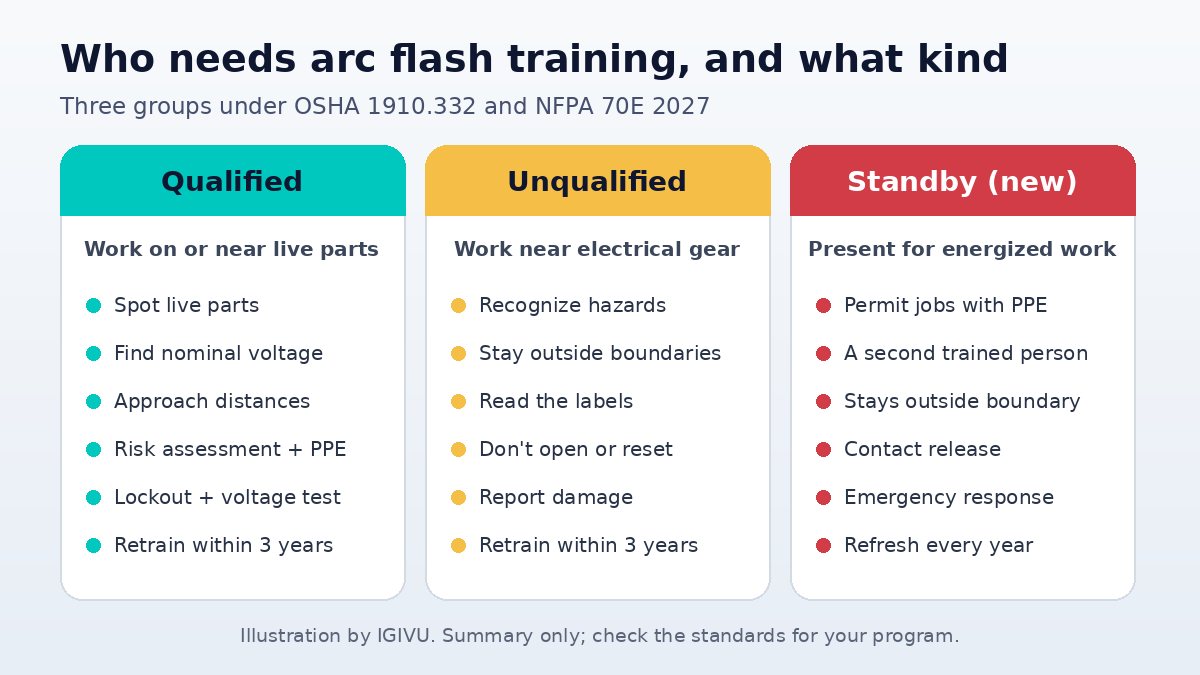
Anyone who could be exposed to an electrical hazard on the job needs some level of training. The depth depends on how close they work to energized parts.
| Who | Typical roles | What their training covers |
|---|---|---|
| Qualified persons | Electricians, maintenance techs, electrical engineers | Telling live parts from other parts, finding nominal voltage, approach distances, risk assessment, PPE, lockout and voltage testing, task by task |
| Unqualified persons | Operators, material handlers, painters, supervisors near electrical equipment | Recognizing hazards, staying outside boundaries, reading labels, never opening or resetting equipment they aren’t qualified for |
| Standby person (new in 2027) | A second worker present during permitted energized work that needs PPE | Contact release (freeing a shock victim safely) and emergency response, refreshed every year |
OSHA’s training rule, 29 CFR 1910.332, lists higher-risk occupations such as electricians, mechanics and repairers, welders, painters and industrial machine operators. Don’t stop at electricians: the Electrical Safety Foundation International reports that non-electrical occupations account for 70% of workplace electrical fatalities. NFPA 70E 2027 also makes clear that a person can be qualified for some equipment and tasks but not others, so training records should name the tasks.
What does OSHA require for arc flash training?
OSHA requires electrical safety training for employees who face a risk of electric shock, and it must be classroom or on-the-job training matched to the level of risk. Qualified persons need specific skills on top of that.
Under 1910.332, qualified persons must at minimum be trained to distinguish exposed live parts, determine their nominal voltage and know the required clearance distances. OSHA doesn’t adopt NFPA 70E or enforce a particular edition. But employers build their programs on it because it is the recognized consensus standard for how to protect workers (see this summary of the 2027 edition).
What changed in NFPA 70E 2027?
The 2027 edition took effect on May 6, 2026, and replaced the 2024 edition. A few changes affect training directly.
- A second person for some energized work. When energized work needs a permit and calls for shock or arc flash PPE, another trained person must be present, outside the boundary. NFPA explains this in its June 2026 blog post.
- Thermal hand protection. Required where a worker could touch a part heated by the current it carries.
- Stricter PPE conformity. A supplier’s self-declaration alone no longer proves arc-rated PPE meets its standard.
- Qualified for specific tasks. Qualification is tied to equipment and tasks, not to a job title.
- New and reorganized hazard articles. Expanded guidance on DC, batteries, capacitors and photovoltaic systems.
The new edition doesn’t instantly expire anyone’s training. But each worker’s next retraining needs to cover these changes. If you change procedures because of them, such as adding a standby person, retrain the people affected sooner.
How often is arc flash training required?
NFPA 70E requires retraining at intervals of no more than three years. Contact release training for standby and emergency responders is refreshed every year.
According to NFPA, you also need extra training sooner when:
- Inspections show someone isn’t following safe work practices
- New technology, equipment or procedures are introduced
- A task is done less than once a year
- Someone’s job duties change
Can arc flash training be done online or in VR?
Partly. NFPA says training can be classroom, on the job or both, and can include interactive electronic or web-based parts. It still has to be paired with demonstrated proficiency.
OSHA takes a similar line. In a 2019 interpretation letter, it said online training alone is not enough. Workers need hands-on parts and timely access to a qualified trainer. NFPA is also clear that being trained doesn’t make someone qualified on its own; they have to show the skills.
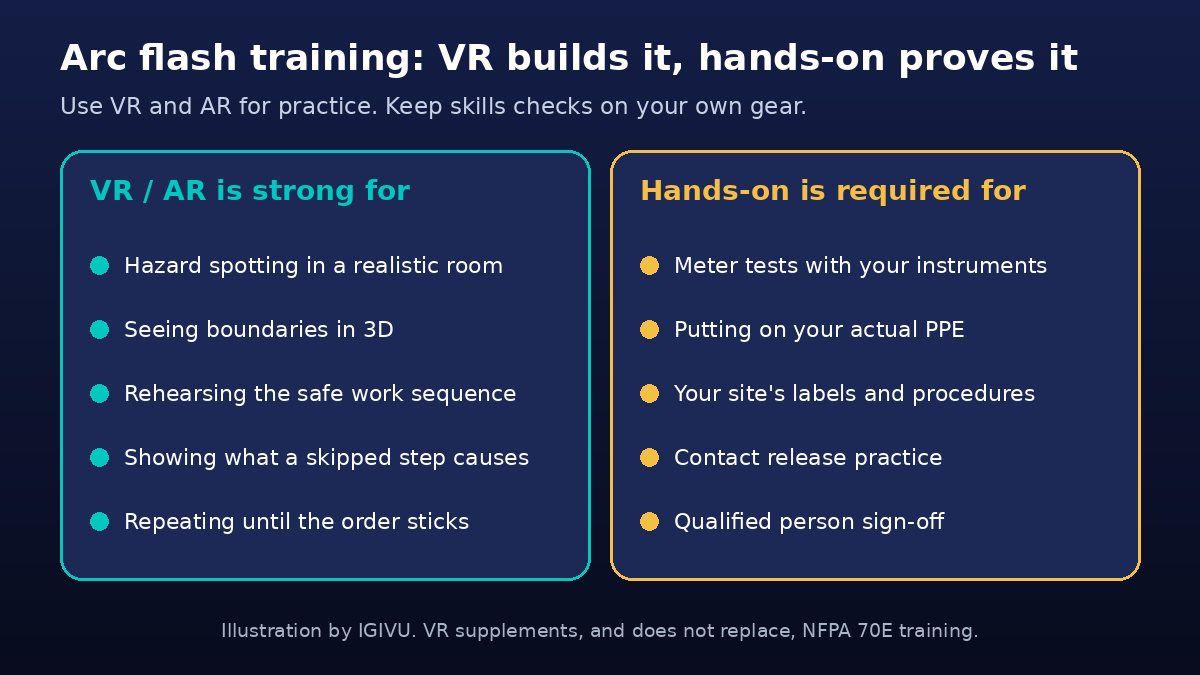
So VR works best as the practice layer inside a blended program, not as a replacement for your instructor-led course or your skills checks.
What can VR and AR cover in electrical safety training?
VR and AR are strongest where real practice would be dangerous or impossible, such as seeing what an arc flash does or walking an approach boundary around live gear.
- Hazard spotting. Finding damaged cords, open panels and missing labels in a realistic room.
- Boundaries in 3D. Seeing the limited approach and arc flash boundaries around equipment instead of reading numbers off a label.
- The safe work sequence. Rehearsing the order: plan, de-energize, lock out, test for absence of voltage, then work.
- Consequences without injury. Watching what a skipped step leads to, which a classroom can only describe.
- Repetition. Running the same scenario again until the order sticks.
What VR doesn’t replace: hands-on meter testing with your own instruments, putting on your actual PPE, your site’s labels and procedures, and a qualified person signing off.
IGIVU’s VR safety training includes electrical safety scenarios covering electrical hazards, lockout/tagout and safe equipment maintenance. For teams that prefer tablets over headsets, the Safety Day page lists an AR Electrical Training collection with four simulators. If your electrical work also involves machines, pair this with our lockout tagout training guide.
How much does arc flash training cost?
It depends on the format. Instructor-led NFPA 70E classes are priced per person or per day, while VR and AR practice can be added for a set event fee or subscription.
| Option | Published price | Best for |
|---|---|---|
| IGIVU Safety Day pilot | From $500 (up to 15 people) | Trying VR with one crew |
| IGIVU SafetyBox VR | $900 per headset, one day | A self-run session at your site |
| IGIVU Safety Day Experience | From $1,990 with on-site facilitator | A full safety day, about 50 visits per consultant |
| IGIVU VR Annual Training | From $3,000 per year | Onboarding and refreshers all year |
| IGIVU AR Safety Training | $100 per employee per month | Phone or tablet training, no headsets |
IGIVU prices are from /safety-day/ and /vr-safety-training/. VR practice is an add-on to your NFPA 70E course, not a substitute for it. For comparison, one instructor-led provider lists private on-site NFPA 70E seminars from $3,500 per day (JCR). For a wider look at pricing, see what VR safety training costs.
How do you add VR to your 2027 arc flash training plan?
Start with your training matrix and use VR where people need more practice, not more slides.
- List who is qualified, for what. Name the equipment and tasks for each person, as the 2027 edition expects.
- Check retraining dates. Flag anyone due within the next three-year window, and anyone whose duties or procedures changed.
- Add the standby role. Identify who will stand by for permitted energized work and book their annual contact release training.
- Book the instructor-led course. Make sure it covers the 2027 changes.
- Add a VR or AR session. Use it before the course to build awareness, or after it to practice the sequence. A Safety Day works well in January when crews are planning the year.
- Finish with hands-on checks. Meter tests, PPE fit and a supervisor sign-off, documented.
Frequently asked questions
Is arc flash training required by OSHA?
Yes. OSHA 1910.332 requires electrical safety training for employees who face a risk of electric shock, with extra skills for qualified persons. OSHA doesn’t adopt NFPA 70E, but employers widely use it to meet OSHA’s requirements.
How long is arc flash training good for?
NFPA 70E requires retraining at intervals of no more than three years, and sooner if duties, equipment or procedures change or a worker isn’t following safe practices. Contact release training is refreshed every year.
Can arc flash training be done online?
Online and VR modules can be part of it. NFPA allows interactive electronic components, but OSHA says online training alone is not enough. Pair it with hands-on practice, a qualified trainer and demonstrated proficiency.
Does a VR course make someone a qualified person?
No. Training alone doesn’t make someone qualified. The employer decides qualification after the worker shows the skills and knowledge for specific equipment and tasks. VR helps build and check those skills.
What changed in NFPA 70E 2027?
The 2027 edition took effect May 6, 2026. It adds a second trained person for permitted energized work that needs PPE, thermal hand protection, stricter PPE conformity and expanded DC, battery and capacitor guidance.
Do we need to buy VR headsets for electrical safety training?
No. IGIVU’s VR Safety Day and VR Annual Training include the headsets, and AR safety training runs on phones and tablets, so no dedicated VR hardware is needed.
Ready to add VR to your electrical safety training?
IGIVU is a nationwide XR company headquartered in Dallas that has served 3,000+ organizations. We deliver VR and AR safety training with the headsets, content and on-site support handled for you. Tell us your crew size, locations and dates, and we’ll send a quote in under 24 hours. Email [email protected] or request a quote.