When Custom VR Content Transforms Your Business Objectives
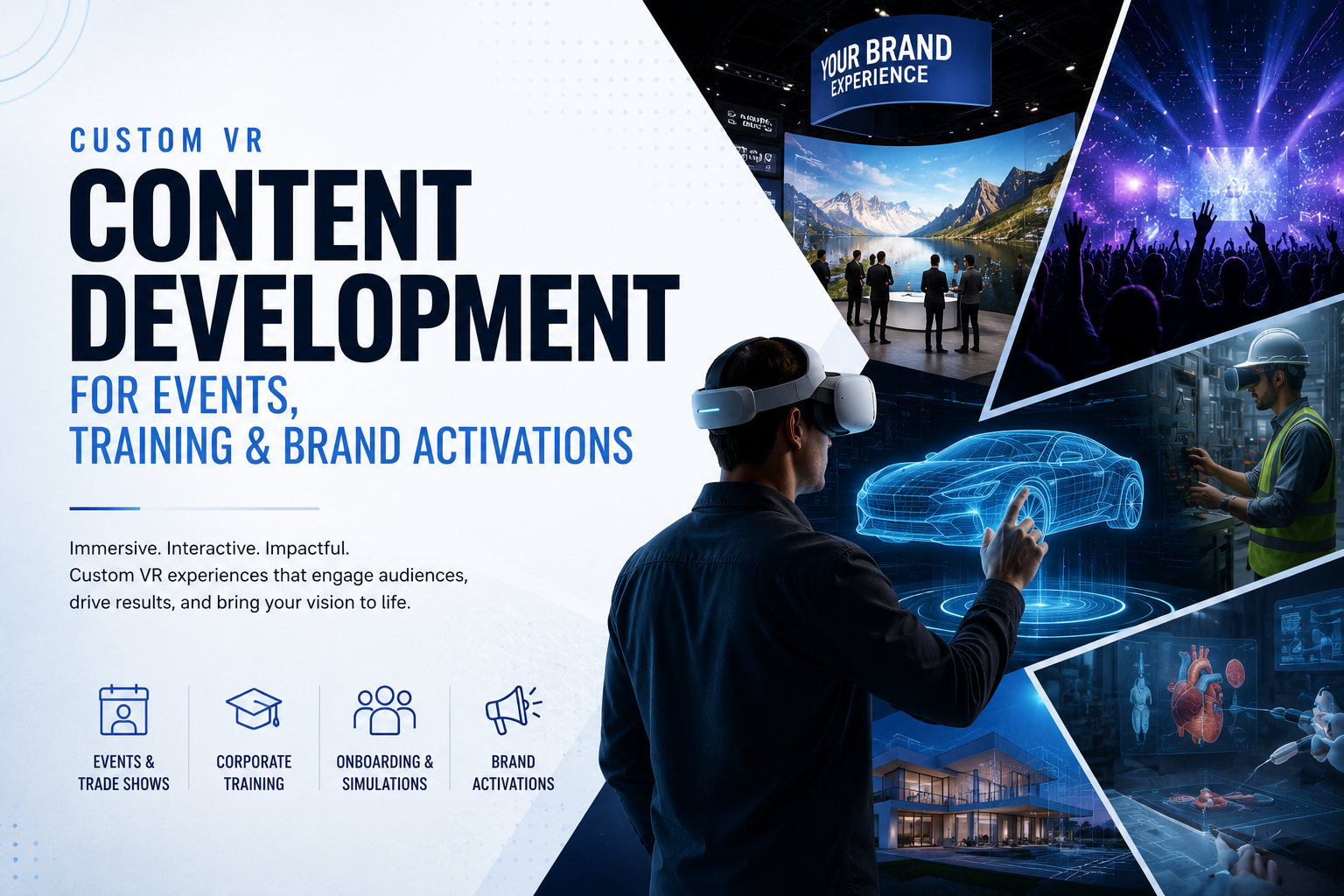
Off-the-shelf VR experiences work for general entertainment, but custom content delivers when you need to showcase a specific product, train on proprietary processes, or create a branded activation that competitors can’t replicate. Here’s how to determine if custom development fits your goals and budget.
Brand Activations and Trade Show Experiences
Product visualization in VR vs. traditional demos
Custom VR content transforms static product displays into immersive explorations. While traditional demos limit interaction to physical constraints, VR allows customers to examine products at impossible scales—walking through industrial machinery, exploring architectural spaces before construction, or manipulating complex assemblies with their hands. A pharmaceutical company showcasing a new drug delivery system can take visitors on a journey through the bloodstream, while an automotive manufacturer can let prospects customize and test-drive vehicles that aren’t physically present at the show.
Booth traffic metrics from custom vs. generic VR
Data from trade show deployments reveals stark differences in engagement metrics. Custom VR experiences tailored to specific products generate 3-4x longer dwell times compared to generic VR games or experiences. Booth visitors spend an average of 8-12 minutes in custom brand experiences versus 2-3 minutes with off-the-shelf content. This extended engagement translates to 40% higher lead quality scores, as prospects who complete custom VR experiences demonstrate genuine interest in the showcased products or services.
Lead capture integration within VR experiences
Custom VR content seamlessly integrates lead capture mechanisms that feel natural within the experience. Instead of interrupting immersion with traditional forms, custom experiences can capture preferences through in-VR choices, track areas of interest through gaze data, and gamify information collection. A B2B software company might design a virtual office tour where selecting different software features automatically tags lead interests, while a consumer brand could capture email addresses through a virtual prize wheel integrated into the experience narrative.
Reusability across multiple events
The economics of custom VR content improve dramatically with reuse. A single custom experience typically deploys across 8-15 events in the first year, reducing the per-event cost to $1,000-3,000 compared to $5,000-10,000 for comparable physical booth upgrades. Content modules can be remixed for different audiences—a construction equipment manufacturer might use the same base VR experience with different emphasis for contractors versus architects, maximizing the initial development investment.
Corporate Training and Onboarding Modules
Safety training scenarios without real-world risk
Custom VR training modules eliminate the danger and cost of real-world safety training. Oil rig workers practice emergency procedures without offshore deployment, manufacturing employees learn lockout/tagout procedures without production line shutdowns, and healthcare workers rehearse contamination protocols without actual hazardous materials. These custom scenarios reduce training incidents by 75% while cutting training time by 40% compared to classroom instruction alone.
Soft skills practice with branching conversations
VR excels at soft skills development through realistic conversational scenarios. Custom modules for customer service training present difficult customer interactions with branching dialogue trees that adapt to trainee responses. Sales teams practice objection handling with virtual prospects programmed with company-specific concerns. HR departments use custom VR to train managers on sensitive conversations, with AI-driven characters responding naturally to different approaches, providing safe spaces to make mistakes and learn from consequences.
Equipment operation in virtual environments
Complex equipment training becomes accessible and scalable through custom VR modules. Airlines train ground crews on new aircraft models before planes arrive, medical device companies onboard surgeons on new instruments without shipping expensive equipment, and logistics companies teach forklift operation without warehouse disruption. Custom VR training reduces equipment damage during training by 85% and accelerates time-to-competency by 50% compared to traditional methods.
Tracking completion and performance metrics
Custom VR training modules capture granular performance data impossible with traditional training. Beyond simple completion rates, systems track decision timing, error patterns, gaze direction during critical moments, and physiological responses to stressful scenarios. This data feeds into learning management systems, identifying knowledge gaps for targeted follow-up and predicting on-job performance with 80% accuracy based on VR training behaviors.
Event Entertainment and Party Experiences
Themed experiences matching event concepts
Custom VR content aligns perfectly with event themes, creating cohesive brand experiences. A 1920s-themed corporate gala might feature a custom speakeasy VR experience where guests solve prohibition-era mysteries. Product launches incorporate the product story into VR narratives—a sports drink brand creating an extreme sports VR challenge, or a luxury travel company offering virtual destination previews that mirror their actual offerings.
Multi-player custom games for team building
Corporate team-building evolves beyond trust falls with custom multiplayer VR experiences. Teams collaborate in virtual escape rooms designed around company values, compete in custom challenges that reinforce training concepts, or work together in virtual construction projects that mirror actual business processes. These experiences accommodate 4-8 simultaneous players, with spectator views for larger groups, creating inclusive activities that engage both VR participants and observers.
Branded virtual venues and environments
Custom VR transforms any physical space into a branded environment. A tech company’s holiday party might transport guests to a virtual version of their headquarters on Mars, while a fashion brand creates a virtual runway where guests become models. These branded environments extend beyond logos and colors, incorporating company culture, inside jokes, and shared experiences that resonate with employees and customers.
Photo/video capture for social sharing
Custom VR experiences designed for events include integrated mixed-reality capture, showing participants within the virtual world. These shareable moments generate 5x more social media engagement than standard event photos. A cosmetics brand might create a virtual makeover experience that outputs branded before/after videos, while an adventure company produces action-packed clips of guests conquering virtual mountains, complete with company branding and event hashtags.
The Custom VR Development Process: From Concept to Deployment
Creating custom VR content involves distinct phases that balance creative vision with technical constraints and deployment logistics. Understanding this process helps set realistic timelines and budgets.
Discovery and Storyboarding Phase
Defining success metrics and user actions
Successful custom VR development begins with clear, measurable objectives. Rather than vague goals like “increase engagement,” effective projects define specific metrics: “achieve 80% module completion rates,” “generate 50 qualified leads per event,” or “reduce training errors by 60%.” User actions map directly to these metrics—if lead generation is primary, the experience designs natural information capture points. If skill transfer matters most, interactions mirror real-world tasks precisely.
Hardware compatibility requirements
Hardware decisions made during discovery affect the entire development process. Standalone headsets like Meta Quest 3 enable untethered experiences ideal for trade shows but limit graphical complexity. PC-powered headsets support photorealistic visuals but require powerful computers and restrict movement. Custom content must account for tracking capabilities, controller types, and play space requirements. Developing for multiple platforms increases costs by 30-50% but expands deployment flexibility.
Content duration and replayability needs
Optimal experience length varies by use case. Trade show experiences target 3-5 minutes for maximum throughput, training modules run 15-20 minutes to maintain focus, and entertainment experiences often extend to 10-15 minutes. Replayability requirements influence design decisions—training scenarios need randomized elements to prevent memorization, while brand experiences might offer different paths to encourage repeat visits.
Branding guidelines and asset collection
Brand integration goes beyond placing logos in virtual spaces. Custom VR development requires comprehensive brand assets: color specifications for VR rendering, audio signatures for spatial sound design, approved messaging for virtual interactions, and character design guidelines for virtual representatives. Companies often discover gaps in their brand guidelines when extending to VR, requiring additional creative decisions about how their brand exists in three-dimensional, interactive spaces.
Development and Testing Timeline
Typical 6-12 week development cycles
Standard custom VR projects follow predictable timelines. Weeks 1-2 focus on concept refinement and technical planning. Weeks 3-4 produce initial prototypes demonstrating core interactions. Weeks 5-8 build out full experiences with placeholder assets. Weeks 9-10 integrate final assets and polish interactions. Weeks 11-12 handle testing, optimization, and deployment preparation. Compressed timelines are possible but typically sacrifice iteration opportunities that improve final quality.
Milestone review points and feedback loops
Structured review points prevent costly late-stage changes. The concept review at week 2 confirms direction before significant development begins. The prototype review at week 4 validates core mechanics. The alpha review at week 8 assesses complete functionality with placeholder content. The beta review at week 10 evaluates the near-final experience. Each milestone includes specific feedback windows—typically 48-72 hours—to maintain development momentum.
User testing with target audience segments
Effective custom VR development includes testing with actual end users, not just internal stakeholders. Trade show experiences test with attendees unfamiliar with VR, training modules evaluate with new employees, and brand activations assess with target demographics. Testing reveals unexpected issues: motion sensitivity in certain populations, cultural interpretation of gestures, or confusion with industry-specific interactions. Budget 10-15% of development costs for comprehensive user testing.
Platform optimization for rental headsets
Custom content must perform consistently across entire rental fleets, not just development hardware. Optimization ensures smooth performance on devices with varying wear levels, different firmware versions, and accumulated software cruft. This process includes reducing texture sizes for consistent loading times, implementing dynamic quality settings for battery optimization, and creating fallback options for tracking issues. Proper optimization reduces on-site technical issues by 70%.
Deployment and Support Structure
Pre-loading content on rental units
Deployment logistics significantly impact event success. Custom content requires 2-4 hours for initial installation and testing per headset, plus 30 minutes for pre-event verification. Content must be locked to prevent accidental deletion, configured for automatic launching, and tested for proper tracking calibration. Rental providers typically handle pre-loading as part of their service, but custom content requires additional coordination to ensure version control and licensing compliance.
On-site technical support requirements
Custom VR experiences demand higher support levels than standard content. While generic experiences might need one technician per 10 headsets, custom content often requires one per 5-6 units, especially during initial deployments. Support staff need experience-specific training covering common user questions, troubleshooting procedures, and reset protocols. Budget $1,500-3,000 per day for dedicated technical support at major events.
Remote content updates and versioning
Modern VR deployment supports remote content updates, but implementation requires planning. Cloud-based distribution enables quick fixes and content refreshes but depends on reliable internet at event venues. Version control becomes critical when content deploys across multiple simultaneous events. Establish clear protocols for update approval, testing requirements, and rollback procedures. Include 10-20 hours of post-launch updates in development contracts.
Usage analytics and reporting setup
Custom VR content captures valuable behavioral data when properly configured. Analytics platforms track completion rates, interaction patterns, dwell times on specific features, and user paths through experiences. Advanced implementations include heat mapping of gaze patterns, emotional response monitoring through headset sensors, and multiplayer interaction analysis. Proper analytics setup requires 8-12 hours of configuration but provides insights that justify continued VR investment.
Custom Content Pricing Models and Budget Considerations
Custom VR development costs vary widely based on complexity, interactivity, and reuse potential. Understanding pricing structures helps align expectations with available budget.
Development Cost Breakdown
$15K-30K for simple 360 experiences
Entry-level custom content includes 360-degree video experiences with basic interactivity. These projects typically feature 2-4 minutes of content, simple hotspot interactions, and limited branching. Examples include virtual facility tours with information overlays, product demonstrations with multiple viewing angles, or simple training scenarios with linear progression. Development timeframes run 3-4 weeks with one round of revisions.
$30K-75K for interactive training modules
Mid-tier custom development creates fully interactive training experiences with meaningful user agency. These modules include 10-15 minutes of content, branching scenarios based on user decisions, basic physics interactions, and performance tracking. Examples include customer service simulations with dialogue trees, equipment operation training with realistic controls, or safety procedures with consequence modeling. Development requires 6-8 weeks with multiple review cycles.
$75K-200K for complex simulations
High-end custom VR development produces sophisticated simulations with realistic physics, AI-driven characters, and complex interaction systems. These experiences often include 20-30 minutes of content, multiplayer capabilities, advanced haptic feedback integration, and detailed analytics. Examples include surgical simulations with accurate tissue modeling, architectural walkthroughs with real-time modifications, or crisis management scenarios with dynamic event generation. Development extends 10-16 weeks with extensive testing phases.
Factors affecting price: duration, interactivity, multiplayer
Content duration adds $2,000-5,000 per additional minute beyond base scope. Interaction complexity scales costs exponentially—simple point-and-click adds 20%, hand tracking adds 40%, and full physics simulation adds 60-80%. Multiplayer functionality typically doubles base development costs due to networking requirements, synchronization challenges, and expanded testing needs. Photorealistic graphics add 30-50% compared to stylized visuals. Platform compatibility beyond a single headset type adds 25-35% per additional platform.
Licensing vs. Ownership Models
Perpetual license for unlimited use
Perpetual licensing grants unlimited use rights for custom VR content, typically costing 100% of development fees. Organizations deploy content across unlimited events, training sessions, or installations without additional payments. This model suits companies with frequent VR deployments, long-term training needs, or permanent installations. Perpetual licenses usually include 12 months of technical support and minor updates, with extended support available for 15-20% annual fees.
Event-based licensing for temporary activations
Event licensing reduces upfront costs for limited deployments. Single-event licenses typically cost 25-35% of full development fees, with multi-event packages offering economies of scale. A three-event package might cost 50% of perpetual licensing, while six events approach 75%. This model works for companies testing VR effectiveness, seasonal campaigns, or organizations with limited annual events.
Revenue sharing for commercial experiences
Revenue-sharing models reduce initial investment for commercial VR experiences. Developers might accept 30-50% reduced upfront fees in exchange for 15-25% of revenue generated through the experience. This structure aligns developer and client incentives, encouraging ongoing optimization and support. Revenue sharing works best for ticketed VR attractions, paid training programs, or experiences with clear monetization paths.
White-label options for resellers
White-label licensing enables agencies and event companies to offer custom VR as their own service. Base licensing typically costs 150-200% of standard perpetual licenses but includes rights to rebrand and resell. Advanced agreements might include territory exclusivity, modification rights, or co-development opportunities. White-label partners often negotiate volume discounts starting at 5-10 deployments annually.
ROI Calculation Framework
Cost per impression at events
Custom VR content ROI calculations start with impression metrics. A $50,000 custom experience deployed at 10 trade shows, engaging 200 visitors per show, generates 2,000 impressions at $25 each. Compare this to traditional booth attractions: professional presenters cost $2,000-3,000 per day plus travel, serving perhaps 50-75 qualified prospects. Custom VR delivers 3-4x more qualified interactions at comparable per-impression costs, with the advantage of consistency and scalability.
Training time reduction metrics
VR training ROI emerges through time savings and improved outcomes. If custom VR reduces training time from 16 to 10 hours while improving retention by 25%, calculate savings by multiplying hourly employee costs by time saved across all trainees. A company training 500 employees annually at $50/hour saves $150,000 in direct labor costs, paying for $75,000 custom content development in six months.
Lead generation value
Custom VR experiences generate higher-quality leads worth premium values. If standard trade show leads convert at 2% with $10,000 average deal size, but VR-engaged leads convert at 5% with $15,000 average deals, each VR lead worth $750 versus $200 for standard leads. A custom experience generating 50 leads per event across 10 events annually produces $375,000 in expected value, justifying significant development investment.
Reuse across multiple deployments
Reusability dramatically improves custom content ROI. Initial development might cost $60,000, but deployment across 20 events over two years reduces per-event cost to $3,000. Adding hardware rental at $5,000 per event creates $8,000 total event cost for experiences engaging 200+ attendees. Traditional alternatives like celebrity speakers, elaborate physical demos, or interactive installations often cost $15,000-30,000 per event with no reusability.
Custom vs. Off-the-Shelf: Making the Strategic Decision
Not every VR deployment needs custom content. Here’s how to evaluate whether custom development or curated existing experiences better serve your objectives.
When Custom Content Makes Sense
Proprietary processes or products to showcase
Custom development becomes essential when showcasing proprietary elements that define competitive advantage. A medical device company demonstrating a patented surgical technique needs custom content that accurately represents their specific approach. Manufacturing companies highlighting unique production processes require custom visualization that competitors can’t access. Software companies showcasing proprietary interfaces benefit from VR experiences that mirror actual user workflows, creating seamless transitions from demo to trial.
Specific learning objectives with assessments
Regulated industries and certification programs demand custom content that aligns with specific standards. Healthcare training must reflect institutional protocols, financial services training must incorporate company-specific compliance requirements, and technical certifications need precise skill assessments. Custom VR enables embedded assessments that track specific competencies, generate detailed performance reports, and integrate with learning management systems for compliance documentation.
Brand differentiation at competitive events
Trade shows where competitors cluster in adjacent booths demand distinctive experiences. While multiple companies might offer generic VR entertainment, custom content creates unique talking points that sales teams leverage. A cybersecurity company might develop a virtual hacking simulation that demonstrates their specific threat detection capabilities, while competitors show generic network visualizations. This differentiation justifies premium pricing and positions companies as innovation leaders.
Long-term use across multiple deployments
Organizations planning 8+ VR deployments annually benefit from custom content economics. The per-use cost drops below off-the-shelf licensing fees while delivering perfectly aligned experiences. Multi-year roadmaps that include trade shows, training programs, customer briefings, and recruitment events maximize custom content value. Companies can also plan content updates and expansions, building a library of custom experiences that serve different audience segments.
When Curated Content Wins
One-time events with entertainment focus
Single corporate parties or employee appreciation events rarely justify custom development. Curated libraries offer diverse entertainment options—from rhythm games to puzzle experiences to virtual tourism—that satisfy broad audiences without customization costs. These experiences are professionally polished, thoroughly tested, and proven to engage diverse demographics. Event planners can select multiple experiences to cater to different preferences, creating variety that single custom experiences can’t match.
Quick turnaround requirements under 4 weeks
Urgent deployments necessitate existing content. Last-minute trade show additions, sudden training needs, or reactive marketing campaigns can’t accommodate 6-12 week development cycles. Quality VR rental providers maintain libraries of proven experiences deployable within days. While these lack customization, professional presentation and reliable performance often matter more than perfect brand alignment for rushed deployments.
Budget constraints under $10K
Limited budgets achieve better outcomes with curated content. Rather than compromising custom development quality to meet budget constraints, organizations can access premium existing experiences for $500-2,000 per event. This budget might secure multiple complementary experiences, creating variety and extending engagement. Some providers offer light customization of existing content—adding logos, changing colors, or modifying text—for $2,000-5,000, bridging the gap between generic and custom.
Testing VR before larger investment
Organizations new to VR benefit from testing with existing content before committing to custom development. Curated experiences reveal audience receptiveness, identify technical challenges, and establish operational requirements. This pilot phase, typically costing $5,000-15,000 across several events, provides data to justify and inform subsequent custom development. Companies often discover unexpected preferences—audiences might prefer social multiplayer experiences over single-player demos—that reshape custom content strategies.
Integrating Custom Content with VR Rental Packages
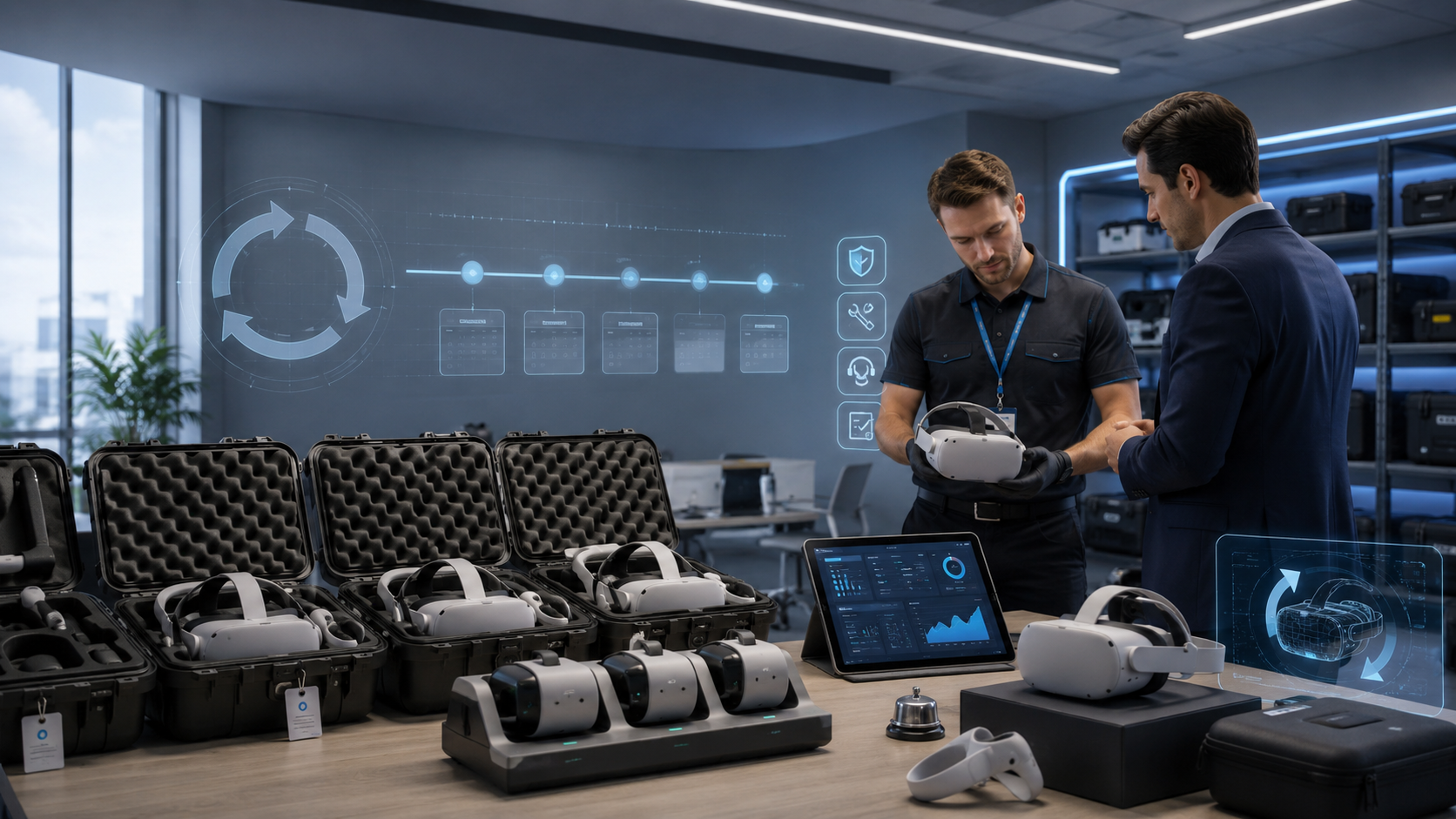
Custom content without the right hardware and support creates deployment headaches. Here’s how bundling development with rental packages ensures smooth execution.
Hardware Optimization and Testing
Matching content specs to rental fleet capabilities
Successful deployment requires perfect alignment between content requirements and available hardware. Custom experiences designed for high-end PCs fail on standalone headsets, while mobile-optimized content underutilizes premium hardware capabilities. Rental providers maintain detailed fleet specifications that inform development decisions. Meta Quest 3 headsets handle 72-120fps at 2064×2208 per eye, while Pico 4 Enterprise offers 90fps at 2160×2160. Understanding these constraints during development prevents deployment disasters.
Pre-event testing on actual devices
Testing on development hardware differs from deployment hardware realities. Rental headsets accumulate wear that affects tracking precision, battery life degrades with charge cycles, and firmware updates introduce unexpected behaviors. Professional providers allocate pre-event testing sessions where custom content runs on actual rental units. This testing identifies issues like tracking drift in worn devices, performance variations across firmware versions, or unexpected interactions with venue lighting conditions.
Backup units with content pre-loaded
Hardware failures during events are inevitable, making backup strategies critical. Professional rental packages include 20-30% spare units with custom content pre-installed and tested. Hot-swappable backups minimize downtime—staff can replace failed units in under 60 seconds. Content must be configured for quick calibration, with user progress preservation where possible. Backup units also accommodate unexpected demand when experiences prove more popular than anticipated.
Cross-platform compatibility considerations
Multi-platform compatibility expands rental options and provides deployment flexibility. Content that runs on Quest, Pico, and HTC headsets enables competitive rental pricing and better availability. However, cross-platform development requires careful feature management. Hand tracking might work differently across platforms, haptic feedback varies by controller, and performance optimization needs per-platform tuning. Budget 25-40% additional development time for true cross-platform compatibility.
Bundled Service Advantages
Single vendor for content and hardware
Integrated providers eliminate finger-pointing when issues arise. Rather than coordinating between content developers, hardware suppliers, and support staff, single-vendor relationships streamline communication and accountability. Bundled providers understand both content requirements and hardware limitations, optimizing experiences for reliable deployment. They maintain version control across their fleet, ensure licensing compliance, and handle update distribution. This integration typically reduces total project costs by 15-20% compared to managing multiple vendors.
Coordinated troubleshooting and support
Technical issues during events demand immediate resolution. Bundled providers train support staff on both hardware and custom content specifics. They know that Scene 3 occasionally freezes on older firmware, that the training module’s final assessment requires specific controller positioning, or that certain user actions trigger known bugs with documented workarounds. This deep familiarity reduces resolution time from 10-15 minutes to 2-3 minutes for common issues.
Volume pricing on combined services
Bundling custom content development with hardware rental unlocks volume discounts unavailable separately. Providers might offer 20-30% discounts on rental rates for clients commissioning custom content, or include development hours in annual rental contracts. A company planning 10 events annually might negotiate a package including custom content development, hardware rental, and support services for 25-35% less than purchasing separately.
Simplified logistics and accountability
Single-vendor relationships dramatically simplify event logistics. One purchase order, one point of contact, one delivery schedule, and one invoice replace complex multi-vendor coordination. When issues arise, there’s no confusion about responsibility. Insurance and liability coverage is straightforward. Post-event reporting consolidates usage data, performance metrics, and recommendations in unified documents. This simplification saves 10-15 hours of coordination time per event.
Frequently Asked Questions
How long does custom VR content development typically take?
Standard custom VR content development requires 6-12 weeks from concept approval to deployment-ready content. Simple 360-degree experiences might complete in 3-4 weeks, while complex simulations extend to 16-20 weeks. Rush development is possible but typically adds 30-50% to costs and limits revision rounds. Planning should include 2 weeks for pre-development discovery and 1-2 weeks for deployment preparation.
Can we update custom VR content after initial development?
Yes, custom VR content supports updates and modifications post-launch. Minor updates like text changes, color adjustments, or audio replacements typically complete within 48-72 hours. Significant updates involving new interactions, additional scenes, or gameplay modifications require 1-3 weeks. Most development contracts include 10-20 hours of post-launch updates, with additional modifications billed hourly at $150-250 per hour.
What file formats and platforms does custom content support?
Custom VR content typically delivers as APK files for Android-based headsets (Quest, Pico), executable files for PC VR (SteamVR, Oculus PC), or WebXR for browser-based deployment. Source files remain with developers unless specifically negotiated. Content packages include all necessary assets, configurations, and documentation. Most providers support Unity and Unreal Engine development, with export capabilities to all major VR platforms.
Who owns the IP rights to custom VR content?
IP ownership depends on contract structure. Standard agreements grant clients perpetual use licenses while developers retain underlying code ownership. Full IP transfer typically adds 25-40% to development costs. Clients always own their provided assets (logos, products, training content), while developers might retain rights to generic functionality for future projects. Clear IP agreements should address modifications, derivatives, and competitive exclusions.
Can custom content work on different VR headset models?
Cross-platform compatibility is achievable but requires planning. Content can be developed to run across Meta Quest, Pico, HTC Vive, and other major platforms, though this adds 25-35% to development costs. Each platform requires optimization, testing, and potentially different interaction methods. Some features might not translate across all platforms—hand tracking, haptic feedback, or eye tracking might require platform-specific alternatives.
What’s the minimum budget for custom VR development?
Meaningful custom VR experiences start around $15,000 for simple 360-degree content with basic interactivity. Interactive experiences with user agency begin at $30,000. Training simulations with assessment capabilities start at $50,000. These minimums assume single-platform development, standard revision rounds, and 3-5 minutes of content. Budgets below these thresholds should consider customizing existing content or selecting from curated libraries.
How do you measure ROI on custom VR content?
ROI measurement varies by use case. Trade show deployments track leads generated, qualification scores, and conversion rates compared to traditional booth activities. Training implementations measure time-to-competency, error reduction, and retention rates versus conventional methods. Brand activations monitor social sharing, brand recall, and purchase intent lift. Establish baseline metrics before VR deployment to enable accurate comparison.
Can existing 3D assets be converted to VR experiences?
Existing 3D assets can accelerate custom VR development but require optimization. CAD models need polygon reduction, texture optimization, and interaction logic. Marketing renders require conversion to real-time rendering formats. Architectural models need scale verification and collision mesh generation. Asset conversion typically saves 20-30% of development time but still requires significant work to create engaging VR experiences.
Conclusion: Making Custom VR Content Work for Your Organization
Custom VR content development represents a significant investment that, when properly executed, delivers measurable returns through enhanced engagement, improved training outcomes, and memorable brand experiences. The decision between custom development and off-the-shelf content hinges on your specific objectives, deployment frequency, and available resources.
Organizations planning multiple deployments, showcasing proprietary products, or requiring specific training outcomes benefit most from custom development. The ability to perfectly align virtual experiences with brand messaging, learning objectives, or product demonstrations justifies the initial investment when amortized across multiple uses.
Success with custom VR content requires careful planning, realistic timelines, and strong partnerships with experienced developers and rental providers. Bundled solutions that combine content development with hardware rental and technical support reduce complexity while ensuring reliable deployment.
As VR technology continues maturing and development costs decrease, custom content becomes increasingly accessible to organizations of all sizes. The key is starting with clear objectives, understanding the development process, and choosing partners who can guide you from concept through successful deployment.
Ready to explore custom VR content for your next event, training program, or brand activation? Contact our team for a consultation on how custom VR development can transform your objectives into immersive realities. We’ll help you evaluate options, understand costs, and determine whether custom or curated content best serves your needs.