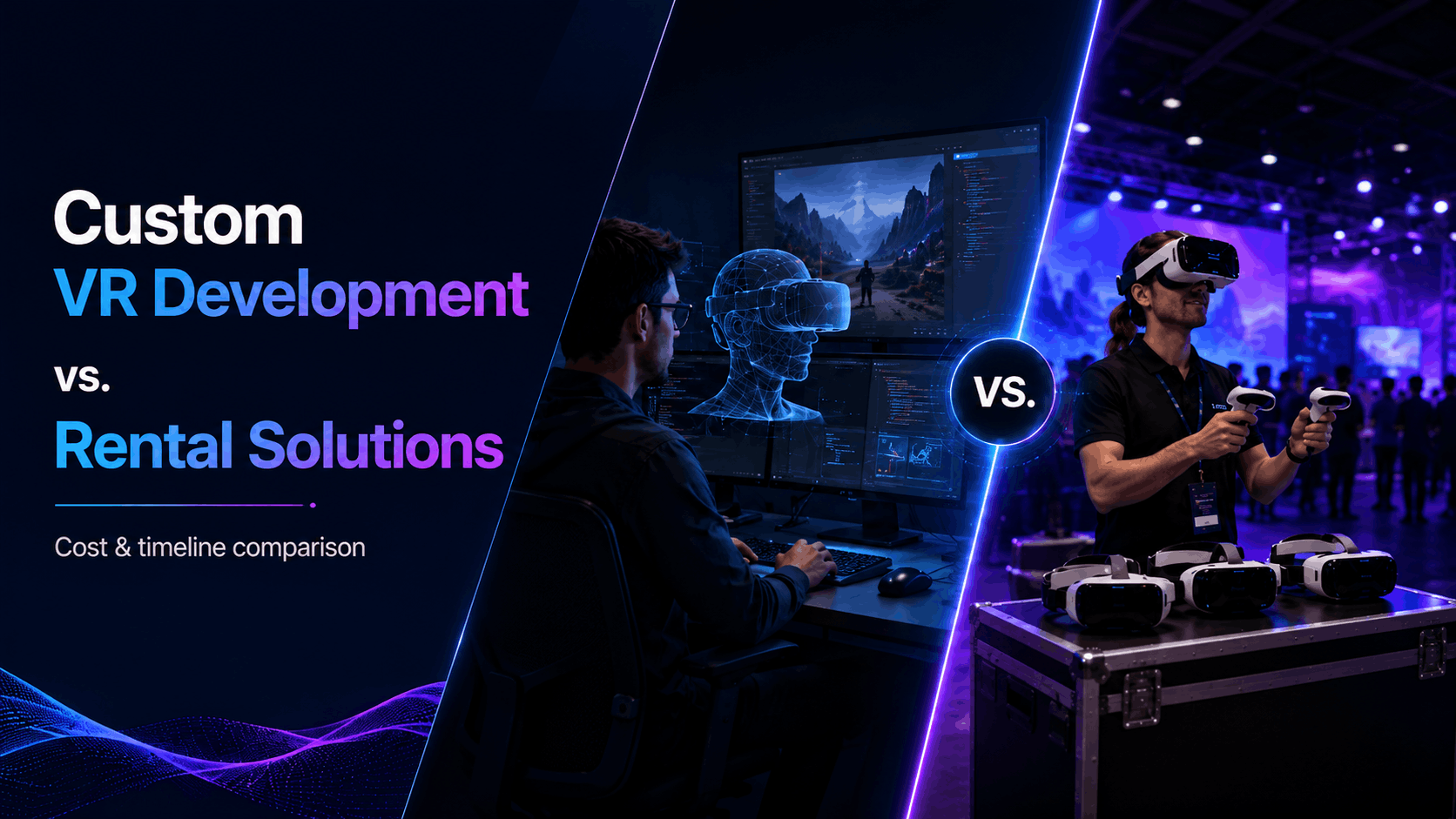
Custom VR development promises a perfectly tailored experience—your brand, your workflow, and your story brought to life in immersive 3D. But that level of customization often comes with 6–12 month timelines, budgets ranging from $50,000 to $500,000 or more, and ongoing maintenance costs that many organizations underestimate.
For most corporate events, trade shows, brand activations, and short-term training programs, existing VR content libraries paired with professional rental packages can deliver comparable engagement at a fraction of the cost and deployment time.
This guide breaks down the real costs, timelines, and operational considerations behind both approaches. It also provides a practical framework for deciding whether custom VR development or a rental solution makes more sense for your organization.
When Custom VR Development Makes Sense and When It Doesn’t
The appeal of custom VR development is straightforward: you get a bespoke experience built around your exact requirements, aligned with your brand standards, and designed for a specific audience or workflow.
The challenge is that most organizations underestimate both the upfront investment and the ongoing operational burden.
Understanding where custom development genuinely pays off starts with an honest look at what it actually costs.
The Real Cost of Custom VR Development
Development Timeline Breakdown
Custom VR projects typically move through three major phases, each with its own risks, dependencies, and potential delays.
- Concept and pre-production: 2–4 weeks. Requirements gathering, storyboarding, asset inventory, experience mapping, technical discovery, and scope definition. This phase can expand quickly when stakeholders disagree on objectives or technical constraints surface late.
- Production: 8–16 weeks. 3D modeling, environment development, interaction scripting, animation, audio production, interface design, and iterative stakeholder reviews. This is usually the longest phase and the most vulnerable to scope creep.
- Testing and deployment: 2–4 weeks. Hardware compatibility testing, performance optimization, user acceptance testing, headset configuration, and deployment infrastructure setup.
A realistic minimum timeline from kickoff to live deployment is approximately 12–24 weeks. More complex projects can easily extend beyond six months.
Budget Ranges by Complexity
| Experience Type | Typical Budget Range |
|---|---|
| 360° video with basic interactivity | $10,000–$50,000 |
| Interactive branching experience | $50,000–$200,000 |
| Multiplayer training simulation | $200,000–$500,000+ |
| Full digital twin with real-time data | $500,000+ |
These figures generally reflect development costs only. They do not include hardware procurement, deployment infrastructure, event staffing, device management, or ongoing support.
Hidden Costs That Can Erode ROI
Custom VR development budgets frequently overlook several ongoing expenses.
- Hardware compatibility testing: VR headset models and operating systems change regularly. An experience built for one hardware generation may require additional development when devices are upgraded.
- Ongoing maintenance: Bug fixes, operating system compatibility updates, and content refreshes can add approximately 15–25% of the original development cost annually.
- Content updates: When products, training procedures, branding, pricing, or compliance requirements change, the VR experience may also need to be updated.
- Deployment infrastructure: Mobile device management, headset configuration, software licensing, storage, IT support, and deployment processes create additional operational costs.
- Internal ownership: Someone within the organization still needs to manage vendors, hardware, updates, content approvals, and event deployment.
Use Cases That Justify Custom Development
Custom VR development can be the right choice when the experience will be used frequently, contains proprietary content, or delivers long-term strategic value.
Permanent installations requiring branded environments
A dedicated VR experience center, flagship retail installation, museum exhibit, or long-term visitor experience may justify the investment because the experience can be used hundreds or thousands of times over several years.
High usage allows the development cost to be amortized across many sessions.
Proprietary training simulations involving specialized procedures
Custom development may be necessary when training requires employees to interact with equipment, environments, or procedures that do not exist in commercial content libraries.
Examples may include a proprietary manufacturing process, specialized medical device, custom industrial system, or organization-specific safety workflow.
The key qualifier is proprietary. If the skill being taught is relatively common—such as customer service, communication, fire safety, or general equipment operation—an existing solution may already be available.
Product demonstrations requiring accurate digital twins
Automotive manufacturers, aerospace companies, industrial equipment vendors, and engineering firms may need VR environments that replicate specific products with a high degree of accuracy.
When the product itself is the competitive differentiator, generic visualization tools may not provide enough detail.
Multi-year campaigns with frequent deployment
A branded VR activation appearing at 20 or more events each year for several years has a very different ROI profile from a one-time trade show activation.
High deployment frequency is one of the strongest arguments for investing in custom development.
How VR Rental Packages Solve Most Custom Development Needs
Many organizations that initially believe they need custom VR development actually need something simpler: an immersive experience that attracts attention, engages participants, demonstrates a concept, or improves training outcomes.
Those are business outcomes, not technical specifications.
Professional VR rental packages provide access to curated content libraries covering many common enterprise use cases without requiring development delays, maintenance obligations, or six-figure upfront investments.
Pre-Built VR Content Categories for Business Use
Team building and icebreaker experiences
Collaborative VR escape rooms, multiplayer challenges, puzzle environments, and competitive mini-games can be highly effective for team building.
One of their advantages is that participants usually enter an unfamiliar environment on relatively equal footing. That can encourage collaboration across roles, departments, and hierarchy levels.
Product visualization tools
VR content can support automotive demonstrations, property walkthroughs, architectural visualization, manufacturing environments, and product exploration.
For many event audiences, a polished visualization experience can achieve the required engagement without the cost of building a completely custom application.
Soft skills training modules
Enterprise VR libraries increasingly include training for areas such as public speaking, customer service, leadership communication, conflict resolution, interview preparation, and presentation skills.
Because the underlying skills are common across industries, organizations often do not need to build these scenarios from scratch.
Trade show attraction content
Short-form VR games, interactive experiences, gamified challenges, simulations, and high-impact visual experiences can help draw visitors into a booth.
These experiences are often designed around short session lengths, fast participant turnover, simple facilitation, and repeatable engagement.
Customization Without Full Development
Rental does not necessarily mean generic.
Meaningful customization can often be added without building an entirely new VR application.
- Branded welcome and outro screens can incorporate company logos, colors, campaign messaging, and event-specific calls to action.
- Custom playlists allow several experiences to be grouped and sequenced around an event agenda, audience profile, or training curriculum.
- Facilitator-guided experiences allow the VR activity to be framed using company-specific objectives, discussion points, and debrief questions.
- Physical booth integration can reinforce the brand through signage, screens, flooring, lighting, displays, and surrounding event design.
- Custom intro videos can provide branded context before participants enter the VR experience.
- Lead capture integrations may allow event teams to connect participation with registration or follow-up workflows, depending on the platform.
The result is an experience that can still feel highly relevant to the organization without requiring months of software development.
Comparing Timelines: 6 Months vs. 6 Days
One of the most overlooked factors in the custom VR development decision is opportunity cost.
Every month spent designing and developing an experience is a month in which the experience cannot be used at events, sales meetings, training sessions, or customer demonstrations.
Rental-based solutions can often deploy within days, which also allows organizations to test VR before making a major development investment.
Custom Development Timeline Reality
A realistic enterprise custom VR project may look like this:
- Month 1–2: Requirements gathering, internal approvals, vendor RFPs, vendor selection, procurement, contract negotiation, and project kickoff.
- Month 3–5: Experience design, 3D asset creation, interaction development, animation, audio production, and stakeholder review cycles.
- Month 6: User acceptance testing, hardware compatibility testing, performance optimization, deployment preparation, and facilitator training.
- Post-launch: Bug fixes, headset and operating system compatibility updates, content revisions, performance monitoring, and future feature development.
The six-month estimate assumes a well-defined project, experienced vendor, available client stakeholders, and limited scope changes.
New requirements, additional review cycles, stakeholder turnover, asset delays, or technical complexity can push a project toward nine or twelve months.
Rental Deployment Timeline
A professional VR rental deployment operates on a fundamentally different schedule.
- Day 1–2: Consultation, objective alignment, audience sizing, content selection, logistical planning, and booking confirmation.
- Day 3–4: Equipment preparation, shipping coordination, event planning, experience configuration, and facilitator briefing.
- Day 5: On-site setup, headset configuration, content loading, network checks, and pre-event testing.
- Day 6: Live deployment with technical support and facilitation.
For organizations working with an urgent event date, late conference booking, upcoming client presentation, or training program that needs to happen within the quarter, rental may be the only realistic path.
ROI Analysis: Development vs. Rental for Common Scenarios
Looking at several common enterprise VR applications makes the financial differences easier to understand.
Trade Show Booth Activation
Custom development path
- Development cost: approximately $75,000 for a branded interactive experience
- Timeline: approximately four months
- Content: one primary experience designed for a specific objective
- Additional costs: maintenance, hardware, deployment, and content updates
- Development cost per show when used across five shows: approximately $15,000 before maintenance and operational costs
Rental path
- Cost per show: approximately $5,000–$10,000 including hardware, content, and on-site support
- Timeline: potentially deployable within one week
- Content: access to proven experiences that can be changed between events
- Maintenance obligation: none for the client
Break-even analysis
At an average rental cost of $7,500 per event, approximately 10 events would equal a $75,000 custom development investment.
That comparison still excludes maintenance, software updates, hardware replacement, and deployment infrastructure associated with owning a custom solution.
Organizations running fewer than 10 events per year using the same VR experience may struggle to justify custom development purely on cost.
Quarterly Team Building Events
Custom development path
- Development cost: $100,000 or more for a branded multiplayer experience
- Ongoing server and infrastructure costs: potentially $12,000–$24,000 annually
- Content: the same experience may be repeated throughout the year
- Audience challenge: novelty can decline after repeated use
Rental path
- Cost per event: approximately $3,000–$5,000
- Annual cost for four events: approximately $12,000–$20,000
- Content: different experiences can be introduced each quarter
- Maintenance: none
- Hardware refresh obligations: none
The variety factor
For recurring employee audiences, content variety can be a major advantage.
Instead of repeating the same custom experience, organizations can rotate activities throughout the year and maintain a stronger sense of novelty.
In this scenario, rental can offer benefits beyond cost savings by giving teams access to a broader range of experiences.
Sales Training Program
Custom development path
- Development cost: approximately $200,000 for an advanced scenario-based sales simulation
- Annual update cost: potentially $30,000–$50,000 as products, messaging, pricing, and competitive positioning change
- Risk: the organization makes a major investment before proving that VR improves the desired performance metrics
Rental path
- Cost for a week-long program: approximately $8,000–$12,000
- Access to multiple training modules
- Ability to test different scenarios and formats
- Lower financial risk during the validation phase
The Hybrid Approach
An organization can start with rental to test whether VR-based training improves performance for its specific team.
Metrics might include participant engagement, knowledge retention, confidence scores, assessment results, sales conversion, or manager feedback.
If the rental program demonstrates meaningful results, the organization has a much stronger business case for custom development.
If the approach does not work, the organization may have spent approximately $10,000 learning that lesson instead of committing $200,000 or more.
Making the Decision: Your VR Strategy Framework
Before choosing between custom development and rental, answer the following questions.
1. Will you use the experience more than 10 times per year?
Below approximately 10 deployments annually, rental often provides stronger unit economics.
At higher deployment frequency, custom development becomes more financially attractive—particularly when the same experience will be reused for several years.
2. Does your experience require proprietary information or processes?
If the core value depends on trade secrets, confidential procedures, unreleased products, highly specialized equipment, or unique workflows, custom development may be necessary.
If the goal involves a common training skill or general event experience, investigate existing content before assuming a custom build is required.
3. Can you wait four to six months for deployment?
If the event, training program, or campaign must launch within the next 30–90 days, full custom development may not be realistic.
Rental solutions are better suited to compressed timelines.
4. Do you have a budget for ongoing maintenance and updates?
Custom development is not a one-time expense.
If maintenance runs approximately 20% of the original project value annually, a $100,000 experience could require roughly $20,000 per year to maintain and update.
That cost should be included in the business case from the beginning.
5. Have you already validated VR for your use case?
If your organization has never deployed VR before, there are still important unknowns.
Will the audience engage with it?
Can facilitators manage the experience effectively?
Will the program produce measurable business outcomes?
What operational challenges appear during a live deployment?
A rental program can answer these questions before a larger investment is made.
When Rental Makes More Strategic Sense
Rental solutions are often the stronger strategic choice in the following situations.
- Testing VR viability before a major investment. Rental provides real-world data on engagement, completion rates, operational requirements, and audience response.
- Periodic events. Quarterly programs, annual conferences, and occasional trade shows typically do not provide enough usage to amortize a large custom development budget quickly.
- Need for content variety. Recurring audiences benefit from access to different experiences instead of seeing the same application repeatedly.
- Tight timelines. When deployment is needed in under 30 days, rental provides a significantly more practical path.
- Annual VR budgets under $50,000. At this budget level, rental can provide multiple deployments while avoiding development and maintenance commitments.
- Organizations without internal VR infrastructure. Rental providers can manage hardware, configuration, transportation, setup, and support.
- One-time brand activations. Building a custom application for a single campaign or event is difficult to justify unless the activation has exceptional strategic value.
Custom VR Development vs. Rental at a Glance
| Factor | Custom VR Development | VR Rental Solution |
|---|---|---|
| Upfront cost | $50,000–$500,000+ | Typically a few thousand dollars per event |
| Deployment timeline | 3–12 months | Days to weeks |
| Branding flexibility | Full customization | Light to moderate customization |
| Proprietary workflows | Excellent fit | Limited |
| Content variety | Limited to what is developed | Access to multiple experiences |
| Maintenance | Client responsibility | Provider responsibility |
| Hardware management | Usually client responsibility | Typically included |
| Best for | High-frequency, proprietary, long-term programs | Events, pilots, training sessions, activations |
| Financial risk | High upfront commitment | Lower upfront commitment |
| Ability to test before scaling | Limited after development starts | High |
Frequently Asked Questions
Can rental VR experiences be branded with our company logo and colors?
Yes. Many professional VR rental packages support branding around the experience, including welcome screens, loading screens, outro sequences, event signage, and physical booth elements.
Some platforms also support limited branding inside the experience.
Changing the core environments, characters, interactions, or visual design usually requires additional development, but entry and exit branding is sufficient for many event and training applications.
What if we need a VR experience that doesn’t exist in any content library?
This is one of the clearest reasons to consider custom development.
Before making that decision, conduct a thorough review of available content libraries. Enterprise VR catalogs have expanded significantly across training, visualization, collaboration, entertainment, and experiential marketing.
If your requirements genuinely cannot be met with existing content, consider starting with a smaller custom project rather than immediately commissioning a large simulation.
A focused pilot can validate the experience before you expand the scope.
How do rental costs compare over three years versus custom development?
Deployment frequency is the biggest factor.
For example, an organization running four events per year at $7,500 per event would spend approximately:
$7,500 × 4 events × 3 years = $90,000
A comparable custom experience might cost $75,000 to develop.
If annual maintenance averages $15,000, three years of ownership could total approximately:
$75,000 development + $45,000 maintenance = $120,000
At four events per year, rental could remain more economical while providing greater content flexibility.
At 12 events per year, the numbers change considerably:
$7,500 × 12 events × 3 years = $270,000
In that scenario, a reusable custom solution may offer stronger long-term economics.
High-frequency, single-use-case deployments generally favor custom development.
Low-frequency, experimental, or multi-use-case deployments generally favor rental.
Can we start with rental and transition to custom development later?
Yes. In many cases, this is the most practical strategy.
Rental programs create real-world data about audience engagement, preferred content, facilitator requirements, technical constraints, session duration, throughput, and operational logistics.
That information can significantly improve a future custom development brief.
Instead of designing the experience based on assumptions, your development team can work from actual user behavior and event data.
What types of VR experiences are typically available in rental libraries?
Depending on the provider, enterprise VR libraries may include:
- Team building and collaborative games
- Escape rooms and social VR experiences
- Public speaking simulations
- Customer service training
- Leadership and communication scenarios
- Safety and hazard awareness training
- Emergency procedure simulations
- Product visualization
- Real estate and architectural walkthroughs
- Automotive experiences
- Wellness and relaxation content
- Interactive games
- Trade show attraction experiences
- Educational simulations
- Creative and artistic applications
Content availability varies by provider, so request a complete catalog before assuming a particular type of experience is unavailable.
How much customization is possible without full custom development?
More than many organizations expect.
Without creating an entirely new VR application, organizations can often:
- Add branded welcome screens
- Add outro screens and calls to action
- Configure content playlists
- Customize session sequences
- Adjust duration or difficulty settings where supported
- Add company-specific facilitator instructions
- Create branded physical event environments
- Include custom intro videos
- Add localized language content
- Integrate basic lead capture or participant registration workflows
Full custom development becomes necessary when the organization needs to modify the core environment, interactions, logic, characters, simulations, or underlying experience mechanics.
Conclusion: Match the Tool to the Actual Problem
Custom VR development is a powerful capability, but it is also a significant financial, technical, and operational commitment.
It makes the most sense for organizations with high deployment frequency, genuinely proprietary requirements, long-term use cases, and the infrastructure required to maintain what they build.
For many corporate events, trade shows, training programs, and brand activations, professional VR rental packages combined with curated content and light customization can deliver the required business outcome with dramatically lower cost, risk, and deployment time.
The most expensive mistake in an enterprise VR strategy is not necessarily choosing the wrong vendor.
It is choosing the wrong approach.
An organization can spend six months and six figures developing a custom experience only to discover that an existing rental solution could have delivered the required outcome within days.
Start with the business objective.
Determine what participants actually need to see, feel, learn, or do.
Then work backward toward the simplest VR solution capable of producing that result.
If rental can achieve the objective, deploy it, measure the results, and use what you learn to make a better-informed decision about custom development later.
Ready to explore what a rental-based VR program could look like for your next event or training initiative?
Contact IGIVU to review available VR content packages, discuss deployment options for your event date, and explore how branding and customization can align existing experiences with your organization’s goals without committing to a six-month development cycle.