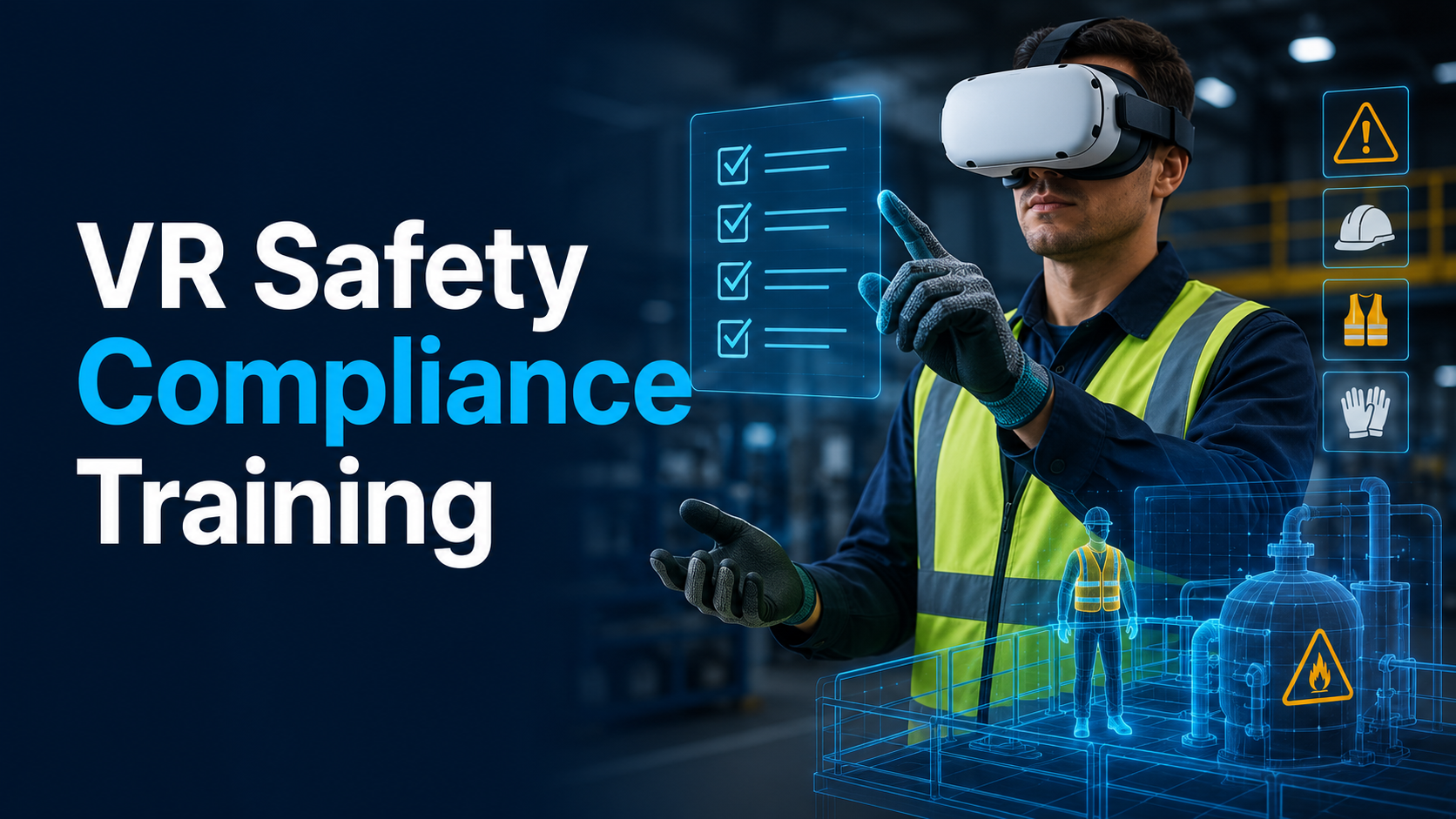
Despite mandatory OSHA training, workplace incidents cost U.S. businesses $170 billion annually. The disconnect: passive video watching and PowerPoint presentations don’t prepare workers for real hazardous situations. Here’s what safety managers tell us about their current training gaps and why immersive alternatives are becoming the compliance standard.
Why Traditional Safety Compliance Training Fails to Prevent Incidents
The $13,000 Cost of Each Preventable Incident
Every workplace incident triggers a cascade of expenses that extends far beyond the initial injury. Direct medical costs average $42,000 for serious injuries, while workers’ compensation claims add another $40,000 per incident. Legal fees for OSHA violations range from $13,494 for serious violations to $134,937 for willful or repeated violations.
The indirect costs multiply these figures by 2-4x. Production stops immediately when an incident occurs, costing manufacturers an average of $22,000 per hour of downtime. Accident investigations pull supervisors and safety personnel from productive work for 40-80 hours. Replacement workers require expedited training at overtime rates, adding $8,000-$12,000 per position.
Insurance premium increases hit the following year, with experience modification rates jumping 20-50% after recordable incidents. A company with a 1.3 EMR pays $130,000 annually for every $100,000 in standard premiums. Major incidents can push EMRs above 2.0, effectively doubling insurance costs for 3-5 years.
Reputational damage proves harder to quantify but equally devastating. Government contracts require EMRs below 1.0, automatically disqualifying companies with poor safety records. Recruitment costs increase 35% when companies develop reputations for unsafe working conditions. Customer audits flag safety violations, threatening supplier relationships worth millions in annual revenue.
Where Classroom and Video Training Falls Short
Traditional safety training achieves dismal retention rates. Workers retain only 10% of lecture content after 30 days, compared to 75% retention for hands-on practice. The forgetting curve accelerates for complex procedures—lockout/tagout sequences, confined space protocols, and emergency response steps vanish from memory without regular practice.
Muscle memory development requires physical repetition that classroom training cannot provide. Workers need 20-30 repetitions to develop automatic responses to hazardous situations. PowerPoint slides showing proper lifting technique don’t train the body’s neuromuscular system. Videos demonstrating fire extinguisher use don’t build the hand-eye coordination needed during actual emergencies.
High-risk scenarios present impossible training challenges in real environments. You cannot safely simulate a chemical spill, electrical arc flash, or fall from height. Traditional training substitutes these critical experiences with descriptions and warnings, leaving workers unprepared when real hazards emerge. First-time exposure to dangerous situations triggers panic responses that override classroom learning.
The engagement crisis compounds these limitations. Workers multitask through online safety videos, achieving 23% completion rates for modules longer than 20 minutes. Mandatory annual refreshers become compliance checkboxes rather than skill-building sessions. Safety managers report workers passing written tests while demonstrating unsafe behaviors immediately afterward.
OSHA Requirements That VR Safety Training Must Address
Virtual reality training isn’t automatically OSHA-compliant just because it’s immersive. Your VR safety program must meet specific regulatory standards for documentation, assessment, and scenario coverage. Here’s the compliance framework you need before selecting any VR training solution.
29 CFR 1910 General Industry Standards in VR
Hazard Communication (1910.1200) Scenario Requirements
VR hazard communication training must include interactive Safety Data Sheet (SDS) location exercises where workers physically search for and retrieve chemical information. Simulations need accurate label reading challenges with partially obscured or damaged labels matching real workplace conditions. Chemical compatibility scenarios should force workers to identify incompatible storage arrangements and segregate materials properly.
The VR environment must replicate your actual chemical inventory, including site-specific storage locations and container types. Workers practice emergency response procedures for your specific chemicals, not generic hazardous materials. Assessment scenarios test workers’ ability to select appropriate PPE based on SDS requirements and communicate hazards to other workers in the area.
Lockout/Tagout (1910.147) Procedure Simulation
LOTO VR modules must follow your facility’s specific energy control procedures, not generic lockout sequences. Each piece of equipment requires accurate energy source identification—electrical disconnects, pneumatic valves, hydraulic controls, and gravity hazards specific to your machines. Workers practice the complete six-step LOTO process: preparation, shutdown, isolation, lockout/tagout application, stored energy release, and verification.
Multi-person LOTO scenarios train group lockout procedures, shift changes, and outside contractor coordination. The VR system tracks each worker’s lock application and removal sequence, flagging violations like removing another worker’s lock or skipping verification steps. Emergency removal procedures require supervisor authorization within the simulation, maintaining real-world accountability.
Fall Protection (1910.28) Height Work Training
Fall protection VR training progresses through increasing complexity levels. Workers begin with ground-level harness inspection, identifying worn webbing, damaged D-rings, and compromised lanyards. Equipment selection scenarios present various anchor points, requiring workers to calculate fall distances and select appropriate connecting devices.
Elevated work simulations place workers on scaffolds, aerial lifts, and roofs with realistic depth perception and balance challenges. The VR system detects improper tie-off points, slack in lanyards, and workers moving outside protected zones. Leading edge work, hole coverage, and guardrail installation scenarios test workers’ ability to recognize and control fall hazards before beginning work.
Confined Space Entry (1910.146) Immersive Preparation
Confined space VR modules begin with permit-required vs non-permit space classification exercises. Workers evaluate atmospheric testing results, identifying oxygen deficiency, combustible gases, and toxic vapors. Entry permit completion requires checking all safety requirements: atmospheric monitoring, ventilation, communication, rescue equipment, and attendant duties.
The immersive environment simulates disorientation and restricted movement inside confined spaces. Workers practice emergency evacuation with simulated visibility reduction and obstacle navigation. Attendant training scenarios include maintaining entry logs, monitoring conditions, and initiating emergency response without entering the space.
Documentation and Certification Requirements
VR training platforms must generate OSHA-compliant documentation automatically. Each training session produces timestamped records including worker identification, module completion, assessment scores, and performance metrics. Digital certificates include unique verification codes that inspectors can validate through online portals.
Performance metrics go beyond pass/fail grades. The system tracks response times for emergency procedures, error rates for critical steps, and improvement trends across multiple attempts. Detailed analytics identify workers struggling with specific concepts, triggering additional training before incidents occur.
Refresher training schedules integrate with your safety management system. Automated notifications alert supervisors 30 days before certifications expire. The platform maintains training histories for the OSHA-required retention period, typically 3-5 years depending on the standard. Customizable compliance calendars track site-specific requirements beyond federal minimums.
Audit trails prepare you for OSHA inspections. Every training record links to the specific regulatory requirement addressed. Inspector-friendly reports summarize compliance status across all standards, highlighting overdue training and upcoming requirements. The system maintains backup documentation in multiple formats, ensuring access during technology failures.
VR Safety Training Scenarios That Reduce Incident Rates by 43%
Companies using VR for safety training report 43% fewer incidents within the first year. The key: workers practice high-risk situations repeatedly in zero-consequence environments. These are the specific VR modules that deliver measurable safety improvements based on incident data from our enterprise clients.
Construction and Height Work Simulations
Scaffold Inspection and Fall Arrest System Use
VR scaffold inspection modules train workers to identify 23 common deficiencies before climbing. The simulation presents randomly generated defects: missing guardrails, improper planking, unstable base plates, and exceeded load ratings. Workers must complete systematic inspections using virtual tags to mark hazards for correction.
Fall arrest scenarios begin with equipment inspection using the same scrutiny required for actual gear. Workers identify manufacture dates, impact indicators, and wear patterns that mandate retirement. Anchor point selection challenges present multiple options with varying strength ratings. Only properly rated anchors allow progression through the simulation.
Dynamic fall scenarios demonstrate arrest forces and swing hazards without actual exposure. Workers experience the sensation of a 6-foot fall with sudden deceleration, reinforcing proper positioning relative to anchor points. Post-fall suspension scenarios train workers to activate trauma straps and maintain circulation while awaiting rescue.
Crane Operation and Load Management
Crane VR modules train both operators and ground personnel in coordinated lifting operations. Operators practice load chart interpretation with varying boom angles, extensions, and counterweight configurations. The physics engine accurately simulates load dynamics, including side loading, shock loading, and two-blocking conditions.
Signal person training uses hand tracking to verify correct signals for hoist, boom, and swing commands. Communication scenarios include radio failures requiring transition to hand signals. Blind lift exercises train spotters to guide operators around obstacles while maintaining safe clearances from power lines and structures.
Load rigging scenarios present various materials requiring different sling configurations. Workers calculate sling angles, load distribution, and center of gravity adjustments. The simulation fails unsafe rigging attempts, showing load shifts and equipment failures that would occur with improper techniques.
Manufacturing and Machine Safety Modules
Lockout/Tagout Procedure Practice
Machine-specific LOTO modules replicate your actual equipment with photorealistic accuracy. Workers navigate to correct disconnect locations, often hidden behind panels or in separate electrical rooms. The simulation tracks whether workers verify zero energy state using appropriate meters and testing procedures.
Complex machinery with multiple energy sources challenges workers to identify all hazards. A single hydraulic press might require electrical lockout, pneumatic isolation, and hydraulic pressure release. Missing any energy source triggers a simulated injury, reinforcing thoroughness over speed.
Group lockout scenarios coordinate multiple workers and contractors. Each person applies their personal lock to group lockout boxes. Shift change procedures test communication between outgoing and incoming crews. The system flags attempts to remove locks without proper authorization or verification.
Machine Guarding Inspection
VR guarding inspection trains workers to identify missing, damaged, or bypassed guards before operation. The simulation presents subtle defects: gaps exceeding 1/2 inch, loose mounting bolts, and defeated interlocks. Workers must recognize guards that appear intact but don’t provide adequate protection for the specific hazard.
Operating scenarios demonstrate consequences of guard failures. Workers witness simulated injuries from unguarded nip points, rotating parts, and flying debris. The emotional impact of seeing virtual coworkers injured reinforces vigilance better than warning signs or safety videos.
Emergency Response and Evacuation Training
Fire Extinguisher Selection and PASS Technique
Fire response VR begins with extinguisher selection for different fire classes. Workers face kitchen grease fires, electrical panels, combustible metals, and ordinary combustibles. Selecting the wrong extinguisher type shows realistic consequences—water on electrical fires causing explosions, CO2 failing to suppress deep-seated Class A fires.
PASS technique training requires proper body mechanics tracked through motion sensors. Workers maintain correct distances, sweep at flame bases, and retreat when extinguishers empty. Multiple fire scenarios test decision-making: when to fight versus evacuate, ventilation considerations, and escape route maintenance.
Chemical Leak Containment Procedures
Chemical response scenarios begin with recognition and identification. Workers observe leak indicators: unusual odors, visible vapors, and equipment alarms. The simulation requires checking SDS information before approaching, selecting appropriate PPE, and establishing safe zones based on wind direction.
Containment procedures vary by chemical properties and leak severity. Workers practice deploying spill kits, building temporary dikes, and operating emergency shutoff valves. The VR environment simulates reduced visibility from vapor clouds and restricted movement in chemical suits, preparing workers for actual response challenges.
Renting vs Buying VR Equipment for Safety Training Programs
A 500-employee safety training program requires 20-30 VR headsets at $400-$3,000 each, plus software licensing, IT setup, and ongoing maintenance. Before committing $50,000+ in capital expenses, here’s how to pilot your VR safety program through rental to prove ROI and refine your training approach.
When Rental Makes Sense for Safety Programs
Pilot Programs to Demonstrate ROI to Leadership
Rental programs eliminate the capital expenditure barrier that delays safety innovations. A 90-day pilot with 10 headsets costs $12,000 versus $30,000 to purchase equivalent equipment. This lower entry point allows safety managers to demonstrate incident reductions and training time savings before requesting full program funding.
Leadership sees actual metrics from your workforce, not vendor case studies. Track injury rates, near-miss reports, and training completion times during the pilot. Document worker feedback and engagement scores. These site-specific results carry more weight than industry averages when justifying expanded investment.
Seasonal Workforce or Project-Based Training Needs
Construction companies hiring 200+ workers for summer projects don’t need year-round VR equipment. Rental programs scale up during peak seasons and down during slow periods. You pay for capacity when training happens, not for equipment gathering dust in storage.
Project-based training creates similar dynamics. Turnaround maintenance requiring 500 contractor orientations over two weeks demands massive VR capacity briefly. Purchasing 50 headsets for two-week annual use makes no financial sense. Rental providers deliver equipment pre-configured for your specific training modules.
Multi-Site Deployments Without Permanent IT Support
Companies with distributed locations face VR deployment challenges. Each site needs network configuration, software updates, and troubleshooting support. Rental programs include remote management and on-site technical assistance, eliminating the need for local IT expertise.
Equipment rotation between sites maximizes utilization without shipping logistics. The rental provider handles transportation, setup, and collection. Your safety team focuses on training delivery rather than equipment management. This proves especially valuable for companies with international operations facing import/export complexities.
Total Cost Comparison: 6-Month Pilot
Purchase Scenario: $75,000 Initial Investment
Hardware costs for 20 Meta Quest 3 headsets reach $14,000 at $700 each. Enterprise software licensing adds $15,000 for safety content libraries and learning management integration. Professional services for setup, configuration, and training total $10,000.
Ongoing expenses compound quickly. Monthly software subscriptions run $2,000. IT support requires 20 hours monthly at $150/hour, adding $3,000. Equipment replacement reserves accumulate at 20% annually, or $2,300 monthly. Storage cases, charging stations, and hygiene supplies add $500 monthly.
Six-month total: $39,000 initial plus $46,800 operating = $85,800
Rental Scenario: $48,000 All-Inclusive
Comprehensive rental programs cost $8,000 monthly for 20 headsets with software, support, and maintenance included. This covers enterprise-grade equipment, not consumer models. Providers handle software updates, technical support, and equipment replacement automatically.
Additional services enhance value. On-site setup and training typically included. Quarterly business reviews track utilization and ROI metrics. Equipment refresh ensures latest technology without additional investment. Hygiene supplies and charging infrastructure provided.
Six-month total: $48,000 with predictable monthly expenses
Hidden Costs of Ownership
Storage requires dedicated space with climate control and security. A 20-headset program needs 100 square feet of secure storage, costing $200-500 monthly depending on location. Charging infrastructure demands electrical upgrades and cable management systems.
Sanitization between users requires UV cabinets ($2,000) or disposable barriers ($30/month per headset). Software updates consume 4-8 IT hours monthly. Equipment failures average 15% annually, with 3-week replacement cycles disrupting training schedules.
Staff time for equipment management often exceeds direct costs. Safety managers spend 20 hours monthly on VR program administration instead of safety improvements. IT teams handle troubleshooting tickets rather than strategic projects. These opportunity costs rarely appear in budget calculations but significantly impact total program expense.
Implementation Roadmap: From Safety Audit to VR Deployment
Rolling out VR safety training requires coordination between safety, HR, IT, and operations teams. This 90-day implementation plan shows exactly how to move from initial safety gap analysis to full VR deployment with measurable compliance improvements.
Days 1-30: Safety Gap Analysis and Scenario Selection
Incident History Review and High-Risk Task Identification
Begin by analyzing three years of incident data from your OSHA 300 logs. Categorize injuries by root cause: equipment operation, hazardous energy, falls, struck-by, and caught-between. Calculate incident rates per 100 workers for each category. This data prioritizes which VR modules deliver maximum impact.
Interview workers who experienced near-misses or minor injuries. Their insights reveal hazards that don’t appear in official reports. Supervisors identify tasks where workers consistently take shortcuts or express safety concerns. These behavioral patterns indicate where immersive training changes outcomes.
Review your Job Safety Analyses for high-consequence tasks. VR excels at training low-frequency, high-risk procedures workers rarely practice. Emergency response, confined space rescue, and annual equipment certifications benefit most from immersive rehearsal.
OSHA Citation Analysis and Compliance Gaps
Examine OSHA citations from your industry sector, not just your company. The OSHA database reveals common violations competitors receive. Addressing these proactively through VR training prevents future citations. Focus on serious violations carrying $13,000+ penalties.
Map current training programs against OSHA requirements. Identify standards requiring annual refreshers, competent person designation, or hands-on demonstration. VR modules must meet or exceed these specific requirements, not approximate them.
VR Content Library Evaluation Against Your Hazards
Request demo access to vendor content libraries. Match available modules against your prioritized hazards. Generic forklift training won’t address your narrow-aisle reach trucks. Chemical handling simulations must include your specific substances.
Evaluate customization capabilities for site-specific scenarios. Your workers need to recognize your equipment, your facility layout, and your procedures. Stock content provides foundations, but customization drives behavior change. Budget 20-30% of program costs for content customization.
Days 31-60: Pilot Setup and Champion Training
Equipment Delivery and IT Integration
Schedule equipment delivery for Day 31, allowing 5 days for IT configuration. Network requirements include 50 Mbps per headset for cloud-based content or local server deployment for offline access. Guest WiFi networks often provide easier setup than corporate networks with strict security protocols.
Create dedicated training spaces with 10×10 foot clear areas per station. Install padding on walls and remove tripping hazards. Position external sensors for room-scale tracking. Mark boundaries with floor tape to prevent collisions between users.
Train-the-Trainer Sessions for Safety Team
Dedicate three days to training your safety team as VR facilitators. They must experience every module before training others. Facilitators learn to recognize and address VR discomfort, guide struggling users, and troubleshoot common technical issues.
Develop standard operating procedures for VR sessions. Document headset hygiene protocols, session scheduling, and progress tracking. Create troubleshooting guides for common problems: tracking losses, software crashes, and user discomfort. These resources ensure consistent delivery across shifts and locations.
Pilot Group Selection
Choose 30 workers representing various departments, experience levels, and technical comfort. Include safety champions who influence peers and skeptics who challenge new initiatives. Mix ages and physical capabilities to identify accessibility issues early.
Balance voluntary participants with mandatory assignments. Volunteers provide enthusiastic feedback and peer advocacy. Mandatory participants reveal resistance points and adoption challenges. This combination prepares for full-scale deployment realities.
Days 61-90: Full Deployment and Compliance Tracking
Scheduling and Rotation Planning for All Workers
Create training schedules that minimize production disruption. Run 45-minute sessions at shift changes when workers already transition between tasks. Schedule makeup sessions for absences. Build buffer time for technical issues and slower learners.
Rotate equipment between departments using a hub-and-spoke model. Central storage simplifies charging and maintenance. Department champions collect and return equipment daily. This reduces theft risk and ensures consistent availability.
Progress Tracking and Completion Certificates
Configure automatic certificate generation upon module completion. Include worker name, completion date, assessment score, and unique verification code. Store certificates in personnel files and safety management systems. Email copies to workers for personal records.
Track leading indicators beyond completion rates. Monitor assessment scores, completion times, and repeat attempts. Flag workers scoring below 80% for additional coaching. Celebrate perfect scores and fastest completion times to gamify engagement.
OSHA Documentation Preparation
Compile training records into OSHA-ready formats. Create summary reports showing compliance percentages by department and standard. Maintain detailed individual records with timestamps and assessment results. Prepare inspector-friendly binders with printed certificates and digital backups.
Document your VR training methodology for inspector questions. Explain how VR modules meet or exceed traditional training requirements. Provide vendor certifications confirming content alignment with OSHA standards. Include worker testimonials about training effectiveness.
Measuring VR Safety Training ROI: Metrics That Matter to Leadership
Safety managers need concrete numbers to justify VR training investment. These are the specific metrics our clients track to demonstrate ROI, typically showing positive returns within 6 months through reduced incidents, lower insurance premiums, and decreased training time.
Leading Indicators to Track
Near-Miss Reporting Rates
VR training typically increases near-miss reporting by 60% within three months. Workers develop better hazard recognition skills and understand why reporting matters. Track monthly reporting rates before and after VR implementation. Rising reports indicate improved safety awareness, not deteriorating conditions.
Weight near-miss quality over quantity. Categorize reports by severity potential and root cause. High-quality reports identify systemic issues rather than isolated events. VR-trained workers provide more detailed reports with specific hazard descriptions and recommended corrections.
Safety Observation Participation
Measure behavior-based safety observation participation rates. VR-trained workers complete 40% more peer observations than traditionally trained colleagues. They recognize more hazards and provide constructive feedback. Track observation quality scores and peer acceptance rates.
Document specific behaviors that improve after VR training. Proper lifting technique compliance increases from 60% to 85%. Lockout/tagout verification steps jump from 70% to 95% completion. These behavioral changes predict incident reductions before they appear in injury statistics.
Hazard Recognition Test Scores
Administer standardized hazard recognition assessments quarterly. VR-trained workers score 35% higher on photo-based hazard identification tests. They spot subtle dangers like missing machine guards, improper chemical storage, and inadequate fall protection.
Track score improvements over time. Initial VR training delivers 25-point score increases. Monthly VR refreshers maintain performance levels that traditionally decline 10% quarterly. Document score correlations with actual incident rates to validate predictive value.
Lagging Indicators and Cost Savings
OSHA Recordable Incident Rate Reduction
Calculate Total Recordable Incident Rate (TRIR) monthly to identify trends quickly. VR-trained departments typically achieve 40% TRIR reductions within six months. Compare rates between VR-trained and traditional-trained groups to isolate training impact from other safety initiatives.
Break down incidents by type to identify where VR delivers greatest impact. Struck-by incidents decrease 50% after mobile equipment VR training. Fall injuries drop 45% following height work simulations. These specific reductions guide future training investments.
Workers’ Compensation Claims Decrease
Track both claim frequency and severity. VR training reduces claim frequency by 35% and severity by 25%. Workers suffer fewer injuries and less severe injuries when incidents occur. Calculate average claim costs before and after VR implementation.
Monitor claim closure rates and return-to-work timelines. VR-trained workers return to full duty 5 days faster on average. They better understand injury prevention and recovery procedures. Document these improvements for insurance negotiations.
Insurance Premium Adjustments
Work with your insurance broker to quantify premium impacts. Experience Modification Rate improvements of 0.1 save $10,000 annually per $100,000 in premiums. VR training documentation supports premium credit applications worth 5-10% additional savings.
Calculate total cost of risk beyond premiums. Reduced deductible payments, lower legal costs, and decreased administrative burden compound savings. A comprehensive VR safety program can reduce total cost of risk by 20-30% within two years.
Frequently Asked Questions
Is VR safety training OSHA approved?
OSHA doesn’t explicitly approve or disapprove VR training methods. The agency requires employers to train workers to recognize and avoid unsafe conditions using training methods appropriate for the situation. VR training meets OSHA requirements when it adequately addresses the specific hazards and includes proper documentation, assessment, and hands-on components where required. Several OSHA regional offices have issued interpretation letters confirming VR training acceptability for specific standards when combined with appropriate evaluation methods.
How many VR headsets do I need for 500 employees?
For 500 employees requiring annual 4-hour safety training, 20-25 headsets enable completion within 3 months. This assumes 6-hour daily utilization, 45-minute sessions, and 20% buffer for technical issues and scheduling conflicts. High-risk industries requiring monthly training need 30-35 headsets. Companies can reduce requirements by 40% using rental programs that scale capacity during peak training periods.
Can VR training replace hands-on safety certification?
VR training cannot completely replace hands-on certification for certain OSHA requirements. Powered industrial truck operation, crane operation, and respiratory protection require actual equipment demonstration. However, VR effectively supplements hands-on training by providing unlimited practice opportunities, hazard recognition skills, and emergency response preparation. Use VR for initial training and periodic refreshers, with hands-on evaluation for final certification.
What’s the typical ROI timeline for VR safety training?
Companies typically achieve positive ROI within 6-9 months through incident reduction and training efficiency gains. A 30% reduction in recordable incidents saves $195,000 annually for a 500-employee manufacturer. Training time reductions of 40% save 8,000 labor hours yearly. Insurance premium improvements and compliance violation avoidance accelerate payback to 4-6 months for high-risk industries.
Do workers need VR experience to complete safety training?
No prior VR experience is necessary. Modern VR interfaces require minimal instruction—workers learn basic controls in 5-10 minutes. Initial sessions include comfort adjustment and motion sickness prevention guidance. 95% of workers successfully complete VR training on their first attempt. Provide alternatives for the 5% who experience persistent VR discomfort, typically older workers with vestibular conditions.
How do we track OSHA compliance in VR training programs?
VR platforms automatically generate compliance reports showing training completion by worker, department, and OSHA standard. Digital dashboards display real-time compliance percentages and upcoming requirement deadlines. Export functions create OSHA-ready documentation for inspections. Integration with existing Learning Management Systems maintains centralized training records. Automated alerts notify supervisors of overdue training before violations occur.
Conclusion: Taking Action on VR Safety Compliance Training
The evidence is clear: traditional safety training methods fail to prevent the $170 billion in annual workplace incidents. VR safety training delivers 43% incident reductions, 75% knowledge retention, and positive ROI within 6 months. The technology exists, the compliance framework is established, and rental programs eliminate capital barriers.
Your next step depends on your organization’s readiness. If leadership needs proof, start with a 90-day pilot program using rented equipment. Focus on your highest-risk tasks and track specific metrics that resonate with executives. If you’re ready for full implementation, use this guide’s roadmap to coordinate your safety, HR, and IT teams.
The question isn’t whether to implement VR safety training, but how quickly you can deploy it before the next preventable incident. Every month of delay represents continued risk exposure and missed opportunities for safety improvement.
Ready to explore VR safety training for your organization? Contact our team for a customized implementation assessment. We’ll analyze your specific OSHA requirements, calculate potential ROI based on your incident history, and design a pilot program that proves value without capital investment. Schedule your consultation today and join the companies transforming safety compliance through immersive training.