

“How much does a virtual tour cost?” sounds like a simple question. Then you start getting quotes and see $300 from one company and $7,000 from another, and it’s hard to tell whether you’re comparing the same thing.
We build 360° virtual tours for venues, facilities, hotels, and public projects. Here’s a plain-spoken breakdown of what drives the price, what you’ll pay after launch, and how to get a quote you can actually compare.
Quick answer: A virtual tour costs anywhere from a few hundred dollars for a basic 360° tour of a home to $5,000 or more for a large commercial property. Price depends on how many scenes you need, how interactive and branded the tour is, where it will be viewed (web, phone, VR headset), and ongoing hosting fees.
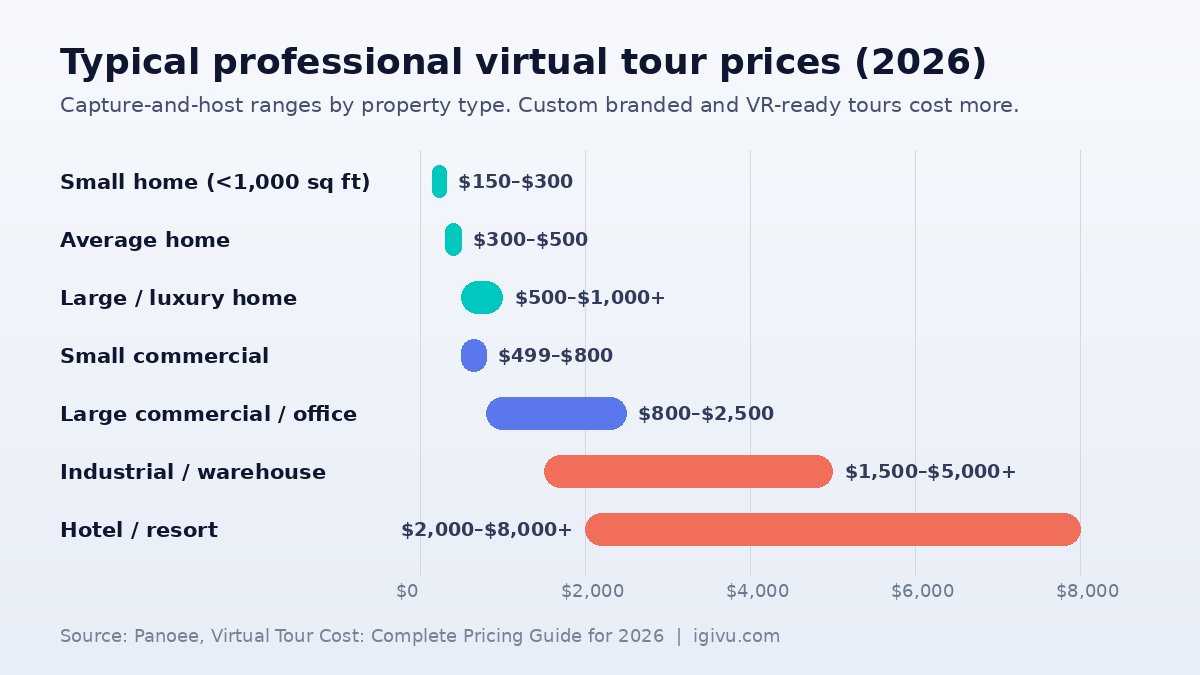
How much does a virtual tour cost in 2026?
Most professional virtual tours fall between about $150 and $8,000, and property type is the biggest single factor. Homes sit at the low end, while hotels, campuses, and industrial sites sit at the high end.
Here are typical agency price ranges published in Panoee’s 2026 pricing guide (Panoee):
| Property type | Typical professional price |
|---|---|
| Small home (under 1,000 sq ft) | $150–$300 |
| Average home (1,000–3,000 sq ft) | $300–$500 |
| Large or luxury home | $500–$1,000+ |
| Small commercial (retail, restaurant) | $499–$800 |
| Large commercial or office building | $800–$2,500 |
| Industrial or warehouse | $1,500–$5,000+ |
| Hotel or resort (full property) | $2,000–$8,000+ |
Those numbers mostly describe capture-and-host: someone photographs the space, stitches it, and sends a link. Add custom branding, narration, hotspots, or headset delivery, and you’re buying a different product.
What’s the difference between a 360° tour, a 3D scan, and a custom VR tour?
They answer different needs. A 360° tour links panoramic photos together, a 3D scan (like Matterport) builds a measurable model of the space, and a custom tour adds your branding, story, and interactivity on top.
- 360° photo tour: Visitors jump from spot to spot and look around. It’s fast to produce, works on any device, and is the most common choice for listings and small businesses.
- 3D scan / digital twin: A LiDAR or depth camera captures geometry, so you get a “dollhouse” view, floor plans, and measurements. It’s great for real estate, construction, and facilities teams, and usually comes with a monthly platform subscription.
- Custom branded tour: Built on high-quality 360° HDR photography with branded hotspots, text or voiceover, calls to action, and delivery on web, mobile, and VR headsets. This is what businesses use for sales, recruiting, training, and events, where the tour has to tell a story, not just show rooms.
If you’re not sure which one you need, our guide on how to create a virtual reality tour for your business walks through the options.
What drives the price of a virtual tour?
Scope drives price: the number of scenes, the amount of custom work inside each scene, and how many places the tour has to run. Square footage matters less for business tours than it does for homes.
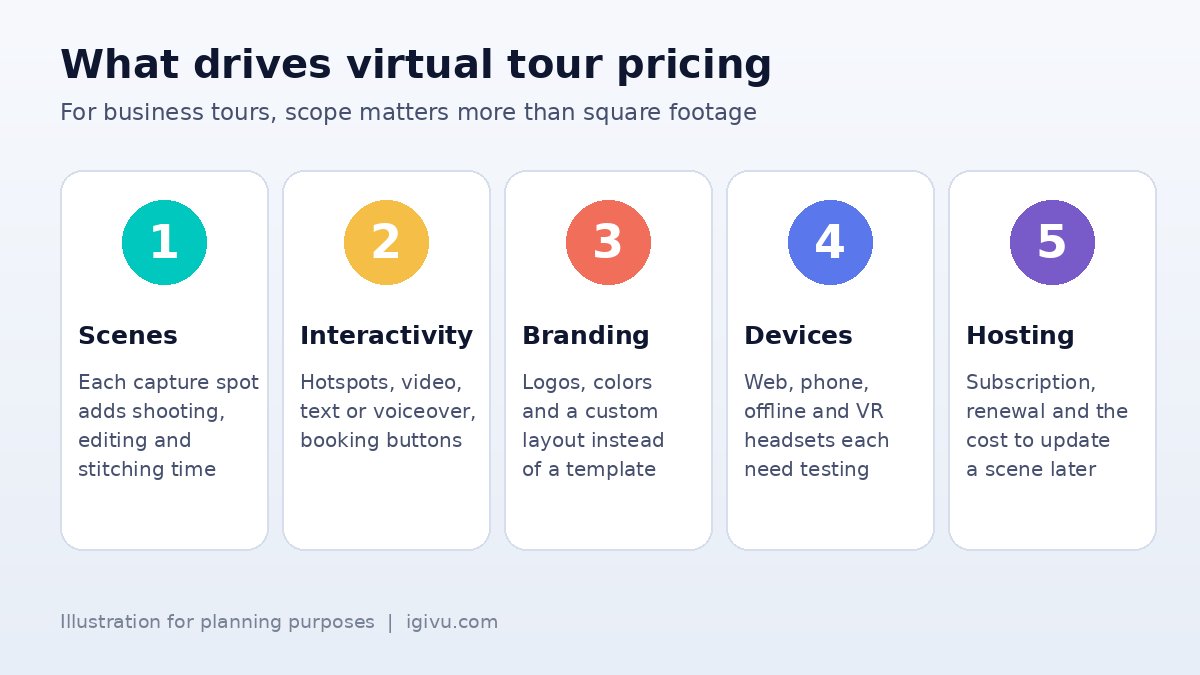
- Number of scenes (spots). Every capture point means shooting, editing, and stitching time. A hotel might only need the lobby, pool, restaurant, and two room types, while a plant tour may need dozens of stops.
- Interactivity. Info hotspots, embedded video, text or voiceover narration, and “book now” buttons all take design and build time.
- Branding and design. Custom colors, logos, navigation, and layout make the tour feel like part of your brand instead of a generic template.
- Where it will be viewed. A web link is the baseline. Tours that also have to work offline or inside VR headsets need extra optimization and testing.
- Hosting and updates. Where the tour lives after launch, and what it costs to update a scene, is the most overlooked line item.
Are there monthly or hosting fees for a virtual tour?
Often, yes. Many tours live on a subscription platform, so budget for hosting after the first year and ask who owns the files if you stop paying.
This got more important this month. In October 2026, Matterport dropped its Starter and Business plans and repriced its Professional plan by number of active spaces. Entry now starts at 10 spaces for $90 a month billed annually ($108 month to month), and the free plan card was removed from its pricing lineup (PricingSaaS; current plans on Matterport). Existing subscribers can keep legacy plans, but new budgets should recheck the numbers.
Questions to ask any vendor about ongoing costs:
- Is hosting included? For how long, and what does renewal cost?
- Does the tour go dark if the subscription lapses?
- Can I get an offline version for trade shows or places with poor Wi-Fi?
- What does it cost to update one scene after a remodel?
How much does an IGIVU virtual tour cost?
IGIVU publishes starting packages on our virtual tour services page: a Starter Tour at $4,000, a Professional Tour at $7,000, and fully custom Enterprise tours by quote. Each one is a branded, interactive tour built for business use, not a quick listing scan.
| Package | Listed price | What’s included |
|---|---|---|
| Starter Tour | $4,000 | Up to 15 spots, text and voiceover options, accessible online and offline, platform integration, unlimited revisions |
| Professional Tour | $7,000 | All standard features plus one day of on-site support, four ready-to-use Meta Quest 3 headsets, and one Cleanbox sanitizing system |
| Enterprise Tour | Custom quote | Built to your needs: branded interface, gamification and real-time feedback, interactive audience tools |
Every IGIVU tour includes 360° HDR photography, stitching, branded hotspots, hosting, and delivery on desktop browsers, iOS and Android phones, and VR headsets including Meta Quest 2, Meta Quest 3, and Apple Vision Pro. No app download is needed. Most tours take 7 to 14 days from photography to final delivery. Larger multi-facility projects, or tours that need 3D models or custom VR content, can take 2 to 4 weeks. If you renovate later, we can update the affected scenes without rebuilding the whole tour.
Want to see one first? Try our example virtual tour.
Why would a business tour cost more than a $300 real estate tour?
Because it does a different job and stays useful much longer. A home listing tour usually needs to work for a few months. A venue, campus, plant, or hotel tour may be used for years in sales calls, recruiting, onboarding, and events, so the extra design, narration, and multi-device delivery pay off over a longer life.
Can people view the tour in a VR headset at an event?
Yes, and it works well at trade shows, investor events, and groundbreakings. For IREN’s Nasdaq event, IGIVU supplied 120 Meta Quest 2 and Quest 3 headsets, each preloaded with an immersive virtual tour. If you need more headsets than a package includes, you can rent Meta Quest headsets or Apple Vision Pro for a premium demo.
Is a virtual tour worth the cost?
It’s worth it when people need to understand a space before they commit, such as booking a venue, touring a facility, choosing a senior living community, or leasing property. It’s harder to justify if few people ever need to see the space.
Platform data points the same way. CoStar’s CEO said on the company’s Q1 2026 earnings call that listings with a Matterport tour get about 30 times the views and 56 times more tour requests (The Motley Fool transcript). That’s a vendor’s own real estate figure, so treat it as directional.
Good fits include:
- Event venues, hotels and resorts, and country clubs selling to planners who can’t visit
- Manufacturing and industrial facilities used for safety orientation, vendor walkthroughs, or recruiting
- Assisted living, schools, and campuses where families compare options from home
- Public projects and groundbreakings. The City of Santa Monica used an IGIVU 360° tour and WebAR experience at its Big Blue Bus charging groundbreaking, as featured on our virtual tour page.
How do you get an accurate virtual tour quote?
Give the vendor a clear scope up front: the spaces and number of stops, who will view the tour and on what devices, and how long it needs to stay live. You’ll get a firm number faster and avoid surprises later.
- List the areas to show and estimate the number of stops.
- Choose extras: voiceover, text, video, booking buttons.
- Note where it will run: website, sales laptops, VR headsets at events.
- Share your deadline. Leave 2 to 4 weeks for larger projects.
For a deeper look at using tours with headsets, see our virtual tour VR rentals guide, and for property marketing, our virtual tours for real estate guide.
Frequently asked questions
How much does a 360 virtual tour cost?
A basic professional 360° tour of a home typically costs $150 to $1,000 depending on size, and small commercial spaces often run $499 to $800, per Panoee’s 2026 guide. Branded business tours with narration, hotspots, and VR headset delivery cost more. IGIVU’s Starter Tour is listed at $4,000 for up to 15 spots.
How much does a Matterport tour cost per month?
Since Matterport’s October 2026 pricing change, its Professional plan starts at 10 active spaces for $90 a month billed annually, or $108 month to month, with higher tiers for more spaces. That’s the platform fee. Paying a photographer to scan the space is separate.
Do virtual tours have ongoing hosting fees?
Many do. Some vendors include hosting for a set period and then charge renewal, and subscription platforms bill monthly or yearly. Always ask what happens to the tour if you stop paying, and whether you can get an offline copy.
How long does it take to create a virtual tour?
Most IGIVU tours take 7 to 14 days from photography to final delivery. Larger multi-facility tours, or tours that need 3D models or custom VR content, can take 2 to 4 weeks.
Can a virtual tour be viewed on a VR headset?
Yes. IGIVU tours run in desktop browsers, on iOS and Android phones, and on VR headsets including Meta Quest 2, Meta Quest 3, and Apple Vision Pro, with no app download needed.
Are virtual tours worth it for a business?
Yes, when customers, recruits, or partners need to understand a space before deciding. A tour used for years across sales, training, and events spreads its cost over many uses.
Ready to price your virtual tour?
IGIVU has served 3,000+ organizations nationwide from our Dallas headquarters, with VR, AR, virtual tours, and immersive training. Tell us about your space, how many stops you need, and where people will view the tour, and we’ll send a clear quote in under 24 hours.
Get your free virtual tour quote or email [email protected].