Every exhibitor wants people who stop, stay long enough to talk, and leave their contact details. A good booth game does all three. VR and AR games are the headline act at tech-heavy shows, but they also have a reputation for long lines.
This guide covers ten VR and AR trade show booth games that work, how to keep the queue moving, the show rules to check, and what it costs to rent them for CES 2027 and the early-2027 show season.
Quick answer: The best trade show booth games are short (60 to 90 seconds), easy to watch from the aisle, built around your product, and tied to a leaderboard that collects the lead. VR and AR games draw the biggest crowds when you run several headsets at once, cast the action to a big screen, and keep the queue inside your booth.
What makes a trade show booth game work?
A booth game works when it is fast, fun to watch, and connected to your product, with lead capture built into the scoring.
- Short rounds. Leaderboarded recommends rounds under two minutes, and The Well Played Awards points to 30- to 60-second turns in successful booth games such as AWS’s Defense Decoder at re:Invent (Leaderboarded, The Well Played Awards).
- Watchable from the aisle. In VR, cast the headset view to a large screen.
- Your product inside the game. The score should give your rep an easy opener.
- Lead capture at the score. People share details willingly to get on the leaderboard.
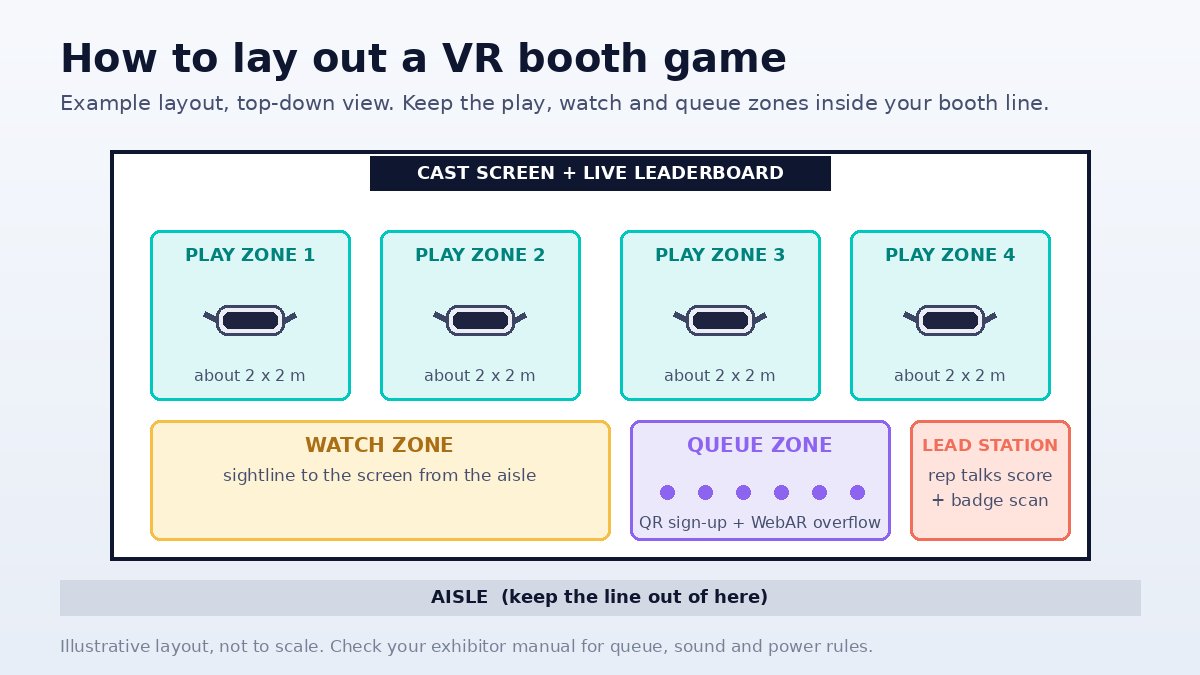
- Room to play, watch, and wait. Plan a play zone, a watch zone, and a queue zone inside your booth line (Innovate 3D).
What are the best VR and AR trade show booth games?
The best VR and AR booth games can be explained in one sentence and finished in about a minute. Here are ten formats that fit most booths.
| Booth game idea | Best for | Typical round | Hardware |
|---|---|---|---|
| 1. 60-second branded VR challenge | Product launches, tech brands | 60–90 sec | Meta Quest 3 or 3S |
| 2. VR sports skill leaderboard | High-traffic halls, any industry | 60–90 sec | Meta Quest 3 or 3S |
| 3. Mixed reality “product in the room” hunt | Equipment and industrial products | 60–120 sec | Meta Quest 3 (passthrough) |
| 4. Driving simulator time trial | Automotive, insurance, fleet, safety | 90–120 sec | Headset plus wheel rig |
| 5. Head-to-head VR duel | Competitive crowds, sales teams | 60–90 sec | Two networked headsets |
| 6. Co-op “defuse the bomb” challenge | Teamwork and communication brands | 2–3 min | One headset plus a printed manual |
| 7. WebAR QR scavenger hunt | Overflow from the line, the whole show floor | Self-paced | Visitors’ own phones |
| 8. AR try-on or photo moment | Consumer brands, social sharing | 30–60 sec | Tablet, phone, or screen |
| 9. AR glasses “spot the feature” tour | Product walk-throughs, guided demos | 2–3 min | XREAL or Ray-Ban Meta glasses |
| 10. Apple Vision Pro VIP demo | Executive meetings, key accounts | By appointment | Apple Vision Pro |
1. 60-second branded VR challenge
A custom mini-game built around your product, such as assembling it against the clock, is the strongest option when the product story matters. Custom branded VR content loads onto rental headsets.
2. VR sports skill leaderboard
A ready-made sports game, such as table tennis or baseball batting, draws a crowd with no custom development. Score it and reset the board daily. Browse our XR experience library.
3. Mixed reality “product in the room” hunt
On a Meta Quest 3, passthrough lets players see the real booth while virtual parts appear around them, which feels safer for first-timers. See mixed reality rentals.
4. Driving simulator time trial
A wheel, a seat, and a lap timer create a fiercely competitive leaderboard. IGIVU has built VR driving simulations, including a light, gamified one for World Insurance with billboards showing insurance and safety facts along the route.
5. Head-to-head VR duel
Two players compete side by side while the crowd picks a favorite. Duels double your throughput per round.
6. Co-op “defuse the bomb” challenge
One visitor wears the headset while a teammate reads a printed manual aloud, as in Keep Talking and Nobody Explodes. Great for pairs, but rounds run longer.
7. WebAR QR scavenger hunt
Visitors scan a QR code and play on their own phones, with no app. It is the perfect overflow when headsets are busy. IGIVU builds WebAR experiences from $2,000.
8. AR try-on or photo moment
A virtual try-on or branded AR photo gives people something to share. Email or text the photo to capture the lead.
9. AR glasses “spot the feature” tour
Visitors wear lightweight AR glasses and find labeled features on a real product, guided by a rep. Rent XREAL glasses or Ray-Ban Meta glasses.
10. Apple Vision Pro VIP demo
Save the premium headset for booked time slots with key accounts, which turns a demo into a meeting. See Apple Vision Pro rentals.
How many VR headsets do you need for a booth game?
Most booths need three to four headsets to keep a steady line moving with 90-second rounds. Each headset handles about 24 players an hour if a round lasts 90 seconds and the changeover (fitting, wiping, and a quick briefing) takes about a minute.
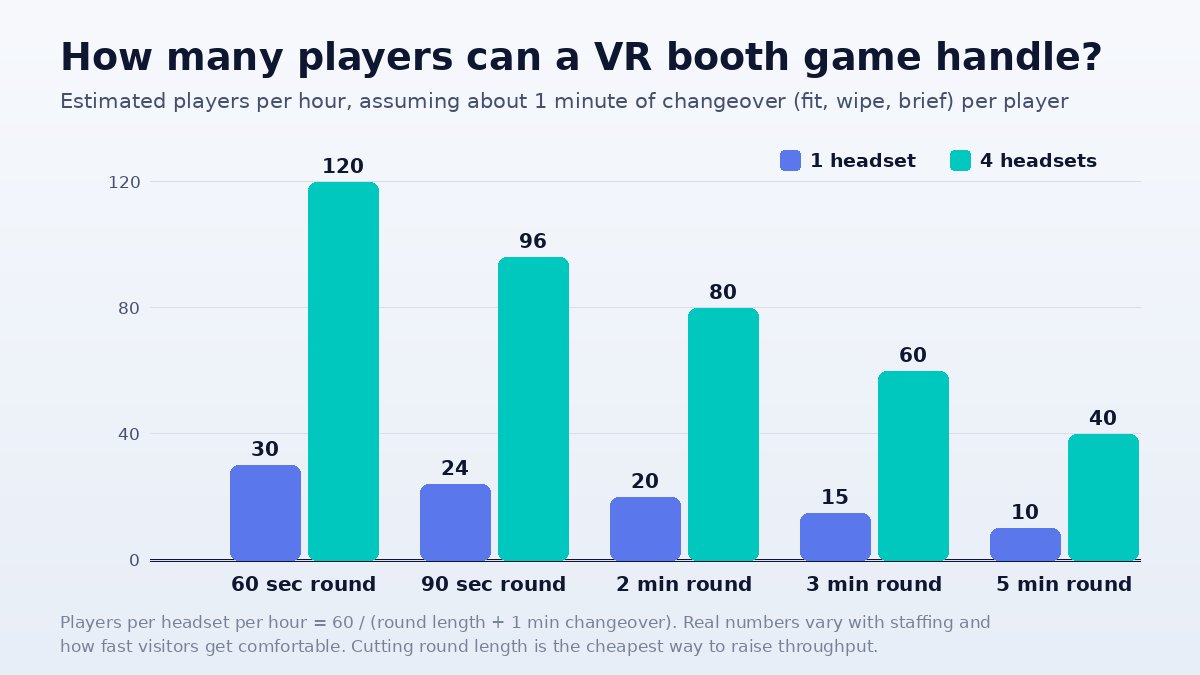
Round length matters more than headset count. A three-minute game with the same changeover drops to about 15 players per headset per hour, and a five-minute game to about 10. That is why some guides call VR slow. Shorter rounds fix most of it.
- Plan one staff member per two headsets, plus one person on the line and leaderboard.
- Keep a charged spare headset. Long show days drain batteries.
How do you capture leads from a VR booth game?
Make the leaderboard the lead form. Visitors scan a badge or QR code to enter their details, play, and see their score on the big screen. Then a rep picks up the conversation from the result.
Plan for drop-off. The Well Played Awards reports that the U.S. Air Force’s touring VR experience drew more than 12,000 people to the line, with 5,282 opting in and 1,453 becoming actual leads (The Well Played Awards). A small prize for every finisher and a bigger one for the daily leader keep players coming back.
What show rules should you check before you plan a booth game?
Check your exhibitor manual for sound, queuing, prize, and internet rules before you lock in a game. These catch interactive booths most often (Innovate 3D):
- Sound: IAEE guidelines suggest staying under 85 decibels measured from the aisle, and NAB Show’s 2026 rules set 80 decibels with speakers facing into the booth.
- Lines: Queues generally have to stay inside your booth footprint, not in the aisle.
- Prizes in Las Vegas: The Las Vegas Convention Center directs gaming and raffle questions to the Nevada State Gaming Control Board. A game of skill, or a small gift for every player, is simpler than a drawing.
- Internet: Don’t rely on show Wi-Fi for anything that must work. Order a wired connection early, and ask your VR provider for experiences that run offline.
How much does a VR or AR booth game cost?
For a single show, renting is usually far cheaper than buying. Starting prices from our VR headset rental page and service pages:
- Meta Quest 3S: from $60 per headset
- Meta Quest 3: from $90 per headset
- Apple Vision Pro: from $550 per headset
- AR event rentals: from $500 per device for a single event, or from $1,500 per event with an on-site technician (AR rentals for events)
- Custom branded VR content: from $2,000 (Meta Quest rentals)
Renting also avoids an aging-hardware problem. Meta says Quest 2 and Quest Pro get their final operating system feature update between January and March 2027, with security fixes through December 2027 (Meta). For a 2027 booth, Quest 3 or 3S is the safer pick, and renting keeps you on current hardware.
IGIVU rentals ship pre-configured and content-loaded, arrive two to three days early, and include a return label and damage insurance. On-site technicians are available nationwide.
When should you book a VR booth game for CES 2027?
Book in November or early December. CES 2027 runs January 6–9 in Las Vegas (CES), and rental headsets ship two to three days early, which puts delivery right after the New Year holiday.
- Now to mid-November: Choose your game format and brief any custom content.
- Early December: Lock your headset count, on-site support, and booth layout.
- Mid-December: Test the experience and the leaderboard before the holiday break.
- January 2–3: Headsets arrive. Run a full rehearsal at the booth.
Planning a different show? Work backward the same way. Our trade show VR rentals page covers packages, and our guide to trade show activations goes deeper on booth traffic and ROI.
Frequently asked questions
What games attract people to a trade show booth?
Games that are fun to watch draw the biggest crowds: VR challenges cast to a big screen, racing simulators, reaction games, and head-to-head duels. A visible leaderboard shows the score to beat.
How long should a trade show booth game last?
Aim for 60 to 90 seconds, and no more than two minutes. Short rounds keep the line moving and leave time for a conversation afterward.
Is VR a good idea for a small 10×10 booth?
Yes, if you plan the space. Leaderboarded suggests about 2 by 2 meters plus clearance per VR station, so one or two standalone headsets, a cast screen, and an in-booth queue can fit. Passthrough helps players stay aware of the booth.
Can we run a prize drawing at a Las Vegas trade show booth?
Check first. The Las Vegas Convention Center directs gaming and raffle questions to the Nevada State Gaming Control Board, and your show may have its own rules. A game of skill or a small gift for every player is simpler.
Do VR headsets need Wi-Fi at a trade show?
Not always. Many experiences run offline on standalone headsets like Meta Quest 3; ask your provider. If your game uses a live online leaderboard, order a wired connection rather than relying on show Wi-Fi.
Ready to plan your booth game?
IGIVU has served 3,000+ organizations with VR and AR rentals, custom content, and on-site support nationwide. Tell us your show, booth size, and dates, and we’ll recommend a game, headset count, and package. Request a quote and you’ll hear back in under 24 hours, or email [email protected].