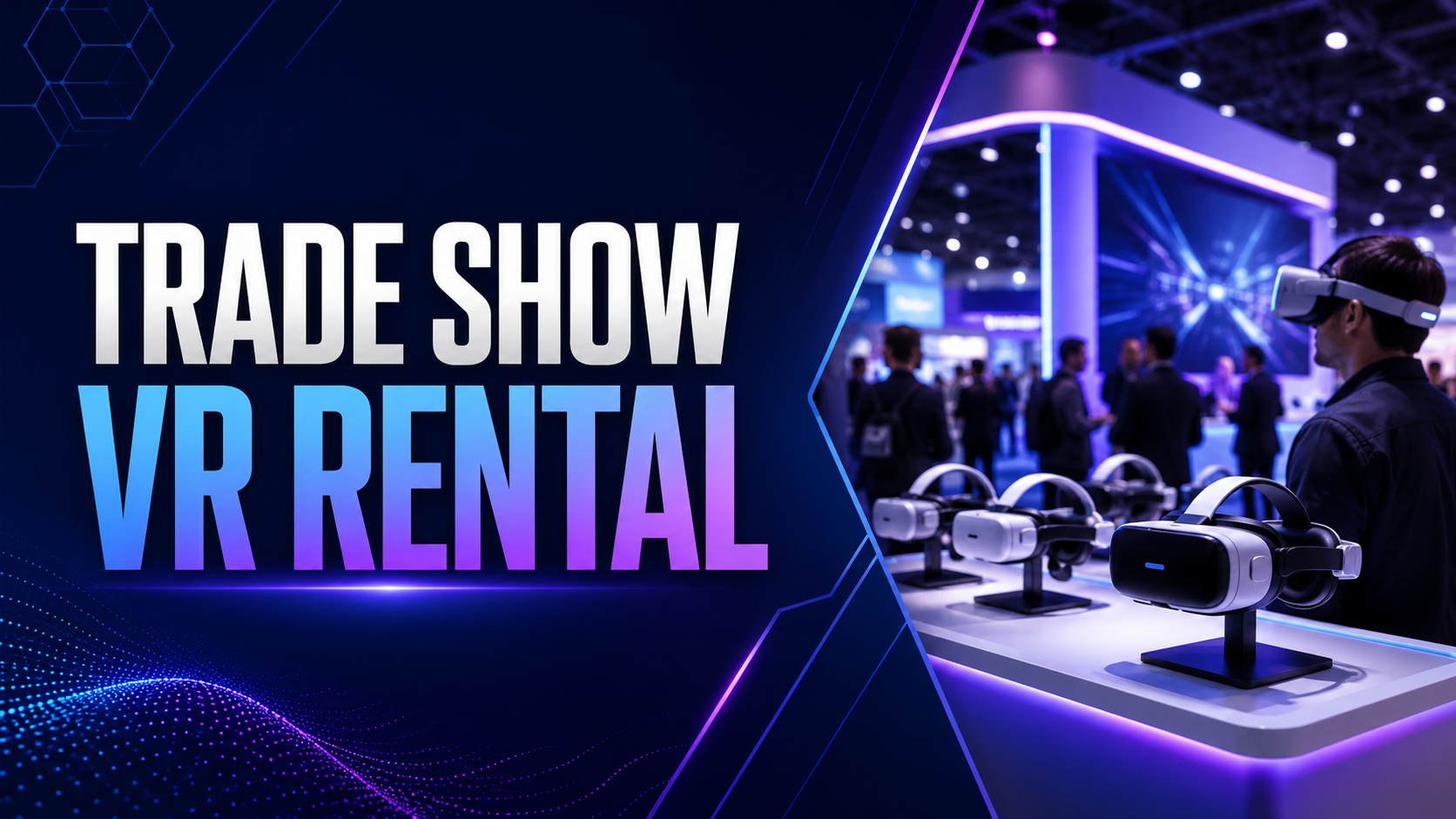
Virtual reality transforms trade show booths from passive displays into memorable experiences that attendees actively seek out. However, implementing VR at exhibitions requires careful planning around equipment selection, spatial constraints, and operational logistics that differ significantly from permanent installations.
This guide walks through the complete VR rental process for trade shows, from initial equipment selection through post-show lead analysis. Whether you’re planning your first VR activation or optimizing an existing strategy, you’ll find practical guidance for maximizing engagement while managing the unique challenges of exhibition environments.
Trade Show VR Rental Equipment Selection
Choosing VR equipment for trade shows requires balancing immersion quality with practical booth constraints. Your hardware selection impacts everything from booth traffic flow to staff requirements.
Standalone vs. Tethered Headsets for Trade Shows
Meta Quest 3 dominates trade show rentals for good reason. The standalone design eliminates trip hazards from cables, reduces setup time to under 10 minutes per station, and operates without external computers. Most exhibitors can run full-day demos on two battery packs per headset, swapping during lunch breaks.
Tethered systems justify their complexity for specific industries. Automotive configurators benefit from high-end graphics cards rendering photorealistic vehicles in real-time. Architecture firms showcasing building walkthroughs need the processing power for detailed environments. Medical device companies demonstrating surgical procedures require the precision tracking of lighthouse-based systems.
Power requirements vary dramatically between configurations. Standalone headsets need standard 110V outlets for charging stations—typically one duplex outlet per two headsets. Tethered systems require dedicated 20-amp circuits for gaming PCs, plus additional outlets for monitors and accessories. Convention centers charge $300-500 per dedicated circuit, making standalone systems significantly more cost-effective.
Multi-day shows demand backup equipment. Plan for one backup headset per four active units, plus spare batteries, facial interfaces, and controllers. Equipment failures typically occur during peak traffic periods when immediate replacement prevents booth disruption.
Multi-Station Booth Configurations
Single demo stations work for booth sizes under 20×20 feet or when showcasing lengthy, complex experiences. The focused approach allows staff to provide personalized attention and qualify leads during the experience.
Multiple concurrent stations become necessary when expecting over 200 visitors daily. Calculate headset requirements using this formula: (Expected daily visitors ÷ demos per hour ÷ operating hours) × 1.5 buffer. A booth expecting 500 daily visitors running 5-minute demos needs minimum four stations to avoid excessive queuing.
Hygiene stations require dedicated table space between demo areas. Stock antibacterial wipes, disposable face masks, and UV sanitizers. Position hygiene stations within sight lines of waiting attendees to demonstrate safety protocols. Budget 2-3 minutes between users for proper sanitization.
Audio presents unique challenges in 2,000-person exhibition halls. Over-ear headphones provide better isolation than standard VR audio but add hygiene complexity. Consider single-use headphone covers ($0.50 each) or bone conduction add-ons that don’t contact ears. For demos requiring spatial audio, use directional speakers aimed at the play area rather than competing with ambient noise.
Trade Show VR Rental Pricing and Packages
Trade show VR rentals typically run 3-5 days including setup/breakdown days. Understanding package structures helps you budget accurately and avoid surprise charges.
Typical Trade Show Rental Pricing Models
Daily rental rates for trade shows average 20-30% higher than standard corporate rentals due to specialized support requirements. Meta Quest 3 headsets rent for $150-200 per day with 3-day minimums. Weekly exhibition packages offer better value at $600-800 per headset, including setup and breakdown days.
Technical support fees add $1,500-2,500 per day for on-site technicians. Smaller activations might use remote support at $500-750 per day, though this requires confident internal staff for basic troubleshooting.
Shipping costs to convention centers include special handling fees. Budget $200-300 per headset for round-trip shipping to major venues. Las Vegas properties add receiving fees of $150-250 per shipment. International shows require customs brokerage, adding $500-1,000 to total logistics costs.
Insurance options include basic damage waivers ($50-75 per headset) covering normal wear or comprehensive coverage ($150-200 per headset) including theft and accidental damage. Most exhibitors choose comprehensive coverage given the chaotic nature of breakdown periods.
What’s Included in Trade Show VR Packages
Standard packages include headsets, controllers, and basic charging cables. Premium packages add tablet-based control interfaces, multi-port charging stations, and equipment cases doubling as booth storage.
Content services vary significantly between providers. Basic packages include pre-loaded demo experiences from libraries of generic content. Custom content development starts at $5,000 for simple brand overlays on existing experiences, reaching $50,000+ for bespoke interactive experiences.
Lead capture integration comes standard with enterprise packages. Systems capture viewing time, interaction points, and completion rates. Advanced analytics packages ($500-1,000 additional) provide heat mapping, gaze tracking, and comparative engagement metrics.
On-site support packages typically guarantee 30-minute response times during show hours. Premium support ($500-750 extra per day) provides dedicated technicians stationed at your booth during peak periods.
Booth Space Planning for VR Activations
VR experiences require specific spatial considerations that differ from traditional booth displays. Planning your footprint prevents day-of setup problems and ensures smooth attendee flow.
Minimum Space Requirements
Each VR station needs 6×6 feet minimum for safe operation. This accounts for arm movements during interactions and prevents users from hitting booth structures or other attendees. Corner booth locations provide natural boundaries on two sides, reducing space requirements to 5×5 feet per station.
Guardian boundaries require careful calibration in confined spaces. Set boundaries 18 inches inside physical barriers to account for arm reach. Use portable stanchions with retractable belts to create visible boundaries that match virtual guardians. Bright LED rope lights on the floor provide visual cues without creating trip hazards.
Tethered systems need 8×8 feet per station plus dedicated cable runs. Overhead cable management systems cost $200-300 per station but eliminate trip hazards. Floor cable covers work for single-day events but deteriorate during multi-day shows with heavy foot traffic.
Spectator displays multiply engagement beyond active users. Wall-mounted 55″ monitors showing the VR perspective require 3 feet of clearance for viewing. Position displays at 6-7 feet height to maintain visibility over crowds while preserving booth floor space.
Booth Layout Optimization
Create distinct zones for queuing, active play, and observation. Linear flow patterns work best: entry → registration → waiting → VR experience → debrief → exit. This prevents congestion and maintains consistent throughput.
Queue management becomes critical during peak periods. Digital sign-up systems using tablets allow attendees to reserve slots and explore other booth areas. QR code scheduling lets visitors register remotely and return at designated times, reducing physical queuing.
Traditional display elements should complement, not compete with VR stations. Position product displays and graphics along the queue path, providing engagement during wait times. Keep literature racks and giveaway stations at booth exits to avoid disrupting traffic flow.
Storage solutions prevent equipment damage during off-hours. Locking road cases double as demo podiums during show hours. Under-table storage bins hold spare batteries, cleaning supplies, and backup equipment while maintaining clean sight lines.
Managing VR Demos During the Show
Successful VR booth activations require active management of both the technology and attendee experience. These operational strategies maximize engagement while maintaining demo quality.
Demo Rotation and Timing
3-5 minute experiences optimize trade show throughput. Shorter demos feel rushed; longer experiences create prohibitive queues. Build in natural break points at 3 minutes for staff to gauge interest and extend for qualified prospects.
Appointment scheduling works for enterprise software or complex B2B products where quality matters more than quantity. Use 15-minute slots: 2 minutes for introduction, 8 minutes in VR, 5 minutes for discussion and lead capture.
Walk-up management suits consumer products or brand awareness campaigns. Implement a token system during peak times—distribute numbered tokens hourly to manage expectations and prevent line-jumping.
Peak traffic patterns are predictable: 10-11 AM as attendees arrive, 2-3 PM post-lunch, and final hour for prize drawings. Schedule double staffing during these periods. Use morning lulls for equipment maintenance and battery swaps.
Reset procedures should take under 30 seconds. Create laminated checkpoint cards listing: headset power check, controller pairing verification, experience reset to start screen, and hygiene completion. Train staff to perform resets while maintaining visitor engagement through conversation.
Staff Training Requirements
Booth staff need 4 hours minimum of hands-on training before show opening. Cover headset adjustment for different head sizes, IPD (interpupillary distance) adjustment for visual comfort, and controller strap positioning.
Troubleshooting skills prevent minor issues from disrupting demos. Staff should master: reconnecting dropped controllers, clearing guardian history when boundaries glitch, force-restarting frozen applications, and switching between multiple pre-loaded experiences.
Comfort adjustments dramatically impact experience quality. Train staff to recognize discomfort signs: frequent headset touching, shortened demo engagement, or balance issues. Quick adjustments to strap tension or facial interface position resolve most problems.
Lead qualification happens during natural VR moments. While users explore virtual environments, staff should observe interaction patterns, note specific interest areas, and prepare relevant follow-up questions for post-demo discussion.
VR Content Strategy for Trade Shows
The VR experience you choose directly impacts booth engagement and lead quality. Trade show content must balance entertainment value with business messaging.
Product Demonstration Experiences
Interactive product tours let prospects explore products impossible to transport. Industrial equipment manufacturers showcase factory-sized machines. Furniture companies display entire room collections. Software companies visualize data flows and system architectures.
Virtual facility tours bring remote locations to the show floor. Manufacturing plants demonstrate production processes. Real estate developers showcase properties under construction. Logistics companies illustrate global supply chains.
Before/after visualizations prove product value instantly. Medical devices show surgical outcomes. Construction equipment demonstrates job site transformation. Training platforms illustrate skill progression.
Technical specifications become engaging through interactivity. Users manipulate 3D models to explore components. Cutaway views reveal internal mechanisms. Animated sequences demonstrate operational principles.
Engagement and Gamification Options
Branded mini-games generate buzz and social sharing. Racing games for automotive brands. Puzzle challenges for technology companies. Reaction tests for sports brands. Keep gameplay under 2 minutes with immediate leaderboard posting.
Prize drawings incentivize participation and data collection. Require registration for gameplay. Display live leaderboards on booth monitors. Award prizes hourly to maintain energy. Budget $50-100 per hour in prizes for meaningful engagement.
Social sharing integration amplifies booth reach. Create Instagram-worthy moments within VR experiences. Provide branded frames for mixed-reality captures. Offer incentives for social posts with event hashtags.
Progressive data collection feels less intrusive than traditional forms. Collect basic information for experience access. Unlock additional content with expanded registration. Offer exclusive post-show content for complete profiles.
Lead Capture and ROI Measurement
VR activations generate valuable engagement data beyond traditional badge scans. Proper setup ensures you capture both participant information and interaction metrics.
Integration with Lead Management Systems
Badge scanner integration streamlines registration without manual entry. Most VR rental companies provide API connections to major event platforms. Test integrations during setup day to resolve authentication issues before opening.
Pre-experience workflows set quality expectations. Display wait times on registration screens. Collect specific qualifying information relevant to VR content. Send automated confirmations with booth location and appointment times.
CRM synchronization should happen in real-time for immediate follow-up. Map VR interaction data to custom CRM fields. Create automated lead scoring based on experience completion and engagement time. Trigger nurture campaigns based on content interests.
GDPR compliance requires explicit consent for data processing. Display privacy notices on registration tablets. Provide opt-out options for marketing communications. Ensure data deletion capabilities for right-to-be-forgotten requests.
Measuring VR Activation Success
Engagement time indicates content quality and interest level. Track average session duration against target benchmarks. Compare engagement across different demographic segments. Identify drop-off points for content optimization.
Completion rates reveal experience effectiveness. Monitor full-experience completions versus early exits. Analyze abandonment reasons through exit surveys. Adjust difficulty or duration based on completion patterns.
Post-demo surveys capture immediate feedback while memories remain fresh. Use tablet-based forms during the cool-down period. Keep surveys under 5 questions for maximum completion. Focus on purchase intent and follow-up preferences.
Cost per engaged lead calculations justify VR investment. Include all rental, shipping, and support costs. Factor in staff time and booth space allocation. Compare against traditional activation methods for ROI analysis.
Logistics and Setup Coordination
Trade show venues have specific requirements for technology installations. Advanced coordination with rental providers and show services prevents costly delays.
Shipping and Receiving
Advanced warehouse delivery requires 3-5 business days before setup. Ship to venue warehouses rather than directly to booth spaces. Include detailed packing lists for receiving verification. Mark cases with booth numbers and contact information.
Drayage fees add substantial costs to equipment logistics. Budget $150-300 per case for round-trip material handling. Minimize case quantities through efficient packing. Consider hand-carrying high-value items to avoid drayage entirely.
Equipment check-in should happen immediately upon delivery. Verify all items against packing lists. Test each headset for functionality. Document any shipping damage with photos before signing receipts.
Return shipping coordination starts before the show ends. Pre-print return labels to avoid show-site shipping desks. Schedule pickup times that avoid breakdown rush periods. Pack equipment in original cases with fresh desiccant packs.
Day-Before Setup Requirements
Electrical verification prevents opening day failures. Test every outlet with actual equipment loads. Verify dedicated circuits aren’t shared with other booths. Mark working outlets and document any issues for facility services.
Internet connectivity affects cloud-based experiences and analytics. Test bandwidth with multiple simultaneous connections. Configure backup mobile hotspots for critical systems. Verify firewall exceptions for VR platform services.
Content testing ensures smooth demonstrations. Run through every experience completely. Verify all interactive elements function properly. Test multiplayer or networked features. Create backup content on local storage.
Safety checks prevent accidents and liability issues. Inspect play areas for trip hazards. Secure overhead displays and mounting systems. Verify emergency stop procedures. Post safety notices for participants with medical conditions.
Frequently Asked Questions
How much does it cost to rent VR equipment for a 3-day trade show?
Budget $2,500-4,000 per headset for a complete 3-day package including equipment, shipping, basic support, and insurance. Multi-headset rentals often receive 15-20% volume discounts.
What’s the minimum booth size needed for a VR activation?
A single VR station requires minimum 10×10 feet of total booth space, accounting for the play area, queue space, and equipment storage. 20×20 booths comfortably accommodate two stations with proper traffic flow.
Do VR rentals include on-site technical support?
Basic packages include remote phone support. On-site technicians cost an additional $1,500-2,500 per day but prove valuable for multi-station activations or mission-critical demonstrations.
How many headsets do I need for expected booth traffic of 500 visitors per day?
For 500 daily visitors running 5-minute demos over 7 show hours, you need minimum 4 headsets to maintain reasonable queues. Add a fifth headset during peak periods or for VIP demonstrations.
Can rental companies ship directly to the convention center?
Yes, most established VR rental companies maintain relationships with major venues and understand their receiving requirements. Provide booth numbers and setup dates when arranging shipping.
What happens if VR equipment gets damaged during the show?
Basic damage waivers cover normal wear and minor accidents. Comprehensive insurance (recommended for trade shows) covers accidental damage, theft, and loss with typical $500-1,000 deductibles.
How far in advance should I book VR rentals for major trade shows?
Book 6-8 weeks ahead for major events like CES or NAB. Smaller regional shows need 3-4 weeks notice. Rush orders within 2 weeks incur 25-50% premiums and limit equipment selection.
Can I load custom branded content onto rental headsets?
Most rental companies pre-load approved content before shipping. Some provide device management portals for remote content updates. Discuss content requirements during initial consultation to ensure compatibility.
Conclusion
VR rentals transform trade show booths from static displays into dynamic experience centers that attendees actively seek out and remember long after the event ends. Success requires careful coordination between equipment selection, spatial planning, content strategy, and operational execution.
Start planning your VR activation 8-10 weeks before your show date. This timeline allows for content customization, staff training, and logistics coordination while avoiding rush charges. Focus first on defining clear objectives—whether generating leads, demonstrating products, or building brand awareness—then select equipment and experiences that support those goals.
Remember that VR represents just one element of your overall booth strategy. The technology should enhance, not replace, human interactions that build relationships and close deals.
Ready to implement VR at your next trade show? Contact specialized VR rental providers for detailed quotes based on your specific event requirements. Request case studies from similar industries and ask about trial rentals for pre-show testing. Most importantly, book early to secure preferred equipment and negotiate volume discounts for multi-show programs.