
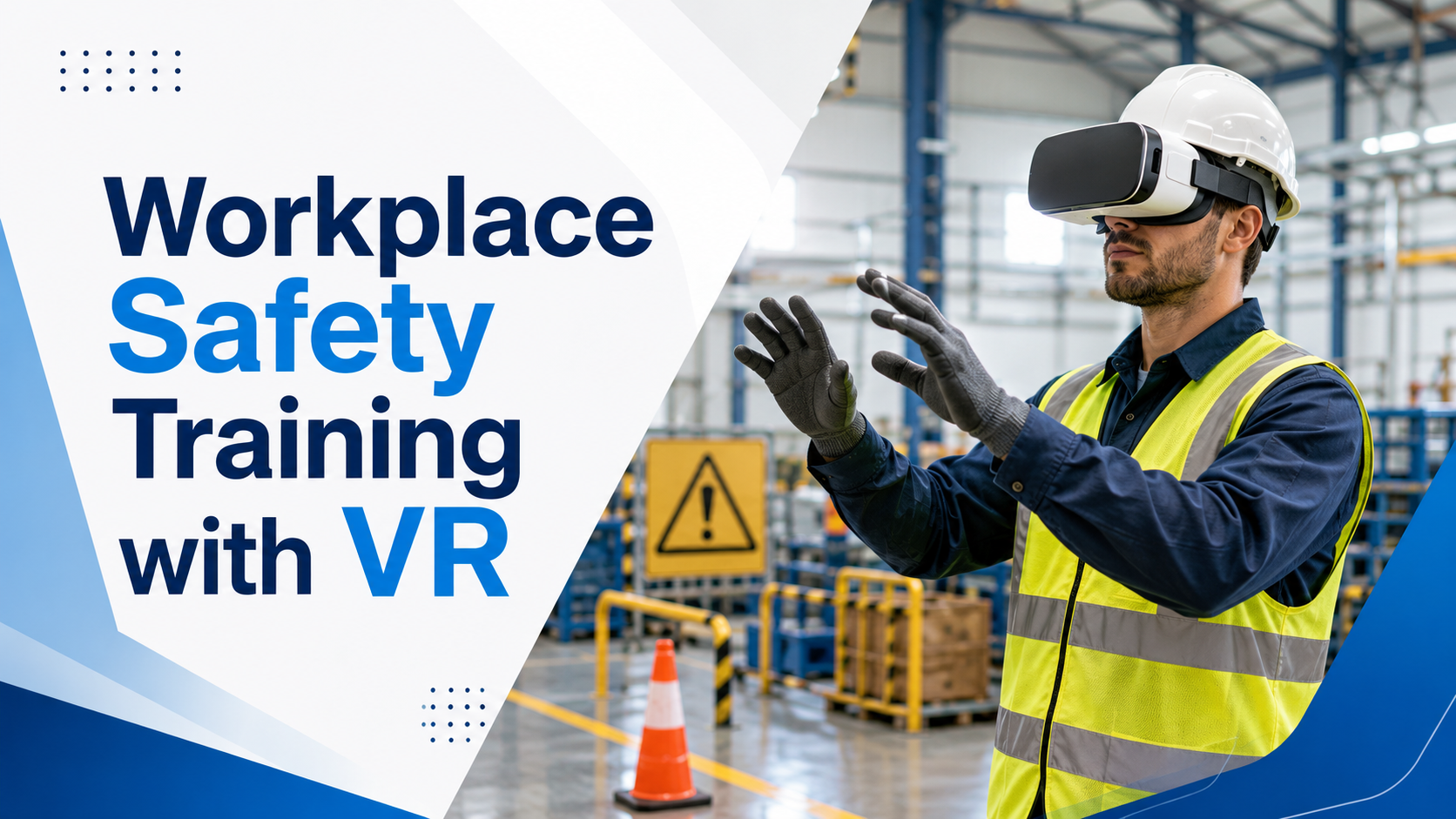
Virtual reality is transforming workplace safety training from passive classroom sessions into immersive experiences that employees actually remember. This guide shows EHS teams how to deploy VR safety training programs through rental models, enabling cost-effective training across distributed workforces without the complexity of hardware ownership.
Why EHS Teams Are Switching from Classroom Safety Training to VR
Traditional safety training faces retention problems and engagement challenges that VR directly addresses. We’ll examine the specific safety training scenarios where VR delivers measurable improvements in hazard recognition, emergency response times, and incident reduction rates.
The 73% Retention Gap in Traditional Safety Training
The National Safety Council reports that workers retain only 27% of safety information from traditional classroom training after 30 days. This retention gap directly correlates with workplace incidents, with OSHA data showing that 40% of workplace accidents involve employees who received safety training within the previous 12 months.
Memory retention for hazard recognition follows a steep decline curve in traditional formats. Lecture-based training shows 5% retention after one week, while demonstration improves this to 30%. VR training, combining visual, auditory, and kinesthetic learning, achieves 75% retention rates after the same period.
The financial impact is substantial. The average workplace injury costs $42,000 in direct expenses, with indirect costs multiplying this by 2-10x. A single prevented incident can fund an entire year’s VR training program for 500+ employees.
VR Safety Training Performance Metrics from Enterprise Deployments
Walmart’s deployment of 17,000 VR headsets across training centers demonstrated 10-30% improvement in safety test scores compared to traditional methods. More importantly, employees completed training 4x faster while reporting 30% higher confidence in handling safety situations.
The construction industry has seen even more dramatic results. Bechtel reported a 43% reduction in safety incidents after implementing VR training for high-risk scenarios. Workers identified 47% more hazards in post-training assessments compared to control groups using traditional methods.
Manufacturing facilities using VR for emergency response training show 60% faster response times in real emergencies. Ford’s Valencia plant documented 70% reduction in workplace injuries within one year of implementing VR-based ergonomics and safety training, with injury rates dropping from 3.4 to 1.0 per 100 workers.
Core VR Safety Training Scenarios That Replace High-Risk Live Training
Certain safety scenarios are expensive, dangerous, or impossible to recreate in real life. Here’s how companies deploy VR versions of these critical training modules using rental equipment for quarterly or annual safety programs.
Hazard Recognition and Risk Assessment Modules
Construction site hazard identification scenarios place workers in photorealistic job sites with 15-20 embedded hazards. Trainees navigate scaffolding with missing guardrails, identify improperly stored materials, and spot electrical hazards without real-world risk. Each identified hazard triggers immediate feedback explaining the specific OSHA violation and potential consequences.
Manufacturing floor safety violation modules simulate active production environments with moving equipment, noise levels requiring hearing protection, and chemical storage areas. Workers practice identifying blocked emergency exits, improper PPE usage, and unsafe equipment operation from multiple perspectives.
Warehouse equipment operation risk scenarios include forklift blind spots, overhead hazards, and pedestrian interaction zones. Trainees experience near-miss situations that would be too dangerous to recreate in actual warehouses, learning to identify risk factors before incidents occur.
Chemical handling and spill response training provides hands-on practice with HAZMAT procedures without exposure to actual chemicals. Workers learn proper PPE selection, containment techniques, and decontamination procedures through repeated practice in various spill scenarios.
Emergency Response and Evacuation Training
Fire evacuation scenarios simulate smoke-filled environments with realistic visibility reduction and disorientation effects. Trainees practice multiple evacuation routes, learn to navigate by touch when visibility is zero, and experience the stress of time-pressure decision making.
Active shooter response protocols use branching scenarios that adapt to trainee decisions. Workers practice Run-Hide-Fight protocols, learn to identify escape routes, and understand barricade procedures without the trauma of live drills.
Chemical leak containment procedures simulate various leak severities and chemical types. Trainees practice isolation valve locations, understand wind direction impacts, and coordinate team responses while wearing simulated SCBA equipment that restricts vision and movement.
Equipment failure emergency shutdown sequences recreate cascading failures requiring specific response sequences. Workers practice emergency stop procedures for conveyor systems, hydraulic presses, and automated production lines under time pressure with realistic alarm sounds and warning lights.
Equipment Operation and Lock-Out Tag-Out Procedures
Forklift operation in tight spaces eliminates damage risk during training. Operators practice load balancing, height restrictions, and blind spot awareness in warehouse configurations matching their actual work environment. The system tracks speed, stopping distances, and load handling precision.
Crane and heavy machinery safety modules include load calculations, swing radius awareness, and ground personnel communication. Operators experience equipment failure scenarios like hydraulic loss or cable snap, learning proper emergency responses without equipment damage or injury risk.
Electrical panel lockout procedures provide hands-on practice with various panel types and voltage levels. Workers learn proper testing procedures, understand arc flash boundaries, and practice lockout sequencing without electrical exposure.
Confined space entry protocols simulate oxygen-deficient environments, toxic atmospheres, and equipment entanglement hazards. Trainees practice atmospheric testing, understand ventilation requirements, and coordinate rescue procedures in spaces too dangerous for live training.
Rental vs. Purchase Decision Framework for Safety Training Programs
Most safety training happens quarterly or annually, making rental deployments more cost-effective than hardware purchases. We’ll break down the economics and logistics of both approaches for different training frequencies and team sizes.
When Rental Makes Sense: Quarterly and Annual Programs
Quarterly training deployments for 100 employees cost approximately $15,000 annually through rental programs, compared to $50,000+ for hardware purchase plus ongoing maintenance. The rental model includes shipping, setup support, and preloaded content, eliminating IT involvement.
Storage and maintenance disappear as concerns with rental programs. Companies avoid dedicating climate-controlled storage space for $50,000+ in VR equipment used only four times yearly. Hardware failures, software updates, and battery replacements become the rental provider’s responsibility.
Preloaded content eliminates 20-40 hours of IT setup per deployment. Headsets arrive configured with specific training modules, user accounts created, and progress tracking enabled. This plug-and-play approach enables same-day training starts without technical delays.
Multi-site shipping logistics are included in rental packages. Providers coordinate delivery to 10+ locations simultaneously, ensuring all sites receive equipment for synchronized safety days. Return shipping labels and packaging are included, simplifying post-training logistics.
Purchase Triggers: Weekly Training or 500+ Employees
Break-even analysis shows purchase becoming cost-effective at 2+ training sessions monthly or with 500+ employees requiring annual training. At this usage level, the per-session cost drops below rental rates within 18 months.
In-house content development becomes viable with owned hardware. Companies can create site-specific scenarios, update training based on actual incidents, and customize modules for specific equipment or procedures. This flexibility requires dedicated VR development resources, typically 2-3 FTEs for enterprise programs.
IT support requirements include device management platforms, user authentication systems, and content distribution networks. Organizations need 1 IT support person per 50 headsets for smooth operations, plus backup hardware representing 10-15% of the active fleet.
Hardware refresh cycles average 24-36 months for commercial VR equipment. Budget planning must account for 33-50% annual replacement costs, plus immediate replacements for damaged units. Technology obsolescence can strand content on outdated platforms, requiring migration costs.
Deploying VR Safety Training Across Multiple Locations
Distributed workforces need synchronized safety training across sites. Here’s how to coordinate multi-location VR deployments using rental packages with preloaded content and remote support.
Logistics Planning for Multi-Site Safety Days
Shipping timelines require 5-7 business days for standard ground delivery to multiple locations. Express shipping reduces this to 2-3 days but increases costs by 40-60%. Schedule buffer time for weather delays or customs clearance for international sites.
Headset quantity calculations follow a 1:4 ratio for all-day training events. For 100 employees training over 8 hours in 20-minute sessions, 25 headsets enable smooth rotation without bottlenecks. Add 10-15% spare units for technical issues or higher-than-expected attendance.
Backup equipment planning includes 2 spare headsets per 10 units deployed, extra batteries for all-day sessions, and alternative training materials for complete technology failure. Rental providers typically include spares in packages over 20 units.
Return shipping coordination requires designated packing personnel at each site. Schedule pickup for the business day following training to allow proper inventory checking. Use provided checklists to ensure all accessories are included, avoiding damage charges.
Content Standardization Across Locations
Preloaded content ensures version consistency across all sites. Every employee experiences identical scenarios, assessments, and scoring criteria regardless of location. Updates are applied before shipping, eliminating site-level software management.
Cloud-streamed content requires 25 Mbps per headset for smooth operation. Many industrial sites lack sufficient bandwidth for 20+ simultaneous streams. Preloaded content eliminates bandwidth dependencies, enabling training in warehouses, construction sites, or remote facilities.
Language localization options include Spanish, French, Mandarin, and other languages based on workforce demographics. Rental providers preload appropriate language versions by site, with language selection available within the application for mixed-language groups.
Progress tracking across sites uses cloud synchronization when internet is available. Offline modes store data locally, uploading when connected. Centralized dashboards show real-time completion rates, scores, and time-in-headset metrics across all locations.
Certification and compliance documentation generates automatically upon scenario completion. Digital certificates include employee ID, completion timestamp, score achieved, and scenario version for audit trails. Export functions support CSV, PDF, and integration with learning management systems.
Measuring ROI and Safety Outcomes from VR Training
EHS teams need concrete metrics to justify VR training investments. These measurement frameworks help track both immediate training effectiveness and long-term safety improvements.
Leading Indicators: Training Engagement and Completion
Time-to-completion metrics show VR training requiring 50-70% less time than traditional methods for equivalent content. A typical hazard recognition module takes 20 minutes in VR versus 60-90 minutes in classroom settings, enabling more employees to complete training within operational constraints.
Scenario replay rates indicate knowledge gaps requiring reinforcement. VR platforms track which scenarios employees repeat voluntarily, identifying challenging concepts. Average replay rates of 15-20% suggest appropriate difficulty, while 40%+ indicates content requiring simplification.
Assessment score improvements average 25-40% between pre- and post-VR training evaluations. More significantly, scores remain 20-30% higher in 90-day follow-up assessments compared to traditional training control groups.
Participant feedback scores for VR training average 4.6/5.0 compared to 3.2/5.0 for traditional methods. Employees specifically cite engagement, relevance, and retention as superior in VR formats. 87% of participants recommend VR training to colleagues.
Lagging Indicators: Incident Rates and Compliance
Incident frequency reduction becomes measurable 3-6 months post-training. Organizations typically see 20-30% reduction in minor incidents within 6 months, with major incident reductions of 40-50% within 12 months of VR training implementation.
Near-miss reporting increases 60-80% following VR training as workers better recognize hazards. This increased reporting is a positive indicator, showing improved hazard awareness before incidents occur.
OSHA recordable rates show 35-45% improvement within 12 months of VR training implementation. Days Away, Restricted, or Transferred (DART) rates improve even more dramatically, with 50-60% reductions common.
Workers compensation claims decrease 25-40% in frequency and 30-50% in severity following VR training programs. Insurance providers increasingly offer premium discounts for companies using VR safety training, recognizing the reduced risk profile.
Implementation Roadmap: From Pilot to Full Deployment
Start with a focused pilot program to prove value before scaling. This phased approach minimizes risk while building internal support for immersive safety training.
Phase 1: 30-Day Pilot Program Design
Pilot scenario selection should focus on high-frequency, high-risk activities with measurable outcomes. Choose 2-3 scenarios representing your most common incidents or most expensive claims. Forklift operation, fall protection, and hazard recognition are proven starting points.
Participant selection requires 20-30 volunteers representing various experience levels, ages, and technical comfort. Include skeptics alongside enthusiasts to gather balanced feedback. Ensure representation from multiple shifts and departments.
Rental package sizing for pilots typically includes 5-10 headsets for 2-4 weeks. This enables 100-150 employees to complete training while maintaining operational coverage. Costs range from $3,000-5,000 for comprehensive pilot programs.
Success metrics and evaluation criteria should be established before pilot launch. Track completion rates, assessment scores, time-to-completion, and participant feedback. Compare against historical training metrics and establish minimum thresholds for expansion.
Stakeholder communication plans require weekly updates during pilots. Share early wins, address concerns promptly, and gather feedback continuously. Include union representatives, senior management, and front-line supervisors in communications.
Phase 2: Scaling Based on Pilot Results
Expansion decision frameworks should weigh pilot metrics against predetermined success criteria. If 3 of 4 key metrics meet targets, proceed with controlled expansion. If all 4 exceed targets, accelerate deployment timeline.
Budget allocation for full deployment typically represents 0.5-1% of annual workers compensation costs. For a company with $2M in annual claims, allocating $10,000-20,000 for VR training represents reasonable investment levels with 6-12 month payback periods.
Training-the-trainer programs develop internal VR training facilitators. Select tech-comfortable safety professionals for 2-day certification programs. These facilitators manage equipment, guide participants, and troubleshoot basic technical issues, reducing external support needs.
Long-term vendor partnerships should include quarterly business reviews, content update schedules, and volume pricing agreements. Negotiate 12-24 month contracts with flexibility for scaling up or down based on training needs. Include SLAs for equipment availability and technical support.
Frequently Asked Questions
How much does VR safety training cost compared to traditional methods?
VR safety training through rental programs costs $30-50 per employee for quarterly sessions, compared to $75-150 for traditional instructor-led training when including instructor time, materials, and lost productivity. Purchase options require $500-1,000 per headset plus $50-100 per user for content licensing.
What safety scenarios work best in VR vs. hands-on training?
VR excels at high-risk scenarios (working at heights, confined spaces), rare events (emergency response, equipment failures), and hazard recognition training. Hands-on training remains superior for muscle memory development, tool handling skills, and team coordination exercises requiring physical interaction.
Can VR safety training meet OSHA compliance requirements?
VR training satisfies OSHA requirements when combined with site-specific elements and hands-on evaluation. OSHA accepts VR for awareness-level and refresher training but requires physical demonstration of skills like respirator fit testing or fall protection equipment inspection.
How many VR headsets do I need for a 100-person safety training day?
For 100 employees completing 20-minute modules over 8 hours, 25 headsets enable smooth rotation with cleaning time between users. Add 3-5 spare units for technical issues. Alternatively, 50 headsets allow 30-minute sessions with more generous timing flexibility.
What happens if employees get motion sick during VR safety training?
Motion sickness affects 15-20% of first-time VR users but drops to 5% with proper setup. Mitigation includes starting with stationary scenarios, ensuring proper headset fit, taking breaks every 20 minutes, and having alternative training materials available. Most rental providers include comfort guidelines and alternative training options.
How do we track and document VR training for compliance audits?
VR platforms automatically generate training records including employee ID, completion date/time, scenario version, assessment scores, and time in headset. Export functions support common formats (CSV, PDF) and API integrations with learning management systems. Cloud storage ensures records remain accessible for the 3-5 year retention periods required by OSHA.
Conclusion
VR safety training delivered through rental programs offers EHS teams a practical path to improved safety outcomes without the complexity of hardware ownership. The combination of higher retention rates, reduced incident frequencies, and lower total costs makes VR training increasingly essential for modern safety programs.
The rental model specifically addresses the realities of quarterly or annual safety training cycles, multi-site logistics, and rapidly evolving technology. By starting with focused pilots and scaling based on measured results, organizations can transform their safety culture while maintaining operational efficiency.
Ready to explore VR safety training for your organization? Contact our team to design a pilot program tailored to your specific safety challenges and workforce requirements. We’ll help you select appropriate scenarios, size your rental package, and establish success metrics that demonstrate clear ROI to stakeholders.