Virtual trade shows are no longer a pandemic workaround. They have become a deliberate format choice for marketing teams, sales organizations, and event planners who need to deliver product experiences that physical booths and slide decks simply cannot match. This guide explains what virtual trade shows actually are, when they make sense, how to run them, and why renting hardware is often the smartest deployment model for teams that need results without a permanent immersive infrastructure.
What a Virtual Trade Show Is and When It Makes Sense
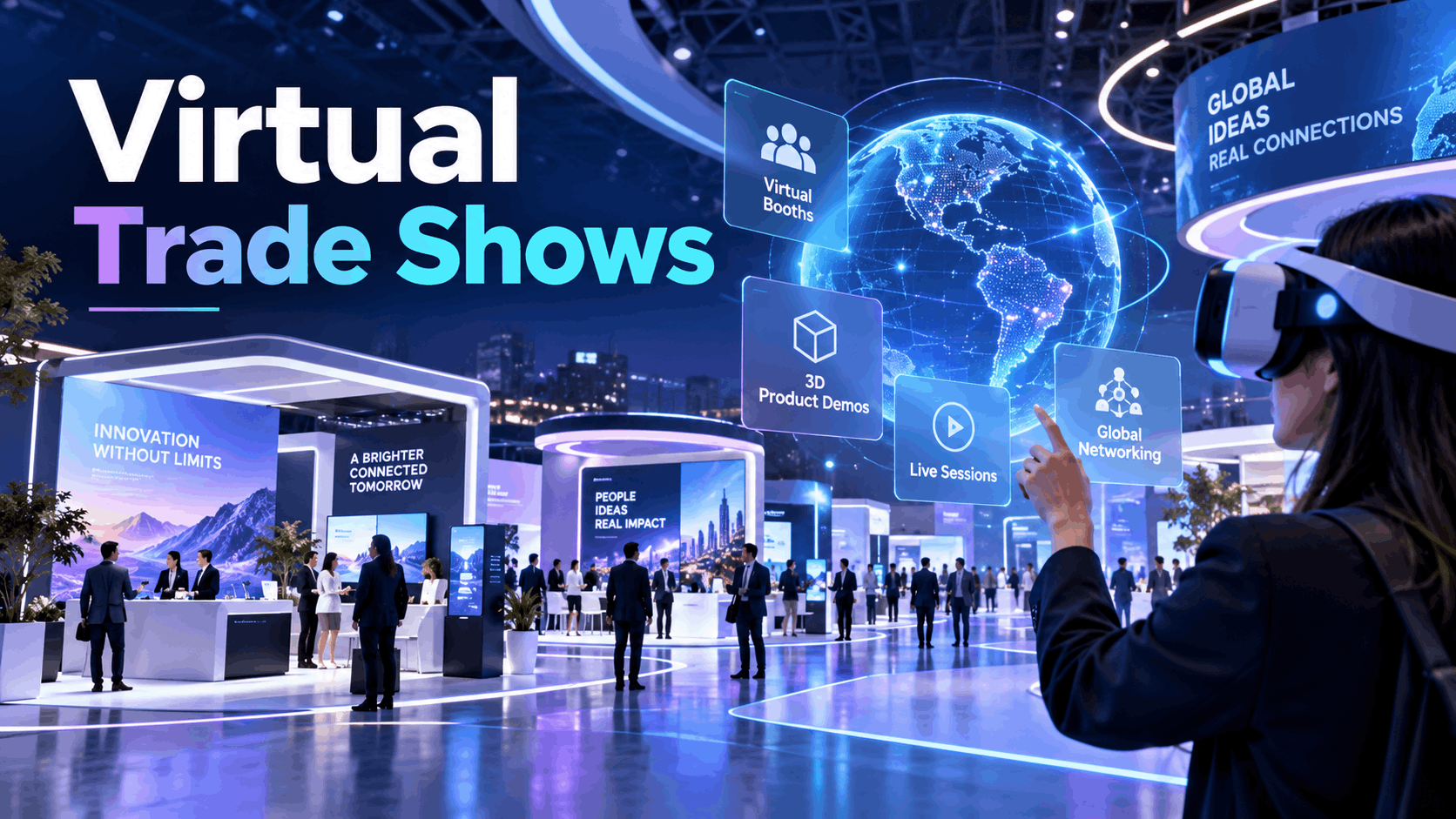
A virtual trade show is an event format, not a software category. It describes any structured event or booth experience where immersive technology most commonly virtual reality (VR) or augmented reality (AR) replaces or supplements traditional product displays, demonstrations, and sales conversations. The “virtual” element is not about moving the event online. It is about using technology to create product environments, guided demos, or interactive experiences that cannot exist in a standard booth or meeting room.
Virtual trade shows are useful in a specific set of business situations:
- Product launches where the product is too large, too complex, or not yet manufactured to be shown physically
- Lead generation events where differentiation from neighboring booths determines who gets the conversation
- Sales demos where a guided, repeatable experience needs to replace an inconsistent in-person pitch
- Partner and channel events where a distributed audience needs access to the same product story
- Hybrid trade show extensions where in-person attendees get immersive demos while remote audiences access a parallel digital experience
The format works because it gives event teams control over the experience. Instead of hoping a prospect reads a brochure or watches a product video, you put them inside the product story.
How Virtual Trade Shows Differ from Standard Virtual Events
The term “virtual event” covers a wide range of formats, and conflating them leads to poor decisions. Here is how the categories differ:
Webinars are broadcast formats. One or a few speakers present to a passive audience. Engagement is limited to chat, polls, and Q&A. There is no immersion and no physical presence.
Virtual event platforms (think Hopin, Bizzabo, or similar tools) replicate the structure of a conference online—sessions, networking rooms, sponsor booths. They are useful for scale and accessibility, but the experience is screen-based and attention is fragmented.
Immersive trade show experiences using VR or AR are fundamentally different. They require physical presence—a headset, a device, a guided interaction. They are not scalable in the same way a webinar is, but they are far more memorable, more persuasive for complex products, and more effective at generating qualified conversations.
VR and AR improve product storytelling because they eliminate the gap between description and understanding. A prospect who walks through a virtual factory floor, configures a product in 3D, or sees an AR overlay of a machine’s internal components understands the product in a way that a spec sheet cannot produce.
That said, immersive formats are not always the right choice. If your goal is broad awareness, simple information delivery, or reaching a large remote audience simultaneously, a webinar or virtual event platform will serve you better. Immersive formats earn their cost when the experience itself is the differentiator.
Common Business Goals Virtual Trade Shows Support
| Business Goal | How Immersive Formats Help |
|---|---|
| Lead capture and sales conversations | Immersive demos attract booth traffic and create natural conversation entry points |
| Product education and feature demonstration | VR environments show how products work in context, not just in isolation |
| Brand differentiation at crowded events | A headset experience stands out in a hall full of banner stands and brochures |
| Multi-location or remote audience access | Hybrid deployments extend the experience beyond the physical event floor |
Virtual Trade Show Use Cases for Marketing, Sales, and Events
The teams that buy immersive trade show experiences have different goals, different success metrics, and different operational constraints. Understanding which use case applies to your organization determines what kind of experience you need and how to measure its value.
Marketing and Brand Activation Use Cases
Marketing teams use virtual trade show experiences to create moments that generate attention, press coverage, and brand recall.
Interactive product storytelling replaces static displays with guided narratives. Instead of a prospect reading about a product’s features, they experience the problem the product solves—inside a simulated environment that makes the value proposition visceral.
Immersive booth traffic drivers work because novelty creates queues. A VR headset station at a trade show booth draws attention from across the aisle. That attention translates into dwell time, which translates into conversations. Marketing teams use this dynamic deliberately to increase the number of qualified interactions per event.
Launch moments and press-friendly demos benefit from immersive formats because they are inherently visual and shareable. A journalist or influencer who puts on a headset and experiences a product launch has a story to tell. That story is more compelling than a press release.
Sales Demo and Product Education Use Cases
Sales teams use virtual trade show experiences to solve a specific problem: how do you show a complex, large, or not-yet-built product to a prospect without shipping it to every event?
Showing complex products without physical inventory is the clearest use case. Industrial equipment, architectural designs, medical devices, and enterprise software all have the same problem—they are difficult or impossible to demonstrate at a trade show booth. VR solves this by creating a photorealistic or functionally accurate virtual version that prospects can explore.
Guided demos for prospects and channel partners benefit from the controlled nature of VR. A sales rep can walk a prospect through a scripted experience that hits every key feature in the right order, without the distractions of a physical showroom or the variability of a live product demo.
Using VR to standardize the sales story matters for organizations with large or distributed sales teams. When every rep uses the same VR demo, every prospect gets the same experience. That consistency improves conversion rates and makes it easier to identify where the story is working and where it is not.
Training and Internal Enablement Use Cases
Virtual trade show technology is not only for external audiences. Event teams and sales organizations use it internally to prepare for events and reinforce product knowledge.
Trade show staff training and rehearsal allows booth teams to practice their demo flow, learn the product experience from the attendee’s perspective, and identify gaps in their knowledge before the event opens.
Product knowledge reinforcement through VR scenarios helps sales and marketing teams internalize complex product information in a way that passive training materials do not. When you have walked through a virtual factory or configured a product in 3D, you remember it.
Scenario-based learning for teams supporting events prepares staff for the range of situations they will encounter on the event floor—different prospect types, different questions, different levels of technical sophistication.
What You Need to Run a Virtual Trade Show Successfully
Concept clarity is not enough. Running an immersive trade show experience in a real event environment requires hardware that works reliably, content that is designed for the format, and operations that keep the experience moving efficiently.
Hardware and Setup Considerations
Standalone wireless VR headsets are the practical choice for most trade show deployments. Devices like the Meta Quest line operate without a PC tether, which eliminates cable management, reduces setup time, and gives attendees freedom of movement within the experience. For a booth environment where setup windows are short and floor space is limited, wireless standalone headsets significantly reduce operational complexity.
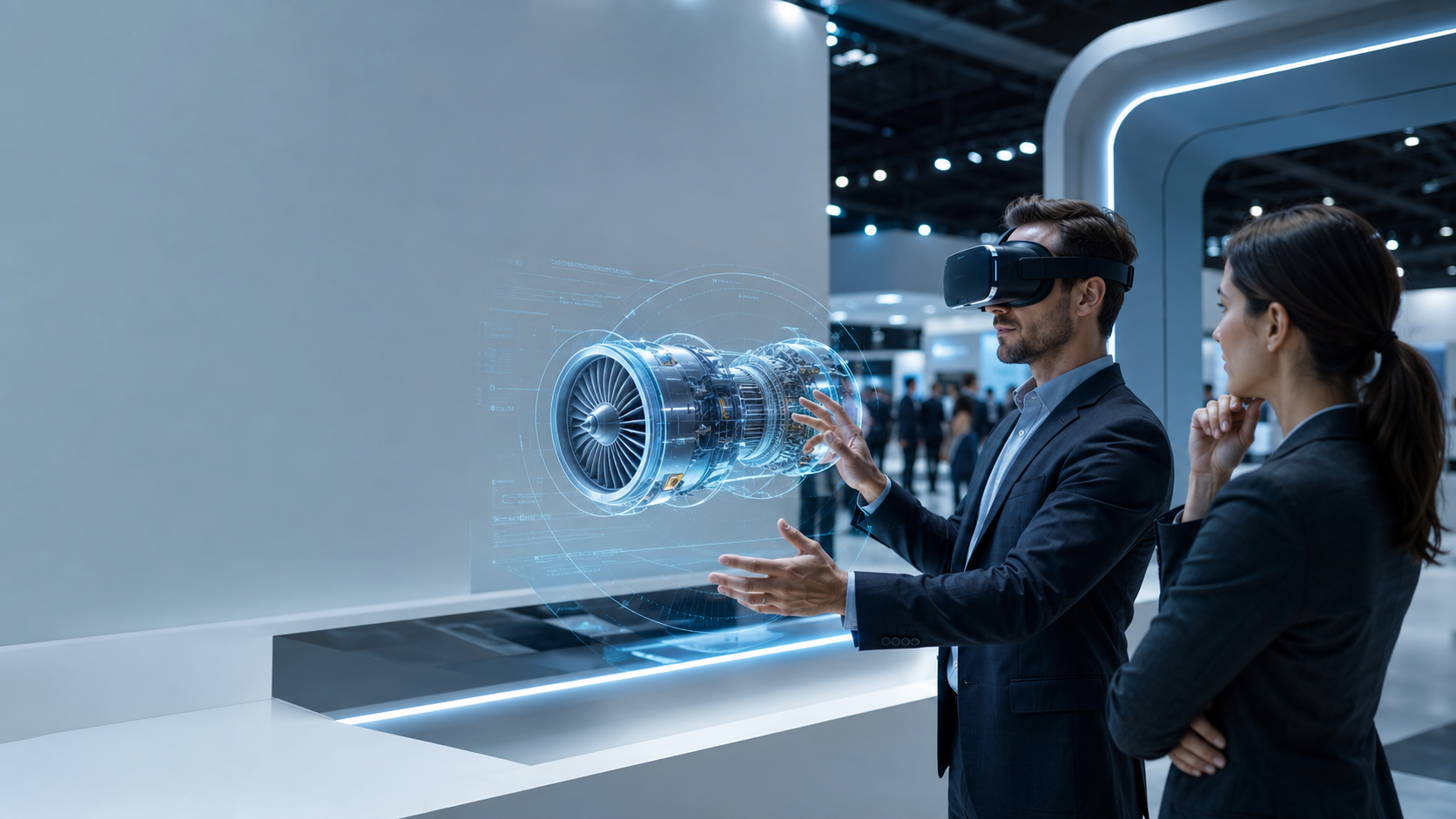
AR glasses are a better fit in specific scenarios. When attendees need to remain aware of their physical environment—during a product demonstration that involves physical objects, for example, or in a field service context—AR overlays information without removing the user from the room. AR is also useful when the goal is to show how a product integrates into an existing physical space rather than transporting the user to a virtual one.
Power, charging, sanitation, and device handling are operational requirements that get overlooked in planning but create real problems on event day. Standalone headsets need charging between sessions. Multi-day events need a rotation plan that keeps devices powered and ready. Sanitation—cleaning headsets between users—is a hygiene and brand perception issue that requires a defined process. Device handling protocols protect expensive hardware from drops, misuse, and loss.
Content and Experience Design Requirements
Preloaded scenarios versus custom builds represent a fundamental decision point. Custom VR experiences can be precisely tailored to your product and brand, but they require development time and budget that may not be available for a single event. Preloaded industry-specific scenarios—available through rental providers like IGIVU—allow teams to deploy a relevant, polished experience without a custom development cycle.
Keeping experiences short and repeatable is a design principle, not a compromise. In a booth environment, the average attendee has limited time and attention. Experiences that run three to five minutes and deliver a clear, memorable message outperform longer, more complex experiences that lose people halfway through. Design for the booth, not the boardroom.
Designing for clarity, not novelty means the technology should serve the message, not the other way around. The goal is not to impress attendees with VR. The goal is to help them understand your product, remember your brand, and start a conversation with your team. Every design decision should serve that goal.
Event Operations and Staffing Requirements
Queue management and session flow determine whether your immersive station creates excitement or frustration. A well-run VR station has a clear entry point, a defined session length, and a smooth handoff between attendees. Without a queue management plan, popular stations create bottlenecks that discourage participation.
Attendee guidance and support roles are essential. Most trade show attendees have limited experience with VR headsets. A staff member dedicated to fitting headsets, explaining the experience, and guiding attendees through the session dramatically improves completion rates and experience quality.
On-site troubleshooting and event-day readiness require a plan. Devices malfunction, content fails to load, and headsets need adjustment. Having a defined troubleshooting protocol—and ideally a support resource available on-site or remotely—prevents a technical issue from shutting down the experience during peak traffic.
Why Rentals Are Often the Best Deployment Model
Purchasing a fleet of VR headsets, licensing content development tools, and building an internal program to manage devices and support events is a significant investment. For most marketing teams and event organizations, that investment is not justified by the frequency of use. Rental is the practical alternative.
Benefits of Renting Versus Buying
Lower upfront cost is the most obvious advantage. Renting hardware for a specific event eliminates capital expenditure and allows budget to be allocated to the event itself rather than infrastructure.
Faster deployment for one-off or seasonal events matters when the timeline is short. A rental provider with configured, preloaded hardware can deliver event-ready devices in days rather than the weeks or months required to procure, configure, and test purchased hardware.
Reduced maintenance and device management burden is significant for teams without dedicated AV or technology staff. Owned hardware requires firmware updates, storage, insurance, and ongoing maintenance. Rental hardware arrives ready to use and returns to the provider after the event.
| Factor | Renting | Buying |
|---|---|---|
| Upfront cost | Low | High |
| Deployment speed | Fast | Slow (setup and configuration required) |
| Maintenance burden | Provider’s responsibility | Your responsibility |
| Flexibility for different events | High | Low (fixed hardware and content) |
| Ideal for | Occasional or seasonal events | Ongoing, high-frequency programs |
What a Curated Rental Package Should Include
Not all rental offerings are equivalent. A rental package that actually supports event execution should include:
- Configured hardware — Devices should arrive charged, updated, and ready to use. Configuration should not be the event team’s problem.
- Preloaded content or scenarios — Relevant experiences should be loaded and tested before delivery. Last-minute content loading at a venue creates risk.
- Delivery and return logistics — The provider should handle shipping, tracking, and return coordination. Event teams should not be managing carrier logistics on top of event execution.
- Optional event support — For complex deployments or high-stakes events, on-site or remote technical support should be available to handle issues as they arise.
How to Choose the Right Virtual Trade Show Format
The right format depends on the event goal, the audience, and the operational environment. This section functions as a decision guide for teams evaluating their options.
Choose VR When the Experience Needs Immersion and Guided Storytelling
VR is the right choice when:
- The product is complex, large, or not physically present at the event
- The goal is to guide the attendee through a specific narrative or demo sequence
- Full attention and focus are required for the experience to land
- The audience is seated or stationary during the experience
VR is best for product visualization, architectural walkthroughs, industrial equipment demos, and experiential brand activations where the attendee should be fully inside the experience.
Choose AR When the Experience Needs Overlay, Context, or Field Utility
AR is the right choice when:
- The attendee needs to remain aware of the physical environment
- The goal is to show how a product integrates with or enhances a physical space
- The experience involves interacting with physical objects while receiving digital information
- The event environment requires mobility or situational awareness
AR is better suited for product overlay demonstrations, field service scenarios, and assisted selling situations where the physical and digital need to coexist.
Choose a Hybrid Approach When the Event Needs Both Reach and Depth
A hybrid approach combines physical booth engagement with immersive demo stations. This works well when:
- The audience includes both in-person and remote participants
- Different audience segments need different levels of engagement
- The event has multiple touchpoints across a day or multi-day program
In a hybrid deployment, the physical booth handles initial engagement and lead capture while VR or AR stations provide deeper product experiences for qualified prospects. Content layers can be designed for different audience segments—a brief AR overview for casual attendees and a full VR demo for serious prospects.
How IGIVU Supports Virtual Trade Show Deployments
IGIVU’s rental model is built for teams that need a trade-show-ready immersive experience without building a permanent program. The following explains how the service works in practice.
Standalone Wireless Headsets for Simpler Event Execution
IGIVU’s fleet uses standalone wireless VR headsets that eliminate the tethering and PC dependency that make VR setups complex in booth environments. Wireless devices mean no cable management, faster attendee transitions, and more flexibility in how the experience is positioned within the booth layout.
For event teams working with short setup windows—often measured in hours, not days—wireless hardware reduces the number of variables that can go wrong before the doors open. Attendees move freely, staff spend less time managing equipment, and the experience runs more smoothly from the first session to the last.
Nationwide Delivery and Optional Event Support
IGIVU ships configured hardware to event locations nationwide, handling delivery logistics so event teams can focus on execution. For organizations running multi-city event programs or national trade show circuits, this logistics capability removes a significant operational burden.
Optional on-site event support is available for deployments where technical complexity or event stakes justify dedicated support. Remote support is available for teams that need a resource available during the event without the cost of a full on-site presence. Either option ensures that a technical issue does not become an event failure.
Preloaded Industry-Specific Scenarios for Business Use Cases
IGIVU offers preloaded VR scenarios designed for specific business contexts—product training, safety simulations, sales demos, and event experiences. These scenarios allow teams to deploy a relevant, polished experience without commissioning custom content development.
For organizations that need to move quickly—a product launch with a six-week runway, a trade show added to the calendar late in the planning cycle—preloaded scenarios compress the timeline from concept to deployment. Teams can review and select a scenario, customize it to the extent the timeline allows, and deploy it with confidence that the content is designed for the format.
Frequently Asked Questions
What is a virtual trade show?
A virtual trade show is an event format that uses immersive technology—typically VR or AR—to create product experiences, guided demonstrations, or interactive brand environments that replace or supplement traditional trade show displays. The term describes the experience format, not a specific software platform.
How is a virtual trade show different from a webinar or virtual event?
A webinar is a broadcast format with a passive audience. A virtual event platform replicates conference structure online. A virtual trade show experience is immersive and requires physical interaction with a device—a VR headset or AR glasses. The experience is designed to be felt, not watched, which is why it is more effective for product demonstration and brand differentiation.
Can VR be used for trade show booths?
Yes. VR is well-suited for trade show booth environments, particularly for products that are difficult to demonstrate physically. Standalone wireless headsets reduce setup complexity and work within the space and time constraints of a typical booth. The key requirements are a defined session flow, a staff member to guide attendees, and a charging and sanitation plan for multi-session use.
What equipment do you need for a virtual trade show?
The core requirements are VR headsets or AR glasses, preloaded content relevant to your product or use case, charging equipment, and sanitation supplies. For booth deployments, you also need a defined physical space for the experience, a queue management plan, and at least one staff member dedicated to guiding attendees. Rental providers like IGIVU supply configured hardware and preloaded content, reducing the equipment burden on the event team.
Is it better to rent or buy VR hardware for trade shows?
For most marketing teams and event organizations, renting is the better choice. Purchasing hardware makes sense when the frequency of use justifies the capital cost and when the organization has the internal resources to manage, maintain, and update a device fleet. For occasional or seasonal events, rental provides configured, event-ready hardware without the overhead of ownership.
How do you measure success at a virtual trade show?
Success metrics depend on the business goal. Common measurements include the number of attendees who completed the immersive experience, qualified leads generated during or after the experience, sales conversations initiated at the booth, post-event recall and brand sentiment, and downstream pipeline influenced by the event. Define your metrics before the event so that staffing, session flow, and follow-up processes are designed to capture the data you need.
Conclusion
Virtual trade shows are a format decision, not a technology experiment. When the goal is to help prospects understand a complex product, differentiate a brand in a crowded event environment, or deliver a consistent sales story across multiple locations, immersive technology earns its place in the event plan. When the goal is broad awareness or simple information delivery, simpler formats serve better.
The practical path to deployment for most teams is rental. Configured hardware, preloaded content, and logistics support remove the barriers that make immersive technology feel out of reach for event budgets and timelines. IGIVU’s rental model is built specifically for this: standalone wireless headsets, nationwide delivery, optional on-site support, and industry-specific scenarios that compress the time from planning to execution.
Ready to bring an immersive experience to your next event? Contact IGIVU to discuss your event goals, explore available scenarios, and get a rental package configured for your timeline and audience.