Virtual reality has transformed from a hardware-centric rental market into a sophisticated content ecosystem where experiences can be licensed independently of equipment. For businesses with existing VR infrastructure or access to headsets through other channels, VR content rental offers a flexible path to deploy immersive experiences without the overhead of full hardware packages.
This comprehensive guide examines the standalone VR content licensing market, covering everything from deployment models and pricing structures to technical requirements and compliance considerations. Whether you’re managing a corporate training program with an existing headset fleet or planning a trade show activation at a venue with permanent VR stations, understanding content-only rental options can significantly reduce costs while expanding your experience library.
VR Content Rental vs. Hardware Bundles: When Content-Only Makes Sense
Most VR rental providers bundle content with hardware packages, but content-only rental serves a distinct market: companies with existing headset fleets, event venues with permanent VR installations, and organizations running pilot programs with borrowed equipment. This section breaks down the economics and logistics of renting VR experiences separately from hardware.
Companies That Already Own VR Hardware
The VR content licensing for events market primarily serves three categories of hardware owners who need fresh experiences without additional equipment investments.
Enterprise training departments with Quest 2/3 fleets needing fresh content quarterly represent the largest segment. These organizations invested heavily in hardware during 2020-2023 but now require diverse training modules to maintain engagement. A Fortune 500 manufacturing company, for instance, might own 200 Quest 3 headsets across multiple facilities but needs specialized safety training content that changes based on seasonal hazards or regulatory updates.
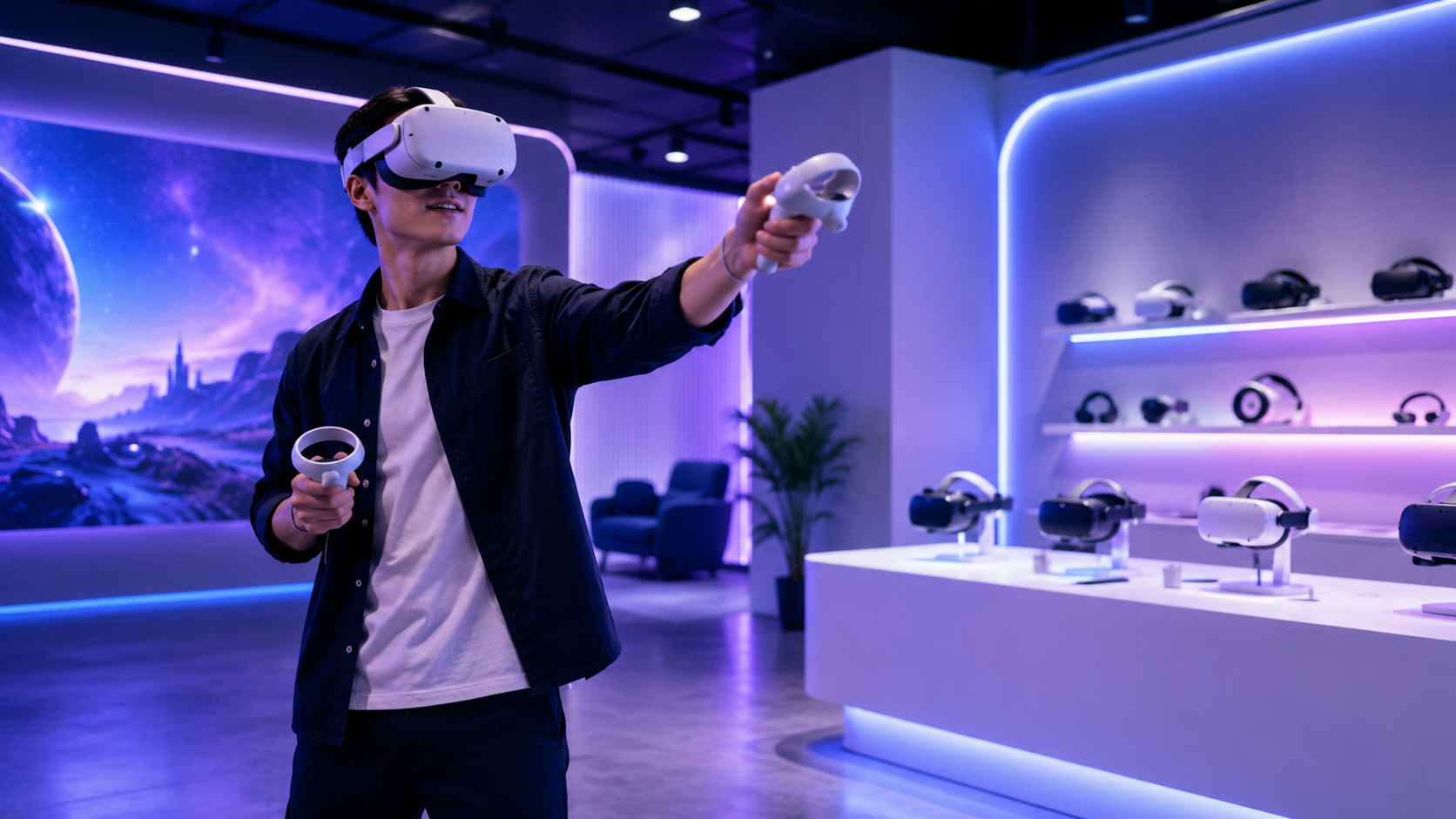
Event venues with permanent VR stations requiring rotating experiences form another key market. Convention centers, innovation hubs, and corporate experience centers often install permanent VR zones with 4-12 stations. These venues need fresh content monthly or quarterly to attract repeat visitors and support different client events. A technology showcase venue in Silicon Valley might rotate through 50+ different experiences annually across their eight-station VR lounge.
Corporate innovation labs testing different content types before custom development use rental as a proof-of-concept mechanism. Rather than investing $50,000-$250,000 in custom VR development, these labs rent similar experiences to validate use cases and gather user feedback. A pharmaceutical company’s innovation team might test six different medical training simulations over three months before commissioning custom content for their specific procedures.
Content-Only Rental Economics
Understanding the financial dynamics of VR experience rental helps justify content-only approaches versus traditional bundles.
Per-experience licensing costs vs. bundled hardware rates show significant savings for hardware owners. While a complete VR rental package (headset + content) typically costs $150-$300 per day per unit, content-only licensing ranges from $25-$100 per experience per day. For a 50-headset deployment over three days, this represents savings of $15,000-$30,000 when using existing hardware.
Multi-headset deployment pricing and concurrent user limits affect total costs substantially. Most content providers offer tiered pricing based on simultaneous users:
- 1-5 concurrent users: Base rate
- 6-20 concurrent users: 20-30% discount per license
- 21-50 concurrent users: 40-50% discount per license
- 50+ concurrent users: Custom enterprise pricing
Event-based vs. time-based licensing models cater to different use patterns. Event licenses typically cover 1-7 days at premium rates ($500-$2,000 per title), while monthly or quarterly licenses offer better value for ongoing programs ($1,000-$5,000 per title per month). Annual subscriptions to content libraries range from $10,000-$50,000 depending on catalog size and user seats.
VR Content Categories Available for Rental
VR content rental spans from off-the-shelf training modules to custom brand experiences. Understanding content categories helps match rental options to specific business objectives, whether that’s employee onboarding, product demonstrations, or event entertainment.
Corporate Training Modules
The VR training content rental market offers increasingly sophisticated simulations across multiple industries and skill domains.
Safety training simulations with OSHA compliance tracking dominate industrial rentals. These experiences include confined space entry procedures, lockout/tagout protocols, fall protection training, and hazardous material handling. Advanced versions incorporate real-time performance metrics, mistake tracking, and completion certificates that integrate with learning management systems. Rental rates typically run $2,000-$5,000 per module per month for unlimited users within an organization.
Soft skills scenarios for leadership and customer service address interpersonal development needs. These simulations place users in challenging conversations with AI-driven characters, covering conflict resolution, performance reviews, diversity training, and sales negotiations. Content providers like Strivr and Immerse offer libraries of 20-50 scenarios with quarterly updates, renting for $500-$1,500 per scenario per month.
Technical skills training for manufacturing and healthcare provides hands-on practice without equipment risk. Welding simulations, surgical procedures, equipment maintenance, and assembly line training reduce real-world training costs by 60-80%. These specialized modules command premium rental rates of $3,000-$10,000 per month due to their complexity and industry-specific customization.
Onboarding experiences for remote employee orientation streamline distributed workforce integration. Virtual office tours, company culture immersions, and interactive policy training reduce onboarding time by 40% while improving retention rates. Standard onboarding packages rent for $100-$300 per new employee, with volume discounts for large hiring initiatives.
Sales and Product Visualization
Product-focused VR content helps sales teams demonstrate complex offerings without physical samples or travel.
3D product configurators for trade show demos allow real-time customization of industrial equipment, vehicles, or architectural elements. Attendees can modify colors, features, and specifications while viewing photorealistic results at actual scale. These experiences rent for $2,000-$5,000 per event, with additional fees for custom product model integration.
Virtual showroom experiences for B2B sales transport clients to idealized retail environments or production facilities. Fashion brands use virtual showrooms to present seasonal collections, while industrial manufacturers showcase factory capabilities without site visits. Monthly rental rates range from $1,500-$4,000 depending on scene complexity and product catalog size.
Architecture and real estate walkthroughs enable remote property tours with interactive features like material selection, furniture placement, and lighting adjustments. Real estate developers rent these experiences for $500-$1,500 per property per month, often bundling multiple properties for portfolio presentations.
Industrial equipment operation simulations demonstrate machinery capabilities without shipping costs or safety concerns. Crane operations, mining equipment, and agricultural machinery simulations help qualify buyers before major purchases. These specialized simulations rent for $3,000-$8,000 per trade show or sales event.
Event and Brand Activation Content
Marketing-focused VR content creates memorable brand interactions at conferences, festivals, and corporate gatherings.
Branded mini-games for conference booths combine entertainment with lead capture. Racing games, puzzle challenges, and sports simulations incorporate product placement and brand messaging while maintaining engagement. Standard mini-games rent for $500-$1,500 per event, with custom branding adding $1,000-$3,000.
360-degree video experiences for marketing campaigns transport viewers to exotic locations, behind-the-scenes footage, or impossible perspectives. Travel brands showcase destinations, automotive companies provide test drive experiences, and entertainment properties offer exclusive content previews. High-quality 360 videos rent for $300-$1,000 per event depending on length and exclusivity.
Virtual venue tours and behind-the-scenes content give exclusive access to restricted areas. Sports stadiums, concert venues, and tourist attractions use these experiences for VIP programs and promotional campaigns. Rental rates vary from $500-$2,000 per experience based on production value and licensing rights.
Competitive multiplayer experiences for team building foster collaboration and friendly competition. Virtual escape rooms, cooperative puzzle games, and team challenges support 4-20 simultaneous players. These experiences rent for $1,000-$3,000 per day, with facilitator training and leaderboard systems included.
Content Licensing Models and Deployment Options
VR content rental operates through multiple licensing frameworks, each with different deployment requirements and cost structures. This section maps out the practical differences between cloud-based streaming, local installation, and managed deployment models.
Cloud-Based Content Streaming
Cloud streaming eliminates local storage constraints but requires robust network infrastructure.
WiFi 6 requirements and bandwidth calculations for multi-user events determine streaming feasibility. Each VR stream requires 25-50 Mbps of dedicated bandwidth for optimal performance. A 20-headset deployment needs 1 Gbps minimum throughput with sub-20ms latency to prevent motion sickness. Event venues must verify network capacity before committing to streaming solutions.
Platform-specific streaming services (Oculus for Business, VIVE Business) offer curated content libraries with built-in deployment tools. Meta’s business platform provides 200+ training and collaboration apps with centralized management, while HTC’s VIVE Business AppStore focuses on enterprise-grade experiences. Subscription costs range from $15-$50 per headset per month depending on content access levels.
Latency considerations for interactive vs. passive experiences affect content selection. Passive 360-degree videos tolerate 50-100ms latency without user discomfort, while interactive training simulations require sub-30ms response times. Cloud streaming works best for video content and simple interactions, while complex simulations typically require local installation.
Local Content Installation
Pre-loading content onto headsets provides optimal performance but requires technical preparation.
Sideloading processes for Quest and Pico headsets vary by manufacturer and enterprise policies. Quest devices require developer mode activation or business device management enrollment. The process takes 5-10 minutes per headset for manual installation or can be automated through MDM platforms for large fleets. Content files range from 500MB for simple experiences to 8GB for high-fidelity simulations.
Content management systems for fleet deployment streamline multi-device installations. Platforms like ArborXR and ManageXR push content to hundreds of headsets simultaneously, managing licenses and version control. These services charge $5-$15 per headset per month plus content licensing fees.
Storage requirements and preloading timelines affect event preparation. Quest 3’s 128GB base model holds 15-20 high-quality experiences, while 512GB versions accommodate 60-80 titles. Preloading 50 headsets with five experiences each requires 8-12 hours including testing and verification.
License key management across multiple devices prevents unauthorized use while enabling legitimate deployment. Enterprise content uses hardware-locked licenses, time-bombed keys, or online verification. Managing 100+ licenses across multiple events requires dedicated spreadsheet tracking or license management software.
Managed Content Deployment Services
Third-party deployment services handle technical aspects of content distribution.
Remote content pushing to distributed headset fleets enables centralized control of geographically dispersed devices. Managed service providers charge $50-$150 per headset for remote installation, configuration, and testing. This model suits organizations with headsets across multiple offices or event locations.
Event-day content switching and playlist management allows real-time experience rotation. Operators can change active content between sessions, create custom playlists for different audience segments, and disable experiences that encounter technical issues. Managed deployment services include on-site or remote technical support for $500-$2,000 per event day.
Usage analytics and engagement tracking setup provides valuable metrics for ROI calculation. Advanced platforms track completion rates, interaction patterns, and user feedback. Analytics packages add $500-$1,500 to content rental costs but deliver insights worth multiples of that investment for training programs and marketing campaigns.
Content Rental Pricing Structures and Budget Planning
VR content rental pricing varies significantly based on licensing scope, deployment scale, and content exclusivity. This section provides concrete pricing benchmarks and calculation methods for different rental scenarios.
Per-Experience Pricing Models
Individual experience licensing offers flexibility for specific event needs.
Single-title rental rates for 1-day, 1-week, and monthly terms follow predictable patterns:
- 1-day event rental: $200-$500 per title
- 1-week rental: $500-$1,500 per title
- Monthly rental: $1,000-$3,000 per title
- Quarterly rental: $2,500-$7,500 per title
Premium content like brand-name IP or specialized training simulations commands 2-3x standard rates.
Volume discounts for 10+ concurrent licenses reduce per-unit costs substantially:
- 10-25 licenses: 20% discount
- 26-50 licenses: 35% discount
- 51-100 licenses: 50% discount
- 100+ licenses: Negotiated enterprise rates
A 40-headset deployment renting five experiences for a three-day event might pay $15,000 at standard rates but only $10,000 with volume discounts.
Premium pricing for exclusive or custom-branded content adds 50-200% to base rates. Exclusive territory rights for competitor lockout cost an additional $5,000-$20,000 per event. Custom branding integration (logos, color schemes, messaging) adds $2,000-$10,000 depending on complexity.
Educational and nonprofit discount structures reduce costs by 30-50% for qualifying organizations. Academic institutions accessing content for research or curriculum development often receive additional benefits like extended rental periods and usage data access.
Content Library Subscriptions
Subscription models provide predictable costs for ongoing programs.
All-access library passes vs. category-specific bundles offer different value propositions. Full library access costs $2,000-$10,000 monthly depending on catalog size and quality. Category-specific bundles (safety training only, soft skills only) run $500-$3,000 monthly. Most organizations find better value in focused bundles aligned with specific business objectives.
Rotating content schedules and refresh frequencies maintain user engagement. Quarterly content refreshes work well for training programs, while event venues need monthly or even weekly rotation. Subscription services typically guarantee 20-30% new content quarterly with retirement of underperforming experiences.
User seat licensing vs. device-based licensing affects scaling costs. User-based licenses ($20-$100 per month per user) work well for organizations with more employees than headsets. Device-based licensing ($100-$500 per month per headset) suits dedicated VR labs or event venues with fixed station counts.
Annual contracts vs. event-based rentals require different budget planning. Annual contracts offer 30-40% savings versus month-to-month rentals but require $25,000-$100,000 upfront commitments. Event-based rentals provide flexibility but cost 2-3x more per day of actual use.
Technical Requirements for Content-Only Rental
Renting VR content without hardware requires specific technical preparations on your existing equipment. This section covers compatibility checks, setup procedures, and troubleshooting protocols for smooth content deployment.
Headset Compatibility and Firmware Requirements
Content compatibility depends on precise technical specifications.
Minimum OS versions for Quest, Pico, VIVE, and Windows MR devices determine content accessibility:
- Meta Quest 2/3/Pro: v57.0 or higher for enterprise features
- Pico 4/Neo 3: PUI 5.0+ for business content
- HTC VIVE Focus 3/XR Elite: Wave 5.0+ for streaming
- Windows Mixed Reality: Windows 10 version 1903+ with latest WMR portal
Firmware updates take 15-30 minutes per device and should be completed 48 hours before events.
Developer mode activation for sideloading requires specific steps per platform. Quest devices need a developer account ($0) and smartphone app pairing. Pico headsets require business registration and admin approval. The activation process takes 24-48 hours for initial setup but enables permanent sideloading capability.
Enterprise MDM integration requirements vary by content security level. Basic content works with standard MDM policies, while high-security training simulations require specific certificates and VPN configurations. MDM setup adds 2-4 hours to deployment timelines but enables remote management and compliance tracking.
Cross-platform content compatibility matrices reveal limitations. Only 30% of VR content works across all major platforms. Quest-exclusive content represents 45% of available experiences, while PC VR content accounts for 35%. Planning multi-platform deployments requires careful content curation or platform standardization.
Content Delivery and Installation Workflows
Systematic deployment processes ensure reliable event execution.
Pre-event content testing timelines prevent day-of surprises:
- 2 weeks before: Content compatibility verification
- 1 week before: Full installation on test devices
- 3 days before: Complete fleet deployment
- 1 day before: Final functionality checks
This timeline accommodates troubleshooting and content substitution if needed.
Batch installation tools and automation scripts reduce deployment time by 80%. Tools like SideQuest for Quest devices or ADB scripts for Android-based headsets install content across multiple devices simultaneously. A 50-headset deployment that would take 20 hours manually completes in 3-4 hours with automation.
Fallback content and offline mode preparations ensure event continuity. Every deployment should include 2-3 backup experiences that run entirely offline. These fallbacks should be pre-tested and require no network connectivity, license verification, or external dependencies.
License activation and verification processes vary by content provider:
- Online activation: Requires internet connection per device
- Offline activation: Uses pre-generated license files
- Hardware binding: Ties licenses to specific device IDs
- Floating licenses: Allow transfer between devices
Understanding each content’s activation method prevents deployment delays.
Content Curation for Specific Business Use Cases
Selecting the right VR content for rental requires matching experiences to audience demographics, event objectives, and logistical constraints. This section provides curation frameworks for common business scenarios.
Trade Show and Conference Activations
Trade show success depends on optimized content selection for high-traffic environments.
Short-duration experiences (3-5 minutes) for high throughput maximize visitor engagement. With average booth dwell times of 8-10 minutes, VR experiences must deliver impact quickly. Racing games, product configurators, and virtual tours work better than lengthy training simulations or narrative experiences.
Standing vs. seated experience selection for booth layouts affects space requirements and throughput. Standing experiences need 2×2 meter play areas per station but accommodate more natural booth flow. Seated experiences work in tighter spaces but require chair management and sanitization between users.
Branded wrapper content and custom intro screens reinforce marketing messages without full custom development. Generic experiences can incorporate 15-30 second branded introductions and conclusions for $500-$2,000 per event. This approach delivers brand presence at 10% of custom content costs.
Lead capture integration with CRM systems converts VR engagement into sales opportunities. Modern VR experiences can capture user information through in-headset forms or companion tablet apps. Integration with Salesforce, HubSpot, or Marketo typically adds $1,000-$3,000 to rental costs but generates 3-5x more qualified leads than traditional booth activities.
Employee Training Programs
Training deployments require different content characteristics than marketing activations.
Progressive difficulty modules for skill building support long-term learning objectives. Effective training programs layer complexity across 3-5 modules, with each building on previous skills. Content libraries should include beginner, intermediate, and advanced versions of core competencies.
Assessment and certification content requirements validate learning outcomes. Training content must include performance metrics, mistake tracking, and completion certificates. Look for experiences that export SCORM-compliant data for LMS integration. Assessment-capable content costs 20-30% more than standard experiences but provides essential ROI documentation.
Multi-language content availability ensures inclusive training. Spanish, Mandarin, and French versions expand accessibility for diverse workforces. Multi-language content typically costs 15-25% more per language but prevents the 3-6 month delays of custom translation projects.
Accessibility features for diverse workforces accommodate various needs:
- Subtitle options for hearing-impaired users
- Seated modes for mobility-limited participants
- Colorblind-friendly interfaces
- Variable text sizes for visual impairments
Accessible content may limit options but ensures compliance with ADA requirements.
Customer Experience Centers
Permanent installations need content strategies that encourage repeat visits.
Self-guided vs. facilitated experience selection depends on staffing models. Self-guided content requires intuitive interfaces, built-in tutorials, and automatic reset functions. Facilitated experiences can be more complex but need trained operators. Most experience centers blend both approaches based on visitor types and staff availability.
Content rotation schedules for repeat visitors maintain engagement over time:
- Weekly featured experience rotations
- Monthly themed content collections
- Quarterly major content refreshes
- Annual library overhauls
Successful centers maintain 60% stable content for first-time visitors while rotating 40% for repeat engagement.
Age-appropriate content filtering ensures suitable experiences for diverse audiences. Family-friendly content avoids violence, horror elements, and complex controls. Professional content can include more challenging themes and interactions. Content management systems should support time-based filtering for different visitor demographics throughout the day.
Safety briefing and tutorial content reduces liability and improves user experience. Every deployment should include a 2-3 minute comfort and safety tutorial covering:
- Headset adjustment and hygiene
- Play area boundaries
- Motion sickness prevention
- Emergency stop procedures
These tutorials rent for $100-$300 per month or come bundled with content libraries.
Legal and Compliance Considerations for Content Rental
VR content rental involves specific legal obligations around licensing, data privacy, and user safety. Understanding these requirements prevents compliance issues and liability exposure during events.
Content Licensing Agreements
Licensing terms significantly impact deployment flexibility and costs.
Public performance rights vs. private use licenses determine venue restrictions. Public performance licenses cost 2-3x private use rates but enable commercial events, trade shows, and public demonstrations. Private use licenses restrict content to internal training and closed employee events. Violating license terms can trigger $10,000-$50,000 penalties per infringement.
Geographic restrictions and international events limit content portability. Many experiences have territory-specific licenses that prohibit use outside designated regions. International events may require separate licenses for each country at additional cost. Global licenses typically add 50-100% to base rental rates.
Sublicensing permissions for client activations affect agency and consultant use. Marketing agencies renting content for client events need explicit sublicensing rights. These permissions add 30-50% to rental costs but prevent legal complications when content appears at third-party branded events.
Content modification and branding rights vary significantly between providers:
- No modifications allowed (most common)
- Logo placement only ($500-$1,500)
- Color scheme adjustments ($1,000-$3,000)
- Content element customization ($5,000-$15,000)
Understanding modification rights prevents scope creep and unexpected costs.
Data Collection and Privacy Compliance
VR experiences collect various user data requiring careful handling.
User data collection in rented experiences includes:
- Movement patterns and interaction data
- Completion times and performance metrics
- Eye tracking and attention patterns (advanced headsets)
- Biometric responses (heart rate, stress indicators)
Rental agreements should specify data ownership, retention periods, and deletion requirements.
GDPR and CCPA compliance for event analytics requires explicit consent mechanisms. European events need clear opt-in processes for data collection, while California events must provide opt-out options. Non-compliant data collection can trigger fines of €20 million or 4% of global revenue under GDPR.
Age verification and parental consent requirements apply to users under 13 (COPPA) or 16 (GDPR). Events allowing minors need:
- Age verification systems
- Parental consent forms
- Modified content without data collection
- Supervised usage policies
Many organizations restrict VR to 13+ users to avoid compliance complexity.
Biometric data handling for eye tracking content faces increasing regulation. Illinois, Texas, and Washington have biometric privacy laws requiring explicit consent and specific data handling procedures. Eye tracking-enabled content should include clear disclosures and opt-out alternatives.
Frequently Asked Questions
Can I rent VR content without renting headsets?
Yes, many content providers offer standalone licensing for organizations with existing VR hardware. Content-only rental typically costs 20-40% of bundled hardware+content packages. Ensure your headsets meet minimum technical requirements and have sufficient storage for the experiences you plan to rent.
How much does VR content rental cost per experience?
Individual VR experiences rent for $200-$500 per day, $500-$1,500 per week, or $1,000-$3,000 per month. Premium content, specialized training simulations, and branded experiences command higher rates. Volume discounts apply for 10+ concurrent licenses, reducing per-unit costs by 20-50%.
What file formats work for rented VR content?
Quest and Pico devices use APK files (Android packages), while PC VR headsets require Windows executables or SteamVR-compatible formats. Most rented content comes pre-packaged for specific platforms. Verify format compatibility before rental to avoid deployment issues.
Do I need special licenses for public VR events?
Public events require public performance licenses, which cost 2-3x standard private use rates. Trade shows, conferences, and marketing activations all qualify as public performances. Using private licenses for public events can result in significant legal penalties.
Can rented content be customized with our branding?
Limited branding options are available for most rented content. Basic logo placement costs $500-$1,500, while deeper customization (colors, messaging, content elements) ranges from $2,000-$15,000. Full custom development may be more cost-effective for extensive modifications.
How far in advance should I book content rentals?
Book VR content rentals 2-4 weeks before your event for standard experiences, or 6-8 weeks for premium or exclusive content. This timeline allows for compatibility testing, license processing, and deployment preparation. Last-minute rentals may incur rush fees of 25-50%.
What happens if rented content doesn’t work on event day?
Reputable content rental providers offer technical support and backup options. Service level agreements should specify response times (typically 1-4 hours) and compensation for outages. Always test content 24-48 hours before events and maintain 2-3 offline backup experiences.
Can I test rented content before my event?
Most providers offer demo periods or test licenses before full rental commitments. Testing typically occurs 1-2 weeks before events using a subset of your headset fleet. Demo access may be limited to 24-72 hours but ensures compatibility and user experience validation.
Are there minimum rental periods for VR content?
Minimum rental periods vary by provider and content type. Event rentals typically have 1-day minimums, while training content often requires weekly or monthly commitments. Some premium experiences have 3-day or 1-week minimums regardless of actual usage duration.
How do I track usage analytics for rented content?
Modern VR content includes built-in analytics for completion rates, interaction patterns, and performance metrics. Analytics access typically requires enterprise licenses or adds $500-$1,500 to rental costs. Data exports support standard formats (CSV, JSON) for integration with business intelligence platforms.
Conclusion
The VR content rental market has matured beyond simple hardware bundles to offer sophisticated licensing options for organizations with specific deployment needs. Whether you’re refreshing training content for an existing headset fleet, activating a trade show booth with cutting-edge experiences, or rotating content through a permanent VR installation, understanding the nuances of content-only rental can dramatically reduce costs while expanding your experience options.
Success in VR content rental requires careful attention to technical compatibility, licensing terms, and deployment logistics. The most effective implementations match content categories to business objectives, leverage volume discounts and subscription models for cost optimization, and maintain robust testing and fallback procedures for reliable event execution.
As the VR content ecosystem continues expanding, with thousands of experiences across training, marketing, and entertainment categories, the ability to rent and deploy content independently of hardware becomes increasingly valuable. Organizations that master content curation, technical deployment, and compliance requirements position themselves to leverage VR’s transformative potential without the capital investments and long-term commitments of custom development.
Ready to explore VR content rental for your next event or training program? Start by auditing your existing hardware capabilities, defining clear objectives for VR deployment, and requesting demos from multiple content providers. With proper planning and the right content partners, you can deliver immersive experiences that drive real business results—without the complexity and cost of full-service VR rental packages.