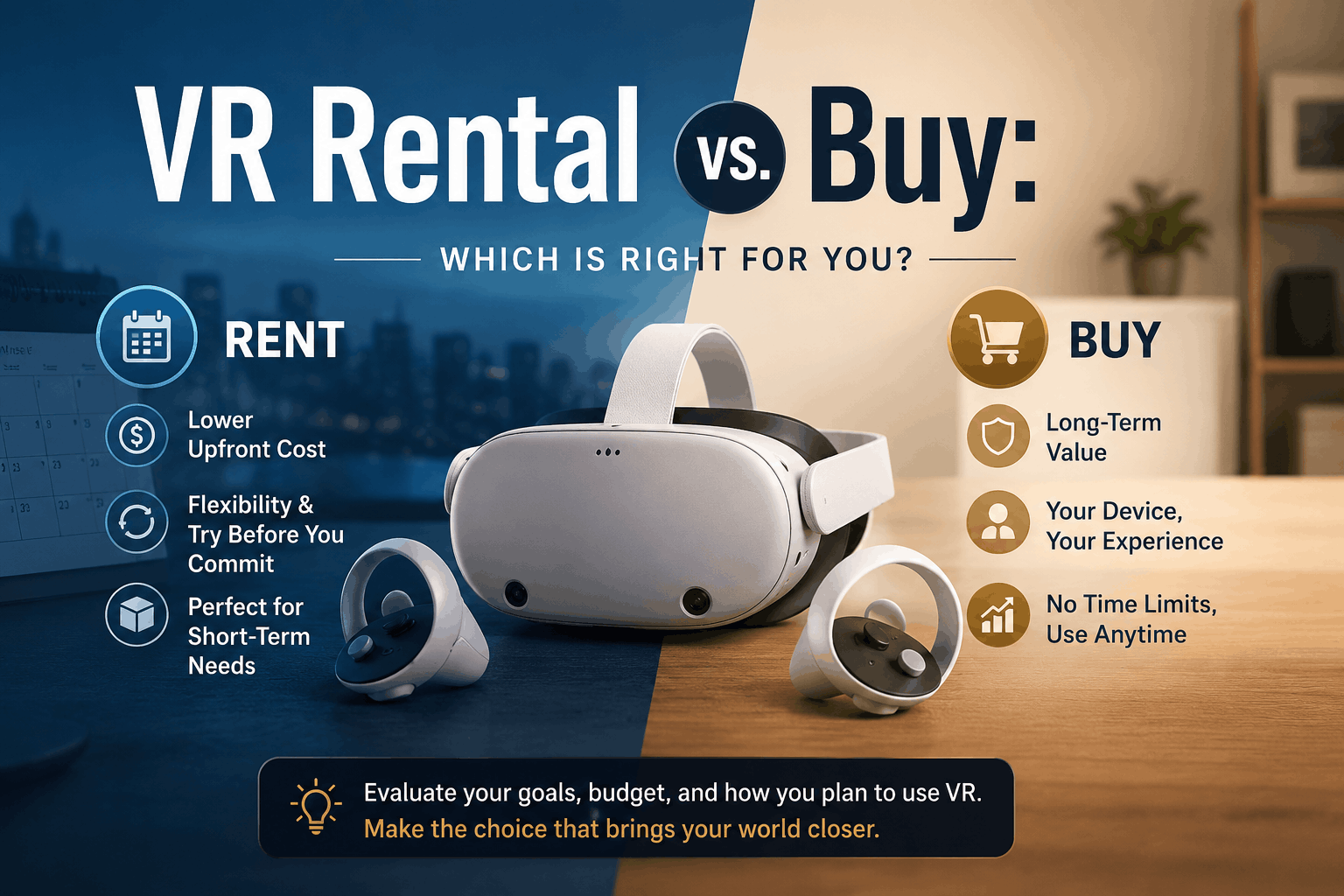
Making the leap into virtual reality for corporate use cases involves a critical decision: should you rent or buy the hardware? The answer isn’t just about the price of a headset; it’s a strategic choice that impacts your budget, IT resources, and the overall success of your immersive programs. This comprehensive guide provides a total cost analysis and a clear decision framework to help you determine the most effective path for your corporate events and training programs.
Quick Decision Matrix: When to Rent vs. Buy VR Equipment
Before diving into a detailed cost analysis, use this matrix to get a quick assessment of which option aligns best with your organization’s needs. Score each factor from 1 (low alignment) to 5 (high alignment) for both renting and buying to see which path is a more natural fit.
| Decision Factor | Score for Renting (1-5) | Score for Buying (1-5) | Your Score |
|---|---|---|---|
| Event Frequency | High (1-6 events/year) | High (Weekly/Monthly use) | |
| Scale & Quantity | Med (10-50 headsets) | High (Consistent number needed) | |
| IT Support Staff | Low (No dedicated VR staff) | High (IT team has capacity) | |
| Setup Complexity | Low (Vendor handles setup) | High (Internal team manages) | |
| Content Management | Low (Rental co. preloads) | High (Internal team manages) | |
| Budget Type | Operational Expense (OpEx) | Capital Expense (CapEx) |
Event Frequency and Scale Assessment
The nature and rhythm of your VR initiatives are the most significant indicators for renting versus buying.
- Rental Sweet Spot: Renting is highly advantageous for organizations running between one and six events per year that require 10 to 50 headsets. This model provides access to the latest technology without a large capital outlay for hardware that will sit unused for long periods.
- Purchase Threshold: If your organization plans to integrate VR into daily or weekly training sessions or conduct monthly marketing activations with a consistent number of users, purchasing becomes the more economical choice.
- Hybrid Approach: For companies with quarterly programs that experience fluctuating demand perhaps needing 10 headsets for one event and 50 for another a hybrid model works well. This involves owning a small “core” fleet and renting additional units to meet peak demand.
- Seasonal Demand: Businesses with seasonal peaks, such as holiday marketing campaigns or annual trade shows, benefit from the flexibility of rentals, avoiding the cost of owning and storing equipment year-round.
Internal IT and Support Capabilities
The operational burden of a VR fleet is a crucial, often underestimated, factor.
- Rental Advantage: When you lack dedicated IT staff with VR expertise, renting is the clear winner. Rental packages often include on-site or remote support, ensuring that any technical issues are handled by experts, allowing your team to focus on the event or training itself.
- Purchase Requirements: Owning a fleet of VR headsets requires your IT team to have the capacity and knowledge to manage firmware updates, troubleshoot hardware and software issues, and ensure all devices are properly configured and secured.
- Setup Complexity: A rental company can typically get a fleet of 20 headsets set up, sanitized, and ready for users within a couple of hours. In contrast, unboxing, charging, updating, and configuring a newly purchased fleet of the same size can take an internal IT team a full day or two.
- Content Management Overhead: Rental services often include preloading your specific applications and content. When you own the devices, your team is responsible for managing content licenses and deploying updates, which requires a Mobile Device Management (MDM) platform.
Total Cost of Ownership Beyond Purchase Price
The sticker price of a VR headset is just the beginning. The total cost of ownership (TCO) reveals the hidden expenses that can accumulate over the life of the device. These additional costs can represent a significant portion of the overall investment.
Storage, Insurance, and Depreciation Costs
Physical hardware comes with physical-world costs that are easy to overlook.
- Storage and Insurance: A fleet of 20 or more headsets requires secure, climate-controlled storage to protect the electronics and lenses. Furthermore, this valuable equipment needs to be covered by your business equipment insurance policy, which will add to your premium.
- Depreciation: VR technology evolves rapidly. Consumer-grade headsets can depreciate significantly, losing up to 70% of their value within two years. Enterprise-specific headsets may have a slightly better resale value but still represent a depreciating asset on your books.
Software Licensing and Content Management
The software that makes the hardware useful is a major ongoing expense.
- Per-Headset Licensing: Many business applications and platforms require a per-device license. These costs are recurrent and scale with the size of your fleet.
- MDM Platform Costs: To efficiently manage, update, and secure a fleet of owned headsets, a Mobile Device Management (MDM) platform is essential. Services like ManageXR or ArborXR have annual per-device fees. As of early 2026, Meta Horizon Managed Services became available at no cost, which can reduce this expense for companies using Meta Quest devices.
- Content Preloading: Rental services that include content preloading save your team valuable time. Managing this internally requires staff to manually load and test applications on each device before deployment.
Support Staff and Training Requirements
The human element is a significant and often unbudgeted cost.
- Dedicated Staff: Industry experts estimate that managing a fleet of 50 or more owned headsets can require the equivalent of a half-time employee (0.5 FTE) to handle logistics, maintenance, and user support.
- Troubleshooting Expertise: Your IT staff will need to develop expertise in diagnosing and fixing common VR hardware and software issues, which may require specialized training.
- User Training: Rental packages often include on-site staff to assist users, ensuring a smooth experience. With owned equipment, your team is responsible for training new users, which takes time away from their primary duties.
- Replacement Logistics: When an owned headset fails, your team must manage the repair or replacement process. Rental companies typically provide backup units on-site for immediate replacement.
Rental Economics for Different Business Scenarios
VR rental pricing is not one-size-fits-all. Costs are influenced by the event type, duration, quantity of headsets, and level of support required.
Trade Show and Conference Rentals
For short-term, high-visibility events, rental is often the most practical solution.
- Typical Costs: A 3-day trade show rental can range from $150 to $250 per headset, often including on-site support to assist attendees. Some rental services start their pricing for events at around $1499.
- Volume Discounts: Most rental companies offer significant volume discounts. Renting 20 or more units can reduce the per-headset cost by as much as 25%.
- Additional Services: Shipping, setup, and teardown services can add 15-20% to the base rental cost but provide significant convenience.
- Support Options: Reputable rental providers offer on-site technicians and backup units to ensure your demonstration runs smoothly without any downtime.
Training Program and Workshop Rentals
For educational purposes, rental agreements can be structured for longer terms.
- Weekly & Monthly Rates: Weekly rentals for training programs can range from $300 to $400 per headset. For month-long programs, the cost per headset can be between $800 and $1200, often with content preloading included.
- Pilot Programs: Many companies offer pilot program packages for 30-60 day evaluations. This allows you to test the effectiveness of a VR training module before committing to a larger-scale deployment.
- Rent-to-Own Options: If a pilot program proves successful, some vendors offer rent-to-own programs where a portion of the rental fees can be applied to the purchase price of the equipment.
Long-term and Enterprise Rental Agreements
For organizations with recurring VR needs, long-term agreements offer cost savings and predictability.
- Contract Discounts: Signing a quarterly or annual contract can reduce costs by 30-40% compared to ad-hoc, short-term rentals.
- Dedicated Equipment: Long-term clients may have a dedicated pool of headsets reserved for their use, ensuring availability even during peak seasons.
- Managed Services: These agreements often function as a “VR-as-a-Service” model, where the rental company manages content updates, hardware refreshes, and ongoing support as part of the contract.
- Flexible Scaling: Enterprise agreements can include provisions for flexible scaling, allowing you to easily add or remove headsets from your fleet based on changing business needs.
Purchase Scenarios Where Buying Makes Sense
Despite the many advantages of renting, there are clear scenarios where purchasing VR equipment provides a better return on investment (ROI).
High-Frequency Training Deployments
When VR becomes a core part of your daily or weekly operations, ownership is key.
- Constant Use: If you are running training sessions multiple times a week with a consistent number of employees, the cost of renting will quickly exceed the purchase price.
- Standardized Content: For training programs with a standardized content library that does not require frequent changes, the content management overhead of an owned fleet is minimized.
- Dedicated Facilities: Organizations with dedicated training centers can create permanent VR stations, making the logistics of owned equipment far simpler.
- ROI Breakeven: The breakeven point is often reached after the equivalent of 15-20 rental events per year. At that point, purchasing becomes the more cost-effective option.
Custom Application Development
Developing proprietary VR software often necessitates owning the hardware.
- Proprietary Software: If you are building a custom VR application tailored to your business, your development team will need permanent access to the target hardware for testing and iteration.
- System Integration: When the VR application needs to be deeply integrated with your existing enterprise systems (like an LMS or ERP), owning and controlling the hardware and its configuration is crucial.
- Data Security: For applications that handle sensitive or proprietary data, owning the devices allows your IT team to implement stringent security protocols and maintain full control over the data.
Hybrid Strategies: Combining Rental and Purchase
For many organizations, the optimal solution is not an “either/or” choice but a strategic combination of both models.
Core Fleet Plus Surge Capacity
This popular hybrid model offers the best of both worlds.
- Own for Regular Use, Rent for Peak Demand: Purchase a small fleet of 10-20 headsets for day-to-day training and development needs. For large annual conferences or company-wide events, supplement your core fleet with rented headsets to meet the surge in demand.
- Test Before You Invest: Use rentals to test new headset models and platforms before making a significant capital investment. This allows you to evaluate the technology with your specific content and use case.
Pilot-to-Purchase Programs
This approach de-risks the investment in VR technology.
- Trial Periods: Engage in a 3- to 6-month rental trial for a specific project or department. Many vendors will offer to credit a portion of the rental fees toward a purchase if you decide to buy the equipment at the end of the trial.
- Build Stakeholder Buy-In: A successful rental pilot provides the concrete data and positive user feedback needed to build a strong business case and secure the capital budget for a larger purchase.
- Gather Performance Metrics: Use the rental phase to collect key performance indicators (KPIs) and measure the ROI of the VR program, justifying further investment.
Implementation Roadmap Based on Your Decision
Whether you choose to rent, buy, or use a hybrid approach, a clear implementation plan is essential for a successful deployment.
Rental Implementation Checklist
- Vendor Evaluation: Create a shortlist of potential rental partners. Evaluate them based on inventory, technical support, content management capabilities, and client testimonials.
- Lead Time: Understand the lead time required for your desired quantity of headsets. For large events, it’s best to book several months in advance.
- Content Protocols: Clearly define the specifications for your custom content, including file formats and testing procedures, and provide them to the rental vendor well in advance.
- Define Success: Establish clear success metrics for your rental program. This could be lead generation at a trade show, employee proficiency in a training module, or user engagement rates.
Purchase Implementation Checklist
- Hardware Selection: Choose the right headset for your use case, considering factors like processing power, display quality, comfort, and enterprise management features.
- Infrastructure Prep: Prepare a dedicated space for charging, storing, and maintaining the headsets. Ensure your Wi-Fi network can handle the data load of multiple devices.
- Staff Training: Develop a training program for both the IT staff who will manage the fleet and the employees who will be using the headsets.
- Maintenance Schedule: Create a schedule for regular maintenance, including cleaning, software updates, and hardware inspections, to prolong the life of your investment.
Conclusion: A Strategic Decision Beyond the Headset
The decision to rent or buy VR equipment is a strategic one that should be driven by your organization’s specific needs, frequency of use, and internal capabilities. For infrequent, large-scale events or initial pilot programs, renting offers flexibility, cost-effectiveness, and expert support. For high-frequency, standardized training or custom application development, purchasing provides long-term value and greater control.
By carefully analyzing the total cost of ownership and considering a hybrid approach, you can create a VR deployment strategy that maximizes your return on investment and successfully integrates this transformative technology into your business.
Ready to explore your options? Contact a VR solutions provider today to get a custom quote for your next event or training program and start your journey into immersive technology.
Frequently Asked Questions (FAQs)
What’s the typical ROI breakeven point between renting and buying VR headsets?
The breakeven point is typically reached when you would have rented the same number of headsets for 15-20 separate events within a year. If your usage exceeds this, purchasing is likely more cost-effective.
Can I rent VR equipment with my custom applications preloaded?
Yes, most corporate VR rental companies offer content preloading services. You will need to provide them with your application files and specifications ahead of the rental period for testing and deployment.
How do rental companies handle damaged or lost VR headsets?
Rental agreements typically include an insurance policy or a damage waiver that covers accidental damage. The terms will be outlined in your contract, but you are generally responsible for the replacement cost if a headset is lost or stolen.
What’s included in enterprise VR rental support packages?
A comprehensive support package usually includes delivery and setup, on-site technicians to assist users and troubleshoot issues, backup headsets for immediate replacement, and post-event technical support.
Should startups rent or buy VR equipment for product demos?
Startups almost always benefit more from renting. It conserves capital, provides access to the latest hardware for the best possible impression, and eliminates the burden of managing equipment, allowing the team to focus on their product and customers.
How do I calculate the true cost of VR headset ownership?
To calculate the total cost of ownership (TCO), you must add the initial purchase price to the costs of software licenses, MDM platforms, insurance, storage, dedicated IT staff time for management and support, and factor in the rate of depreciation over 2-3 years.
What are typical VR rental contract terms for corporate clients?
Contracts typically outline the rental duration, number of headsets, included support services, content preloading details, shipping logistics, insurance/damage waiver terms, and payment schedule. For longer-term rentals, they may also include clauses for hardware refreshes and flexible scaling.
Can I convert a rental agreement to a purchase later?
Many rental companies offer rent-to-own or pilot-to-purchase programs. These allow you to apply a percentage of your rental payments toward the purchase price of the equipment if you decide to buy it after the rental period.