Why Remote Product Demonstrations Fall Short Without Physical Interaction
Video calls show features but can’t replicate the hands-on experience buyers expect. Shipping physical products is expensive and logistically complex. VR bridges this gap by letting remote prospects interact with your product in 3D space without shipping anything except a headset.
The shift to remote selling has exposed fundamental limitations in how companies demonstrate complex products. Screen-based demos reduce three-dimensional products to flat representations, while shipping physical units creates operational nightmares. Virtual reality product demonstrations solve both problems by delivering immersive experiences through lightweight, shippable headsets.
The Engagement Drop-Off in Screen-Based Demos
The difference between passive viewing and active manipulation directly impacts prospect retention rates. During traditional video demos, prospects retain only 10-20% of presented information after 48 hours. VR demonstrations boost retention to 75-90% through spatial memory engagement and hands-on interaction.
Screen-based demos fail to convey critical product attributes. A 2D video cannot communicate the weight distribution of industrial equipment, the texture of premium materials, or the true scale of machinery in a factory setting. Prospects watching a screen share cannot walk around a product, examine it from underneath, or understand how it fits within their existing workspace.
Multitasking kills demo effectiveness. Analytics from remote demo platforms show that 67% of prospects engage in other activities during video presentations—checking email, browsing websites, or working on separate tasks. VR headsets demand complete attention. Once prospects put on the headset, they’re fully immersed in your product experience with no digital distractions competing for their focus.
When Shipping Physical Products Becomes Unsustainable
The economics of shipping physical products for demonstrations quickly spiral out of control. Consider a manufacturer of industrial printing equipment. Shipping a $40,000 digital press for a one-week demo costs $3,000-5,000 in freight charges each way. Add insurance, custom crating, and potential customs fees for international prospects, and a single demo can exceed $15,000 in logistics costs alone.
Risk compounds with every shipment. Products suffer damage during transit, even with professional packaging. A medical device company reported that 23% of demo units shipped to prospects returned with calibration issues or cosmetic damage requiring service before the next demonstration. Some products never return at all—lost in shipping, held at customs, or retained by prospects claiming extended evaluation needs.
Complex products require on-site support, multiplying costs further. Sending a technician to set up demonstration equipment adds $2,000-4,000 per demo in travel expenses and lost productivity. For products requiring special power connections, ventilation, or floor reinforcement, the demonstration might be impossible at the prospect’s location regardless of shipping logistics.
How VR Rentals Enable Remote Product Demonstrations
Renting VR headsets for remote demos means shipping a $400 device instead of a $40,000 machine. Your prospect gets an immersive product experience while you maintain control over the demo environment and content.
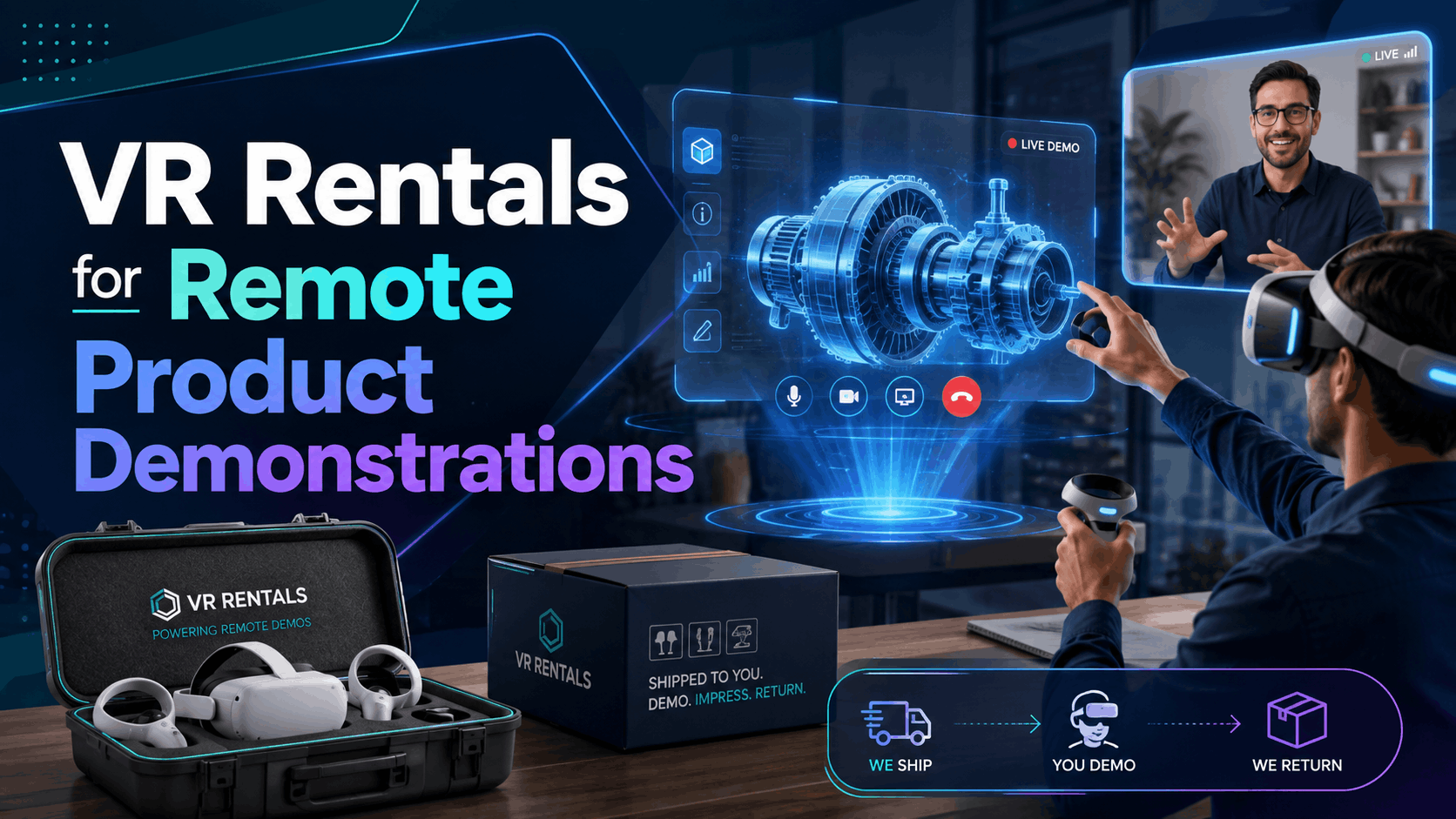
The rental model transforms demonstration economics. Companies ship pre-configured VR headsets loaded with their product experiences directly to prospects. After the demo, prospects return the headsets using pre-paid labels. The entire process costs less than a traditional sales trip while delivering superior engagement compared to video calls.
The Logistics: Shipping VR Headsets vs Products
VR headset shipping operates like any e-commerce fulfillment. Rental companies use standard shipping boxes weighing under 5 pounds, compatible with FedEx, UPS, and USPS services. Two-day shipping costs $30-50 domestically, compared to $500-5,000 for freight shipping industrial equipment.
Pre-loaded standalone devices eliminate setup complexity. Meta Quest 3 headsets arrive with demo content already installed. Prospects charge the device, put it on, and launch directly into the product experience. No app downloads, account creation, or technical configuration required. The entire setup takes less than five minutes versus hours or days for physical product installation.
Return logistics follow the same simplicity. Rental packages include pre-printed return labels and protective packaging. Prospects place the headset back in its case, apply the shipping label, and drop it at any shipping location. The rental company handles device sanitization, recharging, and content updates between deployments.
Creating Your Product Demo in VR
Converting existing product data into VR experiences follows established workflows. Most manufacturers already possess CAD files for their products. These files import directly into VR development platforms like Unity or Unreal Engine. Basic conversion from CAD to viewable VR model takes 2-3 days for simple products, 1-2 weeks for complex assemblies.
Photogrammetry captures products without CAD data. Using specialized cameras, teams photograph products from hundreds of angles. Software reconstructs these photos into detailed 3D models preserving exact textures, wear patterns, and surface details. This technique works particularly well for retrofitting existing equipment or capturing custom configurations.
Interactive elements transform static models into sales tools. Developers add hotspots that reveal specifications when prospects look at specific components. Animated sequences demonstrate operation cycles. Prospects can swap colors, materials, or optional accessories in real-time. Advanced demos let users operate virtual controls, seeing immediate responses in product behavior.
Remote Support During VR Demo Sessions
Screen mirroring keeps sales teams connected during VR demos. Platforms like Oculus Business Suite stream the prospect’s view to the salesperson’s computer. Sales teams see exactly what prospects examine, guiding attention to key features and answering questions about specific components prospects investigate.
Voice communication maintains the human connection. Built-in headset microphones enable natural conversation while prospects explore. Sales teams provide context about what prospects see, share relevant use cases, and respond to technical questions without breaking immersion. This guided exploration combines the best of self-directed discovery with expert consultation.
Session recordings create powerful follow-up tools. The VR platform captures the prospect’s entire journey through the product experience—where they looked, what they touched, which features they explored repeatedly. Sales teams review these recordings to understand prospect priorities, address overlooked features in follow-up conversations, and refine future demonstrations based on actual user behavior.
VR Demo Use Cases by Industry
Different industries leverage VR for remote demonstrations based on their specific product challenges. Manufacturing shows assembly processes, real estate tours properties, and medical device companies demonstrate procedures.
Each sector adapts VR demonstrations to address unique selling challenges. Heavy industry eliminates dangerous factory visits. Real estate previews unbuilt properties. Healthcare technology trains without risking patient safety. The technology flexes to meet diverse demonstration needs.
Industrial Equipment and Manufacturing
Manufacturing equipment demonstrations in VR eliminate factory visit requirements. A packaging machinery company creates virtual production lines where prospects observe their specific products moving through filling, sealing, and labeling stations. Prospects adjust line speeds, change product sizes, and witness the machine adapting to different configurations—impossible to demonstrate with static equipment at trade shows.
Internal component visibility revolutionizes technical sales conversations. Prospects look inside gearboxes to understand lubrication systems. They remove panels to examine wiring layouts. Maintenance procedures play out step-by-step, showing exactly how technicians access wear parts. This transparency builds confidence in long-term serviceability without disassembling physical demonstration units.
Scale visualization places equipment in context. The VR experience positions machines within a virtual replica of the prospect’s actual factory floor. Prospects walk around the equipment, confirming clearances for maintenance access. They visualize workflow patterns with existing equipment. This spatial understanding prevents expensive mistakes in equipment specification and facility planning.
Architecture and Real Estate Development
Pre-construction property walkthroughs close deals on unbuilt projects. Developers showcase residential towers two years before completion, letting buyers experience views from specific units, understand natural light patterns throughout the day, and visualize furniture placement in actual room dimensions. This immersive preview converts reservations into deposits without physical model units.
Material selection happens in context rather than from samples. Prospects swap flooring options while standing in the virtual space. They compare countertop materials under different lighting conditions. Paint colors apply instantly to walls, eliminating the guesswork of how swatches translate to full rooms. This interactive selection process reduces change orders and buyer remorse.
Site planning extends beyond individual buildings. VR demonstrations show entire developments, letting investors walk future streets, understand traffic patterns, and experience the relationship between residential, commercial, and public spaces. Municipal planners evaluate shadow impacts on neighboring properties. Community members explore proposed changes to their neighborhoods before public hearings.
Medical Devices and Healthcare Technology
Surgical procedure simulations demonstrate device benefits without OR access. A spinal implant manufacturer creates VR experiences where surgeons perform virtual procedures using their instruments. Surgeons feel the difference in approach angles, understand tissue retraction requirements, and practice device placement without scheduling cadaver labs or risking patient complications.
Patient room planning optimizes equipment placement before purchase. Hospital administrators enter VR replicas of their actual rooms, positioning new monitoring equipment, adjusting bed configurations, and testing staff movement patterns. They identify potential workflow conflicts, confirm electrical outlet locations, and ensure compliance with safety regulations before committing to expensive equipment purchases.
Training scenarios validate competency without physical equipment. Medical device companies provide VR training modules that prospects use to evaluate learning curves for their staff. Nurses practice using new infusion pumps. Technicians troubleshoot equipment errors. These risk-free training environments demonstrate how quickly teams can adopt new technology, addressing a critical concern in medical equipment purchases.
Setting Up Your Remote VR Demo Program
Implementing VR demos requires choosing between rental packages, determining headset quantities, and establishing your demo workflow. Start with a pilot program before scaling.
Successful VR demo programs begin with small, controlled deployments. Companies typically start with 5-10 headsets for their top sales performers, refine their demo content based on prospect feedback, then expand to full sales team coverage. This phased approach minimizes initial investment while proving ROI through measurable sales improvements.
Rental Package Selection for Demo Programs
Standalone headsets like Meta Quest 3 offer the optimal balance for remote product demonstrations. These devices require no external computers, work on standard WiFi connections, and provide sufficient graphics quality for most product visualizations. At $500-700 retail price, rental rates typically run $200-300 per month per headset with shipping included.
PC-tethered headsets justify their complexity only for specific use cases. Products with extreme detail requirements—microscopic surface textures, complex transparent materials, or massive assembly visualizations—benefit from the superior graphics processing of PC-based systems. However, shipping gaming laptops alongside headsets triples logistics complexity and doubles rental costs.
Minimum rental quantities affect program economics. Most VR rental companies require 5-headset minimums for business accounts. This threshold ensures dedicated support resources and volume shipping rates. Companies needing fewer units should consider per-demo rentals at $150-200 per deployment, though this model becomes expensive beyond 2-3 demos monthly.
Demo Content Development Timeline
Basic CAD conversions deliver viewable models within 2-4 weeks. This timeline covers importing existing CAD files, optimizing polygon counts for VR performance, applying basic materials and textures, and setting up standard lighting. The resulting experience allows prospects to walk around and examine products but lacks interactive elements or animations.
Interactive experiences require 6-8 weeks of development. This extended timeline accommodates hotspot programming, animation sequences, configuration options, and user interface design. Developers create guided tour modes for first-time users and free exploration modes for technical evaluators. Quality assurance testing ensures consistent performance across different headset positions and movement speeds.
Ongoing updates keep demos current with product evolution. Establish monthly or quarterly update cycles aligned with product releases. Minor updates—changing colors, updating specifications in hotspots, or adjusting pricing information—deploy within days. Major updates involving new product models or significant feature additions follow the original development timeline but benefit from reusing existing interaction frameworks.
Sales Team Training and Rollout
Remote demo scripts require VR-specific adaptation. Traditional demo talk tracks assume shared screen viewing. VR scripts must account for prospects looking in different directions, spending variable time with different features, and asking questions about elements the salesperson cannot see without screen mirroring. Successful teams develop flexible conversation frameworks rather than rigid scripts.
Troubleshooting training prevents demo failures. Sales teams must diagnose common issues: WiFi connectivity problems, low battery warnings, and tracking errors from inadequate room lighting. A two-hour training session covering these scenarios prevents 90% of technical difficulties. Provide quick reference cards with solution steps and rental company support numbers for edge cases.
Engagement metrics inform continuous improvement. VR platforms track detailed interaction data—which features prospects examine longest, where they encounter confusion, and when they remove headsets prematurely. Weekly reviews of this data with sales teams identify content improvements and refine demonstration techniques. High-performing demo approaches spread across the team through recorded session sharing.
Measuring ROI of VR Remote Demonstrations
VR demos generate measurable improvements in qualified lead conversion, deal velocity, and average contract value. Track both engagement metrics and sales outcomes.
Return on investment calculations for VR demonstrations extend beyond simple cost comparisons with travel or shipping. The technology fundamentally changes prospect engagement quality, sales cycle dynamics, and competitive differentiation. Companies report 30-40% improvements in demo-to-proposal conversion rates and 20-25% reduction in sales cycle length for complex products.
Engagement Metrics That Matter
Time spent in VR experiences averages 3-4x longer than video demo duration. Prospects explore VR demonstrations for 25-35 minutes compared to 8-10 minutes of active attention during screen shares. This extended engagement correlates directly with information retention and purchase intent. Prospects who spend over 20 minutes in VR demos convert at 2.5x the rate of those with shorter sessions.
Feature interaction heatmaps reveal true prospect priorities. Unlike video demos where presenters control the narrative, VR demonstrations show what prospects actually care about. A industrial pump manufacturer discovered prospects spent 60% of their time examining maintenance access points—not the efficiency metrics their sales team emphasized. This insight reshaped their entire sales messaging.
Demo completion rates indicate content effectiveness. Well-designed VR experiences see 85-90% completion rates compared to 40-50% for video demos. Prospects abandon poorly designed VR demos within 5 minutes, usually due to confusing navigation, overwhelming detail, or motion discomfort from improper movement speeds. These early indicators enable rapid content iteration.
Sales Pipeline Impact
Conversion rates from demo to proposal increase 35-45% with VR demonstrations. The immersive experience creates stronger emotional connections to products. Prospects who virtually operate equipment or walk through spaces develop ownership feelings before purchase. This psychological investment translates to higher proposal acceptance rates and faster decision-making.
Sales cycles compress significantly for complex products. Enterprise software companies report 30-day reductions in average sales cycles after implementing VR demos. The technology eliminates multiple stages of traditional sales processes: scheduling site visits, coordinating multiple stakeholder demonstrations, and waiting for physical product availability. Prospects gain complete product understanding in single VR sessions rather than multiple touchpoints.
Travel cost elimination provides immediate ROI. A single prevented trip to demonstrate industrial equipment saves $3,000-5,000 in travel expenses plus opportunity costs of sales rep time. Companies conducting 10+ remote VR demonstrations monthly save $30,000-50,000 compared to traditional on-site demonstrations. These savings alone justify VR rental costs before considering conversion rate improvements.
Common Concerns About Remote VR Demonstrations
Sales teams worry about technical complexity, prospect adoption, and content security. Address these concerns upfront with the right rental partner and demo design.
Resistance to VR demonstrations often stems from misconceptions about the technology’s complexity or requirements. Modern VR headsets are simpler to operate than video conferencing software. Prospects need only basic technical literacy—if they can use a smartphone, they can navigate a VR demo. Addressing concerns proactively during demo scheduling prevents no-shows and builds prospect confidence.
Technical Support for Non-Technical Prospects
Pre-configured headsets eliminate setup complexity. Rental companies ship devices with demos pre-installed and launching automatically when prospects put on the headset. No app stores, no downloads, no account creation. The experience begins immediately, like pressing play on a DVD player. This simplicity surprises prospects expecting complicated gaming-style setups.
Phone support during setup provides safety nets. Quality rental companies offer dedicated support lines prospects call if they encounter issues. Support agents walk prospects through basic troubleshooting: ensuring full battery charge, confirming WiFi connection, and adjusting headset fit for clarity. This backup support gives sales teams confidence to schedule VR demos with non-technical buyers.
Screen-share fallbacks preserve demo appointments. If VR absolutely fails—rare but possible with poor internet or incompatible environments—sales teams pivot to screen-shared versions of the VR content. While less immersive, these 3D model viewers still surpass traditional video demos. Prospects appreciate the preparation and effort even when technology doesn’t cooperate perfectly.
Content Security and IP Protection
Time-limited access tokens prevent unauthorized viewing. VR demos activate only during scheduled windows, typically 24-48 hours around the demonstration appointment. After expiration, headsets display generic content or rental company branding. This limitation prevents prospects from sharing devices with competitors or extensively reverse-engineering products through extended access.
Simplified models protect detailed IP while maintaining demo effectiveness. Companies create “demo versions” of their products with reduced detail in proprietary areas. External appearances remain photorealistic while internal mechanisms show functional representations rather than exact specifications. This approach balances engagement with protection, similar to how software companies provide feature-limited trial versions.
Remote wipe capabilities ensure content control. Enterprise VR platforms enable instant content deletion from rental devices. If a headset goes missing or a prospect relationship turns adversarial, companies remotely remove their demonstrations within minutes. Rental agreements include device replacement costs, protecting against financial losses from non-returns while maintaining content security.
Frequently Asked Questions
How much does it cost to rent VR headsets for remote demos?
VR headset rentals for business demonstrations typically cost $200-300 per headset per month for ongoing programs, or $150-200 per individual demo deployment. Volume discounts apply for 10+ headsets. These rates include shipping, technical support, and device maintenance between rentals.
Can prospects keep the VR content after returning the headset?
No, VR demo content remains locked to rental headsets through enterprise management platforms. Content automatically deactivates when rental periods end. Prospects cannot transfer, copy, or access demonstrations after returning equipment.
What happens if a prospect damages or loses the rental headset?
Rental agreements include damage protection covering normal wear and minor accidents. Prospects bear responsibility for gross negligence or loss, typically $500-700 per headset. Rental companies handle claims processing and replacement shipping to minimize sales disruption.
How long does it take to convert our CAD files to VR experiences?
Basic CAD to VR conversion takes 2-4 weeks for simple products, 4-6 weeks for complex assemblies. Adding interactivity, animations, and guided tours extends timelines to 6-8 weeks. Rush services available for 50% premium complete simple conversions in 5-7 business days.
Do we need different VR content for different headset models?
Most business VR content works across Meta Quest 2, Quest 3, and Pico 4 headsets without modification. PC-based headsets require separate builds. Rental companies typically standardize on single headset models to avoid compatibility issues.
Can multiple prospects join the same VR demo simultaneously?
Yes, multi-user VR demos support up to 8 participants in the same virtual space. Each prospect needs their own headset. Participants see avatars of other users, enabling collaborative exploration and discussion. This capability particularly benefits committee-based purchase decisions.
What internet speed do prospects need for VR demos?
Standalone VR demos pre-loaded on headsets require no internet during viewing. Streaming or multi-user demos need minimum 25 Mbps download speeds, similar to Netflix 4K requirements. Most business internet connections easily support VR demonstrations.
Conclusion
Virtual reality product demonstrations fundamentally change remote selling economics and effectiveness. By shipping lightweight VR headsets instead of heavy products, companies slash demonstration costs while delivering superior prospect experiences. The technology transforms passive video watchers into active product explorers, increasing engagement time 3-4x and boosting conversion rates 35-45%.
Success with VR demonstrations requires thoughtful implementation but not technical expertise. Start with a pilot program of 5-10 headsets for top performers. Develop compelling content that showcases your product’s unique value. Train sales teams on VR-specific demonstration techniques. Measure results through both engagement analytics and sales outcomes.
The question isn’t whether VR demonstrations outperform traditional remote selling methods—data consistently proves they do. The question is how quickly you’ll adopt this competitive advantage before your rivals do.
Ready to transform your remote product demonstrations? Contact a VR rental provider today for a pilot program consultation. Most offer free demo content assessments and can deliver your first rental headsets within a week. Your prospects are waiting for immersive product experiences. Deliver them.