What Is VR Training and Why Companies Are Adopting It
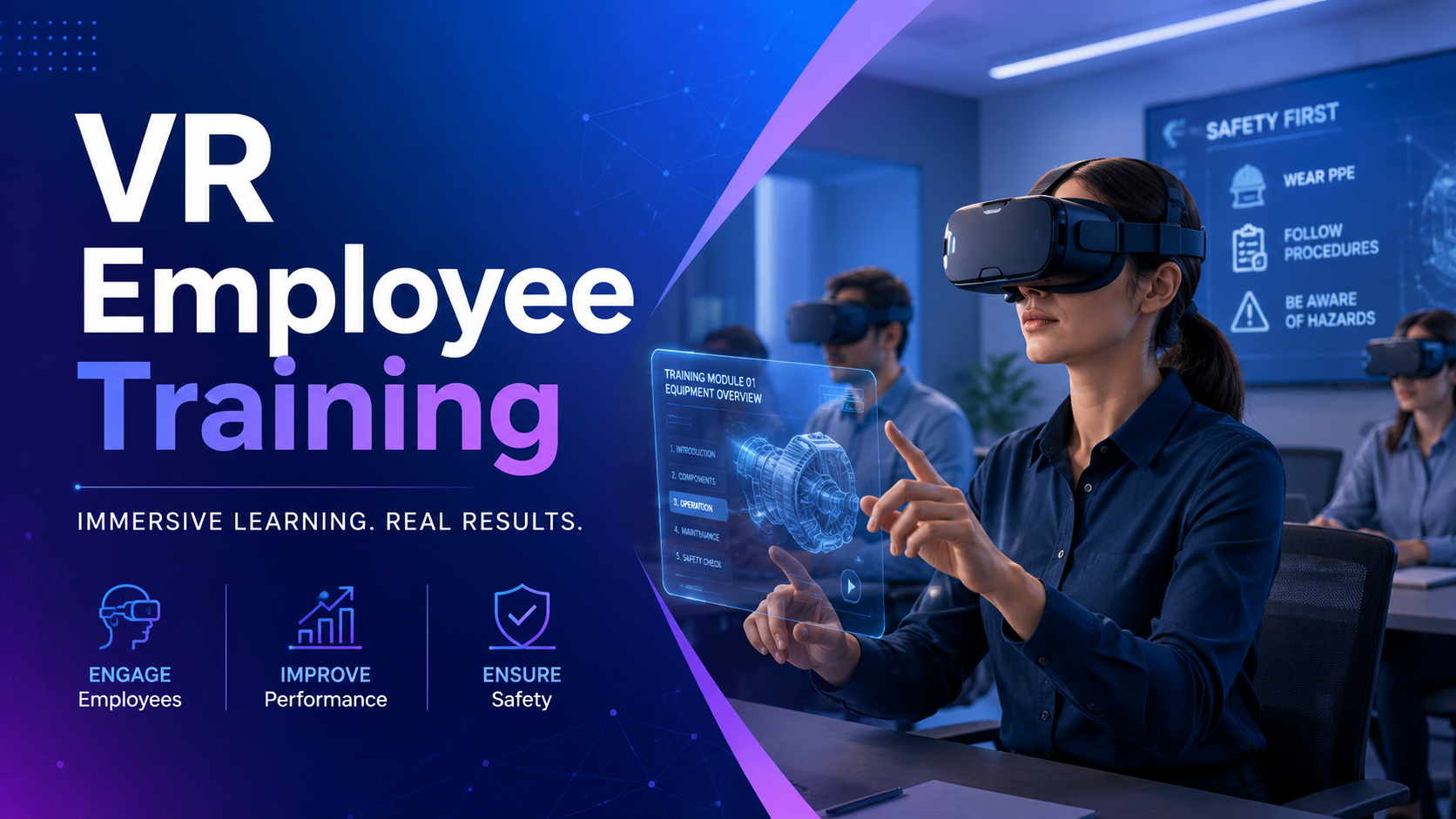
Virtual reality training transforms traditional learning by placing employees directly into realistic scenarios where they can practice skills without real-world consequences. Unlike video-based or classroom training, VR creates muscle memory and emotional engagement that drives 4x faster learning and 275% better confidence in applying skills.
The technology has moved beyond experimental phases into mainstream corporate adoption. Fortune 500 companies now deploy VR training programs across manufacturing floors, retail stores, and corporate offices, driven by measurable improvements in employee performance and dramatic reductions in training costs.
How VR Training Differs from Traditional Methods
Active participation vs passive viewing creates stronger retention. Traditional e-learning achieves 5-10% information retention after one week. VR training participants retain 75% of information through experiential learning that engages multiple senses simultaneously.
Safe environment for high-risk scenario practice. Employees practice dangerous procedures like working at heights, handling hazardous materials, or operating heavy machinery without injury risk. Customer service representatives rehearse difficult conversations with upset customers without damaging real relationships.
Consistent training delivery across locations without trainer travel. Every employee receives identical high-quality instruction regardless of location. A single VR module replaces dozens of instructor-led sessions, eliminating variations in trainer quality and availability constraints.
Real-time performance data and completion tracking. VR platforms capture granular metrics including gaze patterns, reaction times, decision points, and error rates. Managers receive dashboards showing exactly where employees struggle and which skills require additional practice.
Measurable Business Impact of VR Training Programs
Walmart’s 70% improvement in employee test scores after VR training. The retail giant trained over one million associates using VR modules for customer service, compliance, and new technology rollouts. Test scores jumped from 70% to 89% average, with training time reduced by 50%.
PwC study showing VR learners complete training 4x faster. Their 2020 research found VR-trained employees finished coursework in 30 minutes versus 2 hours for classroom learners. Confidence in applying learned skills increased 275% compared to traditional methods.
Cost reduction examples from eliminating travel and facility rental. Johnson & Johnson saved $1.2 million annually by replacing in-person surgical training with VR modules. Travel costs dropped to zero while training capacity increased 10x without additional facilities.
Engagement metrics showing 90%+ completion rates vs 25% for e-learning. Employees voluntarily complete VR training modules at unprecedented rates. The immersive nature prevents multitasking and distraction, ensuring focused attention throughout sessions.
VR Training Use Cases by Industry and Department
VR training applications span from technical skills development to soft skills practice, with each industry finding unique applications that address their specific training challenges and compliance requirements.
Manufacturing and Industrial Training
Equipment operation without production line disruption. New operators learn complex machinery controls in virtual replicas of actual equipment. BMW trains assembly line workers on new vehicle models months before physical prototypes exist, accelerating production readiness by 12 weeks.
Safety protocol training in hazardous environments. Workers experience consequences of safety violations without injury. Shell uses VR to simulate oil rig emergencies, teaching evacuation procedures and emergency response protocols that would be impossible to practice safely in reality.
Assembly line optimization and quality control procedures. Ford reduced assembly errors by 70% using VR training for intricate wiring harness installation. Workers practice identifying defects and following quality checkpoints in accelerated time scenarios.
Maintenance and repair training on expensive machinery. Technicians disassemble and repair virtual equipment unlimited times without damaging costly components. Siemens trains wind turbine technicians in VR, reducing on-site training time by 60% and preventing equipment damage during learning.
Healthcare and Medical Training
Surgical procedure practice without patient risk. Surgeons perform complex operations repeatedly in VR before touching real patients. UCLA Medical Center documented 230% improvement in surgical performance after VR training compared to traditional observation-based learning.
Emergency response scenario training. Medical teams practice rare emergency procedures that occur infrequently in real hospitals. Children’s Hospital Los Angeles uses VR to train pediatric emergency responses, improving team coordination and reducing response time by 40%.
Patient interaction and bedside manner development. Healthcare workers practice delivering difficult diagnoses and showing empathy through avatar-based scenarios. Embodied Labs’ VR training increased caregiver empathy scores by 14% in controlled studies.
Medical device operation training. Technicians learn to operate complex medical equipment without tying up actual devices needed for patient care. Medtronic reduced device training time by 50% while improving competency test scores by 35%.
Corporate Soft Skills Development
Leadership and management scenario practice. Managers navigate difficult conversations including performance reviews, terminations, and conflict resolution. Verizon’s VR leadership training improved manager confidence scores by 40% in handling challenging employee situations.
Diversity and inclusion training with perspective-taking. Employees experience workplace scenarios from different demographic perspectives. PwC’s inclusive leadership VR training showed 3x greater empathy development compared to traditional diversity workshops.
Customer service de-escalation techniques. Representatives practice calming angry customers in realistic retail or call center environments. Walmart trained Black Friday staff using VR crowd management scenarios, reducing customer complaints by 10% during peak shopping periods.
Public speaking and presentation skills. Employees present to virtual audiences that provide realistic reactions including distraction, disagreement, and engagement. VirtualSpeech users report 25% reduction in presentation anxiety after VR practice sessions.
Running a VR Training Pilot: The Rental Advantage
Before investing in VR hardware and platform licenses, smart L&D teams run pilot programs using rental equipment to validate ROI, test content effectiveness, and build stakeholder buy-in without capital expenditure.
Why Rent VR Equipment for Training Pilots
Test multiple headset models to find best fit for your use case. Different training scenarios require different hardware capabilities. Rental programs allow testing Meta Quest 3 for standalone deployment, Pico 4 Enterprise for device management features, or HTC Vive Focus 3 for premium comfort during extended sessions.
Avoid $50,000+ upfront investment before proving value. Enterprise VR deployments typically cost $1,000-1,500 per headset including accessories, software licenses, and support. Rental pilots cost $200-400 per headset monthly, reducing financial risk by 90% during evaluation.
Access to setup support and technical assistance during pilot. Rental providers offer configuration services, user training, and technical support that internal IT teams lack during initial deployment. This expertise prevents common implementation failures that doom 40% of VR pilots.
Scale up or down based on pilot results without equipment waste. Successful pilots can expand immediately by adding rental units. Failed pilots return equipment without depreciation losses or disposal challenges. This flexibility enables rapid iteration and refinement.
Structuring Your Pilot Program
Define success metrics before launch. Establish baseline measurements for current training methods including completion rates, time to proficiency, knowledge retention at 30/60/90 days, and training cost per employee. Set specific improvement targets like 25% faster proficiency or 50% cost reduction.
Select 20-50 participants for statistically significant results. Include diverse user groups across age ranges, technical comfort levels, and job roles. Create control groups using traditional training methods for direct comparison. Document participant feedback through surveys and focus groups.
Run 30-60 day pilot with control group comparison. Week 1-2: Equipment setup and user orientation. Week 3-6: Active training delivery with weekly check-ins. Week 7-8: Assessment and data analysis. Compare results between VR and traditional training groups across all defined metrics.
Document setup requirements and IT considerations for full rollout. Record Wi-Fi bandwidth consumption, space requirements, device management needs, and support ticket volume. Create deployment playbooks covering equipment distribution, user onboarding, content updates, and troubleshooting procedures.
Rental Package Configuration for Training
Headset quantity calculation based on concurrent users. Calculate maximum simultaneous users, not total user population. Most organizations need 1 headset per 10-15 employees for effective rotation. Consider session length, cleaning time between users, and charging requirements.
Content licensing options for training modules. Off-the-shelf content typically costs $30-100 per user monthly. Custom content development ranges from $20,000-500,000 depending on complexity. Many rental providers bundle content libraries with hardware packages.
Support level requirements for non-technical trainers. Basic packages include email support and documentation. Premium support adds phone assistance, on-site setup, and train-the-trainer sessions. Budget 20% of rental costs for adequate support during pilots.
Hygiene and sanitization protocols for shared equipment. UV-C sanitization cabinets clean headsets in 60 seconds between users. Disposable face cushions cost $1-2 each but eliminate hygiene concerns. Establish cleaning schedules and assign responsibility to specific staff members.
VR Training Platform and Content Options
The VR training ecosystem includes off-the-shelf content libraries, custom development platforms, and industry-specific solutions, each with different hardware requirements and pricing models that affect your pilot program design.
Off-the-Shelf Training Content Libraries
STRIVR for enterprise soft skills and safety training. Focused on retail, hospitality, and corporate training with 30+ ready-made modules. Clients include Walmart, Verizon, and FedEx. Pricing starts at $50,000 annually for 100 users. Compatible with Meta Quest and Pico devices.
Immerse for language learning and communication skills. Live instructor-led VR classes for business English, Spanish, and Mandarin. Includes AI-powered conversation practice and cultural training scenarios. Costs $2,000-5,000 per user annually depending on lesson frequency.
Osso VR for surgical and medical device training. 120+ surgical procedures and medical device training modules. Used by Johnson & Johnson and Zimmer Biomet for sales team education. Pricing ranges from $599-1,499 per user monthly based on content access levels.
Compatibility with Meta Quest, Pico, and HTC headsets. Most platforms support multiple hardware options. Meta Quest 3 offers best value at $499 with inside-out tracking. Pico 4 Enterprise adds device management at $899. HTC Vive Focus 3 provides premium comfort for $1,300.
Custom Content Development Platforms
Unity and Unreal Engine for fully custom experiences. Professional game engines enable photorealistic training simulations. Development costs start at $100,000 for basic scenarios. Enterprise licenses include source code access for internal modifications.
No-code platforms like Uptale and Warp Studio. Drag-and-drop interfaces allow non-programmers to create VR training. Monthly subscriptions range from $500-2,000. Best for simple scenarios and rapid prototyping before professional development.
360-video capture for location-specific training. Capture real environments using 360-degree cameras ($5,000-25,000). Effective for facility tours and location familiarization but limited interactivity compared to 3D environments.
Development cost ranges from $20K to $500K+. Simple 360-video experiences with hotspots: $20,000-50,000. Interactive 3D scenarios with branching narratives: $50,000-150,000. Photorealistic simulations with physics: $150,000-500,000+. Factor 20-30% annual maintenance costs.
Implementation Logistics and Best Practices
Successful VR training deployment requires addressing practical considerations around space, equipment management, user onboarding, and ongoing support that determine whether employees actually use the technology.
Physical Space and Setup Requirements
Minimum 6×6 feet clear space per user for room-scale VR. Mark boundaries with tape or portable barriers. Remove tripping hazards including cables, furniture edges, and loose rugs. Install padding on walls and sharp corners within reach distance.
Seated VR options for limited space environments. Many training scenarios work effectively seated, requiring only 3×3 feet. Swivel chairs allow 360-degree rotation without standing. Seated experiences reduce fatigue during longer training sessions.
Wi-Fi bandwidth requirements for cloud-based content. Each headset requires 25-50 Mbps for streaming content. Local network storage reduces bandwidth needs to 5-10 Mbps for progress tracking only. Consider dedicated VR network segments to prevent bandwidth competition.
Charging station setup for multi-headset deployments. Headsets require 2-3 hours charging for 2-3 hours use. Install charging stations with cable management near training areas. Purchase 50% extra batteries for hot-swapping during continuous training days.
User Onboarding and Comfort Optimization
First-time user orientation sessions reduce motion sickness. Start with stationary experiences before introducing movement. Teach users to move physically rather than using joystick locomotion. Provide ginger candy or anti-nausea medication for sensitive users.
Gradual exposure protocols starting with 15-minute sessions. Week 1: 15-minute sessions. Week 2: 30-minute sessions. Week 3+: 45-60 minute sessions as tolerated. Monitor user comfort and adjust individually. Most users adapt within 3-5 sessions.
Interpupillary distance adjustment for visual comfort. Measure IPD using smartphone apps or rulers. Adjust headset IPD settings for each user (range typically 58-72mm). Incorrect IPD causes eye strain, headaches, and blurred vision.
Break schedules and session length recommendations. Enforce 10-minute breaks every 30 minutes for new users. Experienced users can extend to 60-90 minutes with 15-minute breaks. Hydration and eye exercises during breaks reduce fatigue.
Ongoing Management and Support
Device management platforms for content deployment. ArborXR and ManageXR enable remote content installation, device monitoring, and usage restrictions. Costs $10-20 per device monthly. Essential for deployments exceeding 10 headsets.
Troubleshooting common technical issues. Tracking loss: Clean cameras and ensure adequate lighting. Controller drift: Recalibrate or replace batteries. App crashes: Clear cache and reinstall. Network issues: Switch between 2.4GHz and 5GHz bands.
Hygiene protocols and equipment maintenance. Daily: Wipe lenses with microfiber cloths, sanitize face cushions. Weekly: Deep clean straps and controllers. Monthly: Update firmware and audit equipment condition. Replace face cushions every 3-6 months.
Usage analytics and reporting setup. Configure platforms to track session duration, module completion, assessment scores, and error patterns. Export data to LMS or analytics platforms. Schedule weekly reviews to identify struggling users requiring additional support.
Measuring ROI and Scaling Your VR Training Program
Converting pilot success into enterprise-wide adoption requires clear ROI documentation, stakeholder alignment, and a phased scaling plan that maintains quality while expanding reach.
Key Metrics for VR Training ROI
Time to proficiency reduction (typically 40-60% improvement). Measure days from hire to independent work capability. VR-trained employees typically achieve proficiency in 3-5 days versus 7-10 days with traditional methods. Document specific skill checkpoints and assessment scores.
Training cost per employee including travel and facility savings. Calculate fully-loaded costs: trainer salaries, travel expenses, facility rental, materials, and opportunity cost of time away from work. VR training typically costs $100-300 per employee versus $1,000-2,000 for instructor-led training.
Retention rates at 30, 60, and 90 days post-training. Knowledge retention with VR averages 75-80% after 90 days versus 20-30% for traditional training. Conduct follow-up assessments and track on-job performance metrics to validate long-term retention.
Safety incident reduction and compliance improvement. Organizations report 20-40% reduction in safety incidents after VR training implementation. Track OSHA recordables, near-misses, and compliance audit scores. Calculate workers’ compensation and liability insurance savings.
Building Your Business Case
Pilot data presentation for executive buy-in. Lead with business impact metrics, not technology features. Show actual pilot results including completion rates, satisfaction scores, and performance improvements. Include testimonial videos from pilot participants and managers.
Total cost of ownership calculations including hardware refresh. Year 1: Hardware, software, content, and implementation costs. Year 2-3: Software subscriptions and content updates. Year 4: Hardware refresh cycle. Compare 5-year TCO against current training costs.
Risk mitigation benefits for high-stakes training. Quantify liability reduction from safer training methods. Document compliance improvements and audit performance. Calculate brand protection value from better-prepared customer-facing employees.
Competitive advantage through faster employee readiness. Demonstrate faster time-to-productivity for new hires. Show improved employee satisfaction and retention rates. Calculate revenue impact from faster product launches and market entry.
Scaling from Pilot to Enterprise Deployment
Phase 1: Expand pilot to multiple locations or departments. Select 3-5 additional sites representing diverse operating conditions. Validate pilot results replicate across different contexts. Refine deployment playbooks based on lessons learned.
Phase 2: Standardize content and delivery processes. Create training scheduler systems for equipment sharing. Develop trainer certification programs. Establish content governance and update cycles. Implement automated reporting dashboards.
Phase 3: Integrate with LMS and HR systems. Connect VR platforms to existing learning management systems via API or SCORM. Automate training assignments based on role changes. Include VR completion in compliance tracking and performance reviews.
Decision point: continue renting vs purchase equipment. Purchase when monthly rental exceeds 10% of purchase price (typically 10-12 months). Consider lease-to-own options for budget flexibility. Factor hardware refresh cycles into purchase timing decisions.
Frequently Asked Questions
How much does VR training cost compared to traditional training?
VR training costs $100-300 per employee after initial setup, compared to $1,000-2,000 for instructor-led training. Initial investment ranges from $50,000-150,000 for 50-person pilot programs. Ongoing costs include $30-100 monthly per user for content subscriptions and 20% annual maintenance.
What VR headsets work best for corporate training?
Meta Quest 3 ($499) offers best value for most corporate training with standalone operation and hand tracking. Pico 4 Enterprise ($899) adds superior device management for IT departments. HTC Vive Focus 3 ($1,300) provides premium comfort for all-day training sessions.
How long should VR training sessions last?
New users: 15-30 minutes maximum to prevent fatigue and motion sickness. Experienced users: 45-60 minutes with mandatory 10-minute breaks. All-day training: 90-minute sessions with 30-minute breaks. Most effective training uses multiple short sessions rather than marathon experiences.
Can VR training replace all traditional training methods?
VR excels at procedural training, spatial skills, and emotional scenarios but cannot replace all training. Conceptual knowledge transfers better through reading and discussion. Team building requires real human interaction. Use VR for 30-50% of training portfolio where immersion adds value.
What’s the minimum number of employees needed to justify VR training?
Organizations with 50+ employees training on similar content achieve positive ROI within 12-18 months. Smaller organizations should consider shared rental programs or industry consortiums. High-value training (safety, medical, technical) justifies VR for groups as small as 10-20.
How do you handle motion sickness in VR training?
Screen participants for motion sensitivity history. Start with stationary experiences. Use teleportation instead of smooth locomotion. Maintain high frame rates (90+ fps). Provide fresh air circulation. Keep sessions under 30 minutes initially. 95% of users adapt within 3-5 sessions.
What happens to VR training data and analytics?
Platforms capture eye tracking, hand movements, decision timing, and error patterns. Data typically stores on vendor cloud servers with encryption. Review data privacy policies and consider on-premise deployment for sensitive training. Export capabilities vary by platform.
Should we build custom VR content or use off-the-shelf solutions?
Start with off-the-shelf content for common skills like safety, soft skills, and compliance. Build custom content for proprietary processes, unique equipment, or competitive differentiation. Budget $50,000-150,000 for custom development plus 20% annual maintenance.
Conclusion: Your Path to VR Training Success
VR training has evolved from experimental technology to proven enterprise solution, delivering measurable improvements in learning speed, retention, and application. Organizations across industries report 40-70% reduction in training time, 75% better knowledge retention, and 275% increased confidence in skill application.
The rental-based pilot approach eliminates financial risk while proving value within your specific context. By testing with 20-50 employees over 30-60 days, you’ll gather data needed for executive buy-in and enterprise scaling. Focus initial pilots on high-value training where VR’s immersive capabilities provide clear advantages: safety procedures, technical skills, and soft skills requiring emotional engagement.
Success requires more than technology deployment. Address practical considerations including space setup, user comfort optimization, and ongoing support structures. Measure comprehensive ROI including training time reduction, travel elimination, and performance improvement. Build phased scaling plans that maintain quality while expanding reach.
Ready to launch your VR training pilot? Start by identifying your highest-impact training challenge where immersion could drive meaningful improvement. Contact VR equipment rental providers for pilot program consultation. Request demos of relevant training content. Build your pilot team including L&D, IT, and business stakeholders. Define success metrics and comparison methodology.
The organizations winning tomorrow’s talent development race are piloting VR training today. Join forward-thinking companies already transforming their workforce capabilities through immersive learning. Your employees deserve training as advanced as the work they perform.