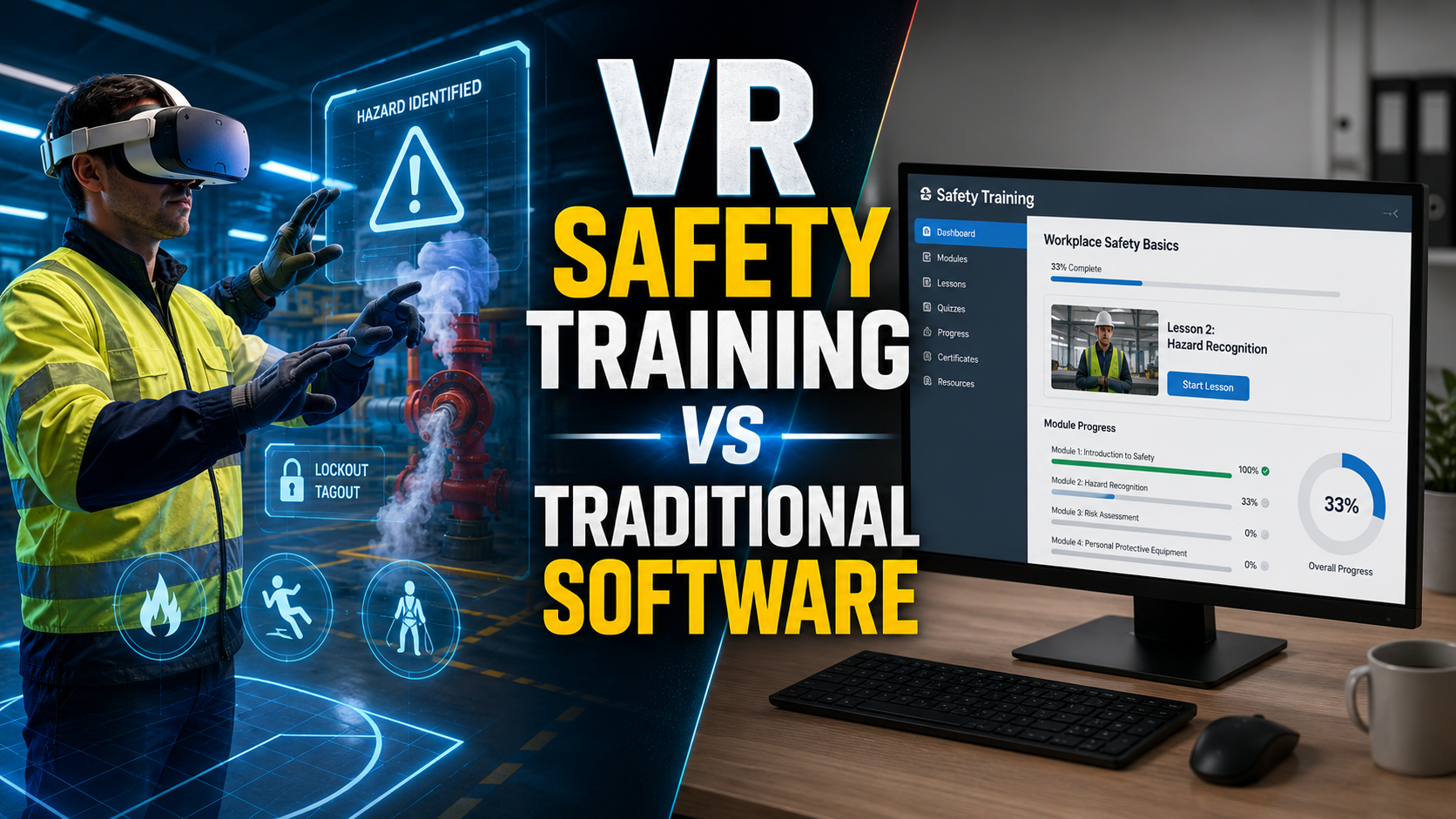
Why Traditional Safety Training Software Falls Short for High-Risk Scenarios
Most safety training software delivers compliance through videos and quizzes, but fails to prepare workers for actual hazard recognition and emergency response. Here’s what 2D training platforms miss and why immersive alternatives matter for construction, manufacturing, and industrial safety programs.
The disconnect between passing an online safety module and recognizing hazards on an active jobsite creates a dangerous knowledge gap. Workers complete required training, check compliance boxes, yet still account for 5,190 fatal workplace injuries annually according to recent Bureau of Labor Statistics data. The problem isn’t lack of training—it’s the training method itself.
The Engagement Problem with Click-Through Modules
Traditional safety learning management systems (LMS) face a fundamental engagement crisis. Industry data reveals sobering statistics about passive training effectiveness:
Completion rates tell only part of the story. While most safety LMS platforms report 85-90% completion rates for mandatory modules, these numbers mask deeper problems. Workers routinely multitask during video-based training, clicking through slides while handling other tasks. Eye-tracking studies show actual attention rates below 40% during typical safety video presentations.
Knowledge retention plummets within weeks. Research from training analytics firms shows workers retain only 20% of safety information from video-based training after 30 days. Compare this to 75% retention rates from hands-on training experiences. The passive nature of watching and clicking simply doesn’t create lasting behavioral change.
Safety managers report widespread dissatisfaction. In surveys of EHS professionals, 67% describe their current safety training software as “checkbox compliance” rather than genuine skill development. Common complaints include:
- Generic content that doesn’t match specific workplace hazards
- Inability to assess actual hazard recognition skills
- Workers gaming the system by sharing quiz answers
- No correlation between training completion and safety performance
What Safety Training Software Actually Costs (Beyond the License)
The true cost of traditional safety training software extends far beyond advertised per-seat pricing. Major platforms like SafetySkills, Vector Solutions, and DuPont Sustainable Solutions typically structure pricing in ways that obscure total investment:
Base licensing fees range from $25-75 per user annually for standard safety content libraries. Organizations with 500 employees face $12,500-37,500 in annual licensing alone. Enterprise agreements often start at $50,000 annually for unlimited users.
Hidden implementation costs quickly escalate budgets:
- Initial setup and integration: $5,000-15,000
- Custom content development: $10,000-25,000 per course
- Administrator training: $2,500-5,000
- Annual content updates: $5,000-10,000
- Technical support packages: $3,000-8,000 annually
Time investment represents the largest hidden cost. Safety managers report spending 15-20 hours weekly on LMS administration, including:
- User account management and password resets
- Training assignment and deadline tracking
- Compliance reporting and documentation
- Troubleshooting technical issues
- Following up on incomplete training
For a safety manager earning $75,000 annually, this administrative burden represents $18,000-24,000 in labor costs yearly—often exceeding the software license itself.
VR Safety Training Through Rental Packages: The Implementation Reality
VR safety training delivers immersive hazard scenarios without software commitments or hardware ownership. Here’s how rental-based VR training works for safety teams, from equipment selection through session logistics.
Unlike traditional safety software requiring long-term contracts and extensive IT infrastructure, VR rental packages provide immediate access to immersive training experiences. Safety teams can deploy realistic hazard simulations within days, not months, while maintaining flexibility to scale or modify their approach based on results.
Equipment and Content Package Options for Safety Training
Modern VR safety training centers on standalone headsets that require no external computers or complex setup. The Meta Quest 3 has emerged as the industry standard for safety training applications, offering:
Pre-configured safety training packages typically include:
- 4-8 Meta Quest 3 headsets for group sessions
- Pre-loaded safety scenarios covering OSHA focus areas
- Tablet-based instructor controls for session management
- Sanitization supplies and storage cases
- Technical support and troubleshooting
Content libraries address critical safety scenarios:
- Fall protection and scaffold inspection
- Confined space entry procedures
- Lockout/tagout protocols
- Fire extinguisher selection and use
- Forklift operation and pedestrian safety
- Chemical handling and spill response
- Emergency evacuation procedures
Customization options allow scenario modification without full development costs. Rental providers offer semi-custom experiences by adjusting existing scenarios to match specific equipment, layouts, or procedures. This middle ground between generic and fully custom content typically adds $2,000-5,000 to rental packages.
Setup Requirements and Session Logistics
VR safety training requires surprisingly minimal infrastructure compared to traditional computer labs or classroom setups:
Physical space needs:
- 6×6 feet per participant for seated experiences
- 10×10 feet per participant for room-scale scenarios
- Standard conference room or break area suffices
- No special ventilation or safety equipment required
Facilitator preparation involves 2-4 hours of orientation covering:
- Headset operation and troubleshooting
- Session flow and time management
- Participant coaching and support
- Data collection and reporting
Most rental packages include remote facilitator training via video conference, eliminating travel costs and scheduling complexity.
Session scheduling accommodates operational realities:
- 20-30 minute sessions fit within normal breaks
- Multiple shifts can rotate through equipment daily
- Remote sites receive shipped equipment for local training
- Make-up sessions require no additional setup
Cost Structure: Rental vs Software Subscription
VR rental pricing provides predictable costs without long-term commitments:
Weekly rental rates for 4-headset packages:
- Basic package with standard content: $2,000-3,000
- Premium package with custom scenarios: $3,500-5,000
- Extended rentals (4+ weeks): 15-25% discount
Monthly rental options for ongoing programs:
- 4-headset package: $6,000-8,000
- 8-headset package: $10,000-14,000
- Unlimited content access included
- Technical support and replacement equipment
Per-session cost analysis reveals compelling economics. Training 100 workers over one month:
- Traditional software: $2,100 (annual license amortized) + $1,500 admin time = $3,600
- VR rental: $8,000 package / 100 workers = $80 per worker
- In-person training with travel: $150-300 per worker
Renting makes sense when:
- Training needs are project-based or seasonal
- Proving ROI before capital investment
- Serving multiple locations without permanent installations
- Avoiding IT infrastructure and support requirements
Measuring Safety Training Effectiveness: VR Metrics vs Traditional Assessments
Safety training effectiveness goes beyond quiz scores. Compare how VR training and traditional software measure hazard recognition, response time, and behavior change in real work environments.
The immersive nature of VR enables performance measurement impossible with traditional training software. Instead of selecting multiple-choice answers about safety procedures, workers demonstrate actual behaviors in realistic scenarios while the system captures detailed performance data.
Performance Metrics Available in VR Safety Scenarios
VR training platforms capture granular behavioral data that reveals true competency levels:
Eye tracking and attention patterns show where workers look during hazard exposure. The system records:
- Time to notice specific hazards
- Scan patterns during safety inspections
- Attention distribution across multiple risks
- Distraction susceptibility in complex environments
This data identifies workers who might pass written tests but miss critical visual cues in real situations.
Response time measurements quantify emergency preparedness:
- Seconds to initiate evacuation procedures
- Time to select appropriate PPE
- Speed of lockout/tagout sequence execution
- Decision lag when confronting unexpected hazards
Traditional software cannot measure these critical performance indicators that directly correlate with injury prevention.
Mistake tracking and correction provides learning opportunities without consequences:
- Number of attempts to complete procedures correctly
- Types of errors made during initial attempts
- Improvement rate across multiple sessions
- Ability to apply learning to novel scenarios
Workers can fail safely in VR, learning from mistakes impossible to make in traditional training.
Compliance Documentation and Reporting
VR training platforms generate comprehensive documentation meeting and exceeding OSHA requirements:
Automated recordkeeping captures:
- Date, time, and duration of each training session
- Specific scenarios completed by each worker
- Performance scores and improvement trends
- Instructor observations and interventions
OSHA compliance alignment satisfies regulatory requirements:
- 29 CFR 1910 general industry standards
- 29 CFR 1926 construction safety requirements
- Written certification of training completion
- Demonstration of worker competency
Integration capabilities connect with existing systems:
- Export to common HR and safety management platforms
- API connections for automated data transfer
- CSV exports for custom reporting
- PDF certificates for personnel files
Common Safety Training Scenarios: VR Implementation Examples
See how specific safety training requirements translate to VR experiences, with implementation details for construction, manufacturing, and warehouse safety programs.
Each safety scenario below represents actual deployments where VR training replaced or supplemented traditional methods, with measured improvements in both engagement and safety outcomes.
Fall Protection and Working at Heights
Fall protection training in VR eliminates the risks and logistics of physical height exposure while maintaining psychological realism:
Scaffold inspection scenarios place workers on virtual scaffolding where they must:
- Identify missing or damaged components
- Verify proper assembly and bracing
- Recognize overloading conditions
- Select appropriate fall protection equipment
Workers experience genuine height sensations through visual perspective and spatial audio, creating memorable training without actual elevation. One construction firm reported 73% reduction in scaffold-related incidents after implementing VR inspection training.
Harness selection and attachment becomes hands-on practice:
- Choose correct harness type for specific tasks
- Identify proper anchor points on various structures
- Calculate fall distances and clearances
- Practice emergency self-rescue procedures
Cost comparison with physical training towers:
- Physical tower construction: $50,000-100,000
- Annual maintenance and inspection: $5,000-10,000
- Insurance and liability: $3,000-5,000 annually
- VR rental for equivalent training: $8,000 monthly
Confined Space Entry Procedures
Confined space training in VR replicates hazardous atmospheres without actual exposure:
Atmospheric testing procedures require workers to:
- Select appropriate monitoring equipment
- Follow proper testing sequences
- Interpret readings and make entry decisions
- Respond to changing atmospheric conditions
The virtual environment simulates oxygen deficiency, toxic gases, and explosive atmospheres, teaching recognition and response without creating actual hazards.
Permit verification and communication practices include:
- Reviewing and completing entry permits
- Establishing communication with attendants
- Coordinating with rescue teams
- Managing multiple entrant scenarios
Training advantages over classroom-only methods:
- Spatial awareness in confined environments
- Stress response under simulated emergency conditions
- Team coordination in restricted spaces
- Equipment familiarization without contamination risks
Manufacturing facilities using VR confined space training report 60% reduction in permit violations and 45% faster emergency response times.
Lockout/Tagout and Machine Guarding
LOTO training in VR enables practice on multiple equipment types without production disruption:
Equipment-specific procedures cover:
- Energy source identification on actual equipment models
- Proper lockout device selection and placement
- Verification testing without energization risks
- Group lockout coordination
Workers practice on virtual replicas of actual facility equipment, ensuring relevance and transferability.
Machine guarding assessments develop hazard recognition:
- Identifying missing or inadequate guards
- Recognizing bypass attempts
- Understanding guard interlock systems
- Reporting and correcting violations
Zero-downtime training benefits:
- No production interruption for training
- Practice on equipment during normal operation
- Multiple failure scenarios without damage risk
- Consistent training across all shifts
Making the Business Case: VR Rental ROI for Safety Programs
Calculate the actual return on VR safety training investment, including injury reduction potential, training time savings, and avoided costs from traditional methods.
The financial case for VR safety training extends beyond simple cost comparisons. Organizations implementing VR training report measurable improvements in injury rates, insurance costs, and operational efficiency that deliver returns within 6-12 months.
Direct Cost Comparisons by Training Type
Analyzing total costs for training 100 workers reveals the true economics:
| Training Method | Direct Costs | Indirect Costs | Total Investment | Time Required |
|---|---|---|---|---|
| Traditional LMS | $3,500 (annual) | $4,000 (admin) | $7,500 | 2 hours/worker |
| Classroom + Travel | $8,000 (instructor) | $12,000 (travel/venue) | $20,000 | 8 hours/worker |
| VR Rental (1 month) | $8,000 (equipment) | $1,000 (facilitation) | $9,000 | 30 min/worker |
| Hybrid (LMS + VR) | $5,500 | $2,500 | $8,000 | 1 hour/worker |
Productivity impact calculations:
- Traditional training: 100 workers × 2 hours × $35/hour = $7,000 lost productivity
- Classroom training: 100 workers × 8 hours × $35/hour = $28,000 lost productivity
- VR training: 100 workers × 0.5 hours × $35/hour = $1,750 lost productivity
The productivity savings alone often justify VR rental costs, particularly for high-value operations where downtime carries significant opportunity costs.
Injury Prevention and Insurance Premium Impact
Documented injury reductions from VR training implementation create substantial financial returns:
Workers compensation claim reductions:
- Average claim cost for fall injuries: $48,000
- Average claim cost for struck-by incidents: $35,000
- Typical reduction after VR training: 25-40%
- Annual savings for 500-person operation: $75,000-125,000
Experience modification rate (EMR) improvements:
- 0.1 EMR reduction saves approximately 10% on premiums
- Average premium for 500-person construction firm: $500,000
- Potential savings from improved safety record: $50,000 annually
OSHA citation avoidance:
- Average serious violation penalty: $14,502
- Willful violation penalties: up to $145,027
- Documented VR training demonstrates good faith effort
- Reduced penalties for comprehensive training programs: 25-40%
Insurance carriers increasingly recognize VR training as a risk reduction measure, with some offering premium discounts of 5-10% for documented VR safety training programs.
Implementation Roadmap: Starting VR Safety Training with Rentals
Transform your safety training program with a phased VR implementation approach. This roadmap covers pilot program setup, stakeholder buy-in, and scaling strategies.
Success with VR safety training depends on thoughtful implementation rather than technology alone. Organizations achieving the best results follow a structured approach that builds confidence, demonstrates value, and scales based on proven outcomes.
Phase 1: Pilot Program Design
The initial pilot phase establishes proof of concept while minimizing risk and investment:
Scenario selection for maximum impact:
- Identify highest-risk activities from injury data
- Choose scenarios with clear performance metrics
- Select enthusiastic early adopters as participants
- Focus on one department or site initially
Pilot program structure (3-month timeline):
- Month 1: Equipment familiarization and baseline measurement
- Month 2: Intensive VR training sessions (2-3 per week)
- Month 3: Performance assessment and data analysis
Success metrics to track:
- Hazard recognition improvement rates
- Time to complete safety procedures
- Worker confidence scores
- Near-miss reporting changes
- Supervisor observations of behavior change
Budget for 50-person pilot:
- VR rental (3 months): $18,000-24,000
- Facilitation support: $3,000
- Data analysis and reporting: $2,000
- Total pilot investment: $23,000-29,000
Phase 2: Stakeholder Engagement and Expansion
Building on pilot success requires strategic communication and gradual expansion:
Presenting results to leadership:
- Lead with injury reduction potential and ROI calculations
- Show video testimonials from pilot participants
- Demonstrate the technology live if possible
- Provide conservative projections for full implementation
Incorporating feedback:
- Union representatives often become champions after experiencing VR
- Address concerns about job displacement (VR supplements, not replaces trainers)
- Modify scenarios based on worker suggestions
- Create internal ambassadors from pilot participants
Scaling strategy options:
- Geographic expansion: Roll out to additional sites
- Scenario expansion: Add new training modules
- Frequency increase: Move from quarterly to monthly sessions
- Hybrid approach: Combine VR with existing programs
Full deployment timeline:
- Months 4-6: Expand to 200 workers
- Months 7-9: Add second high-risk scenario
- Months 10-12: Evaluate purchase vs. continued rental
- Year 2: Integrate VR as standard training component
Frequently Asked Questions
How much does VR safety training cost compared to traditional software?
VR safety training through rental packages typically costs $80-100 per worker for comprehensive scenario training, compared to $25-75 annually for traditional safety software licenses. However, when factoring in administration time, lost productivity, and training effectiveness, VR often delivers lower total cost per competency gained. A 100-person training program costs approximately $8,000-10,000 via VR rental versus $7,500 for traditional LMS, but VR requires 75% less worker time and demonstrates 3x better skill retention.
Can VR training meet OSHA compliance requirements?
Yes, VR training satisfies OSHA requirements when properly documented and combined with site-specific elements. OSHA standards require demonstration of worker competency, which VR provides through performance tracking and behavioral assessment. The technology exceeds documentation requirements by capturing detailed performance data, time stamps, and completion records. Always supplement VR training with site-specific hazard communication and hands-on equipment familiarization to ensure complete compliance.
What safety scenarios work best in VR vs traditional training?
VR excels at high-risk, low-frequency scenarios that are dangerous, expensive, or impractical to recreate physically. Ideal VR applications include fall protection, confined space entry, emergency response, and hazardous energy control. Traditional training remains appropriate for policy review, regulatory updates, and site-specific procedures. The most effective programs combine VR for skill development with traditional methods for knowledge transfer.
How many VR headsets do I need for group safety training?
Calculate headset needs based on session duration and daily throughput. For 100 workers with 30-minute sessions, 4 headsets can complete training in 3-4 days. For ongoing programs, use this formula: (Number of workers × session length) ÷ (available training hours × refresh period) = minimum headsets needed. Most organizations find 4-8 headsets optimal for balancing cost with scheduling flexibility.
Do workers need VR experience to complete safety training?
No prior VR experience is necessary. Modern safety training applications feature intuitive interfaces designed for first-time users. The typical onboarding process takes 5-10 minutes, including headset adjustment, controller familiarization, and comfort settings. Rental packages include facilitator support to assist workers who need additional help. Studies show workers over 50 adapt to VR safety training within one session.
How do I track and document VR safety training completion?
VR training platforms automatically generate comprehensive documentation including completion certificates, performance scores, time stamps, and behavioral metrics. Data exports in CSV or PDF formats integrate with existing learning management systems. The documentation exceeds OSHA requirements by providing performance evidence beyond simple completion records. Cloud-based dashboards offer real-time visibility into training progress across locations.
What’s the typical ROI timeline for VR safety training implementation?
Organizations typically achieve positive ROI within 6-12 months through a combination of injury reduction, decreased training time, and avoided costs. A 25% reduction in injury rates (industry average for VR implementation) saves approximately $150,000 annually for a 500-person operation. Additional returns come from reduced travel costs, minimized production disruption, and lower insurance premiums. Rental-based programs can demonstrate ROI within 3-4 months due to lower initial investment.
Conclusion: Making the Strategic Choice for Safety Training
The comparison between VR safety training and traditional software reveals a fundamental truth: compliance checkboxes don’t prevent injuries. While traditional safety LMS platforms serve a purpose for policy distribution and basic awareness, they fail to develop the spatial awareness, muscle memory, and split-second decision-making that prevent workplace accidents.
VR rental packages offer a practical path to immersive safety training without the commitment and complexity of software purchases or hardware ownership. For EHS teams facing pressure to reduce injuries while controlling costs, VR rentals provide measurable improvements in worker competency with predictable monthly expenses and minimal implementation burden.
The evidence supports a hybrid approach where VR handles high-risk skill development while traditional platforms manage compliance documentation and policy updates. This combination delivers the best of both worlds: engaging, effective training for critical safety skills and efficient administration for routine requirements.
Ready to transform your safety training program? Start with a focused pilot program targeting your highest-risk activities. Contact VR rental providers for customized packages that match your specific safety scenarios, worker population, and operational constraints. Request performance data from similar organizations in your industry to build a compelling business case for stakeholder buy-in.
The question isn’t whether to adopt VR safety training, but how quickly you can implement it to start preventing injuries and saving lives. Every day of delay represents continued exposure to preventable workplace hazards that traditional training methods simply cannot address effectively.
Take action today: Schedule a VR safety training demonstration, calculate your potential ROI using injury data from the past year, and design a pilot program that proves the value of immersive training for your organization. Your workers’ safety depends on training that prepares them for reality, not just compliance.