
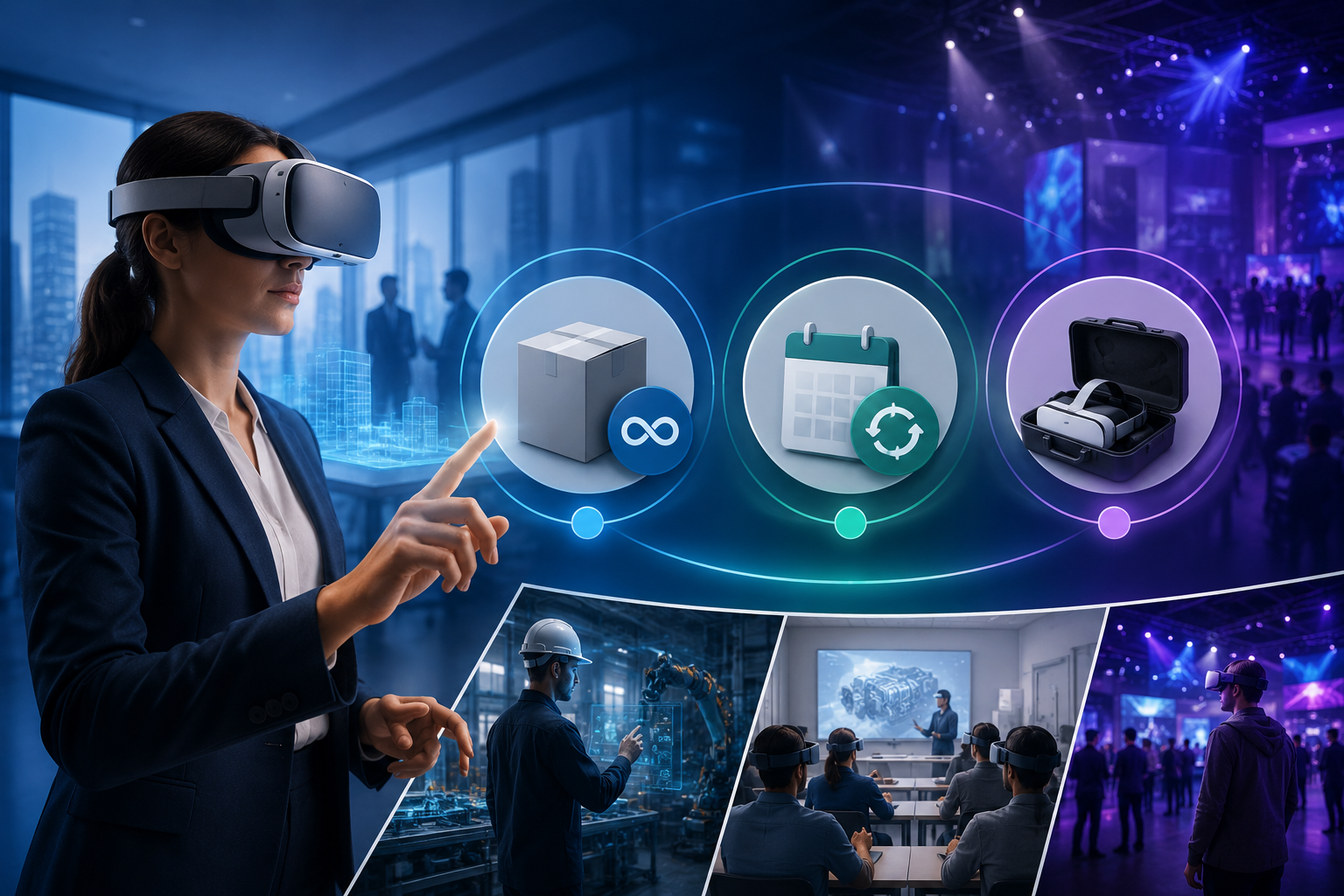
The extended reality software market has evolved beyond simple one-size-fits-all licensing. Today’s XR deployments demand careful evaluation of licensing models that balance cost, flexibility, and operational requirements. Whether you’re planning a trade show activation, implementing enterprise training, or launching product demonstrations, understanding the nuances between perpetual licenses, subscription models, and rental packages determines both your immediate success and long-term scalability.
XR Software Licensing Models Explained
Extended reality software licensing spans three primary models: perpetual licenses with upfront costs, subscription-based SaaS platforms, and rental packages that bundle software with hardware. Each model carries different cost structures, update policies, and operational requirements that directly impact your event activation or enterprise deployment.
The complexity of XR software licensing stems from the intersection of rapidly evolving hardware, diverse content requirements, and varying deployment scenarios. Unlike traditional software, XR platforms must account for hardware compatibility, rendering capabilities, and often proprietary ecosystem constraints that affect both initial selection and future flexibility.
Perpetual License Structure
Perpetual licenses represent the traditional software ownership model adapted for XR platforms. Organizations pay a one-time fee ranging from $5,000 to $50,000 per seat for enterprise-grade XR software, gaining indefinite usage rights for the purchased version. This model appeals to organizations with predictable, long-term XR requirements and sufficient capital for upfront investment.
The perpetual model includes several critical considerations often overlooked during initial evaluation. Annual maintenance fees, typically 15-20% of the original license cost, provide access to updates, patches, and technical support. Without maintenance agreements, organizations risk running outdated software incompatible with newer hardware or missing critical security updates.
Hardware compatibility presents another challenge with perpetual licenses. Software purchased today locks specifications to current-generation hardware, potentially requiring additional investment when upgrading headsets or tracking systems. Organizations must factor hardware refresh cycles into their total cost calculations, as XR hardware typically requires replacement every 18-24 months to maintain optimal performance.
Perpetual licenses work best for permanent installations such as training centers, design studios, or visitor centers where usage patterns remain consistent. High-frequency internal applications, such as daily design reviews or regular safety training, can justify the upfront investment through lower per-use costs over time.
Subscription and SaaS Models
Subscription-based XR software licensing has gained traction as cloud infrastructure and streaming capabilities improve. Monthly costs range from $99 for basic single-user licenses to $2,500 per user for comprehensive enterprise platforms with advanced features, collaboration tools, and priority support.
The subscription model’s primary advantage lies in its flexibility and predictable operational expenses. Organizations can scale licenses up or down based on project requirements, seasonal demands, or pilot program results. Automatic updates ensure access to the latest features and security patches without additional investment or IT overhead.
Cloud-based content management systems accompanying many subscription platforms simplify multi-location deployments and remote collaboration. Teams can access shared content libraries, synchronize experiences across devices, and manage user permissions through web-based dashboards. This centralized approach reduces the technical burden on local IT staff while ensuring consistency across deployments.
API access and integration capabilities distinguish enterprise subscription platforms from consumer offerings. Organizations can connect XR experiences to existing systems such as learning management platforms, CRM databases, or analytics tools. These integrations enable automated user provisioning, progress tracking, and performance measurement critical for demonstrating ROI.
Subscription models particularly benefit organizations with variable XR requirements, such as agencies managing multiple client projects or companies exploring different use cases before committing to specific applications. The ability to test different platforms through monthly subscriptions reduces risk while maintaining flexibility for future pivots.
Rental-Inclusive Software Packages
Rental packages represent the newest evolution in XR software licensing, bundling software licenses with hardware rental periods. This integrated approach eliminates compatibility concerns while providing turnkey solutions for events, activations, and pilot programs.
Software licenses included in rental packages typically cover the entire rental period, from pre-event testing through post-event data collection. Pre-configured experiences eliminate the setup complexity that often derails event deployments, while included technical support covers both hardware and software issues. Rental providers maintain libraries of proven experiences, reducing content development time and ensuring reliable performance.
The rental model’s no-commitment structure makes it ideal for one-off events, trade shows, or pilot programs where long-term requirements remain uncertain. Organizations avoid the capital expenditure of purchasing equipment and licenses that might sit idle between events. Additionally, rental providers handle hardware maintenance, software updates, and compatibility testing, reducing internal resource requirements.
Advanced rental packages now include custom branding options, allowing organizations to maintain brand consistency without developing proprietary applications. Providers offer white-label solutions where logos, colors, and messaging can be incorporated into existing experience templates, significantly reducing time-to-deployment while maintaining professional presentation standards.
Total Cost Analysis for XR Software Deployment
Software licensing represents only one component of XR deployment costs. Hardware requirements, content creation, training, and ongoing support significantly impact the total investment, particularly for event activations where setup time and technical expertise become critical factors.
Understanding the complete cost structure prevents budget overruns and ensures realistic ROI projections. Organizations frequently underestimate the resources required for successful XR deployments, focusing solely on headline licensing costs while overlooking operational expenses that can exceed initial investments.
Hidden Costs in Traditional Licensing
Traditional licensing models carry numerous hidden costs that emerge during implementation and ongoing operations. IT infrastructure requirements include servers for content distribution, network upgrades for wireless streaming, and backup systems for mission-critical deployments. These infrastructure investments can add $10,000-50,000 to initial deployment costs, particularly for organizations lacking existing XR-capable networks.
Staff training represents another significant expense often excluded from initial budgets. Platform administrators require 40-80 hours of training to manage enterprise XR systems effectively. Content creators need additional specialized training on 3D modeling, interaction design, and platform-specific optimization techniques. Organizations typically spend $5,000-15,000 per employee on comprehensive XR platform training.
Content conversion and optimization fees accumulate quickly when adapting existing assets for XR deployment. CAD models require polygon reduction, texture optimization, and interaction scripting to function properly in real-time XR environments. Professional content optimization services charge $500-5,000 per model depending on complexity, with typical projects requiring 20-100 models.
Hardware refresh cycles impose recurring costs beyond software maintenance fees. Consumer headsets lose support after 18-24 months, while enterprise hardware typically remains viable for 36 months. Organizations must budget for complete hardware replacement cycles, including peripherals such as controllers, tracking systems, and computing hardware.
Technical support overhead extends beyond vendor-provided assistance. Internal IT staff spend 10-20 hours monthly maintaining XR systems, troubleshooting user issues, and coordinating with vendors. This ongoing support requirement translates to $2,000-5,000 monthly in labor costs for organizations running regular XR deployments.
Event-Specific Cost Considerations
Event deployments introduce unique cost factors absent from permanent installations. Setup and teardown labor for trade shows typically requires 2-4 skilled technicians for 4-8 hours, costing $2,000-6,000 per event. Complex multi-station installations or custom booth integrations can double these requirements.
Shipping and insurance for owned XR equipment adds $500-2,000 per event depending on destination and equipment value. International events require customs documentation and potentially carnets, adding complexity and cost to logistics planning. Equipment damage during transport occurs in approximately 5% of shipments, necessitating repair or replacement budgets.
Backup licenses ensure continuity when primary systems fail during critical events. Organizations typically purchase 20-30% additional licenses as redundancy, increasing software costs proportionally. For high-stakes events such as product launches or investor demonstrations, 50% redundancy becomes standard practice.
Per-event content licensing for branded experiences varies widely based on IP ownership and exclusivity requirements. Music licensing for VR experiences costs $500-5,000 per track for event usage. Celebrity likenesses or branded environments require separate negotiations, potentially adding $10,000-100,000 to event budgets.
Use Case Alignment: When Each Model Makes Sense
The optimal XR software licensing model depends on deployment frequency, audience size, content requirements, and internal technical capabilities. Event marketers face different constraints than learning teams or product demonstration groups.
Successful XR deployments align licensing models with operational realities rather than forcing organizations to adapt to software vendor preferences. This alignment requires honest assessment of internal capabilities, realistic usage projections, and clear success metrics.
Trade Shows and Brand Activations
Trade show deployments demand maximum reliability with minimum setup complexity. Short-term rental packages eliminate the waste of annual licenses used only during event seasons while providing professional support throughout the event cycle. Pre-loaded experiences reduce booth setup from days to hours, critical when installation windows are limited to overnight periods.
Multiple headset licenses for concurrent users present unique challenges at trade shows where visitor flow varies dramatically. Rental packages scale elastically, allowing organizations to adjust headset quantities based on booth traffic without maintaining excess inventory. This flexibility proves particularly valuable for companies attending events of varying sizes throughout the year.
Branded content creation for trade shows often requires separate licensing from platform licenses. Experience developers typically retain IP rights to custom content, licensing it per event or through annual agreements. Organizations must clarify content ownership and reuse rights during initial development contracts to avoid unexpected licensing fees for subsequent events.
The transient nature of trade show deployments favors rental models that include transportation, setup assistance, and on-site support. Internal teams can focus on visitor engagement rather than technical troubleshooting, improving lead quality and brand perception. Post-event analytics provided by rental vendors inform future event strategies without requiring internal data processing capabilities.
Corporate Training and Learning
Corporate training applications benefit from subscription models that accommodate evolving curriculum requirements and distributed learner populations. User management capabilities become critical when deploying XR training across multiple locations or departments. Subscription platforms provide centralized dashboards for provisioning users, assigning content, and tracking progress without local IT involvement.
SCORM compliance and LMS integration determine platform viability for organizations with established learning ecosystems. Enterprise subscription platforms increasingly support standard learning protocols, enabling XR experiences to report completion status, assessment scores, and time-on-task metrics to existing learning management systems. This integration eliminates duplicate data entry while maintaining compliance with training documentation requirements.
Multi-location deployment challenges include bandwidth limitations, hardware standardization, and local support capabilities. Cloud-based subscription platforms minimize location-specific requirements by streaming content rather than requiring local installation. However, organizations must verify network capabilities at all locations, as XR streaming requires consistent 25-50 Mbps connections per concurrent user.
Remote access capabilities enable work-from-home employees to participate in XR training using personal devices or company-provided hardware. Subscription platforms supporting cross-platform deployment allow organizations to mix high-end headsets for office use with mobile-based solutions for remote workers, maximizing reach while controlling costs.
Product Demonstrations and Sales
Product demonstration use cases require maximum flexibility in content presentation and hardware deployment. Sales teams need portable solutions that setup quickly in varied environments from corporate boardrooms to factory floors. Custom content requirements for different product lines or customer segments favor licensing models that permit rapid iteration without prohibitive change fees.
Field sales teams operating independently require self-contained solutions with offline capabilities. Perpetual licenses with local content storage eliminate connectivity dependencies that could derail customer presentations. However, organizations must implement version control systems to ensure sales teams present current product information and pricing.
Version control becomes critical when product updates occur frequently or when regulatory compliance requires specific documentation. Subscription platforms with automated content distribution ensure all users access the latest approved versions while maintaining audit trails for compliance purposes. This centralized control prevents sales teams from inadvertently presenting outdated or non-compliant information.
Analytics and engagement tracking for ROI measurement differentiate professional XR platforms from consumer alternatives. Sales-focused platforms capture interaction data, dwell time, and navigation patterns that inform product development and sales training. Advanced analytics correlate XR engagement metrics with downstream sales performance, justifying continued investment in XR demonstration tools.
Major XR Software Platforms and Their Licensing Terms
Understanding specific platform licensing helps narrow your evaluation. Each major XR software provider structures their licensing differently, with varying levels of hardware flexibility and content ecosystem access.
Platform selection significantly impacts long-term flexibility and total deployment costs. Organizations must evaluate not only current licensing terms but also vendor roadmaps, ecosystem health, and market position to ensure sustainable XR strategies.
Enterprise XR Platforms
Microsoft’s HoloLens commercial licensing operates through tiered structures aligned with deployment scale and support requirements. The basic commercial license starts at $125 per user monthly, including device management and Windows Holographic OS updates. Advanced tiers at $200-500 monthly add Dynamics 365 integration, Azure Remote Rendering, and priority support. Perpetual licenses for specialized applications such as HoloLens for Defense require direct negotiation with Microsoft enterprise sales teams.
Unity’s XR development and runtime licenses separate creation tools from deployment rights. Unity Pro licenses at $150 per seat monthly provide access to XR development features, while runtime licenses for commercial distribution vary based on revenue and deployment scale. Organizations with revenue exceeding $100 million annually require Unity Enterprise agreements starting at $4,000 per seat annually. Runtime fees for XR applications depend on whether content is distributed through Unity’s platform or independently deployed.
PTC Vuforia’s AR platform structures pricing around scanning targets and cloud recognition calls. The basic Engine license at $499 monthly supports 1,000 model targets and unlimited image targets for local recognition. Cloud recognition services add $0.05-0.15 per recognition depending on volume commitments. Enterprise agreements starting at $50,000 annually provide unlimited targets and priority support for large-scale deployments.
Varjo’s professional XR hardware requires accompanying software licenses beyond the hardware purchase price. Varjo Base software licenses at $795 annually per headset enable basic functionality, while Varjo for Business at $1,495 annually adds fleet management, analytics, and priority support. Specialized licenses for automotive design or flight simulation start at $3,995 annually, including industry-specific features and compliance certifications.
Event and Experience Platforms
Spatial’s virtual event platform offers tiered licensing based on concurrent users and feature requirements. The Professional tier at $20 per host monthly supports up to 50 concurrent participants with custom branding and analytics. Enterprise pricing starting at $500 monthly removes participant limits and adds API access for integration with event management platforms. White-label solutions for complete brand customization require annual contracts starting at $25,000.
VRChat private instance licensing for brands operates through VRChat Plus for Business agreements. Basic private worlds cost $1,000 monthly for up to 100 concurrent users, with additional capacity at $10 per concurrent user. Custom avatar systems and branded environments require separate development agreements typically ranging from $25,000-100,000 depending on complexity and exclusivity requirements.
Custom branded world development rights vary significantly across platforms. Some platforms retain ownership of all uploaded content, licensing it back to creators for commercial use. Others permit full ownership but require revenue sharing for monetized experiences. Organizations must carefully review terms of service and commercial licensing agreements to understand long-term content rights and platform lock-in implications.
Concurrent user limits and scaling options determine platform viability for large events or enterprise deployments. Consumer platforms typically limit concurrent users to 20-50 per instance, requiring complex load balancing for larger audiences. Enterprise platforms support 100-500 concurrent users per instance but charge proportionally higher licensing fees. Organizations must model expected peak concurrency to avoid service disruptions or unexpected overage charges.
Implementation Timeline and Decision Framework
Selecting an XR software licensing model requires evaluating immediate needs against long-term strategy. For many organizations, starting with rental packages provides risk-free validation before committing to annual licenses or perpetual purchases.
The implementation timeline significantly impacts licensing decisions. Rushed deployments favor turnkey rental solutions, while long development cycles may justify investing in perpetual licenses. Organizations must balance speed-to-market pressures with sustainable cost structures.
Pilot Program Approach
A 3-6 month rental trial provides sufficient data to validate use cases without long-term commitment. During this period, organizations should document setup time, user engagement, technical issues, and support requirements. These metrics inform realistic projections for scaled deployments and highlight potential obstacles before major investment.
Key metrics to track before licensing decisions include utilization rates, user satisfaction scores, content development time, and support ticket volume. Utilization below 40% suggests reconsideration of deployment scope or use case selection. Support tickets exceeding 5 per deployment indicate insufficient training or platform complexity beyond organizational capabilities.
Gradual transition from rental to ownership follows successful pilot validation. Organizations might purchase perpetual licenses for core platforms while maintaining rental agreements for overflow capacity or specialized experiences. This hybrid approach balances cost optimization with operational flexibility, particularly valuable during scaling phases.
Hybrid models combining owned and rented assets maximize capital efficiency while maintaining surge capacity. Organizations might own base hardware and software for regular operations while renting additional units for major events or seasonal peaks. This strategy requires careful coordination between owned and rented assets to ensure compatibility and consistent user experience.
Vendor Evaluation Criteria
Hardware compatibility and upgrade paths determine long-term platform viability. Vendors committed to backward compatibility protect existing investments when new hardware generations launch. Conversely, platforms requiring complete hardware refresh for major updates impose recurring capital expenses that compound initial licensing costs.
Content library access and creation tools affect both initial deployment speed and long-term flexibility. Platforms with extensive content marketplaces accelerate initial deployments but may limit differentiation. Strong creation tools enable custom experiences but require specialized skills and longer development cycles. Organizations must balance immediate needs with future customization requirements.
Technical support response times and coverage critically impact event deployments where downtime directly affects brand perception. Service level agreements (SLAs) should specify maximum response times, escalation procedures, and coverage hours. Premium support tiers costing 20-30% above base licenses often prove worthwhile for mission-critical deployments.
Contract flexibility for scaling or cancellation protects against changing business requirements or technology shifts. Annual contracts should include provisions for mid-term adjustments, particularly for subscription models. Perpetual licenses should clarify transferability rights and upgrade paths to prevent stranded investments if requirements change.
Making the Right Choice for Your Organization
The optimal XR software licensing model emerges from careful analysis of deployment patterns, internal capabilities, and strategic objectives. Organizations conducting fewer than 10 XR deployments annually typically benefit from rental packages that eliminate maintenance overhead and capital investment. High-frequency users deploying XR weekly justify perpetual licenses or annual subscriptions that reduce per-use costs.
Budget constraints and cash flow considerations influence the perpetual versus subscription decision. Perpetual licenses require significant upfront investment but provide predictable long-term costs. Subscriptions spread costs over time but may exceed perpetual license costs within 18-24 months. Organizations must model total costs over realistic deployment lifespans, including hardware refresh cycles and content updates.
Internal technical capabilities determine the feasibility of self-managed XR deployments. Organizations with dedicated XR teams can leverage perpetual or subscription licenses effectively. Those lacking specialized resources benefit from full-service rental packages that include setup, operation, and troubleshooting support. Attempting complex deployments without adequate expertise risks project failure and reputational damage.
Strategic alignment with broader digital transformation initiatives may favor specific licensing models. Organizations standardizing on cloud services naturally align with subscription-based XR platforms. Those prioritizing data sovereignty and on-premise deployment require perpetual licenses with local hosting capabilities. XR licensing decisions should support rather than contradict enterprise technology strategies.
Frequently Asked Questions
What’s the typical cost difference between XR software licensing and rental packages?
Annual XR software licenses typically cost $1,200-30,000 per seat, while rental packages range from $500-2,000 per headset per day including hardware and software. For organizations using XR fewer than 20 days annually, rentals provide lower total costs. High-frequency users save 40-60% with annual licenses compared to repeated rentals.
Can I use consumer VR software licenses for commercial events?
Most consumer VR software explicitly prohibits commercial use in their terms of service. Using consumer licenses for commercial events risks legal action and account termination. Commercial licenses typically cost 3-10 times consumer prices but include necessary usage rights, support, and liability protections required for public deployments.
How do XR software licenses handle multiple concurrent users?
Concurrent user licensing varies by platform. Some licenses support unlimited sequential users but restrict simultaneous access. Others charge per concurrent user regardless of total user count. Enterprise platforms typically offer concurrent user packs in blocks of 5, 10, or 25 users. Organizations must carefully model peak concurrency to avoid service interruptions.
What happens to custom content when a software license expires?
Content ownership and access rights depend on specific licensing agreements. Some platforms retain content access for viewing but disable editing capabilities. Others completely revoke access upon license expiration. Organizations should negotiate content extraction rights and maintain local backups to prevent vendor lock-in.
Do XR rental packages include commercial usage rights?
Professional XR rental packages include commercial usage rights for standard content libraries. However, premium content, branded experiences, or celebrity likenesses may require additional licensing. Rental agreements should explicitly state included usage rights and any restrictions on audience size, geographic scope, or industry applications.
How do software updates work with perpetual XR licenses?
Perpetual licenses typically include 12 months of updates from purchase date. Continued updates require annual maintenance agreements costing 15-20% of original license price. Without maintenance, software remains functional but lacks new features, security patches, and hardware compatibility updates. Critical security updates may be provided separately from feature updates.
What XR platforms offer trial licenses before purchase?
Most enterprise XR platforms provide 14-30 day trial licenses with full functionality. Unity offers unlimited personal use licenses with revenue restrictions. Microsoft provides 60-day HoloLens trials for qualified organizations. Varjo offers on-site demonstrations but rarely provides take-home trials due to hardware value. Trial terms often restrict commercial deployment and require detailed feedback.
XR software licensing decisions significantly impact deployment success, operational efficiency, and total project costs. The choice between perpetual licenses, subscriptions, and rental packages extends beyond simple price comparisons to encompass support requirements, scalability needs, and organizational capabilities.
Start your XR journey with careful assessment of actual rather than aspirational usage patterns. Pilot programs using rental packages provide valuable data while minimizing risk. As use cases mature and deployment frequency increases, transition to subscription or perpetual licenses that optimize long-term costs.
Ready to implement XR in your organization? Begin with a comprehensive needs assessment documenting deployment frequency, audience size, content requirements, and support capabilities. Contact multiple vendors for detailed proposals, ensuring all costs including training, support, and updates are clearly specified. Most importantly, start small with pilot deployments that validate assumptions before committing to enterprise-wide licensing agreements.
The XR software licensing landscape will continue evolving as hardware improves and use cases expand. Organizations that maintain flexibility while building internal capabilities position themselves to leverage emerging opportunities. Whether through rentals, subscriptions, or perpetual licenses, the right licensing model enables sustainable XR deployment that delivers measurable business value.