Why VR Entertainment Transforms Event Engagement
Traditional event entertainment creates spectators. VR entertainment creates participants. When you introduce virtual reality experiences at your event, you shift the dynamic from passive viewing to active engagement, measurably increasing dwell time, social sharing, and brand recall.
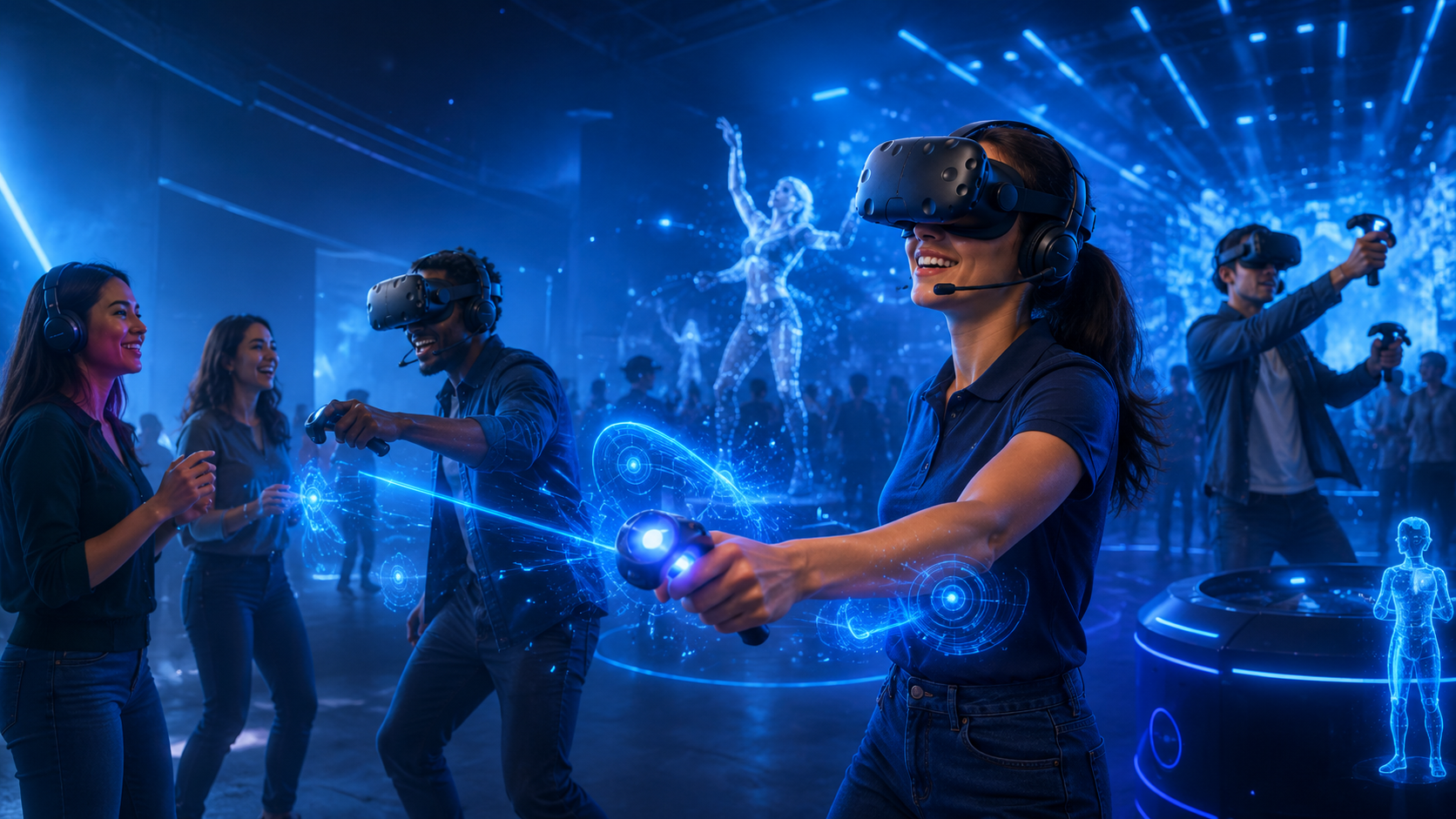
The difference becomes immediately apparent when you watch attendees interact with VR stations versus traditional displays. Instead of polite nods and quick booth passes, you see genuine excitement, extended engagement, and spontaneous crowd formation around active participants. This transformation from observer to player fundamentally changes how attendees connect with your brand, message, or event purpose.
From Spectators to Participants: The Engagement Shift
Virtual reality entertainment delivers quantifiable engagement metrics that traditional event activations struggle to match. Where typical booth interactions last 30 seconds to 2 minutes, VR experiences command 8-12 minutes of focused attention per participant. This extended engagement window creates multiple opportunities for brand messaging, product education, and emotional connection.
The participation effect extends beyond individual users. VR experiences generate natural crowd dynamics, with spectators gathering to watch participants react, compete, and explore virtual worlds. This creates a multiplier effect where one headset entertains 5-10 people simultaneously through shared screens and live reactions.
Social amplification metrics tell a compelling story. Participants share VR experiences on social media at 3x the rate of traditional event activations. The combination of personal achievement, novel experience, and visual proof creates irresistible sharing moments. Attendees post leaderboard victories, reaction videos, and “first time in VR” moments that extend your event’s reach far beyond the venue walls.
Memory formation through active participation creates lasting impressions that passive observation cannot match. Neuroscience research confirms that embodied experiences—where participants physically move and make decisions—create stronger memory encoding than watching presentations or demonstrations. Your event becomes the story attendees tell colleagues, not just another conference they attended.
VR Entertainment ROI for Different Event Types
Trade Shows: VR stations consistently deliver 40-60% increases in booth traffic compared to traditional displays. The visual magnetism of participants wearing headsets and reacting to virtual experiences creates natural curiosity that draws attendees from across the show floor. Qualified lead capture improves as extended engagement time allows for meaningful conversations with booth staff while prospects wait their turn or discuss their experience afterward.
Booth visitors who engage with VR experiences spend an average of 18 minutes at your location versus 3-4 minutes at traditional booths. This extended presence increases brand exposure for passing traffic and creates opportunities for deeper product discussions with engaged prospects.
Corporate Events: Team building exercises using VR deliver 95% participation rates compared to 60-70% for traditional activities. The novelty factor combined with inclusive design means even typically reluctant participants eagerly join VR challenges. Shared virtual experiences create common ground across departments and hierarchy levels, breaking down barriers that limit interaction at standard corporate gatherings.
Employee satisfaction scores for events featuring VR entertainment average 4.6/5.0 compared to 3.8/5.0 for traditional entertainment options. The combination of novelty, achievement, and social interaction addresses multiple engagement drivers simultaneously.
Brand Activations: Conversion metrics show VR participants convert to customers at 2.3x the rate of non-participants. The immersive brand experience creates emotional connections that traditional sampling or demonstration cannot achieve. Lead quality scores increase as VR experiences naturally filter for engaged, interested prospects willing to invest time in your brand.
Data capture rates reach 85% for VR experiences compared to 30% for traditional activation methods. The value exchange feels natural—attendees willingly provide contact information to access premium VR entertainment, receive their scores, or enter competitions.
Private Parties: Guest satisfaction scores for events featuring VR entertainment average 9.2/10 compared to 7.8/10 for traditional entertainment options. The inclusive nature of VR—where physical ability, age, and skill level matter less than in traditional activities—ensures broad participation and enjoyment.
Event memorability metrics show 78% of guests can recall specific details from VR experiences six months post-event, compared to 34% for traditional entertainment elements. The combination of physical engagement, emotional response, and social sharing creates lasting memories that define successful private events.
Entertainment Formats That Drive Maximum Participation
Not all VR experiences deliver equal entertainment value. The most successful event VR entertainment balances accessibility, spectator appeal, and participant satisfaction. Here’s how to select experiences that maximize both individual enjoyment and crowd engagement.
The key lies in matching format to context. High-energy competitive experiences excel at trade shows where you need to create buzz and draw crowds. Collaborative puzzles work better for team building where cooperation matters more than competition. Understanding these dynamics ensures your VR entertainment amplifies rather than distracts from your event objectives.
Competitive Multiplayer Experiences
Tournament structures transform VR from individual entertainment to crowd spectacle. Design competitions that run throughout your event, building anticipation for finals and creating reasons for repeat booth visits. Implement qualifying rounds during peak traffic periods and schedule finals during natural gathering times like lunch breaks or happy hours.
Leaderboard dynamics drive engagement beyond individual sessions. Display real-time rankings on prominent screens to create aspirational targets and bragging rights. Update social media with hourly leaders to extend competition beyond physical attendees. Offer tiered prizes that reward participation alongside performance—everyone who completes the experience enters a drawing while high scores earn premium rewards.
Spectator screens multiply entertainment value per headset. Configure external displays that show the participant’s view, allowing crowds to follow the action and cheer favorites. Add commentary capabilities for staff to narrate exciting moments and build energy. Position screens at eye level and angles that create natural gathering spaces without blocking traffic flow.
Quick rotation formats maximize throughput without sacrificing satisfaction. Design 3-5 minute competitive rounds that deliver complete experiences while maintaining queue movement. Implement “sudden death” tiebreakers that add excitement while managing time. Create spectator engagement activities like prediction contests or crowd voting to maintain interest during wait times.
Branded Adventure Experiences
Custom environments showcase products and services within entertaining narratives. Transport participants to virtual showrooms where they interact with your offerings in impossible real-world scenarios. Create fantasy versions of your products with superpowers that demonstrate benefits memorably. Design virtual factories or behind-the-scenes experiences that reveal your brand story through exploration rather than exposition.
Narrative-driven experiences with natural brand integration avoid heavy-handed marketing while delivering message retention. Develop storylines where your product or service becomes the hero’s tool for solving challenges. Create emotional arcs that mirror customer journey stages from problem recognition to solution discovery. Include decision points that demonstrate product benefits through participant choices rather than passive presentation.
Photo-worthy moments and shareable outcomes extend experience value beyond participation. Design specific scenes optimized for mixed reality photos where participants appear in branded virtual environments. Generate personalized takeaways like achievement certificates, custom avatars wearing your brand colors, or shareable video highlights. Create unique visual signatures that make your VR experience instantly recognizable in social feeds.
Data capture opportunities flow naturally within entertainment contexts. Integrate preference surveys as character customization choices. Capture product interest through in-experience selection tasks. Track engagement patterns that reveal customer priorities and pain points. Design opt-in moments that feel like experience enhancements rather than data requests.
Team Challenge Formats
Collaborative puzzles and escape room scenarios build connections through shared problem-solving. Design challenges requiring diverse skills so every team member contributes meaningfully. Create roles that rotate throughout the experience, preventing single-player dominance. Implement communication requirements where success depends on information sharing between participants.
Communication-based challenges leverage VR’s unique ability to separate visual and verbal channels. Place team members in different virtual spaces where they must describe unseen elements to partners. Create scenarios where one person navigates while another provides directions from a map. Design trust exercises where participants guide teammates through challenges they cannot see.
Mixed reality experiences combine physical and virtual elements for enhanced team dynamics. Incorporate real props that appear in virtual space, creating tactile feedback alongside visual immersion. Design challenges where VR participants direct non-VR teammates through physical tasks. Create hybrid experiences where teams split between virtual and physical environments to achieve common goals.
Scalable formats accommodate varying group sizes without compromising experience quality. Develop modular challenges that expand or contract based on participant numbers. Create tournament brackets for large groups and intimate experiences for small teams. Design asynchronous competitions where teams complete challenges independently then compare results. Implement spectator roles that maintain engagement for waiting participants.
Planning VR Entertainment Flow for Your Event
Successful VR entertainment requires more than dropping headsets into your event space. Strategic placement, timing, and flow management determine whether VR becomes a highlight or a bottleneck. These implementation frameworks ensure smooth integration with your overall event experience.
The difference between memorable VR entertainment and frustrating queues often comes down to planning decisions made weeks before your event. Consider traffic patterns, peak attendance times, and complementary activities when designing your VR deployment strategy.
Station Design and Traffic Management
Optimal station layouts vary significantly based on venue characteristics and event formats. For trade show booths, position VR stations at corners to create natural gathering points without blocking product displays. Angle stations 45 degrees outward to maintain participant privacy while maximizing spectator viewing angles. Elevate platforms 6-12 inches to improve visibility and create defined play spaces.
Conference breakout areas benefit from hub-and-spoke configurations where multiple stations surround central spectator zones. This creates social spaces where waiting participants can interact while maintaining clear sight lines to active experiences. Include charging stations and seating in spectator areas to encourage extended engagement.
Queue management systems prevent congestion while maintaining excitement. Implement virtual queuing through event apps that notify participants when their turn approaches. Display estimated wait times prominently to set expectations and enable planning. Create overflow activities like AR previews or trivia contests that maintain engagement during peak periods.
Spectator viewing areas require careful attention to create inclusive experiences for non-participants. Install large displays at multiple heights to accommodate standing and seated viewers. Provide audio zones where spectators can hear participant reactions without overwhelming adjacent areas. Design photo opportunities where spectators can capture participants in action against branded backgrounds.
Staff-to-station ratios determine operational smoothness and participant satisfaction. Maintain one dedicated attendant per two stations during peak periods to ensure quick transitions and troubleshooting. Add floating staff members for every four stations to handle registration, questions, and crowd management. Schedule technical support on 30-minute rotations to prevent fatigue-related service degradation.
Session Timing and Rotation Strategies
Five-minute experiences optimize throughput for high-traffic activations while delivering satisfying entertainment. Structure content with 30-second onboarding, 3-minute main experience, and 90-second conclusion including score reveal and data capture. Implement automatic session timers that provide warnings before graceful experience conclusions. Design natural ending points that feel complete rather than abruptly terminated.
Fifteen-minute deep dives create premium experiences for qualified leads or VIP guests. Reserve longer sessions for pre-scheduled appointments or earned rewards through event participation. Include multiple chapters or levels that provide natural pause points if time runs short. Offer session recordings or continuation codes that let participants complete experiences post-event.
Scheduled versus walk-up participation models each offer distinct advantages. Scheduled sessions reduce wait uncertainty and enable better staff planning but may decrease spontaneous participation. Walk-up models maximize accessibility but require robust queue management and adequate station capacity. Hybrid approaches reserve 60% capacity for appointments while maintaining 40% for walk-up availability.
Peak time management prevents bottlenecks during natural congregation periods. Stagger session starts across multiple stations to create rolling availability rather than synchronized endings. Implement express experiences during lunch rushes that deliver abbreviated but complete entertainment. Create appointment incentives for off-peak periods through enhanced experiences or exclusive content.
Integration with Event Programming
VR as ice breaker versus main attraction positioning shapes entire event dynamics. Opening events with VR entertainment creates immediate energy and conversation starters for networking. Positioning VR as midday energizers combats post-lunch attention drops. Closing with VR competitions creates memorable finales that extend engagement through event conclusion.
Complementing speakers and presentations through thematic VR experiences reinforces key messages. Schedule VR sessions that simulate concepts speakers discuss, allowing attendees to experience rather than imagine scenarios. Create pre-presentation experiences that generate questions speakers can address. Design post-talk VR challenges that test comprehension through gamified application.
Awards and recognition tie-ins elevate VR from entertainment to achievement. Present VR tournament winners during main stage moments to create aspirational targets. Include VR challenges in broader event competitions where points contribute to overall standings. Create custom trophies or digital badges that commemorate VR achievements beyond the event.
Social media moment creation requires intentional design and timing. Schedule photo opportunities when lighting optimizes image quality. Create branded frames or filters that participants can apply to VR action shots. Coordinate social media pushes with VR competition milestones to maximize real-time engagement. Design shareable score cards or achievement graphics that participants proudly post.
Content Selection for Different Audiences
Your audience demographics and event goals determine which VR entertainment delivers maximum impact. Match experience intensity, complexity, and themes to your specific attendee profile for optimal engagement rates.
Content selection mistakes can transform potential advocates into VR skeptics. Understanding audience preferences, limitations, and expectations ensures every participant enjoys their experience regardless of technical familiarity or physical capabilities.
Executive and C-Suite Entertainment
Premium experiences for executive audiences prioritize sophistication over intensity. Golf simulators let leaders compete in familiar formats while experiencing VR innovation. Virtual travel to exclusive destinations combines aspiration with accessibility. Architectural walkthroughs of future facilities blend entertainment with strategic visualization.
Low-intensity, high-polish content respects physical limitations and professional appearance concerns. Seated experiences eliminate balance concerns while maintaining immersion. Minimal movement requirements prevent perspiration or dishevelment. Short sessions respect time constraints while delivering complete experiences. Professional themes align with executive self-image and interests.
Private session options acknowledge executive preferences for exclusive access. Create VIP hours before general event opening or after standard closing. Design separate experience zones with enhanced privacy and comfort. Offer personalized demonstrations that integrate specific business challenges or opportunities. Provide dedicated support staff familiar with executive communication styles.
Business-relevant simulations and scenarios blend entertainment with professional development. Create negotiation simulations that test skills in risk-free environments. Design crisis management scenarios that challenge decision-making under pressure. Develop market visualization tools that make complex data physically explorable. Include industry-specific challenges that demonstrate thought leadership and innovation.
Sales Team and Customer Activations
Competitive experiences generate energy that sales teams channel into customer engagement. Design head-to-head challenges where sales reps compete against prospects to break ice and build rapport. Create team-based competitions that mix sales staff with customers for relationship building. Implement progressive difficulty that lets players choose challenge levels matching their comfort.
Product demonstration integrations transform features into experiences customers remember. Build virtual environments where product benefits become superpowers participants wield. Create problem scenarios that products solve through entertaining gameplay. Design comparison experiences where participants feel differences between product tiers. Include customization options that mirror real product configurations.
Lead capture through entertainment engagement feels natural rather than transactional. Gate premium experiences behind contact information exchange. Offer score tracking across multiple attempts to encourage data sharing. Create team registrations that capture entire buying committee information. Design follow-up experiences accessible post-event to maintain engagement momentum.
Memorable brand touchpoints emerge from emotional peaks within experiences. Script triumph moments where participants overcome challenges using your solutions. Create surprise elements that delight and generate spontaneous reactions. Design collaborative victories that bond participants with your brand. Include personalized elements that make each experience unique and shareable.
Mixed Demographics and Public Events
Age-appropriate content curation ensures inclusive entertainment across generations. Maintain experience libraries spanning from educational children’s content to sophisticated adult challenges. Implement rating systems that clearly communicate content intensity and themes. Design family modes where parents and children participate together safely. Create grandparent-friendly experiences with minimal physical demands and maximum wonder.
Accessibility considerations extend VR entertainment to all attendees regardless of physical capabilities. Offer seated experiences for mobility-impaired participants. Provide subtitle options for hearing-impaired users. Design high-contrast modes for visually-impaired players. Include one-handed control schemes for participants with limb differences.
Cultural sensitivity in experience selection prevents unintended offense or exclusion. Avoid content requiring specific cultural knowledge for success. Provide multiple language options for international events. Design avatar customization that represents diverse populations. Consider religious and dietary restrictions when designing virtual consumption experiences.
Family-friendly versus adult-oriented options require clear differentiation and controls. Implement parental controls that restrict access to age-inappropriate content. Schedule family hours with curated content selections. Create separate zones for different content ratings. Design experiences that entertain adults while remaining appropriate for observing children.
Measuring Entertainment Impact and ROI
VR entertainment delivers measurable outcomes beyond traditional event metrics. Track participation rates, engagement duration, social amplification, and downstream business impact to justify investment and optimize future deployments.
The data richness available from VR entertainment surpasses traditional event measurement capabilities. Every interaction, decision, and reaction becomes trackable, providing unprecedented insight into attendee engagement and preference patterns.
Engagement Metrics That Matter
Participation rate versus total attendees reveals VR entertainment’s draw power. Track unique participants to identify reach and repeat players to measure satisfaction. Compare participation rates across different experiences to optimize content selection. Analyze demographic patterns to understand which audiences engage most readily.
Average session duration and completion rates indicate content effectiveness and difficulty calibration. Monitor drop-off points to identify frustration triggers or technical issues. Track replay attempts that signal high entertainment value. Compare intended versus actual session lengths to optimize scheduling.
Repeat participation and referral behavior demonstrate genuine enjoyment beyond novelty. Measure how many participants return for additional sessions. Track peer recommendations through referral codes or companion registrations. Analyze social proof generation through participant recruitment of friends.
Queue time tolerance and satisfaction scores reveal acceptable wait thresholds. Survey participants about wait time perception versus actual duration. Monitor abandonment rates at different queue lengths. Correlate satisfaction scores with wait times to find optimal balance points.
Business Outcome Attribution
Lead quality scoring for VR participants shows engagement correlation with purchase intent. Compare conversion rates between VR participants and non-participants. Track sales cycle progression speed for leads generated through VR entertainment. Analyze deal sizes to determine if VR engagement correlates with purchase value.
Sales cycle acceleration post-experience indicates improved product understanding and emotional connection. Measure time from VR participation to first sales meeting. Track progression through sales stages for VR-engaged prospects. Compare close rates and speeds against baseline metrics.
Brand recall and message retention studies validate communication effectiveness. Survey participants immediately post-experience and at intervals afterward. Test specific message recall from VR experiences versus traditional presentations. Measure unprompted brand mention in follow-up conversations.
Social media reach and earned media value quantify amplification beyond direct participation. Track hashtag usage and mention volume during VR activations. Calculate reach through participant follower networks. Measure earned media value through equivalent advertising cost calculations.
Technical Requirements Without the Complexity
While VR entertainment appears technically complex, modern rental packages eliminate setup friction. Understanding basic requirements helps you plan confidently without becoming a VR expert.
Professional VR entertainment providers handle technical complexity, but knowing basics ensures smooth planning and realistic expectations. Focus on space and infrastructure rather than hardware specifications.
Space and Infrastructure Needs
Minimum 8×8 foot play areas per station provide safe movement space while maintaining venue efficiency. Mark boundaries with tape or mats that participants feel through feet. Ensure 2-foot buffer zones between stations to prevent collision. Account for spectator space in addition to play areas.
Power requirements typically involve standard outlets sufficient for most VR entertainment setups. Each station needs one dedicated 15-amp circuit to prevent overload. Position stations within 10 feet of outlets to avoid trip hazards from extension cords. Include power strips with surge protection for peripheral equipment.
WiFi considerations for cloud-based content affect experience quality and reliability. Dedicated bandwidth of 25 Mbps per station ensures smooth streaming. Separate VR traffic from general event WiFi to prevent competition. Have cellular hotspot backups for critical demonstrations.
Lighting and sound isolation options enhance immersion and comfort. Dim lighting around VR stations reduces glare and improves display visibility in headsets. Sound dampening between stations prevents audio confusion. Directional speakers contain sound to specific zones without requiring headphones.
Staffing and Support Models
On-site technician versus self-service options balance cost against reliability. Professional technicians ensure smooth operation but increase costs. Self-service models work for simple experiences with tech-savvy audiences. Hybrid approaches use technicians for setup then transition to self-service.
Training requirements for event staff vary based on support model and experience complexity. Basic operation requires 30-minute training sessions covering startup, reset, and shutdown. Troubleshooting training adds 60 minutes for common issue resolution. Customer service training ensures positive interactions during technical difficulties.
Troubleshooting protocols and backup plans prevent minor issues from becoming major disruptions. Document common problems with step-by-step resolution guides. Maintain spare equipment for quick swaps rather than repairs. Establish escalation procedures for issues beyond staff capabilities.
Remote support availability provides expert assistance without on-site presence costs. Ensure stable internet connections for remote desktop access. Install cameras for remote technicians to see physical setup. Schedule support windows that align with event hours across time zones.
Frequently Asked Questions
How many VR stations do I need for my event size?
Calculate one station per 50-75 attendees for comfortable flow without excessive waiting. For a 500-person event, 7-10 stations provide good coverage. Adjust based on event duration—longer events can serve more people per station. Consider peak attendance patterns; lunch-hour-only activation needs more stations than all-day availability.
What’s the typical cost per participant for VR entertainment?
VR entertainment costs range from $15-50 per participant depending on experience complexity and event structure. Basic rental packages for standard experiences average $2,000-5,000 per day including equipment and support. Custom branded experiences increase costs but deliver exclusive content. Volume discounts apply for multi-day or multiple station rentals.
Can VR entertainment work outdoors or in bright spaces?
Modern VR systems function in bright environments with proper setup adjustments. Use popup tents or canopies to create shaded zones that improve display visibility. Position stations to avoid direct sunlight on sensors that can interfere with tracking. Indoor venues remain optimal, but outdoor events succeed with appropriate planning.
How do we handle hygiene concerns with shared headsets?
Professional VR entertainment providers implement comprehensive hygiene protocols. Disposable face masks create barriers between users and headsets. UV-C sanitization between users eliminates germs without chemical residue. Alcohol wipes clean controllers and surfaces. Staff monitor and enforce hygiene standards throughout events.
What happens if someone gets motion sick?
Motion sickness affects approximately 5-10% of VR participants, decreasing with newer technology and appropriate content selection. Staff trained in recognition can intervene before severe discomfort. Ginger candies and fresh air provide quick relief. Experience selection avoiding rapid movement reduces incidence. Clear warnings let susceptible individuals self-select out.
Can we customize VR content with our branding?
Customization ranges from simple logo placement to fully branded experiences. Basic packages include branded loading screens and environment elements. Advanced customization creates unique experiences featuring your products, facilities, or services. Development time ranges from 2 weeks for simple branding to 3 months for custom experiences.
How far in advance should we book VR entertainment?
Book VR entertainment 6-8 weeks in advance for standard packages to ensure availability. Custom content development requires 3-4 month lead times. Peak season events (September-November, March-May) need earlier booking. Last-minute rentals remain possible but limit experience selection and customization options.
What’s the minimum age for VR participation?
Most VR manufacturers recommend minimum age 13 for extended use, though shorter experiences work for younger children. Family-friendly content suits ages 7+ with parental supervision. Adjust headset fit and experience intensity for younger participants. Provide alternative AR experiences for children too young for VR.
Elevate Your Next Event with VR Entertainment
VR event entertainment transforms traditional gatherings into memorable experiences that attendees discuss long after leaving. The shift from passive observation to active participation creates deeper engagement, stronger brand connections, and measurable business outcomes that justify investment.
Success comes from matching VR entertainment to your specific audience and objectives rather than implementing technology for novelty alone. Whether driving trade show traffic, energizing corporate teams, or creating unforgettable brand activations, VR entertainment delivers quantifiable value beyond traditional alternatives.
The technical barriers that once limited VR adoption have dissolved. Professional providers handle complexity while you focus on strategic integration with your event goals. Space requirements fit standard venue configurations. Costs align with comparable entertainment options while delivering superior engagement metrics.
Start planning your VR entertainment integration by identifying primary objectives, lead generation, team building, or pure entertainment. Select experiences that align with audience demographics and comfort levels. Design traffic flow that maximizes participation without creating bottlenecks. Measure outcomes that matter to stakeholders.
The question isn’t whether VR entertainment fits your event, but which implementation strategy maximizes impact. Contact professional VR entertainment providers to discuss your specific needs and explore options that transform your next event from attended to experienced.
Take action today: Request VR entertainment proposals for your upcoming event and discover how immersive experiences create the participation and engagement your attendees crave.