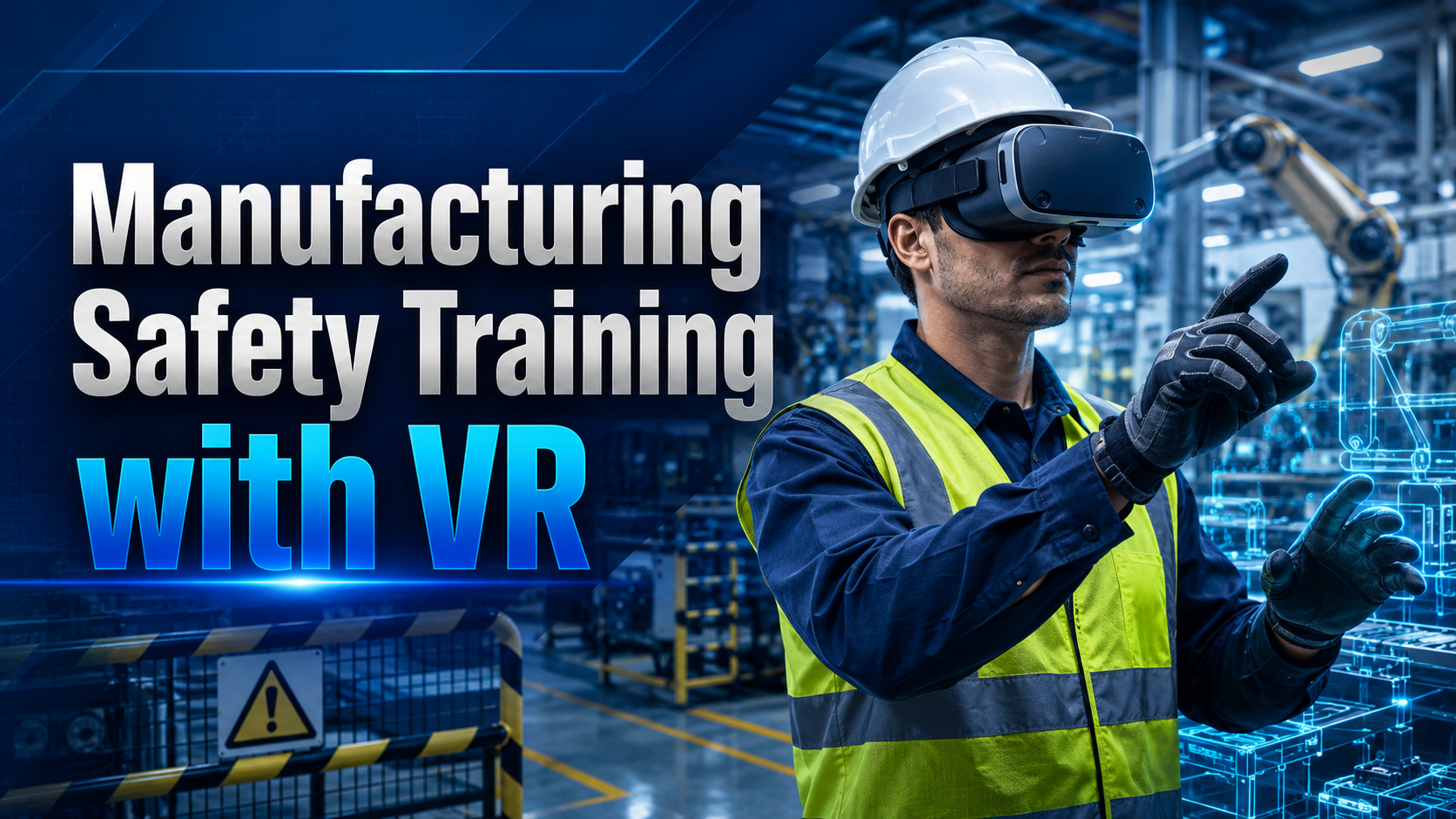
Manufacturing facilities face an ongoing challenge: how to deliver effective safety training without disrupting production or exposing workers to actual hazards. Virtual reality safety training offers a solution that transforms high-risk scenarios into controlled learning experiences, all while maintaining OSHA compliance and reducing training costs through flexible rental programs.
Manufacturing Safety Challenges That VR Training Solves
Manufacturing environments present unique safety training challenges: high-risk equipment that can’t be stopped for training, hazardous scenarios that are dangerous to recreate, and the need for consistent training across multiple shifts and locations. VR safety training addresses these challenges by creating risk-free simulations of actual plant floor hazards.
Traditional safety training methods often fall short when dealing with complex machinery, hazardous materials, and emergency procedures. Workers need hands-on experience with dangerous situations, but creating these scenarios in real life poses unacceptable risks. VR bridges this gap by providing immersive, repeatable training experiences that prepare workers for real-world hazards without any actual danger.
Equipment Operation Without Production Downtime
Manufacturing facilities lose thousands of dollars per hour when production lines stop for training. VR eliminates this costly trade-off by creating virtual replicas of actual equipment that workers can operate without affecting production schedules.
Training on virtual forklifts, cranes, and conveyor systems allows new operators to develop muscle memory and spatial awareness before touching actual equipment. Workers practice loading sequences, weight distribution calculations, and emergency procedures in a virtual warehouse that mirrors their actual work environment. Advanced haptic feedback systems simulate the resistance and vibration of real controls, making the transition to actual equipment seamless.
Simulating emergency stops and malfunction responses prepares operators for critical situations that rarely occur but demand immediate, correct action. Workers experience hydraulic failures, brake malfunctions, and load shifts in VR, learning to recognize warning signs and execute proper shutdown procedures. These high-stress scenarios can be repeated until responses become automatic, without risking equipment damage or worker injury.
Multi-operator coordination training in shared virtual environments addresses the complex choreography required in modern manufacturing. Teams practice synchronized crane operations, conveyor handoffs, and assembly line coordination in the same virtual space, even when training from different physical locations. This collaborative training builds communication protocols and spatial awareness essential for preventing accidents in facilities where multiple operators work in close proximity.
Hazard Recognition in Controlled Environments
VR training transforms abstract safety concepts into visceral experiences that workers remember. Instead of viewing photos of hazards in a PowerPoint presentation, trainees navigate through virtual facilities where they must actively identify and respond to dangers.
Identifying slip, trip, and fall hazards in virtual plant layouts develops the constant vigilance required for manufacturing safety. Workers walk through virtual facilities where oil spills appear on walkways, cables cross traffic paths, and tools lie in unexpected places. The system tracks where trainees look and how quickly they identify hazards, providing objective metrics on hazard recognition skills. Scenarios adjust dynamically, placing hazards in different locations to prevent memorization and ensure workers develop genuine observation skills.
Chemical spill response training without actual hazmat exposure allows workers to practice emergency procedures that would be too dangerous or expensive to simulate with real chemicals. Trainees experience the stress of a chemical release, practice proper evacuation routes, and learn containment procedures using virtual absorbents and barriers. The VR system simulates visibility restrictions from vapor clouds and the limited mobility of chemical suits, preparing workers for the physical challenges of real spill response.
Confined space entry procedures in simulated tanks and vessels provide critical training for one of manufacturing’s most dangerous operations. Workers practice atmospheric testing, lockout procedures, and emergency extraction in virtual vessels that replicate the claustrophobia and disorientation of actual confined spaces. The training includes communication protocols with outside attendants and rescue procedures, all without the risks associated with actual confined space entry.
Compliance Documentation and Tracking
VR platforms automatically generate the detailed records required for regulatory compliance, eliminating the paperwork burden that often accompanies safety training programs.
Automated training completion records for OSHA requirements create tamper-proof documentation of every training session. The system logs entry and exit times, modules completed, and performance scores, generating certificates that meet regulatory standards. These digital records integrate with existing learning management systems, creating a comprehensive training history for each employee that stands up to regulatory audits.
Performance metrics on hazard identification accuracy provide objective evidence of training effectiveness. Unlike traditional training where comprehension is measured through written tests, VR training captures behavioral data: how quickly workers identify hazards, whether they follow proper procedures, and how they respond under pressure. These metrics identify workers who need additional training before they’re exposed to actual hazards.
Consistent training delivery across all shifts and locations ensures every worker receives the same high-quality instruction. VR eliminates the variability introduced by different instructors, language barriers, and training materials. A worker training on night shift in Detroit experiences the exact same scenarios as one training on day shift in Dallas, ensuring uniform safety standards across the entire organization.
VR Rental Packages for Manufacturing Safety Programs
IGIVU’s manufacturing safety training rentals include standalone wireless headsets preloaded with industry-specific scenarios. These packages eliminate the need for permanent VR infrastructure while providing enterprise-grade training experiences.
The rental model removes the barriers that typically prevent manufacturers from adopting VR training: high upfront costs, technical complexity, and content development requirements. Facilities receive fully configured headsets with proven training content, allowing them to start training immediately without IT involvement or infrastructure changes.
Lockout/Tagout (LOTO) Training Packages
Lockout/tagout procedures prevent 120 deaths and 50,000 injuries annually, making LOTO training a critical safety priority. VR rental packages transform this complex training into an engaging, memorable experience.
Meta Quest 3 headsets with LOTO procedure simulations provide wireless, high-resolution training that doesn’t require external sensors or computers. Workers practice identifying energy sources, applying locks and tags, and verifying zero-energy states on virtual equipment identical to their actual machinery. The headsets’ hand tracking technology allows natural interaction with virtual locks, tags, and testing equipment.
Machine-specific energy isolation scenarios replicate the exact equipment in your facility, including electrical disconnects, pneumatic valves, and hydraulic systems. Workers learn to identify all energy sources for complex machinery, understanding how stored energy in capacitors, springs, and elevated components poses ongoing hazards even after primary power disconnection. The training includes unexpected startup scenarios that demonstrate the consequences of improper lockout procedures.
Multi-user training for group lockout procedures addresses the coordination challenges when multiple contractors and employees work on the same equipment. Teams practice applying multiple locks, transferring lockout responsibility between shifts, and managing complex permit systems. The virtual environment shows each worker’s locks in different colors, making it easy to track who has control of which energy sources.
2-week to 3-month rental periods for certification cycles align with typical LOTO training requirements. Short-term rentals support annual recertification training, while longer rentals enable comprehensive initial training for new employees. The rental includes unlimited training sessions, allowing facilities to train all shifts without scheduling conflicts or overtime costs.
Forklift and Material Handling VR Rentals
Forklift accidents cause 85 fatal injuries and 34,900 serious injuries annually. VR training addresses this risk by providing extensive practice in challenging scenarios before operators touch actual equipment.
Pico 4 Enterprise headsets with warehouse navigation training create photorealistic warehouse environments where operators practice maneuvering in tight spaces, managing blind spots, and maintaining safe speeds. The enterprise-grade headsets include enhanced comfort for extended training sessions and administrative controls for managing multiple users.
Load stability and weight distribution simulations teach operators to recognize unstable loads before they become accidents. Trainees experience how different load positions affect forklift balance, practice securing irregular shaped items, and learn to calculate load centers. The physics engine accurately simulates load shifts during turns and stops, helping operators develop an intuitive understanding of momentum and stability.
Pedestrian safety and blind spot awareness modules address the leading cause of forklift fatalities: struck-by incidents. Operators practice scanning for pedestrians, using horns at blind corners, and maintaining safe distances in mixed traffic areas. The training includes scenarios where pedestrians appear unexpectedly, teaching operators to maintain constant vigilance even in familiar environments.
Setup support for warehouse training rooms includes delivery of a mobile training cart with charging stations, headset storage, and sanitization supplies. IGIVU technicians provide on-site setup, ensuring optimal tracking space and safety boundaries. The support package includes remote troubleshooting and next-day replacement for any technical issues.
Chemical and Hazmat Response Packages
Chemical incidents require split-second decisions and precise procedures. VR training provides the repetition needed to make these responses automatic without exposing workers to actual hazardous materials.
HTC Vive Focus 3 rentals with spill containment scenarios deliver premium visual quality essential for identifying chemical hazards and reading safety labels. Workers practice initial response procedures: alerting others, establishing perimeters, and selecting appropriate containment materials. The training includes various spill sizes and locations, from small bench-top spills to large-scale releases requiring evacuation.
PPE selection and donning/doffing procedures ensure workers choose appropriate protection for specific chemicals and follow proper sequences to avoid contamination. The VR system times each step of the donning process, identifying workers who rush through critical safety checks. Doffing procedures receive special emphasis, as improper removal of contaminated PPE causes many chemical exposures.
Emergency shower and eyewash station training provides critical practice for procedures that workers hope never to use but must execute perfectly in an emergency. Trainees learn to locate stations quickly, operate them properly, and maintain the required 15-minute flush time despite discomfort. The training includes scenarios with obstructed paths and inoperative stations, teaching workers to identify alternate routes and equipment.
SDS interpretation in virtual environments moves beyond classroom reading to practical application. Workers access virtual SDS sheets during simulated incidents, learning to quickly locate critical information about exposure limits, first aid procedures, and incompatible materials. The training reinforces the connection between SDS information and real-world response actions.
Implementation Timeline for Manufacturing VR Safety Training
Deploying VR safety training in manufacturing facilities follows a structured timeline from pilot planning through full rollout. Most organizations start with a 30-day pilot program before expanding to facility-wide implementation.
The phased approach minimizes disruption while building internal support for the program. Early successes with a small pilot group create champions who advocate for broader adoption, while lessons learned during the pilot inform the full-scale deployment.
Week 1-2: Pilot Program Setup
The first two weeks focus on preparation and infrastructure, setting the foundation for successful training deployment.
Select 10-15 operators for initial pilot group, choosing a mix of experienced workers and new hires to test the training’s effectiveness across skill levels. Include representatives from different shifts and departments to ensure broad applicability. Operators with previous VR experience can provide valuable feedback on the user experience, while VR newcomers test the system’s accessibility.
Configure training room or mobile cart setup in a space that allows for safe movement while wearing headsets. A 10×10 foot area per headset provides adequate space for most training scenarios. Install padding on any nearby obstacles and mark boundaries with floor tape. For facilities without dedicated training space, mobile carts allow VR training to move between break rooms, conference rooms, or warehouse mezzanines.
Load facility-specific scenarios onto rental headsets before delivery, customizing training content to match your actual equipment and layout. IGIVU’s technical team works from equipment photos and floor plans to configure scenarios that mirror your facility. This customization happens before headset delivery, eliminating setup delays and ensuring immediate training readiness.
Conduct train-the-trainer session with safety team to ensure internal capability for ongoing training delivery. Safety managers learn to operate headsets, guide trainees through scenarios, and interpret performance reports. The session covers troubleshooting common issues, maintaining headsets, and modifying difficulty settings for different skill levels. This knowledge transfer ensures the program continues smoothly after the initial setup period.
Week 3-4: Initial Training Deployment
The second phase focuses on running actual training sessions and gathering data to optimize the program.
Run first training sessions with pilot group using a structured schedule that minimizes production impact. Sessions typically run 30-45 minutes, allowing workers to complete training during break periods or shift overlaps. Start with basic familiarization modules before progressing to complex scenarios. Document any technical issues, content gaps, or user difficulties for resolution.
Collect performance data and feedback through the VR platform’s analytics dashboard and structured debriefs. The system automatically captures completion times, error rates, and areas where trainees struggle. Combine this quantitative data with qualitative feedback about comfort, difficulty, and perceived value. Survey participants about their confidence in performing actual tasks after VR training.
Adjust difficulty levels and scenario parameters based on initial results. If trainees consistently fail certain modules, reduce complexity or add intermediate steps. Conversely, if experienced workers find scenarios too simple, add complications like equipment malfunctions or time pressure. The goal is challenging but achievable training that builds confidence without causing frustration.
Document time savings versus traditional training by comparing VR session lengths to previous classroom or on-floor training. Include preparation time, travel to training locations, and production downtime in calculations. Most facilities find VR training takes 40-60% less time than traditional methods while delivering superior retention and engagement.
Month 2-3: Scaling and Optimization
The final phase expands successful pilot programs to full facility implementation while optimizing processes and measuring return on investment.
Expand to additional shifts and departments based on pilot success and identified training needs. Prioritize high-risk operations and departments with recent incidents or upcoming audits. Develop a rollout schedule that ensures all workers receive training within compliance deadlines. Consider adding headsets to support increased training volume without creating bottlenecks.
Integrate with existing LMS platforms to streamline record keeping and compliance reporting. VR training data flows automatically into your learning management system, updating employee training records and generating compliance reports. This integration eliminates duplicate data entry and ensures training records remain current for regulatory audits.
Develop custom scenarios for specific equipment unique to your facility. While standard training modules cover common equipment, custom scenarios address facility-specific hazards and procedures. Work with IGIVU’s content team to create scenarios for proprietary equipment, unique chemical processes, or facility-specific emergency procedures.
Calculate ROI based on incident reduction and training efficiency improvements. Compare incident rates before and after VR training implementation, including near-misses and first aid cases. Factor in reduced training time, eliminated production downtime, and decreased travel costs. Most facilities achieve positive ROI within 3-6 months through a combination of efficiency gains and incident reduction.
Cost Comparison: VR Rental vs Traditional Manufacturing Safety Training
Manufacturing safety training costs include instructor time, production downtime, and potential incident liability. VR rentals shift this cost structure by eliminating production interruptions and reducing instructor requirements.
Understanding the true cost of safety training requires looking beyond direct training expenses to include opportunity costs, liability exposure, and long-term retention rates. VR training’s higher retention rates mean less frequent retraining, multiplying cost savings over time.
Traditional Classroom and On-Floor Training Costs
Traditional safety training carries hidden costs that significantly exceed the visible expenses of instructors and materials.
8-hour OSHA training sessions at $200-500 per employee represent just the starting point for training costs. Add instructor fees, facility rental, and materials, and costs quickly escalate. Multi-day training programs require travel expenses, hotel accommodations, and meal allowances. Workers on different shifts require multiple sessions, multiplying instructor costs.
Production line downtime valued at $5,000-20,000 per hour dwarfs direct training costs for many manufacturers. Training on actual equipment requires stopping production, calibrating machinery after training, and potential damage from inexperienced operators. Even brief demonstrations can cascade into hours of lost production as lines restart and reach optimal efficiency.
Travel costs for off-site training facilities include transportation, accommodations, and per diem expenses that add hundreds of dollars per employee. Workers traveling to training centers lose productive time in transit. Facilities often struggle to schedule training around production demands, leading to overtime costs when workers attend training outside normal shifts.
Inconsistent delivery across multiple trainers creates variable training quality that undermines safety programs. Different instructors emphasize different points, use different examples, and may skip content they consider less important. Language barriers and cultural differences further complicate training delivery. This inconsistency leads to knowledge gaps that contribute to incidents.
VR Rental Investment and ROI
VR rental models transform the economics of safety training by converting large capital expenses into predictable operational costs.
Headset rental packages from $300-500 per unit per month provide enterprise-grade VR training without capital investment. A 10-headset rental supporting 100+ workers costs less than sending 10 workers to off-site training. Rental fees include maintenance, updates, and technical support, eliminating IT burden and ensuring consistent performance.
Preloaded content eliminates development costs that typically reach $50,000-100,000 for custom VR training. IGIVU’s library includes proven scenarios for common manufacturing hazards, equipment, and procedures. Facilities start training immediately without the months-long development cycles required for custom content. Regular content updates ensure training remains current with changing regulations and best practices.
Training time reduction of 40-60% versus classroom methods multiplies savings across large workforces. A forklift certification that traditionally requires 8 hours completes in 3-4 hours with VR training. This time savings translates directly to productivity gains and reduced overtime costs. Workers retain VR training better, reducing refresher training frequency.
Zero production downtime for equipment-based training eliminates the largest hidden cost of traditional safety training. Workers practice on virtual equipment while actual machinery continues producing. This separation of training from production allows flexible scheduling that doesn’t impact delivery commitments or revenue generation.
Measuring Safety Training Effectiveness with VR Analytics
VR training platforms capture detailed performance metrics that traditional training cannot measure, including reaction times, gaze tracking for hazard identification, and decision accuracy under pressure.
These metrics transform safety training from a compliance checkbox into a data-driven process that continuously improves. Managers identify struggling workers before they face real hazards, while aggregate data reveals systemic training gaps that require attention.
Performance Metrics and Reporting
VR platforms generate objective performance data that eliminates the subjectivity of traditional skills assessment.
Hazard identification speed and accuracy scores reveal how quickly and reliably workers spot dangers in their environment. The system tracks every hazard in a scenario, recording whether trainees identified it, how long identification took, and what action they took in response. Heat maps show where trainees focus their attention, revealing whether they’re checking critical areas or developing dangerous blind spots.
Proper PPE selection rates in different scenarios indicate whether workers understand protection requirements for various hazards. The system presents scenarios requiring different PPE combinations, tracking whether workers select appropriate protection and follow proper donning sequences. Incorrect selections trigger immediate feedback explaining why chosen PPE provides insufficient protection.
Emergency response time measurements capture the critical seconds that determine incident outcomes. VR training records how quickly workers initiate emergency stops, evacuate danger zones, and activate alarm systems. Repeated training reduces response times as procedures become automatic. Managers can set minimum response time standards and identify workers requiring additional practice.
Heat maps showing areas of focus during inspections reveal whether workers thoroughly examine equipment or rush through safety checks. The eye tracking data shows inspection patterns, identifying workers who skip critical components or spend insufficient time on high-risk areas. This objective data replaces subjective supervisor observations with quantifiable metrics.
Compliance Documentation
VR training automatically generates the comprehensive documentation required for regulatory compliance and liability protection.
Automated training certificates with completion timestamps create tamper-proof records of training completion. Each certificate includes the trainee’s name, modules completed, performance scores, and completion timestamp. Digital signatures and blockchain verification prevent falsification. Certificates generate automatically upon successful completion, eliminating administrative delays.
Individual progress tracking across multiple modules maintains comprehensive training histories for each employee. The system tracks every training session, including incomplete attempts and failed assessments. This detailed history helps managers identify workers struggling with specific concepts and provide targeted remediation. Progress tracking also ensures workers complete all required modules before certification.
OSHA-compliant record keeping for 5-year retention meets regulatory requirements without manual filing systems. Digital records remain accessible and searchable throughout the retention period. Automated backups prevent data loss, while encryption protects sensitive employee information. The system generates standard OSHA forms and custom reports for specific regulatory requirements.
Audit trails for regulatory inspections provide complete documentation of training program administration. Every system access, configuration change, and record modification is logged with timestamps and user identification. Inspectors can verify training authenticity, review historical performance data, and confirm compliance with training frequency requirements.
Getting Started with Manufacturing VR Safety Training Rentals
Launch your manufacturing safety VR program with a focused pilot that demonstrates value before scaling. IGIVU’s rental model lets you test specific use cases without long-term commitments.
Starting small with a clearly defined pilot reduces risk while building internal support for broader deployment. Success with a limited scope creates momentum for facility-wide implementation.
Pilot Program Planning Checklist
Effective pilot programs follow a structured planning process that ensures meaningful results and smooth execution.
Identify highest-risk operations for initial VR training focus by analyzing incident history, near-miss reports, and upcoming regulatory requirements. Operations with recent incidents or citations provide clear success metrics for VR training effectiveness. High-frequency tasks affecting many workers multiply the impact of training improvements. Complex procedures with serious consequences justify the investment in immersive training.
Select pilot participant group across different experience levels to test training effectiveness for various audiences. Include 3-5 new hires to assess VR’s effectiveness for initial training. Add 5-7 experienced workers to evaluate whether VR training adds value for skilled employees. Include 2-3 supervisors who can provide feedback on training quality and suggest improvements.
Define success metrics that demonstrate clear value to stakeholders. Incident reduction targets provide the clearest ROI demonstration, though pilot duration may be too short for statistical significance. Training time reduction offers immediate, measurable savings. Knowledge retention scores from post-training assessments indicate learning effectiveness. Participant satisfaction scores influence broader adoption.
Allocate 200-400 sq ft training space with power outlets for a comfortable, safe training environment. The space needs adequate ventilation and climate control for comfort during extended sessions. Position the training area away from high-traffic zones to minimize distractions and collision risks. Install sound dampening if the area is near noisy equipment. Provide seating for trainees waiting their turn and observers evaluating the training.
Rental Package Selection
Choosing the right rental package ensures your pilot program has the resources needed for success without overcommitting resources.
Choose headset quantity based on shift size and training frequency to avoid bottlenecks while minimizing costs. Calculate the number of workers requiring training divided by available training hours to determine minimum headset requirements. Add 1-2 extra headsets to accommodate equipment issues or increased demand. Consider whether headsets will be shared across shifts or dedicated to specific groups.
Select content modules matching your equipment and hazards from IGIVU’s extensive library. Start with modules addressing your highest-priority safety concerns. Generic modules like hazard recognition and emergency response apply across departments. Equipment-specific modules for forklifts, cranes, or machinery match your operational needs. Chemical handling and confined space modules address specialized risks.
Include setup support and train-the-trainer services to ensure smooth deployment and sustainable operations. On-site setup ensures optimal configuration for your specific environment. Train-the-trainer services create internal capability for ongoing program management. Technical support agreements provide rapid resolution for any issues that arise. Content customization services adapt generic scenarios to your specific equipment and procedures.
Plan for 30-90 day initial rental period that provides sufficient time for meaningful results without long-term commitment. 30-day rentals work for focused pilots with clear objectives and limited scope. 60-day rentals allow for iteration and optimization based on initial feedback. 90-day rentals enable comprehensive evaluation including pre- and post-training incident comparisons. Extension options provide flexibility if the pilot shows promise but needs more time for full evaluation.
Frequently Asked Questions
How many VR headsets do I need for a 100-person manufacturing facility?
For a 100-person facility operating multiple shifts, 5-8 headsets typically provide adequate capacity without creating training bottlenecks. This assumes 30-minute training sessions with 15-minute buffers for sanitization and setup between users. Facilities with concentrated training periods, such as annual recertification weeks, may need 10-12 headsets to avoid overtime costs. Single-shift operations can often manage with 3-4 headsets, scheduling training during lunch breaks and shift overlaps.
Can VR training replace hands-on equipment certification?
VR training supplements but doesn’t entirely replace hands-on equipment operation for final certification. OSHA requires actual equipment operation for powered industrial truck certification, but VR can deliver the classroom portion and initial skills training. Most facilities use VR for hazard recognition, procedure training, and initial familiarization, then conduct final certification on actual equipment. This hybrid approach reduces actual equipment time by 60-70% while ensuring operators have real-world experience.
What happens if a rental headset is damaged during training?
IGIVU’s rental agreements include damage protection covering normal wear and accidental damage during proper use. The rental fee includes basic coverage for scratched lenses, worn straps, and minor impacts. Facilities are responsible for damage from negligence or misuse, such as stepping on headsets or exposure to chemicals. Replacement headsets ship overnight to minimize training disruption. Optional enhanced protection plans cover all damage except loss or theft, providing complete peace of mind.
How do we customize VR scenarios for our specific equipment?
Customization begins with providing photos, videos, and specifications of your equipment to IGIVU’s content team. Standard equipment models can be modified within 1-2 weeks to match your specific configurations. Completely custom equipment requires 3-4 weeks for 3D modeling and scenario development. Some rental packages include customization hours for adapting scenarios to your facility. Advanced customization incorporating your actual procedures, warning signs, and facility layout creates highly realistic training that directly transfers to your work environment.
Does VR safety training meet OSHA compliance requirements?
VR training satisfies OSHA’s requirements for safety training when it covers required content and includes appropriate evaluation methods. OSHA accepts VR training for general safety topics, hazard communication, and emergency procedures. Equipment-specific certifications may require hands-on components, but VR can deliver required knowledge training. The key is ensuring VR training includes all elements specified in relevant OSHA standards. IGIVU’s training modules are designed to meet or exceed OSHA requirements, with documentation systems that satisfy audit requirements.
Conclusion
Manufacturing safety training with VR represents a fundamental shift in how facilities prepare workers for hazardous environments. By eliminating production downtime, providing consistent training across all shifts, and creating risk-free simulations of dangerous scenarios, VR training addresses the limitations that have long plagued traditional safety programs.
The rental model removes barriers to adoption, allowing facilities to access enterprise-grade VR training without capital investment or technical complexity. With packages tailored to specific manufacturing hazards—from lockout/tagout procedures to chemical spill response—facilities can start training immediately with proven content that meets OSHA requirements.
The data-driven insights provided by VR analytics transform safety training from a compliance requirement into a strategic advantage. Objective performance metrics identify at-risk workers before incidents occur, while automated documentation simplifies regulatory compliance and reduces administrative burden.
For EHS managers and safety directors evaluating VR training options, the path forward is clear: start with a focused pilot program that demonstrates value, then scale based on proven results. The combination of reduced training time, eliminated production downtime, and improved safety outcomes delivers ROI that justifies broader deployment.
Ready to transform your manufacturing safety training? Contact IGIVU today to discuss rental packages tailored to your facility’s specific hazards and training requirements. Our safety training specialists will help you design a pilot program that demonstrates clear value while building internal support for facility-wide implementation.