Augmented reality used to sound like a big-budget experiment. Today, a branded AR experience can run in any smartphone browser from a single QR code, and pricing has come down to match. The catch is that published price ranges are all over the map, from a couple of thousand dollars to well into six figures.
This guide breaks down what augmented reality actually costs in 2026, what drives the price up or down, the hidden costs most quotes leave out, and how to time a project for the holiday season or a January trade show like CES.
Quick answer: Augmented reality starts at about $2,000 to $8,000+ for most business projects with IGIVU, while published agency ranges run from $5,000 to $300,000+ for fully custom builds. A browser-based WebAR experience is the cheapest option. Event activations and 3D product configurators sit in the middle, and native iOS and Android apps cost the most.
How much does augmented reality cost?
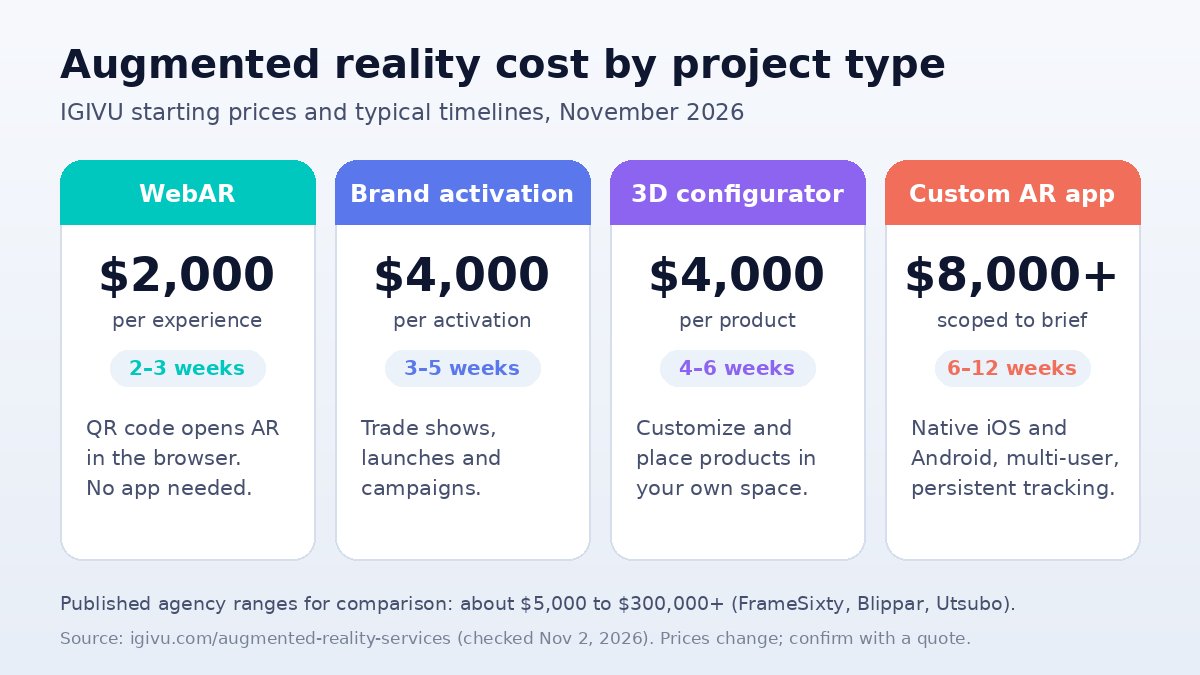
The price depends mostly on what kind of AR you need. Here are IGIVU’s published starting prices and typical timelines for the four project types businesses ask for most.
| AR project type | Starting price | Typical timeline | What you get |
|---|---|---|---|
| WebAR experience | $2,000 per experience | 2–3 weeks | Scan a QR code, the AR opens in the phone’s browser. No app, no install. |
| AR brand activation | $4,000 per activation | 3–5 weeks | An interactive AR moment for trade shows, launches, and campaigns |
| 3D product configurator | $4,000 per product | 4–6 weeks | Customize options and place the product in your own space; embeds on your site |
| Custom AR app | $8,000+, scoped to your brief | 6–12 weeks | Native iOS and Android with complex interactions, persistent tracking, multi-user |
Every IGIVU AR project includes concept design, development, revisions, and deployment, so the starting price isn’t just the coding.
What do other AR studios charge?
Published industry ranges run higher, usually because they assume heavier custom 3D work, more scenes, or multi-market rollouts. Expect anywhere from about $5,000 for a simple WebAR piece to $300,000 or more for enterprise builds.
- FrameSixty puts a simple WebAR or marker-based experience at $5,000–$40,000, a mid-complexity native app at $50,000–$120,000, and enterprise deployments at $120,000 to $300,000+ (FrameSixty).
- Blippar lists agency-built WebAR campaigns at $5,000–$50,000+ and enterprise custom work at $50,000–$300,000+ (Blippar).
- Utsubo prices a single WebAR activation at $20,000–$50,000, plus $15,000–$80,000 for custom 3D production (Utsubo).
The takeaway: compare quotes by scope, not just the headline number. Two quotes for “an AR experience” can describe very different projects.
What drives the cost of an AR project?
3D content and interactivity drive most of the price. The AR technology itself is usually the smaller part. These are the levers that move a quote:
- 3D assets. Using your existing product models or CAD files costs far less than building models from scratch.
- Number of scenes or products. One great scene costs less than ten average ones.
- Tracking type. Scanning a QR code or image target is simplest. Placing objects on any surface, or anchoring content to a real place, takes more work.
- Interactivity. Games, configurators, photo sharing, and lead capture add design and testing time.
- Platform. WebAR is one build for every phone. Native apps need iOS and Android versions plus app store review.
- Languages and markets. Utsubo estimates each extra language adds 30–50% to a WebAR campaign.
- Timeline. Rush jobs are possible, but they limit how much can be built.
What hidden costs should you plan for?
The biggest surprises are hosting, platform fees, and upkeep after launch. Ask about all three before you sign.
- Hosting and platform fees. Self-serve WebAR platforms range from free to about $315 a month, and some charge per view (Banuba). Ask whether hosting is included and for how long.
- Platform shutdowns. 8th Wall, a popular WebAR platform, ended platform access in February 2026, and its hosted projects come offline on February 28, 2027 (Niantic Spatial). If your current AR lives there, budget to move it.
- Maintenance. If the experience will outlive one campaign, Utsubo suggests planning 15–20% of the build cost per year for upkeep.
- Hardware. Phone-based AR needs none. Glasses or headsets at an event add a rental or purchase cost, plus staff to run them.
Do you need AR glasses or headsets?
Not for most projects. WebAR runs on the phones your audience already carries, which is why it’s the default for events and marketing. Glasses and headsets make sense when you want a hands-free, premium demo.
The hardware is moving fast this season. Google and XREAL opened orders for XREAL Aura, the first Android XR glasses, on October 28 at a launch price starting at $1,099, with U.S. shipping from mid-November (Google). Samsung’s Android XR “Intelligent Eyewear” is reportedly due in the U.S. and Korea in mid-December, with pricing not yet set (SamMobile).
For a one-day event, renting is usually smarter than buying new devices. IGIVU rents Ray-Ban Meta AI glasses, XREAL glasses, and mixed reality headsets, shipped pre-tested, with on-site tech support available. See our AR glasses rental guide for how the formats compare.
How long does an AR project take, and when should you start?
Plan two to six weeks for most projects, and longer for native apps. For a January show, that means briefing your AR partner in November.
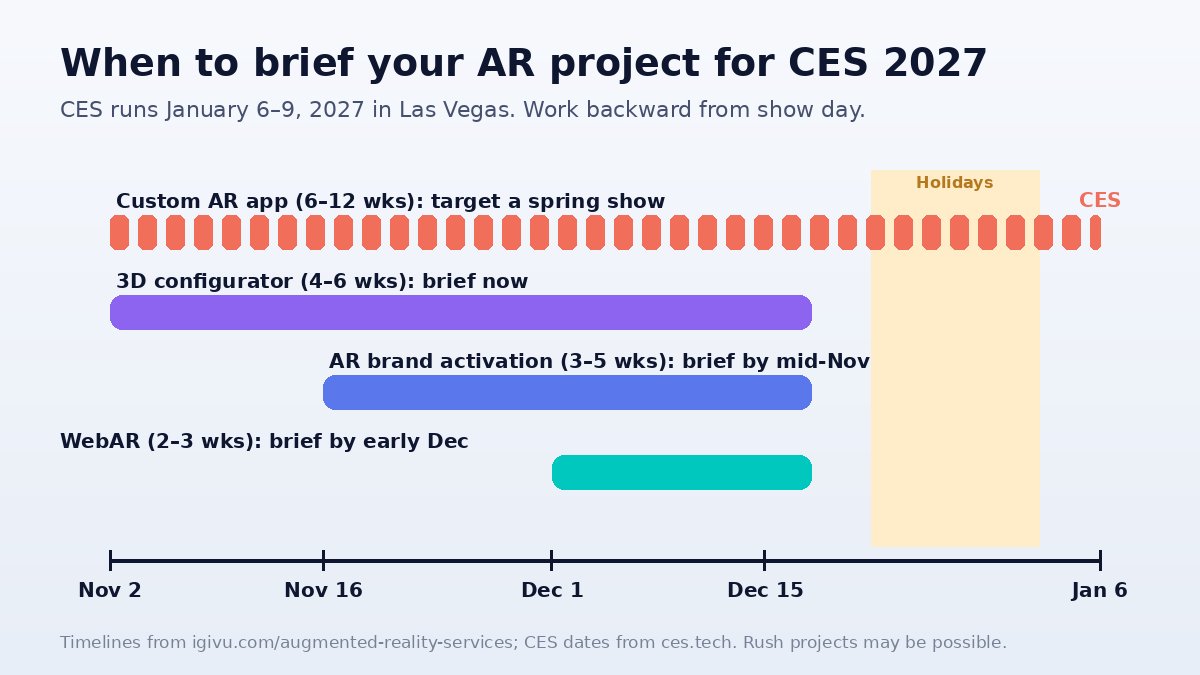
CES 2027 runs January 6–9 in Las Vegas (CES). Working backward, and leaving room for holiday closures:
- WebAR (2–3 weeks): brief by early December.
- AR brand activation (3–5 weeks): brief by mid-November.
- 3D configurator (4–6 weeks): brief now.
- Custom AR app (6–12 weeks): aim for a spring show instead.
Tight deadlines happen. For the City of Santa Monica’s groundbreaking event, IGIVU took a WebAR experience from brief to live link in 5–7 days. Ask early and we’ll tell you what’s realistic.
Is augmented reality worth the cost?
It’s worth it when AR does a job a brochure or video can’t, such as showing a life-size product, explaining something complex, or pulling people into a booth. It’s not worth it as a gimmick.
Decide up front how you’ll measure success. WebAR can track scans, session length, interactions, and shares, and IGIVU provides analytics reporting on every experience we deploy. For trade shows, pair scan counts with booth traffic and leads. Our AR activation guide covers event planning in more detail.
How do you get an accurate AR quote?
Send a rough idea, a deadline, and any 3D files or brand assets you already have. You don’t need a formal brief.
- What should people see or do in AR?
- Where will it be used: a trade show booth, packaging, a website, a training floor?
- Your event date or launch date.
- Existing 3D models, CAD files, product photos, and brand guidelines.
- Whether you need hardware, like AR glasses or tablets, and on-site staff.
- How you’ll measure results.
Frequently asked questions
Is augmented reality expensive?
Not necessarily. A browser-based WebAR experience starts at $2,000 with IGIVU, and most event activations start around $4,000. Costs climb into five or six figures for native apps, large 3D catalogs, and multi-market campaigns.
How much does a WebAR experience cost?
IGIVU’s WebAR experiences start at $2,000 and typically take 2–3 weeks. Published agency ranges run from about $5,000 to $50,000 or more, depending on 3D content and interactivity.
How much does an AR app cost to develop?
A custom native AR app for iOS and Android starts at $8,000 with IGIVU and takes 6–12 weeks. Industry guides put mid-complexity native apps at $50,000–$120,000, so scope matters a lot.
Do people need to download an app to use AR?
Not with WebAR. Visitors scan a QR code or tap a link, and the experience opens in their phone’s browser. Modern iPhones and Android phones cover most audiences.
Can I rent AR glasses for an event instead of buying them?
Yes. IGIVU rents AR and AI glasses, including Ray-Ban Meta and XREAL models, plus mixed reality headsets. Devices ship pre-tested, and on-site support is available.
Ready to price your AR project?
IGIVU has served 3,000+ organizations nationwide from our Dallas headquarters, with AR services, VR and AR rentals, virtual tours, and on-site support. Tell us your idea and your date, and we’ll send a clear, scoped quote in under 24 hours.
Get your free AR quote or email [email protected].