If you have searched for Matterport alternatives lately, you are not alone. Businesses that need a virtual tour of a showroom, hotel, warehouse, campus, or commercial property are comparing DIY tour software, measured 3D scanners, and done-for-you branded tours as hosting costs and platform lock-in get harder to ignore.
This guide covers Matterport alternatives for businesses in 2026: when DIY is enough, when a measured twin still wins, and when a branded tour with web, mobile, and VR viewing fits better.
Quick answer: Matterport alternatives for businesses fall into three buckets: low-cost DIY 360 platforms (such as CloudPano or Kuula), measurement-first 3D systems (such as iGUIDE or Cupix), and done-for-you branded virtual tour services that capture, build, host, and optionally deploy the tour on VR headsets. Pick DIY for high-volume self-shooting, a measured twin when floor plans and accuracy matter most, and a branded service when you want your logo, hotspots, hosting you control, and headset viewing for sales or events.
What are Matterport alternatives?
Matterport alternatives are tools or services that create interactive walkthroughs without relying only on Matterport’s camera-plus-cloud stack. Some produce a measured 3D digital twin with a dollhouse view. Others stitch 360° photos into a navigable tour. A third group builds a branded experience and hosts it for you. For most businesses the real question is whether the tour helps someone book a visit, sign a lease, or understand a facility on the devices they already use.
Why are businesses looking for Matterport alternatives in 2026?
Three pressures keep showing up in buyer forums and industry roundups:
- Cost that scales with every active space. Matterport remains a strong product for polished 3D tours, but plans and add-ons are priced around active spaces, users, and exports. Portfolio owners who keep dozens of models live feel that cost every month.
- Vendor concentration. After CoStar Group acquired Matterport in early 2025, some commercial teams began asking whether listing media and tour hosting should sit with one large CRE data company.
- Branding and headset limits. Many DIY players still look like the platform, not your brand, and few ship the same tour onto Meta Quest headsets for an open house or live demo.
That last gap is where IGIVU’s custom virtual tours sit: capture and build are handled for you, the interface is branded, and the same tour runs on web, mobile, and VR headsets.
What types of Matterport alternatives should businesses compare?
Group options by the job they do, not by marketing slogans.
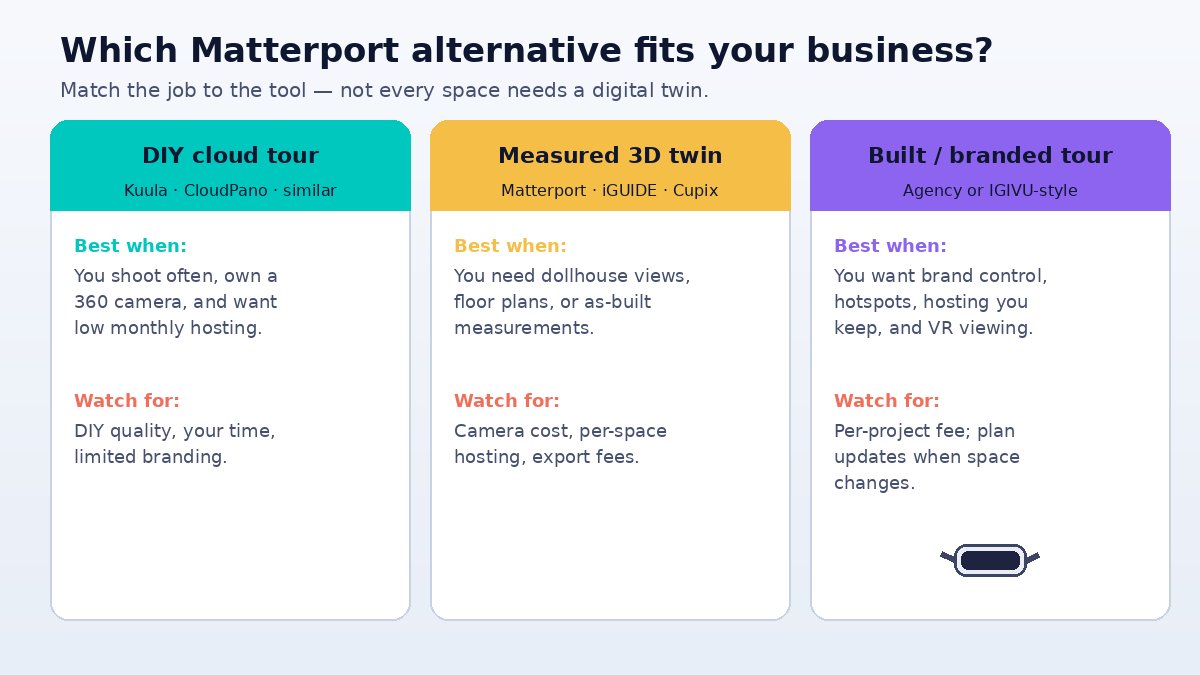
1. DIY cloud 360 platforms
Tools such as CloudPano, Kuula, and similar builders let you upload 360 photos, link scenes, add hotspots, and publish. Published plans often start in the low tens of dollars per month. They suit teams that already shoot with a Ricoh Theta, Insta360, or similar camera.
Best for: high listing volume and a subscription budget. Watch for: your team’s capture time, quality drift, and template-looking branding.
2. Measurement-first 3D and digital twin tools
iGUIDE, Cupix, Giraffe360, and Matterport itself compete when you need accurate floor plans, construction documentation, or a dollhouse view. iGUIDE sells per-project processing with its PLANIX camera; Cupix is common on construction and industrial sites with BIM integrations.
Best for: CRE due diligence, facilities docs, and AEC progress capture. Watch for: proprietary cameras and hosting or export fees that grow with portfolio size.
3. Done-for-you branded virtual tour services
A virtual tour company photographs or scans your space, builds hotspots and navigation, and hosts a branded player. You do not buy a camera or learn authoring software.
IGIVU’s approach is end-to-end: 360° HDR capture, stitching, custom UI, branded hotspots, hosting, and deployment on browsers plus VR headsets such as Meta Quest 2, Meta Quest 3, and Apple Vision Pro. Typical delivery is 7–14 days, or 2–4 weeks for larger multi-facility projects.
Best for: hotels, assisted living, showrooms, industrial sites, campuses, and event venues that need a few flagship tours. Watch for: per-project pricing if you need 50+ self-serve tours a month.
How do Matterport alternatives compare for business use?
| Option type | Typical cost shape | Strength | Weak spot for businesses |
|---|---|---|---|
| DIY cloud 360 (CloudPano, Kuula, etc.) | Monthly subscription | Cheap at volume | Your time and quality control |
| Measured 3D twin (Matterport, iGUIDE, Cupix) | Hardware + plan or per project | Dollhouse and floor plans | Cost and lock-in at portfolio scale |
| Desktop builders (3DVista, Pano2VR) | One-time license; you host | Full branding and ownership | Steep learning curve |
| Done-for-you branded tour (agency / IGIVU) | Fixed project fee | Brand control + optional VR deploy | Higher per-tour cost than DIY alone |
Software roundups from CloudPano, Virtuance, Moraine CRE, and agencies such as Photoplan cover DIY tools well. Many still skip headset viewing for live sales demos — a gap when you pitch a facility in person, not only on a listing site.
When should a business stay with Matterport?
Stay with Matterport when the dollhouse view and measured model are the product, buyers already expect that player, and you have budget for cameras plus active-space hosting. Commercial brokers still lean on it because prospects recognize the player and room-level analytics are useful.
If that workflow is paid for and working, do not switch for its own sake. Look elsewhere when branding, portfolio cost, data ownership, or VR event deployment become the bottleneck.
What should you look for in a Matterport alternative?
Before you buy software or hire a vendor, check:
- Audience and device — phone, laptop, Quest headset, or all three?
- Branding — your logo, colors, and CTAs that send leads to your form
- Ownership and hosting — who keeps the files if you cancel, and can you embed or share a QR code for years?
- Updates — can renovated rooms be replaced without a full rebuild?
- Measurements — do you need floor plans, or is a visual walkthrough enough?
- Support — on-site capture team, or are you fine shooting alone?
How much do Matterport alternatives cost?
Published DIY plans in 2026 often start around $12–$50 per month for basic 360 hosting. Measured systems add camera hardware or per-project fees. Professional capture for commercial spaces commonly runs from a few hundred dollars for a small suite to several thousand for hotels, campuses, and large venues.
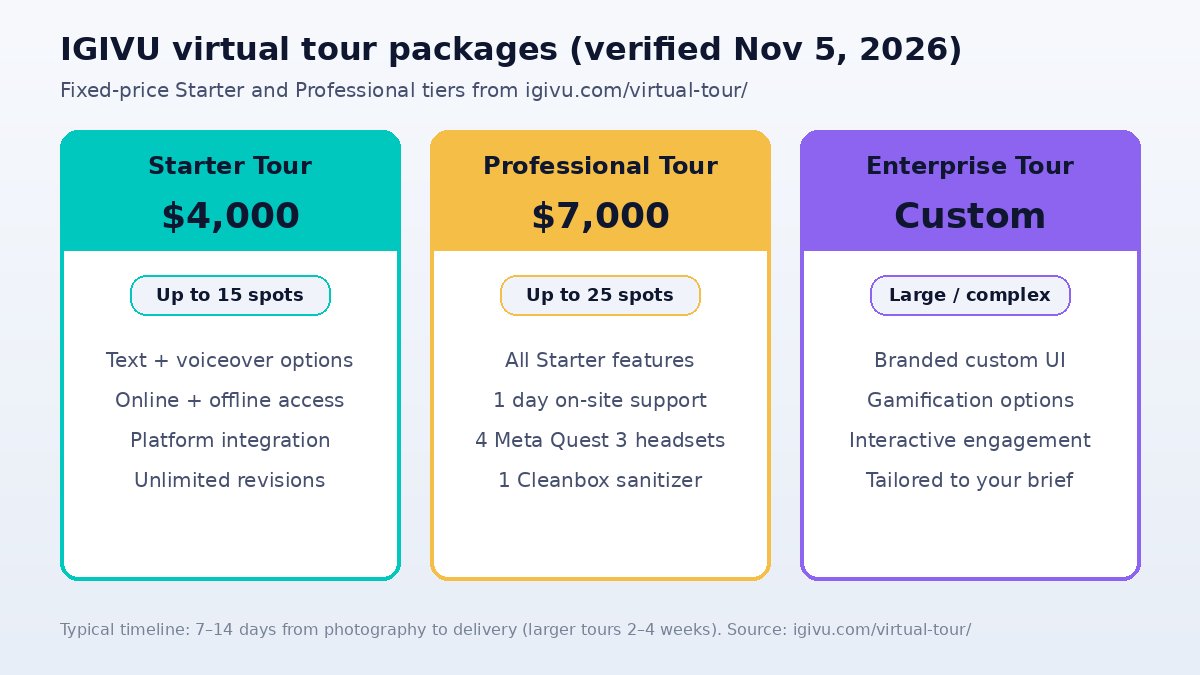
IGIVU publishes fixed packages on its virtual tour page (verified November 5, 2026):
- Starter Tour — $4,000 for up to 15 spots, with text and voiceover options, online and offline access, platform integration, and unlimited revisions.
- Professional Tour — $7,000 for up to 25 spots, including Starter features plus one day of on-site support, four ready-to-use Meta Quest 3 headsets, and one Cleanbox sanitizing system.
- Enterprise Tour — custom quote for branded interfaces, gamification, and larger facilities.
For a deeper pricing breakdown across the market, see IGIVU’s guide: How much does a virtual tour cost in 2026?
Do Matterport alternatives work in VR headsets?
Most DIY 360 players are browser-first. Few are packaged as a turnkey headset experience for a live event. If you run investor walkthroughs, campus open houses, hotel sales days, or public groundbreakings, ask whether the vendor can preload the tour on Meta Quest or Apple Vision Pro and staff the activation.
In late 2026 Meta is focusing new Horizon OS features on Quest 3 and Quest 3S (Quest 2 and Quest Pro get their final major feature update in early 2027), so plan business headset viewing on current Quest 3 / 3S hardware. IGIVU’s Professional Tour package includes four Meta Quest 3 headsets and on-site support; larger fleets are available through Meta Quest rentals and VR headset rentals.
Which industries get the most from a branded virtual tour?
IGIVU builds tours for real estate, assisted living, commercial and industrial spaces, hospitality, showrooms, campuses, and event venues. The pattern is the same: the space is hard to visit for every prospect, so a phone or headset tour shortens the sales cycle.
Example: for the City of Santa Monica’s Big Blue Bus groundbreaking (April 2026), IGIVU delivered a 360° tour with information tags plus a WebAR charging-station experience — no app download required. The tour remains public after the event.
How do you choose the right Matterport alternative in five steps?
- Write the job to be done. Pre-qualifying a warehouse for out-of-town tenants is a different brief than putting every listing online with a 3D tour.
- Decide if measurements are mandatory. If yes, shortlist measured twins. If no, DIY or branded 360 is usually enough.
- Count annual tours. High volume favors DIY capture. One to twenty flagship tours a year usually favors a done-for-you service.
- Check branding and CTAs. Open a sample on your phone. Can a prospect request a quote without leaving?
- Ask about headset and updates. Get VR deployment and scene-update pricing in writing.
FAQ: Matterport alternatives for businesses
What is the best Matterport alternative for commercial real estate?
There is no single winner. For measured twins, Matterport, iGUIDE, and peers still lead. For branded marketing tours with white-label players, CloudPano and done-for-you agencies are common. Choose by measurements, volume, or brand control.
Is CloudPano a good Matterport alternative?
Yes for DIY hosting, white labeling, and features such as live video chat inside a 360 tour. It is not a full replacement for Matterport’s measured digital twin. Pair it with strong photography if image quality matters.
Do I need a Matterport camera to create a virtual tour?
No. Many alternatives work with consumer 360 cameras, smartphones, or a vendor’s capture kit. Done-for-you services bring their own gear, so you do not buy hardware.
Can I switch from Matterport without losing my tours?
Plan a migration. Export what you can, rebuild critical properties on the new host, and keep high-traffic Matterport links live until the replacement is embedded everywhere you share it.
How long does a professional virtual tour take?
IGIVU’s typical timeline is 7–14 days from photography to delivery. Larger multi-facility projects often take 2–4 weeks. Get the timeline in writing before capture day.
Are virtual tours worth it for businesses in 2026?
Yes when remote decision-makers need to understand a space before they travel. Use embeds, QR codes, sales emails, and headset demos. They help less if every buyer already visits in person.
Get a branded virtual tour quote in under 24 hours
IGIVU is a nationwide XR company headquartered in Dallas that has served 3,000+ organizations with VR/AR rentals, AR services, virtual tours, and VR safety training. For a branded Matterport alternative ready for web, mobile, and VR headsets, email [email protected] — quotes in under 24 hours. Start on the virtual tour services page or contact page.