Why Medical Institutions Choose VR Rental Over Purchasing Surgical Training Systems
Medical schools and teaching hospitals face a $50,000-$200,000 decision when evaluating surgical training platforms. VR rental eliminates this capital risk while delivering the same immersive training outcomes – here’s how leading programs use rental models to validate ROI before committing to purchases.
Capital Risk vs. Operational Flexibility in Medical Education Budgets
Traditional surgical simulation labs represent significant capital investments that strain medical education budgets. A comprehensive simulation center typically requires:
- Hardware costs: $30,000-$150,000 per high-fidelity mannequin simulator
- Software licensing: $10,000-$50,000 annually per specialty module
- Maintenance contracts: 10-15% of equipment value yearly
- Facility modifications: $25,000-$100,000 for dedicated simulation space
- Technical support staff: $60,000-$80,000 annual salary per FTE
Medical institutions operate within complex funding cycles that complicate major purchases. Federal training grants require 12-18 month application processes. Hospital capital committees meet quarterly, creating delays between identification of training needs and equipment acquisition. State funding for public medical schools fluctuates with legislative sessions, making multi-year commitments challenging.
VR rental bridges these funding gaps through operational expense models. Programs convert $200,000 capital requests into $2,000-$5,000 monthly operating expenses, bypassing lengthy approval processes. Rental agreements align with academic calendars, allowing termination during summer breaks or curriculum transitions. This flexibility proves especially valuable during accreditation preparation, when programs need temporary capacity expansion without permanent infrastructure changes.
Grant-funded pilot programs particularly benefit from rental models. A typical NIH medical education research grant provides $250,000-$500,000 over 2-3 years. Purchasing equipment consumes 40-60% of these funds immediately, limiting resources for personnel and evaluation. Rental preserves capital for research activities while providing access to cutting-edge training technology.
Scaling Surgical Training Programs: From 5-Student Pilots to 50-Resident Rollouts
Successful VR surgical training implementations follow predictable scaling patterns. Programs begin with focused pilots targeting specific competencies within single specialties, then expand based on measured outcomes.
Phase 1: Specialty-Specific Pilot (Months 1-6)
- Select high-volume procedure with clear performance metrics
- Deploy 5-10 VR headsets for targeted resident group
- Establish baseline competency measurements
- Track time-to-proficiency improvements
- Document faculty acceptance and integration challenges
Orthopedic programs often start with arthroscopic knee procedures, where VR simulation closely mimics actual surgical conditions. General surgery residencies typically begin with laparoscopic cholecystectomy modules, leveraging established proficiency benchmarks. Neurosurgery pilots focus on tumor resection planning, where 3D visualization provides unique training value.
Phase 2: Validated Expansion (Months 7-12)
- Increase headset deployment to 15-25 units
- Add complementary procedures within same specialty
- Integrate VR sessions into formal curriculum
- Develop assessment rubrics aligned with ACGME milestones
- Generate preliminary ROI data for administration
Phase 3: Multi-Specialty Rollout (Year 2+)
- Scale to 50+ headsets across multiple departments
- Establish centralized VR simulation lab
- Implement scheduling systems for equipment sharing
- Create faculty development programs
- Transition high-performing modules to purchased equipment
This phased approach minimizes risk while building institutional support. Programs demonstrating 30-40% improvements in technical skill assessments secure funding for permanent installations. Failed pilots terminate cleanly without stranded assets or political complications.
Surgical Training Software Platforms Available Through VR Rental
Not all VR surgical simulators require institutional purchases. These platforms offer flexible licensing models compatible with rental hardware, allowing programs to access premium training content without long-term contracts.
Procedure-Specific Training Modules
Modern VR surgical training platforms provide comprehensive procedure libraries covering multiple specialties. Content ranges from basic skills training to complex operative scenarios, with varying fidelity levels appropriate for different training stages.
Laparoscopic Surgery Simulators
Leading platforms offer 20-30 laparoscopic procedures with haptic feedback integration. Fundamental skills modules teach camera navigation, tissue manipulation, and suturing techniques. Advanced scenarios simulate complete procedures including:
- Cholecystectomy with normal and variant anatomy
- Appendectomy with complications
- Hernia repair (inguinal, ventral, hiatal)
- Colorectal resections
- Bariatric procedures (gastric bypass, sleeve gastrectomy)
Haptic controllers provide force feedback mimicking tissue resistance, critical for developing appropriate tissue handling techniques. Assessment algorithms track instrument path length, economy of motion, and task completion times against expert benchmarks.
Orthopedic Procedure Simulations
Orthopedic modules emphasize spatial reasoning and precision drilling techniques. Available procedures include:
- Total knee arthroplasty with implant sizing decisions
- Total hip replacement via anterior and posterior approaches
- Fracture reduction and fixation (femur, tibia, radius)
- Arthroscopic procedures for knee, shoulder, hip
- Spinal fusion and decompression techniques
These simulations incorporate fluoroscopy interpretation, allowing residents to practice minimizing radiation exposure while maintaining surgical accuracy. Bone density variations and patient-specific anatomy from CT data create realistic training scenarios.
Cardiovascular Interventions
Catheter-based procedure simulators teach wire navigation and device deployment without radiation exposure. Training modules cover:
- Diagnostic coronary angiography
- Percutaneous coronary intervention with stent placement
- Structural heart procedures (TAVR, MitraClip)
- Peripheral vascular interventions
- Electrophysiology procedures and ablations
Physics engines accurately model guidewire behavior and vessel deformation. Complication scenarios include vessel perforation, dissection, and no-reflow phenomena, preparing residents for adverse events.
Neurosurgical Planning Scenarios
Neurosurgery modules focus on 3D anatomical understanding and approach planning. Available simulations include:
- Brain tumor resection with tractography visualization
- Aneurysm clipping approaches
- Ventriculostomy placement
- Spinal tumor excision
- Functional neurosurgery targeting
Patient-specific imaging integration allows rehearsal of actual scheduled cases. Residents practice optimal trajectory planning while avoiding eloquent structures, improving operative efficiency and safety.
Assessment and Competency Tracking Features
VR surgical training platforms provide objective performance measurement impossible with traditional training methods. Automated assessment eliminates inter-rater variability while generating detailed analytics for competency documentation.
Performance Metrics Collection
Systems capture granular data throughout training sessions:
- Instrument tip trajectory and path length
- Force application patterns and tissue damage scores
- Time allocation across procedural steps
- Error frequency and type classification
- Dominant vs. non-dominant hand coordination
- Head movement and visual attention patterns
Machine learning algorithms compare trainee performance against expert databases, identifying specific deficiencies requiring targeted practice. Real-time feedback during procedures reinforces proper technique without faculty intervention.
Progress Tracking Across Cohorts
Administrative dashboards display resident progression through curriculum milestones. Program directors monitor:
- Individual learning curves with plateau identification
- Cohort performance distributions
- Time-to-competency achievements
- Practice frequency and duration patterns
- Correlation between VR metrics and clinical evaluations
Predictive analytics identify residents at risk of falling behind milestone expectations, enabling early intervention. Comparative benchmarking against national databases demonstrates program effectiveness for accreditation reviews.
System Integration Capabilities
Modern platforms integrate with existing medical education infrastructure:
- Direct data export to New Innovations, MedHub, and other residency management systems
- Automated competency attestation for ACGME milestone reporting
- LMS grade passback for curriculum credit
- SCORM compliance for content packaging
- API access for custom analytics development
Single sign-on authentication simplifies access while maintaining security compliance. Role-based permissions ensure appropriate data visibility for residents, faculty, and administrators.
Implementation Timeline: Launching VR Surgical Training in 30 Days
Unlike traditional simulation labs requiring 6-12 months of planning, VR rental enables rapid deployment of surgical training programs. Here’s the accelerated timeline medical educators follow.
Week 1-2: Needs Assessment and Platform Selection
Successful implementations begin with systematic evaluation of training gaps and available solutions. Program leadership conducts focused needs assessment through multiple channels.
Stakeholder Surveys and Interviews
Residency program directors distribute structured questionnaires identifying:
- Procedures with highest learning curves
- Current training bottlenecks and OR availability constraints
- Faculty comfort with simulation technologies
- Resident preferences for self-directed learning tools
- ACGME milestone areas requiring improvement
Focus groups with chief residents reveal practical considerations like scheduling preferences and space availability. Faculty champions emerge who will drive adoption post-implementation.
Content Library Evaluation
Programs review available procedure modules against curriculum requirements:
- Map VR content to rotation objectives
- Verify anatomical accuracy and procedural fidelity
- Assess haptic feedback quality for manual skills
- Evaluate assessment metrics against competency frameworks
- Confirm case variety for repeated practice
Platform demonstrations allow hands-on evaluation by key faculty. Side-by-side comparisons identify best-fit solutions for specific specialties.
Success Metrics Definition
Clear outcome measures guide implementation and justify continued investment:
- Technical skill score improvements on validated assessments
- Reduction in time to achieve competency milestones
- Decreased error rates in initial clinical procedures
- Faculty time savings from automated training
- Resident satisfaction with training resources
Baseline data collection begins immediately, establishing pre-implementation performance levels for comparison.
Week 3-4: Hardware Configuration and Space Planning
Technical deployment requires coordination between medical education, IT, and facilities teams. Systematic planning prevents implementation delays and ensures sustainable operations.
Equipment Specification and Setup
Hardware selection balances performance requirements with budget constraints:
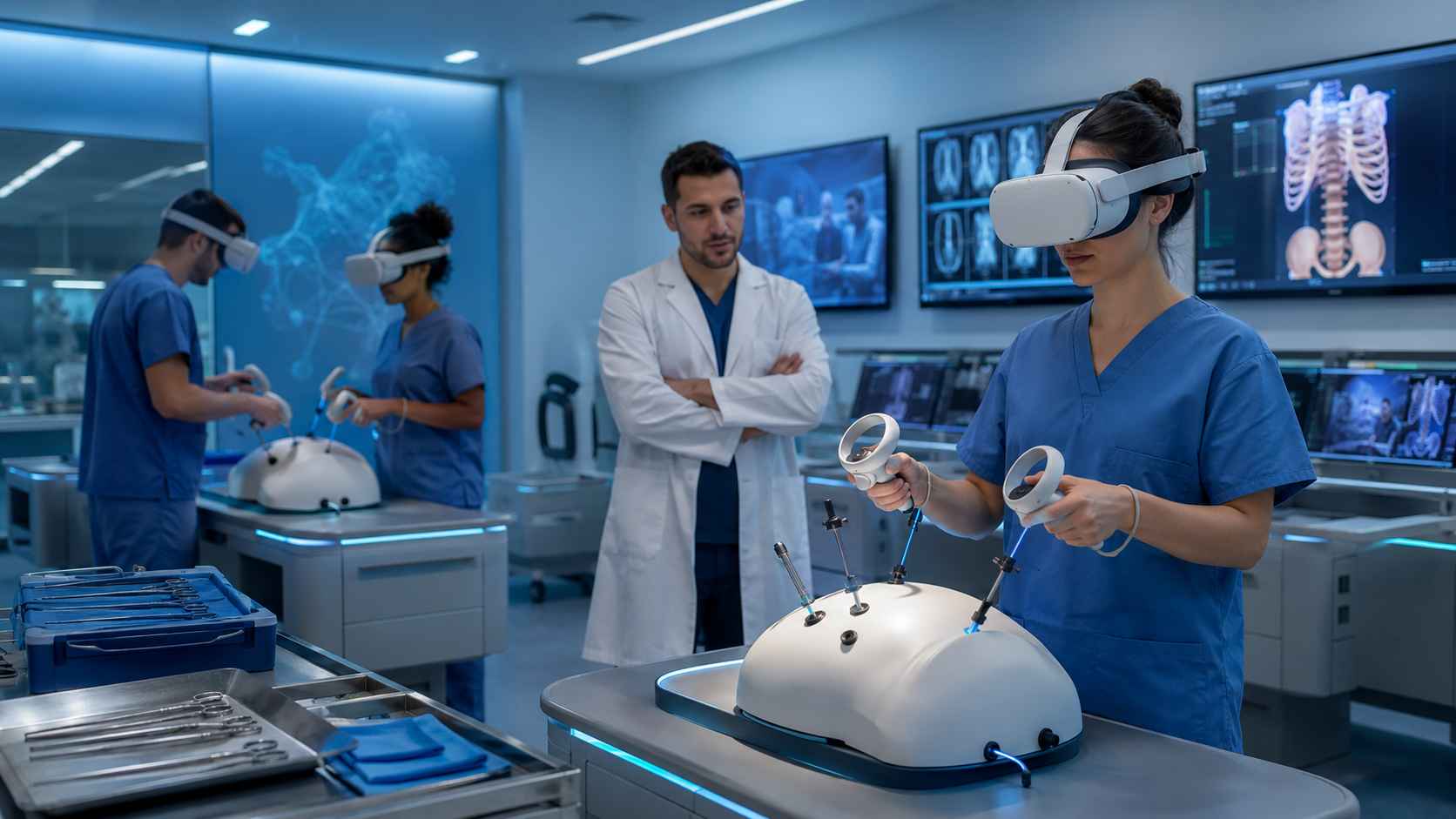
- Standalone headsets (Quest 2/3, Pico 4): Simplified deployment, lower cost, limited graphics
- PC-tethered systems (HTC Vive Pro, Varjo Aero): Maximum fidelity, haptic support, higher complexity
- Hybrid configurations: Standalone for basic skills, tethered for advanced procedures
Standard deployments include:
- 1 headset per 3-4 residents for adequate access
- Haptic controllers for procedures requiring force feedback
- Boundary marking systems for safety
- Charging stations and cable management
- Backup equipment (10-15% of primary inventory)
Physical Space Configuration
VR training areas require specific environmental considerations:
- Minimum 6×6 feet clear space per station
- Overhead cable management for tethered systems
- Adjustable height chairs for seated procedures
- Sound dampening between stations
- Adequate ventilation for extended use
- Lockable storage for equipment security
Multi-user spaces benefit from central monitoring stations where instructors observe multiple trainees simultaneously. Modular furniture allows rapid reconfiguration between individual and team training scenarios.
Network Infrastructure Validation
IT departments verify technical requirements:
- Bandwidth: 50-100 Mbps per concurrent user for cloud content
- Latency: <20ms for responsive haptic feedback
- Wi-Fi 6 coverage for wireless headsets
- Firewall exceptions for platform services
- Local caching servers for frequently accessed content
Security reviews ensure HIPAA compliance when patient data integration is planned. Network segmentation isolates VR systems from clinical networks while maintaining necessary connectivity.
Safety and Hygiene Protocols
Shared VR equipment requires systematic cleaning procedures:
- Disposable face cushions or wipeable silicone covers
- UV-C sanitization stations between users
- Lens cleaning supplies and microfiber cloths
- Hand sanitizer stations at entry/exit
- Posted protocols for equipment handling
- Incident reporting procedures for motion sickness or falls
Staff training covers proper fitting, interpupillary distance adjustment, and troubleshooting common issues. Clear signage prevents unauthorized access and ensures appropriate use.
Cost Comparison: VR Rental vs. Traditional Surgical Simulation Labs
A single high-fidelity mannequin simulator costs $30,000-$150,000. VR rental delivers comparable training outcomes at 10% of the investment – here’s the detailed cost analysis medical administrators use to justify programs.
Monthly Rental Costs for Medical Training Programs
VR rental pricing scales with deployment size and service levels, providing predictable operational expenses aligned with training volumes.
Hardware Rental Tiers
- Small pilot (5-10 headsets): $150-$250 per headset monthly
- Department deployment (15-25 headsets): $125-$200 per headset monthly
- Institution-wide (50+ headsets): $100-$150 per headset monthly
- Haptic controllers: Additional $50-$75 per unit monthly
- High-end workstations: $200-$400 monthly when required
Volume discounts reduce per-unit costs by 20-40% for large deployments. Academic pricing provides additional 15-25% reductions for qualified institutions.
Software Licensing Models
Platform access follows various pricing structures:
- Per-user licenses: $50-$150 monthly per resident
- Concurrent user model: $500-$1,500 monthly per simultaneous user
- Site licenses: $2,000-$10,000 monthly for unlimited users
- Module-based pricing: $200-$500 monthly per procedure type
- Academic bundles: $5,000-$15,000 annually for comprehensive libraries
Cloud-based platforms eliminate server infrastructure costs while enabling remote access. Locally hosted options provide greater control but require IT resources.
Support Service Packages
- Basic support: Email/ticket system, 24-48 hour response, self-service resources
- Standard support: Phone support, same-day response, quarterly check-ins
- Premium support: Dedicated account manager, 2-hour response, on-site visits
- White-glove service: Full management, curriculum integration, faculty training
Support packages add 20-30% to base rental costs but significantly improve adoption rates and user satisfaction.
Total Cost Comparison
25-resident surgical program comparison over 3 years:
- Traditional lab: $400,000 equipment + $150,000 maintenance = $550,000
- VR purchase: $125,000 hardware + $90,000 software = $215,000
- VR rental: $4,000 monthly x 36 months = $144,000
Rental provides 74% cost reduction versus traditional labs, 33% savings compared to VR purchase, with no disposal costs or technology obsolescence risk.
ROI Metrics That Justify Continued Investment
Quantifiable outcomes demonstrate VR training value beyond cost savings, supporting sustained funding through measurable improvements in clinical performance and educational efficiency.
Clinical Competency Improvements
Programs track objective skill enhancements:
- 35-45% reduction in task completion times for trained procedures
- 40-50% decrease in technical errors during skills assessments
- 25-30% improvement in economy of motion metrics
- 20-25% reduction in learning curve for new procedures
- 30-40% better retention of skills at 6-month follow-up
Translated to clinical practice, VR-trained residents demonstrate:
- 18-22% reduction in operative time for index procedures
- 15-20% lower complication rates in first 10 independent cases
- 25-30% fewer assist requests during procedures
- Improved confidence scores on self-assessments
- Higher faculty evaluations for technical skills
Educational Efficiency Gains
Faculty time represents hidden training costs:
- Traditional skills lab: 1:4 faculty-to-resident ratio, 2 hours per session
- VR training: 1:12 ratio with automated assessment, 30 minutes oversight
- Faculty time savings: 75% reduction, ~$500 per training session
- Annual savings for 50-resident program: $100,000-$150,000
Automated assessment eliminates grading burden while providing richer performance data. Faculty redirect saved time toward complex case discussions and clinical mentoring.
Grant Funding Success
Pilot data from rental deployments strengthens funding applications:
- Programs with VR pilot data show 3x higher grant success rates
- Average award size increases 40-60% with preliminary outcomes
- Time to funding decreases by 6-12 months
- Multi-site collaboration opportunities expand with proven platforms
Published outcomes from rental pilots support permanent funding requests, converting operational expenses to capital investments once value is demonstrated.
Case Studies: Medical Schools Using VR Rental for Surgical Training
These institutions launched successful surgical training programs through rental models, generating the evidence needed to secure permanent funding.
Regional Medical Center: Orthopedic Residency Program
Midwest Regional Medical Center’s orthopedic residency program faced declining arthroscopy case volumes due to shift toward office-based procedures. The 12-resident program needed alternative training methods to maintain ACGME case log requirements.
Implementation Strategy
The program initiated a 6-month VR rental pilot focused on knee and shoulder arthroscopy:
- Deployed 8 Quest 2 headsets with haptic controllers
- Selected ArthroS simulator for procedural accuracy
- Established twice-weekly mandatory VR lab sessions
- Integrated assessments into rotation evaluations
Total monthly cost: $3,200 including hardware, software, and support.
Measured Outcomes
Pre/post assessments using validated arthroscopy skills tests showed:
- 43% improvement in camera navigation scores
- 38% reduction in cartilage damage during practice
- 52% decrease in time to complete diagnostic arthroscopy
- 91% resident satisfaction with training modality
Clinical outcomes in first 20 post-training cases:
- 22% reduction in procedure time
- Zero incidents of iatrogenic cartilage injury
- Attending takeover rate decreased from 15% to 5%
Funding Success
Pilot data supported successful $180,000 simulation lab grant from hospital foundation. Program purchased 12 VR stations plus high-fidelity arthroscopy tower, maintaining rental units for overflow capacity during interview season.
University Teaching Hospital: Multi-Specialty Implementation
State University Teaching Hospital deployed VR surgical training across four residency programs, creating shared simulation resources serving 250 residents.
Phased Rollout Strategy
- Months 1-6: General surgery laparoscopy pilot (30 residents, 10 headsets)
- Months 7-12: Added orthopedics and neurosurgery (80 residents, 25 headsets)
- Months 13-18: Integrated OB/GYN and urology (140 residents, 40 headsets)
- Month 19+: Full deployment (250 residents, 60 headsets)
Resource Optimization
Centralized VR lab with scheduling system maximized equipment utilization:
- Online booking platform with specialty-specific time blocks
- 6am-10pm operating hours accommodating resident schedules
- Peer tutoring program reducing faculty oversight needs
- Monthly utilization rate: 78% during peak periods
Comprehensive Outcomes
18-month aggregated results across specialties:
- 2,847 VR training sessions completed
- 34% average improvement in technical skills assessments
- $240,000 faculty time savings
- 94% resident satisfaction scores
- 12 peer-reviewed publications generated
Hybrid Ownership Model
Based on utilization data, hospital transitioned to optimized configuration:
- Purchased 30 high-use stations for core curriculum
- Maintained 30 rental units for surge capacity
- Established equipment refresh cycle every 24 months
- Annual savings: $85,000 versus full purchase model
Technical Requirements for VR Surgical Training Deployment
Medical IT departments need specific assurances before approving VR installations. These technical specifications address common concerns about security, compatibility, and support.
HIPAA Compliance and Data Security
Healthcare privacy regulations require careful consideration of data handling within VR training systems. Compliance strategies vary based on content type and deployment model.
Data Classification and Storage
VR surgical training generates multiple data types with varying sensitivity:
- Performance metrics: Generally not PHI, stored locally or cloud
- Anatomical models: De-identified data acceptable for training
- Patient-specific rehearsals: PHI requiring full HIPAA compliance
- Video recordings: May contain identifiable information
- Assessment records: Educational records under FERPA
Local storage on encrypted drives provides maximum control for sensitive data. Cloud platforms with BAA agreements enable scalability while maintaining compliance. Hybrid approaches store PHI locally while leveraging cloud compute for rendering.
Access Controls and Authentication
Multi-layered security prevents unauthorized access:
- Single sign-on integration with institutional directories
- Multi-factor authentication for administrative functions
- Role-based permissions (resident, faculty, administrator)
- Session timeouts and automatic logoff
- Device-level PIN codes for shared headsets
Audit logs track all system access, content viewing, and configuration changes. Automated reports identify unusual usage patterns requiring investigation.
Network Security Requirements
VR systems require network connectivity while maintaining security:
- Isolated VLAN for VR equipment traffic
- Encrypted connections (TLS 1.2 minimum) for all data transfer
- Whitelist-only firewall rules for required services
- Regular security patches and firmware updates
- Vulnerability scanning before production deployment
Air-gapped configurations support maximum security for sensitive applications, though limiting functionality and increasing management complexity.
Integration with Medical Education Systems
Seamless integration with existing educational technology maximizes VR training value while minimizing administrative burden.
Learning Management System Connectivity
Direct LMS integration enables:
- Automatic enrollment based on rotation assignments
- Grade passback for completed modules
- Assignment creation and due date tracking
- Discussion forums for case debriefs
- Resource libraries for supplementary materials
Major platforms support Canvas, Blackboard, Moodle through LTI standards. Custom integrations via API accommodate proprietary systems.
Residency Management Platform Synchronization
Bidirectional data exchange streamlines administration:
- Milestone achievement documentation from VR assessments
- Procedure log updates for simulated cases
- Evaluation form population with performance metrics
- Schedule integration for simulation lab reservations
- Dashboard widgets displaying training progress
New Innovations, MedHub, and ACGME WebADS connections eliminate duplicate data entry while ensuring accurate competency tracking.
Clinical Systems Interoperability
Advanced implementations connect training with clinical operations:
- PACS integration for patient-specific rehearsal
- OR scheduling systems for case preparation
- Electronic health records for outcome correlation
- Credentialing databases for privileging decisions
- Quality databases for performance improvement
HL7 FHIR standards enable modern integrations while maintaining security and privacy requirements.
Frequently Asked Questions
How many VR headsets do we need for a surgical residency program?
Calculate requirements based on resident numbers and training frequency. General formula: Total residents ÷ 4 = minimum headsets needed. This assumes each resident trains 2 hours weekly with 75% equipment utilization. Larger programs benefit from 1:3 ratios, enabling flexible scheduling and equipment maintenance windows. Consider peak usage during orientation and interview seasons when determining inventory.
Can VR surgical training replace cadaver labs?
VR complements but doesn’t fully replace cadaver training. VR excels at procedure repetition, anatomical variation exploration, and complication management scenarios impossible with cadavers. Cadaver labs remain valuable for tissue handling experience and anatomical dissection. Hybrid curricula using VR for initial learning and cadavers for validation show optimal outcomes. Programs report 40-60% reduction in cadaver requirements when VR supplements training.
What’s the learning curve for faculty who’ve never used VR?
Faculty achieve basic proficiency within 2-3 hours of structured training. Initial sessions cover headset operation, navigation controls, and student monitoring tools. Advanced features like custom scenario creation require additional 4-6 hours. Peer mentoring accelerates adoption – identify tech-savvy faculty champions for colleague support. Vendors typically provide 8-16 hours of included training with rental agreements.
How do we clean and maintain VR equipment in clinical settings?
Establish systematic cleaning protocols using EPA-approved disinfectants safe for electronics. Disposable hygiene barriers provide primary protection, with full disinfection between users. UV-C sanitization cabinets offer rapid turnaround for high-use equipment. Lens cleaning requires special non-abrasive materials. Schedule monthly deep cleaning and inspection. Rental agreements typically include maintenance and replacement for normal wear.
Which surgical specialties have the most developed VR training content?
General surgery leads with 50+ laparoscopic procedures available. Orthopedics offers 30+ procedures focusing on arthroscopy and joint replacement. Neurosurgery provides 20+ scenarios emphasizing planning and approach selection. Cardiac surgery and interventional cardiology catalogs expand rapidly. OB/GYN, urology, and ENT show growing libraries. Evaluate content roadmaps when selecting platforms, as development pace varies significantly.
Can residents access VR surgical training remotely?
Standalone headsets enable home-based training for self-directed learning. Cloud-based platforms support remote access with appropriate bandwidth. Institutions establish equipment loan programs with agreements covering liability and maintenance. Remote training shows high engagement for schedule flexibility but lower completion rates without structure. Hybrid models combining on-site group sessions with remote practice optimize outcomes.
How do we measure competency improvement from VR training?
Validated assessment tools translate VR performance to clinical competency predictions. Pre/post training evaluations using FLS, GOALS, or specialty-specific instruments quantify improvement. Learning analytics dashboards track progression curves and plateau identification. Clinical correlation studies compare VR metrics with OR performance evaluations. Longitudinal tracking through residency demonstrates skill retention and transfer. Publication-ready data emerges within 6-12 months of implementation.
Conclusion
VR rental solutions eliminate the traditional barriers preventing surgical training programs from accessing advanced simulation technology. Medical educators can deploy comprehensive training platforms within 30 days, validate educational outcomes through pilot programs, and scale successful implementations without capital risk. The rental model’s operational expense structure aligns with medical education budgets while providing flexibility to evolve with curriculum needs and technological advances.
Programs consistently demonstrate 35-45% improvements in technical skill assessments, 20-25% reductions in clinical procedure times, and substantial faculty time savings through VR training deployment. These measurable outcomes, combined with 70-90% cost reductions compared to traditional simulation labs, create compelling ROI justification for continued investment or transition to permanent installations.
The pathway from pilot to program is clear: start with focused specialty deployment, measure competency improvements, expand based on proven outcomes, and leverage success data for permanent funding. Leading institutions have validated this approach, transforming surgical education through accessible, scalable VR training solutions.
Ready to explore VR rental options for your surgical training program? Contact our medical education specialists for a customized deployment plan aligned with your curriculum objectives, budget constraints, and timeline requirements. Schedule a virtual demonstration to evaluate platform capabilities and discuss pilot program structures that generate the evidence needed for long-term investment decisions.