Falls are still the hazard OSHA cites most, and winter adds icy roofs, snow-covered skylights and slick ladders to the list. If you run a crew that works at height, you have probably asked whether VR fall protection training is worth it, and whether it counts toward OSHA’s training rules. This guide answers both questions honestly, explains what VR can and can’t replace, and shows what it costs to run.
Quick answer: VR fall protection training puts workers on virtual roofs, scaffolds, ladders and lifts so they can spot fall hazards and practice tie-off decisions with zero risk. It helps you meet OSHA’s training requirements for hazard recognition, but it doesn’t replace hands-on harness practice with a competent or qualified trainer. Most employers rent it for a Safety Day from $900 per headset.
What is VR fall protection training?
VR fall protection training is a headset-based simulation where workers walk through realistic work-at-height scenes and make safety decisions in real time. Instead of watching a video about an unguarded roof edge, they stand on one, look down, and have to decide what to do next.
A typical session puts each worker in a headset for a few short scenarios. Depending on the module, they might:
- Walk a jobsite or rooftop and flag hazards such as unguarded edges, open holes and covered skylights
- Spot problems on a scaffold, from missing guardrails to poor access
- Work from a mobile elevating work platform (aerial lift) and choose the right actions
- Experience the consequence of a bad choice, safely, so the lesson sticks
IGIVU’s Safety Day catalog includes Hazard Spotting – Work at Height, Hazard Spotting – Scaffolding, Work at Height – Mobile Elevating Working Platform and Awareness Training on the use of the Aerial Work Platform. There is also an AR Falls Prevention collection with five simulators for tablets and phones.
Why is fall protection training a priority right now?
Because falls are the most-cited OSHA violation, and winter brings more of them. Fall Protection – General Requirements (29 CFR 1926.501) topped OSHA’s preliminary FY2026 list for the 16th year running, with 4,041 violations, and Fall Protection – Training Requirements (1926.503) placed eighth with 1,273 (Safety+Health, OSHA).
The human cost is just as clear. In 2024, 389 of the 1,034 deaths in private-sector construction were falls, slips and trips, and 95.9% of those were falls to a lower level (BLS).
Then there’s the season. OSHA’s hazard alert on rooftop snow removal says falls cause the most worker deaths and injuries during that work, including falls off roof edges, through skylights and from ladders and aerial lifts (OSHA). It also notes that the maintenance workers who often do this job may have little training for it.
What does OSHA require for fall protection training?
OSHA requires training before anyone is exposed to a fall hazard, delivered by a competent person (construction) or qualified person (general industry), with retraining when skills or conditions change. Construction also requires a written certification record.
Here’s how the two main standards compare:
| Requirement | Construction (29 CFR 1926.503) | General industry (29 CFR 1910.30) |
|---|---|---|
| Who must be trained | Each employee who might be exposed to fall hazards | Each employee who uses personal fall protection or is required to be trained, before exposure |
| Who trains | A competent person | A qualified person |
| Core topics | Nature of fall hazards in the work area; erecting, inspecting and using fall protection systems; guardrails, PFAS, nets, warning lines, safety monitoring; fall protection plans | Recognizing fall hazards; procedures to minimize them; installing, inspecting and maintaining PFAS; hook-up, anchoring and tie-off |
| Records | Written certification with name, date(s) and trainer or employer signature | No specific certification record in 1910.30 |
| Retraining | When the workplace or equipment changes, or a worker shows gaps | Same triggers, plus training must be in a manner the worker understands |
Sources: 29 CFR 1926.503 and 29 CFR 1910.30.
Does VR fall protection training count for OSHA?
It can count as part of your training, but not all of it. OSHA has said that self-paced computer-based training alone doesn’t satisfy its training requirements unless it includes interactive and hands-on components and timely access to a qualified trainer (OSHA letter, 2019).
VR is far more interactive than a video, and a facilitator in the room answers the “ask a trainer” point. But fall protection has physical skills OSHA expects workers to practice with real gear: putting on and adjusting a harness, inspecting it, and hooking up to a real anchor. OSHA has even said PFAS training should simulate jobsite conditions as closely as reasonably possible (OSHA letter, 1995). So the honest answer is to use VR for hazard recognition and decisions, then finish with hands-on practice.
What can VR teach well, and what still needs hands-on practice?
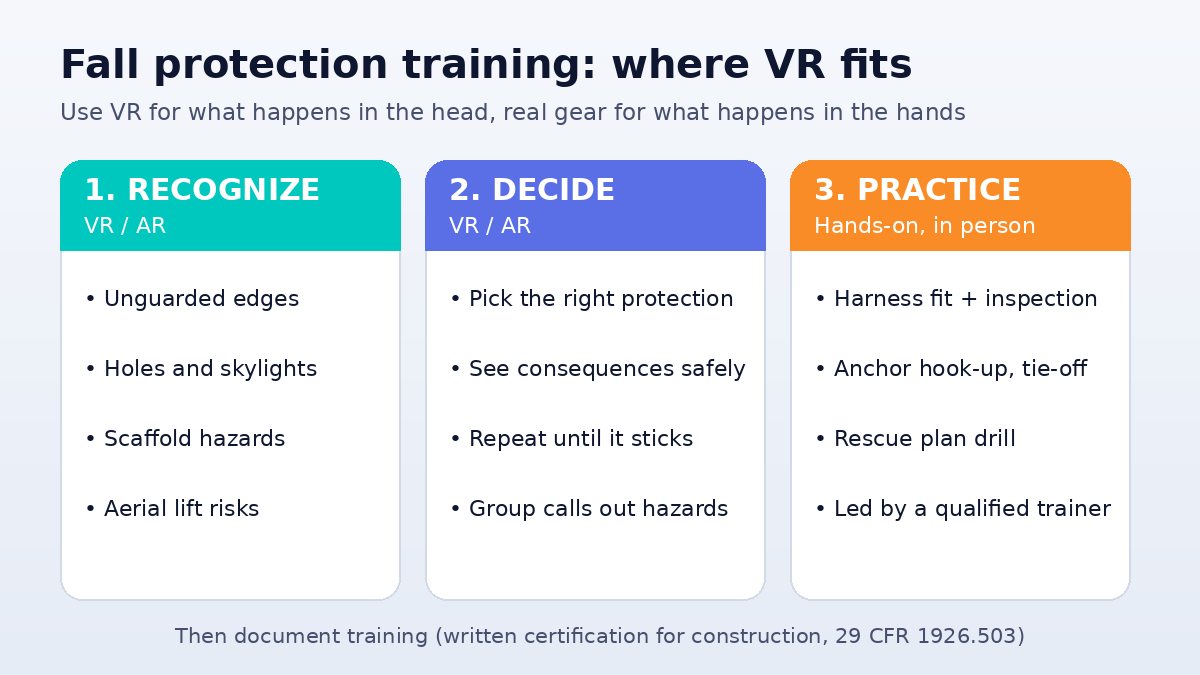
VR is strongest at the “recognize and decide” parts of fall training and weakest at the “touch and fit” parts. Split your program that way and each method does what it’s good at.
| Training element | VR or AR | Hands-on with real gear |
|---|---|---|
| Spotting unguarded edges, holes and skylights | Strong | Site walk adds local detail |
| Scaffold and aerial lift hazard awareness | Strong | Equipment-specific training still required |
| Feeling height and consequences safely | Strong (the reason VR exists) | Not possible without real risk |
| Choosing the right protection for a task | Good | Good |
| Harness donning, fit and inspection | Awareness only | Required |
| Anchor hook-up and tie-off on your site | Awareness only | Required |
| Rescue plan for a worker in a harness | Awareness only | Practice with your rescue equipment |
How do you run a VR fall protection session?
Most teams fold it into a Safety Day or a winter safety stand-down, with workers rotating through headsets in small groups. Here’s a format that works:
- Pick the scenarios. Match modules to your real exposure: roofs and skylights, scaffolds, ladders or aerial lifts.
- Brief for 5 minutes. Explain the hazards and the protection your site actually uses.
- Rotate through VR. Each worker runs a short scenario while others watch on a cast screen and call out hazards.
- Move to the gear station. Your competent or qualified person runs harness fit, inspection and tie-off with real equipment.
- Debrief and document. Discuss what people missed, then complete your written certification records.
IGIVU says a VR Safety Day usually runs 4 to 6 hours, setup takes about 30 to 45 minutes, and no one needs prior VR experience. Sessions can be scheduled across shifts and run on site in all 50 states (Safety Day).
How long is fall protection training good for?
OSHA doesn’t set a fixed expiration date for fall protection training. Instead, you must retrain when the workplace changes, the fall protection equipment changes, or a worker shows they no longer have the understanding or skill (1926.503(c)). Many employers set a regular refresher anyway, and a short VR session before winter roof work is an easy way to keep it fresh.
How much does VR fall protection training cost?
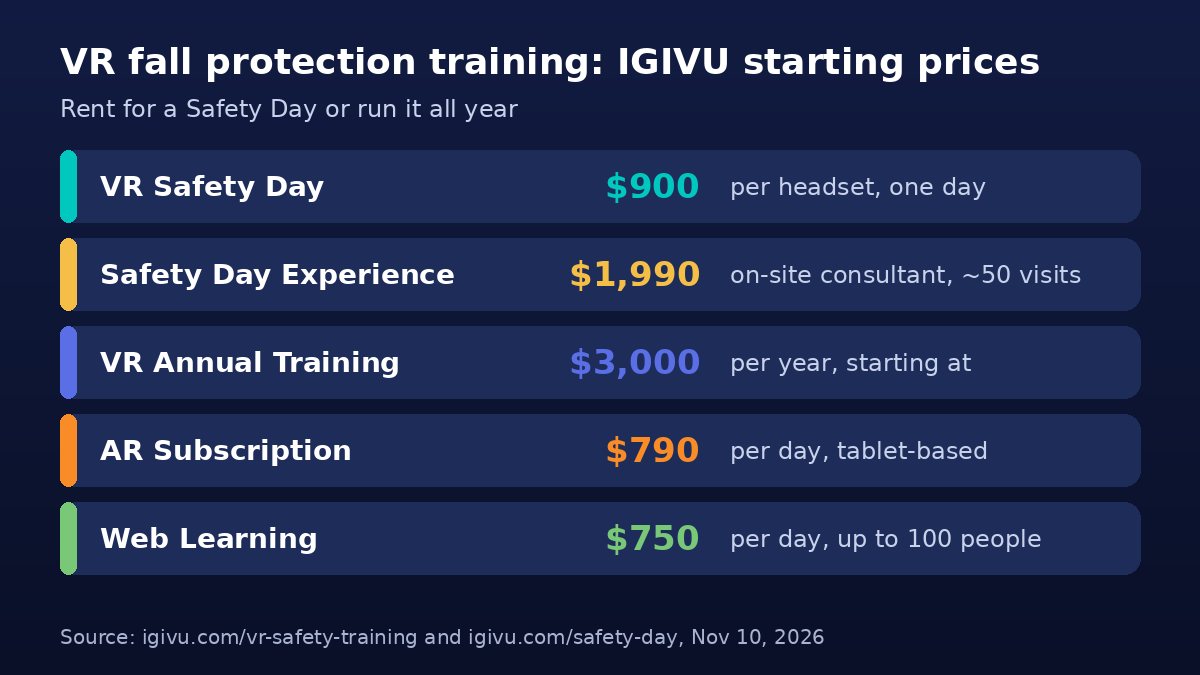
Renting is the low-cost way in. IGIVU’s VR Safety Day starts at $900 per headset for a day, and a full Safety Day Experience with an on-site consultant starts at $1,990.
| Option | Starting price | Best for |
|---|---|---|
| VR Safety Day (SafetyBox VR) | $900 per headset, one day | A self-run session at your site, unlimited passes that day |
| Safety Day Experience | $1,990 | A full-day event with an on-site technician or consultant, about 50 visits per consultant |
| VR Annual Training | From $3,000 per year | Onboarding and refreshers all year, 30+ VR experiences |
| AR Subscription | $790 per day | Tablet-based AR simulators, no headset |
| AR Safety Training | $100 per employee per month | Ongoing mobile training across sites |
| Web Learning | $750 per day | Browser access for up to 100 people |
Prices from IGIVU’s VR safety training and Safety Day pages, verified November 10, 2026. For a deeper look at what drives price, see our guide to VR safety training cost.
Should you rent or buy a VR fall protection simulator?
Rent if you train a few times a year; buy if you train every week. Renting gets you hardware, loaded content and support only for the days you need them, which suits most seasonal fall training. If your sites are unusual, custom VR content can recreate your own roofs or structures; IGIVU says custom safety content typically takes 4 to 8 weeks.
Who should use VR fall protection training?
Any team whose people work above the ground, even occasionally. That includes:
- Construction, roofing and scaffold crews
- Facilities and maintenance staff who clear snow, change lights or reach rooftop units
- Warehouse teams using aerial lifts, mezzanines and dock edges
- Manufacturing and utility workers on platforms and towers
For related programs, see our VR safety training use cases, our VR forklift training guide and our guide to OSHA VR training.
Frequently asked questions
Can fall protection training be done online or in VR only?
Not completely. OSHA says online training alone doesn’t meet its requirements unless it includes hands-on practice and timely access to a qualified trainer. Use VR or online modules for hazard recognition, then have a competent or qualified person run hands-on harness and tie-off practice.
Is fall protection training required annually?
OSHA doesn’t require a yearly class for fall protection. It requires training before exposure and retraining when the workplace changes, equipment changes, or a worker shows gaps in knowledge or skill. Many employers still schedule regular refreshers.
Who can conduct fall protection training?
In construction, a competent person qualified in the topics listed in 29 CFR 1926.503. In general industry, a qualified person under 29 CFR 1910.30. A VR facilitator can run the headsets, but your competent or qualified person should lead the hands-on portion.
What fall protection scenarios are available in VR?
IGIVU’s catalog includes work-at-height and scaffolding hazard spotting, mobile elevating work platform and aerial work platform awareness, and an AR Falls Prevention collection with five simulators. Modules are available in English and multiple languages.
How much does VR fall protection training cost?
Renting a VR Safety Day from IGIVU starts at $900 per headset for a day. A full Safety Day Experience with an on-site consultant starts at $1,990, and VR Annual Training starts at $3,000 per year.
How many workers can you train in one day?
IGIVU’s Safety Day programs handle 15 to 200 employees depending on the package, and the Safety Day Experience covers about 50 visits per consultant. Larger workforces can be covered with more headsets, multiple shifts or multi-day programs.
Get a VR fall protection training quote
IGIVU has served 3,000+ organizations with VR and AR rentals, safety training content and on-site support nationwide. Tell us your sites, headcount, shifts and the fall hazards your people face, and we’ll recommend scenarios and a package. Request a quote and you’ll hear back in under 24 hours, or email [email protected].