Peak season is here. Amazon says it is hiring more than 300,000 people for its U.S. operations this holiday season, and UPS says it is adding more than 100,000 seasonal workers (Amazon, UPS). Every warehouse that staffs up now has the same problem: more new people, more forklifts moving, and very little time to train.
That is why so many safety managers are looking at VR forklift training. This guide explains what VR can and can’t do under OSHA’s forklift rule, what it should cover, what it costs, and how to fit it into a busy peak-season schedule.
Quick answer: VR forklift training uses a headset to teach inspections, load handling and hazard spotting in a simulated warehouse. It can cover OSHA’s formal-instruction requirement and help trainees prepare for hands-on practice, but it can’t replace hands-on practice and the workplace evaluation on a real truck. Use VR to prepare people, then evaluate them on the forklift.
What is VR forklift training?
VR forklift training puts a trainee in a virtual warehouse where they can make mistakes, like a tip-over or a near miss with a pedestrian, without anyone getting hurt. It comes in two main forms.
- Operator simulators. A headset paired with a steering wheel, pedals or a seat that mimics the truck’s controls. These teach how to drive and lift, and vendors usually sell them for purchase or long pilots. One vendor, Humulo, offers sit-down counterbalance, stand-up reach truck and riding pallet jack modules (Humulo).
- Hazard-awareness VR. Standalone headsets that run short scenarios about spotting forklift, pedestrian and warehouse hazards. These suit everyone on the floor, not just drivers, and are easy to run at a Safety Day or onboarding session.
IGIVU’s VR safety training library falls in the second group. It includes a Forklift & Warehouse module for identifying equipment, pedestrian and warehouse hazards, plus warehouse hazard-spotting, packaging and storage risks, and tail lift checks.
Does VR forklift training meet OSHA requirements?
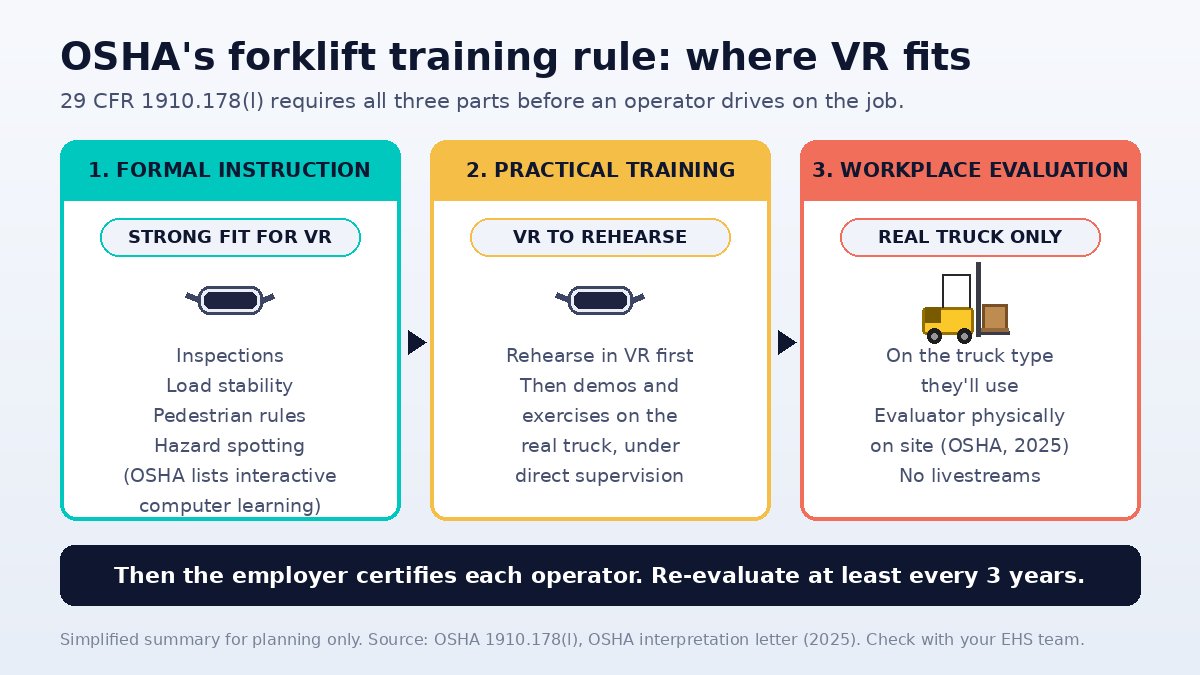
Partly. OSHA’s forklift standard, 29 CFR 1910.178(l), requires three things: formal instruction, practical training and an evaluation of the operator’s performance in the workplace. VR fits best in the first.
The standard lists “interactive computer learning” as an example of formal instruction (OSHA 1910.178). Practical training and the evaluation still happen on the truck. In a 2025 interpretation letter, OSHA said the qualified person supervising and evaluating a trainee must be physically present where the practical training and evaluation take place, so a livestreamed evaluation doesn’t qualify (OSHA interpretation, 2025).
| OSHA training element | Where VR helps | What still needs a real truck |
|---|---|---|
| Formal instruction | Strong fit: inspections, stability, hazards, pedestrian rules | Nothing, but cover your own trucks and site rules |
| Practical training | Rehearsal before the first live session | Demonstrations and exercises on the truck under direct supervision |
| Workplace evaluation | None | Evaluation on the truck type the operator will use, with the evaluator on site |
| Certification | Completion records support your paperwork | The employer certifies each operator |
OSHA’s training eTool says the certification must include the operator’s name, the training date, the evaluation date and the name of the trainer or evaluator (OSHA eTool). In a separate 2020 letter, OSHA said whether virtual reality training is “adequate” or “effective” is decided case by case (OSHA interpretation, 2020). No headset makes an operator “OSHA certified.” Check your plan with your EHS team.
Why does forklift training matter so much right now?
Forklift deaths remain stubbornly high, and warehouses are under closer watch. OSHA says 84 workers died in incidents involving forklifts and other powered industrial trucks in 2024, and the forklift standard ranked eighth among OSHA’s most-cited standards in fiscal year 2025 (OSHA).
OSHA’s renewed National Emphasis Program on warehousing and distribution centers began inspections on July 31, 2026. OSHA also lists being struck by powered industrial trucks among the most common warehouse injuries (OSHA Warehousing). That’s a good reason to train the pickers and packers who walk near forklifts, not only the drivers.
How often is forklift training required?
OSHA requires an evaluation of each operator at least once every three years. Refresher training is also required sooner when any of these happen (OSHA 1910.178(l)(4)):
- The operator is seen driving unsafely.
- The operator has an accident or near miss.
- An evaluation shows the operator isn’t driving safely.
- The operator is assigned a different type of truck.
- Workplace conditions change in a way that affects safe operation, such as new racking, new traffic routes or a crowded peak-season floor.
VR is handy here because a near-miss refresher or a “new layout” briefing can happen in a short session without pulling a truck out of service.
What should VR forklift training cover?
Good VR forklift training focuses on the decisions that cause incidents: what to check, when to stop and where people are. Look for scenarios that cover:
- Pre-use inspection. OSHA requires forklifts to be examined at least daily before use, and after each shift when used around the clock (OSHA eTool).
- Load stability. Capacity, load center, tilt and travel with the load low.
- Pedestrian awareness. Blind corners, intersections, horn use and walkways.
- Docks, ramps and tail lifts. Trailer edges, grades and dock plates.
- Storage and stacking. Unstable loads and racking contact.
- Hazard spotting. Walking a virtual warehouse and finding what’s wrong.
If your site has unusual trucks or layouts, custom VR content can recreate them. IGIVU says custom safety content typically takes 4 to 8 weeks, so start well before you need it.
How much does VR forklift training cost?
For a one-off session or Safety Day, renting VR is usually far cheaper than buying a simulator. These are IGIVU’s published starting prices for safety training, which include the ready-made forklift and warehouse content:
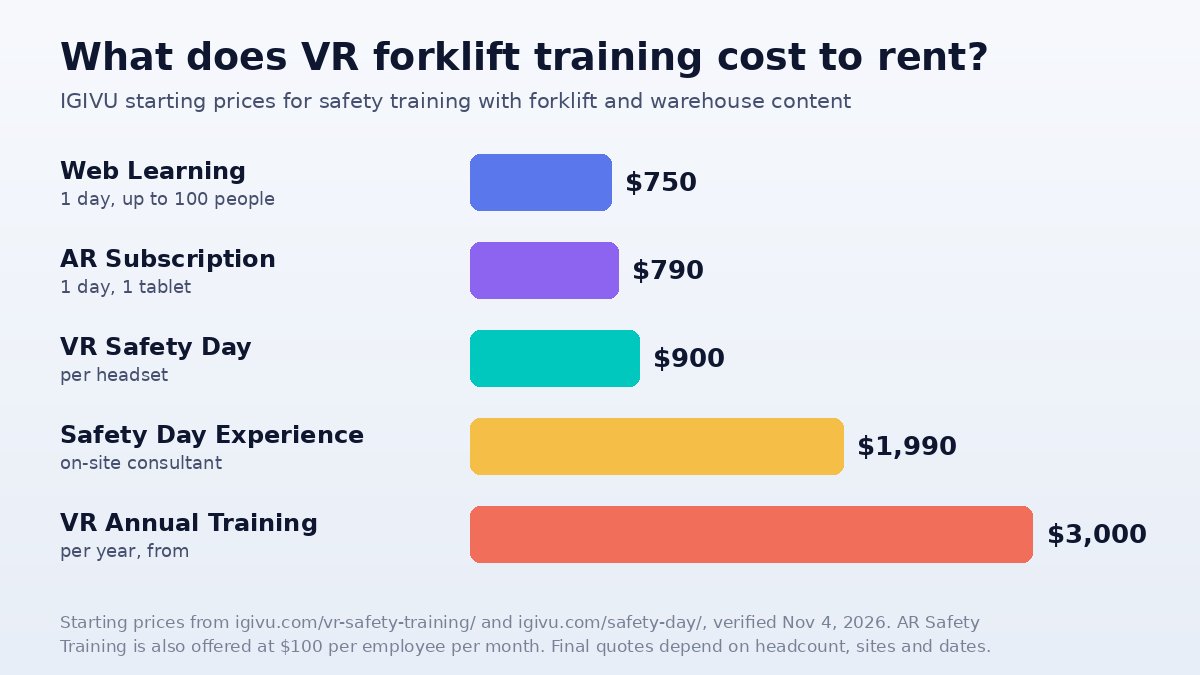
| Option | Starting price | Best for |
|---|---|---|
| VR Safety Day (headset plus content) | $900 per headset | Piloting VR or a single site event |
| Safety Day Experience with on-site technician or consultant | $1,990 | A full facilitated day, about 50 visits per consultant |
| AR Subscription (one tablet, one day) | $790 | Training without headsets |
| Web Learning (up to 100 people, one day) | $750 | Remote or multi-site teams |
| VR Annual Training | From $3,000 per year | Onboarding and refreshers all year |
| AR Safety Training | $100 per employee per month | Ongoing mobile and tablet training |
Sources: VR safety training and Safety Day pages. For comparison, Humulo lists a 30-day pilot of its dedicated forklift simulator at $3,499 (Humulo). For a wider look at pricing, see our guide to VR safety training cost.
How do you run VR forklift training during peak season?
Keep it short, run it by shift and connect it to the on-truck evaluation. A simple plan:
- Pick the audience. New operators first, then pedestrians who work near forklift traffic.
- Keep sessions short. MHL News reports that integrators have seen sessions longer than five minutes raise the risk of motion sickness, so run several short scenarios rather than one long one (MHL News).
- Rotate by shift. Set up in a break room or training room so each shift cycles through without stopping the line.
- Debrief right away. Ask each person what they missed and how they’d handle it on the floor.
- Move to the truck. Follow with supervised practice and the workplace evaluation, then certify.
- Keep the records. File completion records with your training paperwork.
IGIVU ships headsets with the content loaded, and a Safety Day runs on site in all 50 states. For more ideas, see our guides to VR fire extinguisher training and OSHA VR training, or our manufacturing VR training page.
Frequently asked questions
Is VR forklift training OSHA approved?
No training product is “OSHA approved,” because OSHA doesn’t approve training products. VR can deliver the formal-instruction part of 29 CFR 1910.178(l), but practical training and the workplace evaluation must happen on a real truck with a qualified evaluator present.
Can forklift training be done online or in VR?
Only the classroom part. OSHA lists interactive computer learning as formal instruction, but practical training and the evaluation must be in person on the truck. OSHA said in 2025 that the evaluator must be physically present, so a livestream doesn’t count.
How long is forklift certification good for?
OSHA requires each operator to be evaluated at least once every three years. Refresher training is needed sooner after an accident or near miss, unsafe operation, a poor evaluation, a different truck type or a change in workplace conditions.
Who should take VR forklift safety training?
New and current operators, plus anyone who works near forklifts. OSHA lists being struck by powered industrial trucks among the most common warehouse injuries, so pickers, packers and supervisors benefit too.
How many employees can do VR safety training in a day?
It depends on headsets and staff. IGIVU’s Safety Day Experience plans for about 50 visits per consultant, and Safety Day programs handle 15 to 200 employees, with sessions across shifts.
Ready to train your team before the rush?
IGIVU has served 3,000+ organizations with VR and AR rentals, safety training content and on-site support nationwide. Tell us your site, headcount, shifts and dates, and we’ll recommend a format and package. Request a quote and you’ll hear back in under 24 hours, or email [email protected].