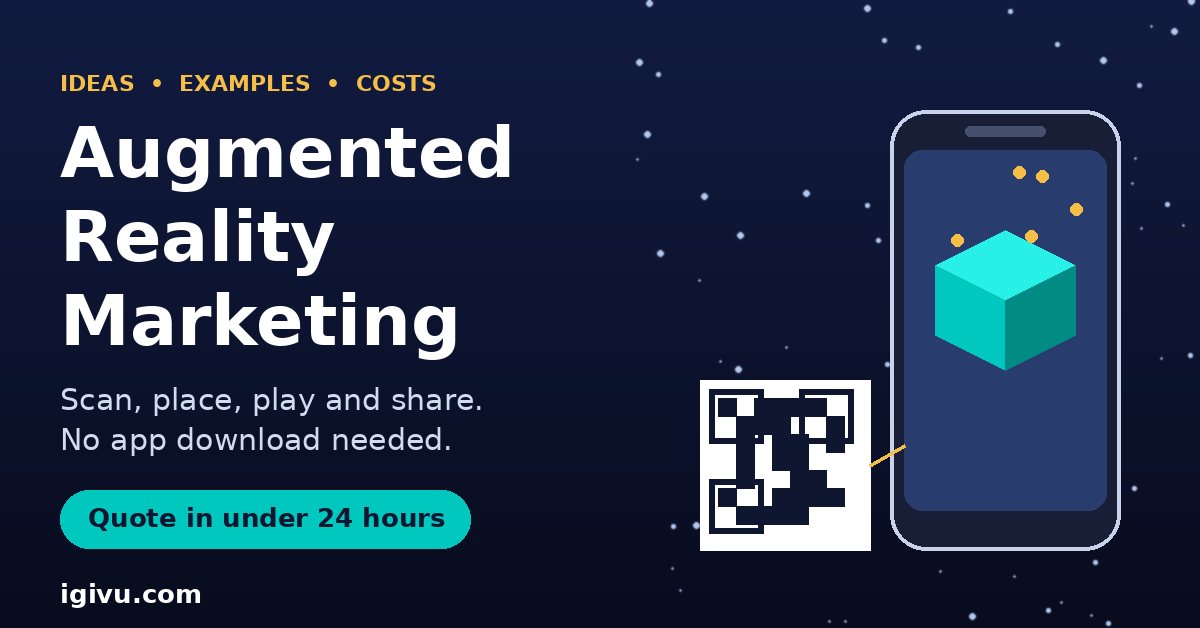
Augmented reality marketing has moved past the “cool demo” stage. A customer scans a QR code on a box, a booth banner or a holiday card, and your product or message appears in their space, right in the phone browser. This guide covers practical AR marketing ideas, real examples, honest costs and a timeline you can hit for the holidays, January trade shows or a 2027 launch.
Quick answer: Augmented reality marketing uses a phone camera, or AR glasses, to place interactive 3D content, games or product previews into the real world around a customer. The strongest ideas are scan-to-place product previews, AR packaging, booth demos, try-ons and scavenger hunts. WebAR works without an app, starts around $2,000 and can launch in 2 to 3 weeks.
What is augmented reality marketing?
Augmented reality marketing is any campaign that layers digital content on top of the real world to get people to try, explore or share your brand.
Most AR marketing today runs in one of three ways:
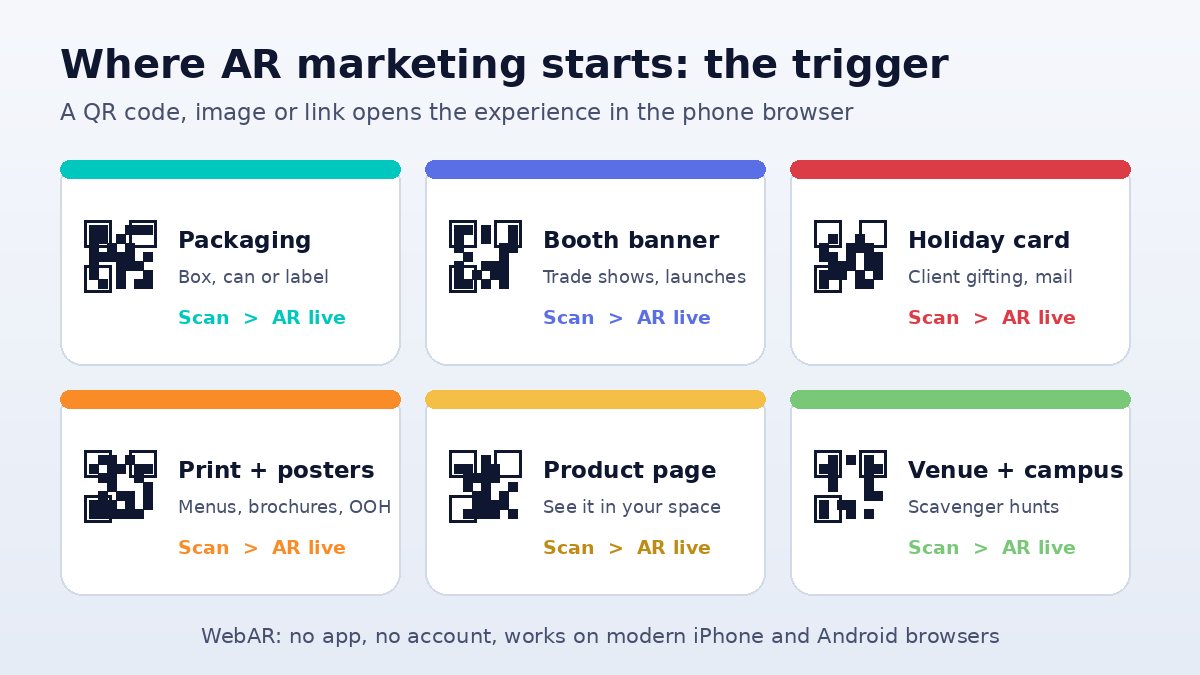
- WebAR: the customer scans a QR code or taps a link, and the experience opens in the phone browser. No app, no account.
- Social AR: lenses and filters inside apps such as Snapchat, Instagram or TikTok.
- Native apps and headsets: custom iOS and Android apps, or mixed reality headsets and AR glasses at events, for richer experiences.
For most businesses, WebAR is the starting point. IGIVU’s augmented reality services cover all three, from QR-based WebAR to custom apps.
Why is AR marketing worth planning right now?
Because several deadlines and launches are landing at once. The holiday season, January trade shows and a new wave of AR hardware all reward brands that brief early.
- Holiday campaigns: packaging, gift guides, in-store displays and holiday cards are all natural AR triggers between now and New Year’s.
- CES and trade show season: CES 2027 runs January 6 to 9 in Las Vegas (CES), and booth experiences need to be built and tested before the holidays.
- New AR glasses: preorders for the first Android XR “Intelligent Eyewear” from Warby Parker open November 12, with deliveries promised for the holiday season (The Verge).
- Platform changes: 8th Wall stopped allowing edits in February 2026, and its hosted projects go offline after February 28, 2027 (8th Wall FAQ). If your current AR campaign lives there, it needs a new home.
What are the best augmented reality marketing ideas?
The best AR marketing ideas solve a real customer question, like “will it fit?” or “how does it work?”, or give people a fun reason to scan and share. Here are ten that work for B2B and consumer brands.
1. Scan-to-place product previews
Let customers drop a true-to-scale 3D model of your product into their home, office or plant floor. It works best for furniture, equipment and anything big or expensive.
2. AR packaging
Turn the box, can or label into a trigger for recipes, product stories, games or rewards. The packaging is already in the customer’s hand, so you are not paying for extra media placement.
3. Holiday AR cards and direct mail
Add a QR code to a client holiday card or gift box that opens an animated 3D scene, a thank-you message from your team, or a mini game. It’s a low-cost way to stand out in a pile of December mail.
4. Trade show booth AR demos
Put a QR code on your booth banner that launches a life-size product demo on any visitor’s phone. Nobody has to wait for a headset, and visitors can keep exploring after they leave the booth. For a premium demo add headsets; see our trade show booth games guide.
5. Location-based scavenger hunts
Hide AR moments around a venue, campus, store or downtown block. Each scan unlocks a story piece, prize entry or coupon.
6. AR on print, posters and out-of-home
Make a flat poster, menu, brochure or billboard come alive when scanned. Give people a reason to scan, such as an offer or a reveal.
7. Virtual try-on
Let shoppers preview eyewear, makeup, apparel or accessories on themselves. Try-on works when fit and look are the main reasons people hesitate to buy.
8. 3D product configurators
Let buyers change colors, materials and options, then place the result in their space with AR. It embeds on your website and doubles as a sales tool.
9. Public and community campaigns
AR makes big, abstract projects easy to picture. For the City of Santa Monica’s $56M electric bus charging initiative, IGIVU built a WebAR experience that put a life-size bus in front of attendees at the groundbreaking, alongside a 360° virtual tour.
10. AR sales leave-behinds and business cards
Give your sales team a card or one-pager that opens a 3D product demo when scanned. It keeps your pitch alive after the meeting.
| Idea | Best for | Typical format |
|---|---|---|
| Scan-to-place product preview | Large or high-value products | WebAR or 3D configurator |
| AR packaging | Food, beverage, consumer goods | WebAR (image tracking) |
| Holiday AR cards | Client gifting, B2B brands | WebAR |
| Booth AR demo | Trade shows, product launches | AR brand activation |
| Scavenger hunt | Venues, campuses, retail districts | AR brand activation |
| Print and out-of-home AR | Posters, menus, brochures | WebAR |
| Virtual try-on | Eyewear, beauty, fashion | WebAR or native app |
| 3D configurator | Products with many options | 3D configurator |
| Public campaigns | Cities, utilities, nonprofits | WebAR plus virtual tour |
| Sales leave-behinds | B2B sales teams | WebAR |
What do successful AR marketing campaigns have in common?
The campaigns that work give people a clear reason to scan, keep the interaction simple, and tie the experience to something they already do. A few public examples show the pattern.
- Dairy Queen Canada “Scan-a-Leaf”: a Snapchat lens turned fallen maple leaves into coupons. More than 2.5 million Snapchatters engaged with it, and the brand reported 18% year-over-year growth in frozen-treat sales during the campaign (Strategy Awards 2026).
- Kirin “Mrs. Green Label Camera”: buyers opened a web page and pointed their phone at the can to see a band perform, with six random variants that gave people a reason to scan again (Utsubo).
- City of Santa Monica: attendees scanned a QR code and saw a life-size electric bus appear in front of them, no app or setup needed (IGIVU case study).
How much does augmented reality marketing cost?
A simple WebAR campaign typically starts around $2,000, an event activation or product configurator around $4,000, and a custom native app from $8,000. Cost rises with 3D modeling detail, interactivity and the number of devices you need to support.
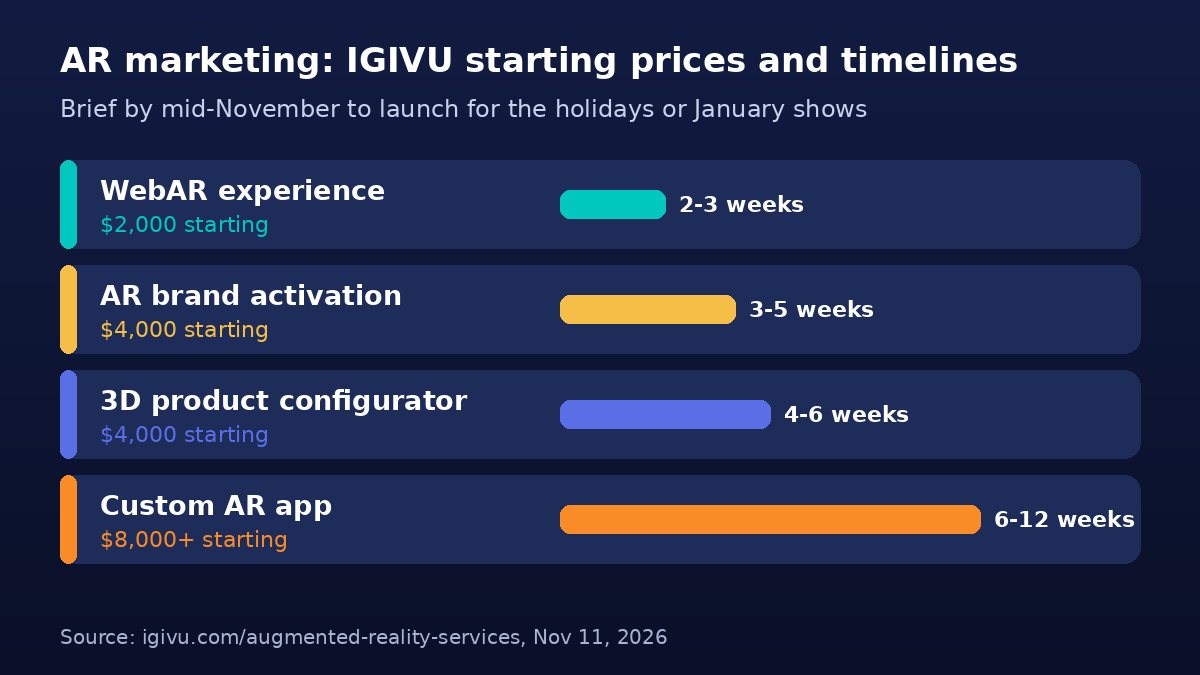
| IGIVU AR format | Starting price | Typical timeline |
|---|---|---|
| WebAR experience (QR to browser) | $2,000 per experience | 2 to 3 weeks |
| AR brand activation (events, launches) | $4,000 per activation | 3 to 5 weeks |
| 3D product configurator | $4,000 per product | 4 to 6 weeks |
| Custom AR app (iOS and Android) | $8,000+, scoped to brief | 6 to 12 weeks |
Prices are from IGIVU’s AR services page, and each project includes concept design, development, revisions and deployment. For a deeper breakdown, read How Much Does Augmented Reality Cost? If you also want headsets or AR glasses at an event, see VR headset rentals and our smart glasses rental guide.
How do you launch an AR campaign in time for the holidays or CES?
Brief now. WebAR needs about 2 to 3 weeks and an event activation 3 to 5 weeks, so a brief in mid-November can be live in early December or ready for January shows.
- Pick one goal. Leads, sales, education or social shares. One goal keeps the experience short and focused.
- Choose the trigger. Packaging, a booth banner, a holiday card, a poster or a web page.
- Gather assets. Logos, product photos and any CAD or 3D files. If you don’t have 3D models, IGIVU’s AR/VR content creation team can build them.
- Approve the concept. Sign off on flow, interactions and look before the build starts.
- Test on real phones. Check older iPhones and Androids, bright booth lighting and weak venue Wi-Fi.
- Launch with a clear call to action. Tell people what they get for scanning, then send them to an offer, a form or a booking page.
Rush timelines are possible: Santa Monica’s WebAR went from brief to live link in 5 to 7 days.
How do you measure AR marketing results?
Track scans, time spent, interactions and the action people take afterward. WebAR analytics report scans, session length and interactions; event teams can add booth traffic and leads.
- Reach: unique scans or link opens
- Engagement: average session time and interactions per session
- Action: coupon redemptions, form fills, demo bookings or sales
Frequently asked questions
What is an example of augmented reality marketing?
A common example is a QR code on packaging or a booth banner that opens a 3D product in the customer’s phone browser, so they can place it in their space or play a short game. Dairy Queen Canada’s Scan-a-Leaf lens, which turned fallen leaves into coupons, is a well-known recent campaign.
Do customers need an app for AR marketing?
No. WebAR runs in the phone’s browser after a QR scan or link tap, with no app or account. Social lenses run inside apps people already have, and custom apps are only needed for complex, long-term experiences.
How much does an AR marketing campaign cost?
IGIVU’s WebAR experiences start at $2,000, AR brand activations and 3D configurators start at $4,000, and custom AR apps start at $8,000. The final price depends on 3D detail, interactivity and timeline.
How long does it take to create an AR experience?
A WebAR experience typically takes 2 to 3 weeks, an event activation 3 to 5 weeks, a configurator 4 to 6 weeks and a custom app 6 to 12 weeks. Simple rush projects can sometimes launch in about a week.
Is augmented reality marketing effective?
It is effective when it answers a real buying question or gives people a clear reward for scanning. It works poorly as decoration, so pick one goal, keep the experience short and measure scans, engagement and actions.
What happens to AR campaigns hosted on 8th Wall?
8th Wall’s hosted projects stay live through February 28, 2027, then hosting shuts down and links stop working. Locked projects can’t be edited or exported, so plan to rebuild or re-host any campaign you still need.
Ready to plan your AR marketing campaign?
IGIVU builds WebAR, AR brand activations, 3D configurators and custom AR apps for brands in all 50 states, and has served more than 3,000 organizations. Send us a rough idea and a date, no formal brief needed, and you’ll get a scoped quote in under 24 hours. Request your AR quote or email [email protected].